通胀黏性

Search documents
2026年全球市场怎么走?摩根大通眼中的资产大洗牌
Jin Shi Shu Ju· 2025-12-25 07:44
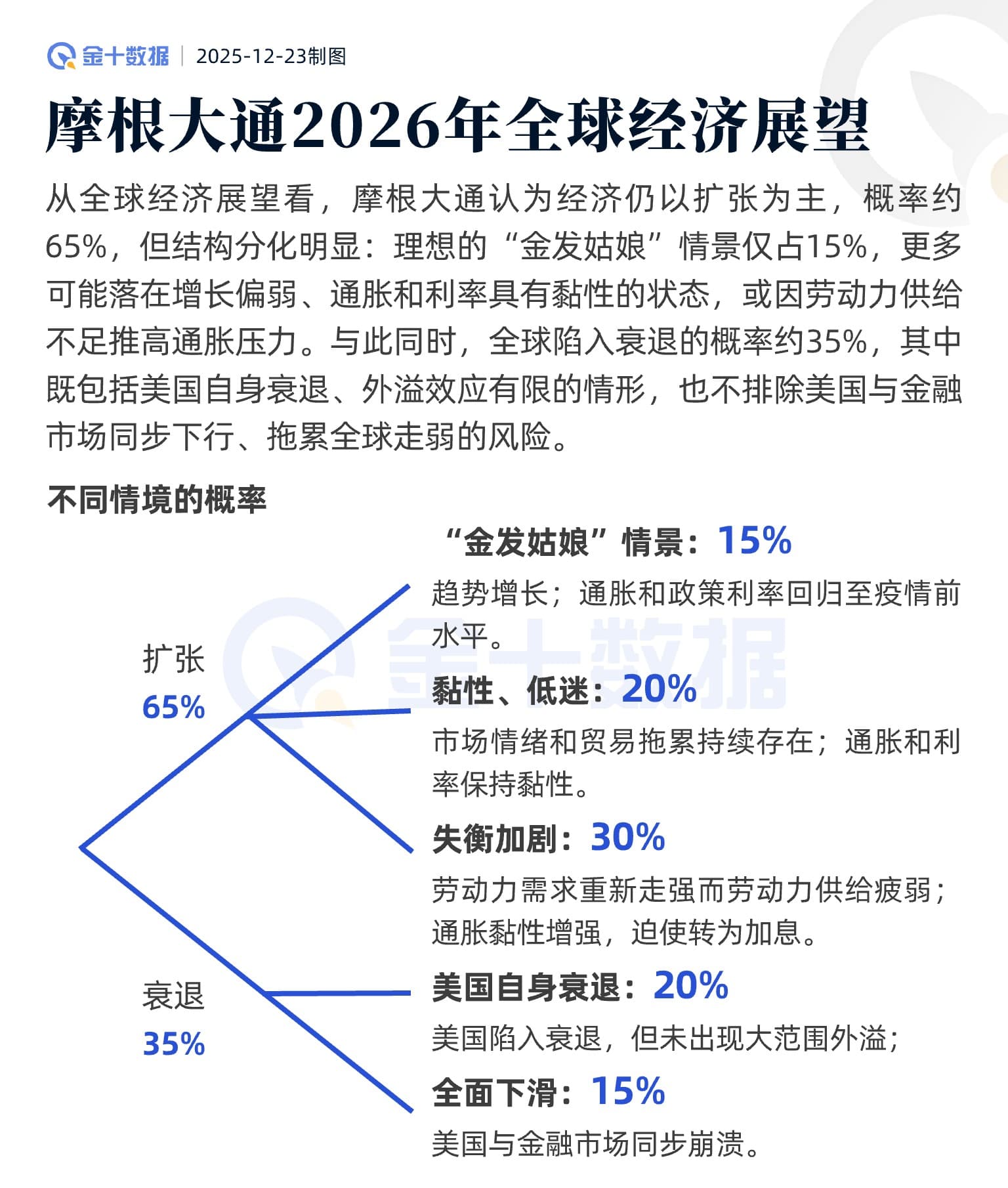
Global Market Outlook - The global market in 2026 is characterized by a blend of resilience and risks, influenced by divergent monetary policies, the acceleration of AI, and structural market differentiation [1][2] - Morgan Stanley anticipates that fiscal stimulus and robust corporate and household balance sheets will support continued global growth, despite weakening corporate confidence and a slowing labor market [1][2] Stock Market - Morgan Stanley holds a positive outlook for the global stock market in 2026, expecting double-digit gains in both developed and emerging markets driven by strong earnings growth, declining interest rates, and the ongoing rise of AI [7] - The AI-driven supercycle is expected to propel record capital expenditures and rapid earnings expansion across various sectors, creating both winners and losers [7] - The S&P 500 index is projected to see a 13%-15% super trend earnings growth over the next two years due to the AI supercycle [7] Economic Outlook - The global economy is at a critical juncture, with structural imbalances emerging as demand shifts towards technology capital expenditures and employment growth stagnates [12] - Morgan Stanley estimates a 35% probability of recession in the U.S. and globally in 2026, although fiscal stimulus is expected to boost GDP growth in the first half of 2026 [12][13] Interest Rate Market Predictions - Morgan Stanley predicts that most developed markets will see economic growth at or above potential levels in 2026, with inflation continuing to decline but remaining sticky in some economies [14] - The U.S. Federal Reserve is expected to lower interest rates by 50 basis points, while the Bank of Japan may raise rates by 50 basis points [14] Commodity Predictions - Global oil demand is expected to increase by 900,000 barrels per day in 2026, with supply growth anticipated to outpace demand growth significantly [17] - Morgan Stanley maintains a Brent crude oil price forecast of $58 per barrel for 2026, with gold prices projected to rise to $5,000 per ounce by the fourth quarter of 2026 [17][19]


美国非农数据即将揭晓!CoinUp.io 助你预判加密资金大流向
Sou Hu Cai Jing· 2025-12-25 03:17
Group 1 - The upcoming US non-farm payroll data is expected to significantly impact forex, US stocks, and cryptocurrency markets, with investors preparing for potential volatility [1][3] - Market predictions suggest a slowdown in job growth, with wage growth and unemployment rate changes being critical observation points [3] - A "hot" data release could reignite concerns over Federal Reserve policy tightening, while a "moderate" or "weak" report may bolster liquidity easing expectations, benefiting risk assets like cryptocurrencies [3] Group 2 - CoinUp.io, a leading one-stop cryptocurrency derivatives trading platform, aims to provide deep liquidity, professional trading tools, and robust risk control systems to help investors navigate market volatility [5] - The platform offers a comprehensive trading solution for various market scenarios, including high leverage contracts and a wide range of trading pairs, allowing users to capitalize on market movements [6] - CoinUp.io's AI-driven market analysis tool provides objective trend analysis and risk management suggestions, helping users make rational trading decisions amidst emotional market fluctuations [7][8] Group 3 - CoinUp.io emphasizes asset transparency, with a proof of reserve exceeding $490 million, ensuring user assets are fully backed [8] - The platform has established a user protection fund starting at $50 million, with plans to increase it to over $200 million in the next three years, providing additional security during extreme market conditions [8] - CoinUp.io operates under multiple regulatory licenses globally, including in the US and Canada, creating a compliant operational network [10]

长江有色:圣诞临近谨慎情绪及地缘溢价逐步减弱 24日锡价或下跌
Xin Lang Cai Jing· 2025-12-24 03:21
Group 1 - The core viewpoint of the article highlights the mixed macroeconomic environment affecting the tin market, with U.S. economic resilience and the onset of a Federal Reserve rate cut cycle boosting market optimism, while inflation concerns and geopolitical tensions pose risks [1] - The LME tin price closed at $42,835 per ton, up $105, reflecting a 0.25% increase, while domestic Shanghai tin futures showed a decline, closing at 336,110 yuan per ton, down 5,570 yuan, or 1.63% [1] - The global macroeconomic landscape is at a critical juncture, transitioning from recession fears to a re-evaluation of growth and liquidity, but the market is expected to experience high volatility due to competing bullish and bearish factors [1] Group 2 - Supply concerns from geopolitical conflicts remain, but expectations of resumed production in Myanmar and normalized tin exports from Indonesia are easing previous price-driving fears [1] - Demand is facing negative feedback due to high prices, with traditional sectors like electronic soldering showing weakness, despite long-term positive prospects in emerging fields like semiconductors and photovoltaics [1] - The tin industry association has indicated that current tin prices are disconnected from fundamental market conditions, calling for a more rational market approach, which reflects a consensus against high prices and provides a negative outlook for market expectations [1]

加息、降息轮番上阵:日本央行狂加到30年最高,美联储却在谈还要继续降?
Sou Hu Cai Jing· 2025-12-23 04:57
Group 1: Japan's Interest Rate Hike - The Bank of Japan raised its benchmark interest rate to 0.75%, the highest in 30 years, marking the end of an ultra-loose monetary policy era [2] - The core logic behind the rate hike is persistent inflation, with Japan's core CPI exceeding the 2% target for 44 consecutive months, reaching a year-on-year increase of 3% in November 2025 [2] - Concerns about economic recession are rising, as Japan's GDP contracted by 0.6% in Q3 2025, and a second consecutive quarter of negative growth could lead to a technical recession [2] - Japan's government debt exceeds 260%, with interest payments accounting for 22.4% of the budget, raising concerns about fiscal sustainability as the cost of debt servicing increases [2] Group 2: Global Liquidity Impact - The yen has been a key currency for global carry trades, and the interest rate hike could disrupt this arbitrage chain, potentially triggering a reversal of $30 trillion in yen carry trades and increasing global asset volatility [3] Group 3: U.S. Federal Reserve's Rate Cuts - The Federal Reserve cut rates by 75 basis points in 2025, lowering the federal funds rate to 3.5%-3.75%, shifting focus from anti-inflation to preventing economic slowdown [4] - The U.S. economy is characterized by "weak growth + high debt," with core CPI remaining sticky at 3.5% and rising unemployment rates indicating a cooling labor market [4] - There is significant internal division within the Federal Reserve regarding the path of rate cuts, with hawkish members advocating for maintaining rate hike options while dovish members support preventive rate cuts [5] Group 4: Global Capital Flow Dynamics - The interest rate differential between the U.S. and Japan has narrowed from 300 basis points pre-pandemic to approximately 300 basis points currently, which may lead to a temporary appreciation of the yen if the Fed continues to cut rates while the BOJ maintains a tightening stance [5] - In developed markets, funds are flowing back to European debt markets as the ECB maintains rates, while U.S. Treasuries regain attractiveness due to rate cut expectations [6] - Emerging markets like India and Indonesia benefit from interest rate differentials and growth resilience, becoming safe havens for capital, while Latin America and Africa face constraints due to debt pressures [6] Group 5: Asset Price Volatility - U.S. Treasuries are supported by short-term rate cut expectations, but long-term yields may rise due to increasing debt risks [7] - Japanese assets may face selling pressure if carry trades reverse, although the BOJ's bond purchasing operations could mitigate the impact [7] - Commodity prices are influenced by a weaker dollar supporting gold prices, while industrial metal demand is constrained by weak global manufacturing recovery [8] Group 6: Future Outlook - The Bank of Japan faces a dilemma; if inflation does not decline as expected, it may need to accelerate rate hikes, but recession risks will limit policy options [9] - The Federal Reserve must balance between curbing inflation and avoiding recession, with potential for restarting quantitative easing if the labor market deteriorates significantly [9] - The divergence in monetary policy may become the new norm, challenging the dominance of the dollar and leading to differentiated performances among emerging economies [10][11]
人民币兑美元中间价调升29点至7.0573,升值至2024年10月9日来最高!非农后美联储明年3月降息的概率有所上升
Sou Hu Cai Jing· 2025-12-17 01:36
Group 1 - The central bank of China has raised the RMB to USD midpoint rate by 29 points to 7.0573, marking the highest appreciation since October 9, 2024 [2] Group 2 - Following the non-farm payroll report, the probability of the Federal Reserve lowering interest rates in March 2024 has increased, with a 44.4% chance of a 25 basis point cut and a 9.5% chance of a 50 basis point cut [5] - Prior to the non-farm payroll report, the probabilities for January 2024 indicated a 24.4% chance of a 25 basis point cut and a 75.6% chance of maintaining the current rate [5] Group 3 - Atlanta Fed President Bostic has warned about persistent inflation and opposed rapid interest rate cuts, suggesting that rates should remain unchanged until 2026 due to upward pressure on inflation from various economic factors [6]
日元迎来30年拐点:日本央行加息至0.75%,宽松时代正式落幕
Xin Lang Cai Jing· 2025-12-16 23:42
Group 1 - Japan's manufacturing activity showed a slower contraction in December, with the PMI rising from 48.7 in November to 49.7, remaining below the expansion threshold of 50 for the sixth consecutive month [1][36] - The service sector's growth momentum weakened, with the service PMI declining from 53.2 to 52.5, leading to a composite PMI drop from 52.0 to 51.5 [2][37] - Despite a slowdown in factory output, the pace of declining goods demand has eased to the lowest level in a year and a half, indicating potential stabilization in the manufacturing sector [2][37] Group 2 - Japan's government approved an additional budget of 18.3 trillion yen (approximately 118 billion USD) for the fiscal year 2025, marking the largest economic stimulus plan since the COVID-19 pandemic [3][38] - The budget is significantly higher than the previous year's 13.9 trillion yen and is primarily financed through new debt issuance, reflecting a proactive stance on economic support [3][38] Group 3 - The Bank of Japan is expected to raise the short-term policy interest rate from 0.5% to 0.75%, the highest level in 30 years, signaling a move towards monetary policy normalization [4][40] - This rate hike is driven by persistent inflation pressures, with Japan's inflation rate remaining above the 2% target for nearly four years [6][51] - The central bank's confidence in a wage-inflation cycle is bolstered by expectations of significant wage increases due to labor shortages [6][41] Group 4 - Japan's fiscal spending is expanding, with the initial budget for the fiscal year 2026 projected to exceed 120 trillion yen, driven by rising social welfare costs and defense spending [4][39][54] - Concerns over fiscal sustainability are growing as the government prepares to issue a large volume of bonds, pushing the benchmark 10-year government bond yield to an 18-year high [4][54] Group 5 - In the U.S., November non-farm payrolls increased by 64,000, rebounding from a decline of 105,000 in October, indicating resilience in the labor market despite trade policy uncertainties [7][42] - The unemployment rate rose to 4.6%, influenced by a 43-day government shutdown that distorted data collection [7][42] - Retail sales in October remained flat, reflecting cautious consumer spending amid rising living costs, with core retail sales showing a 0.8% increase [7][45][46] Group 6 - U.S. business activity growth slowed to a six-month low in December, with the composite PMI dropping from 54.2 to 53.0, indicating weakening demand in both manufacturing and services [12][47] - Input price inflation reached a near three-year high, reinforcing concerns about persistent inflation [12][49]

澳元新高 政策分化与数据博弈
Jin Tou Wang· 2025-12-16 02:51
Core Viewpoint - The Australian dollar (AUD) has appreciated against the US dollar (USD), reaching a two-month high, driven by the Reserve Bank of Australia's hawkish stance and the Federal Reserve's expectations of rate cuts [1][2]. Group 1: Australian Economic Indicators - The Reserve Bank of Australia (RBA) maintained the benchmark interest rate at 3.6%, marking the third consecutive meeting without a rate cut, with inflation risks identified as rising [1]. - The Consumer Price Index (CPI) rose to 3.2% year-on-year in Q3 and further increased to 3.8% in October, driven by housing, electricity prices, and service sector inflation [1]. - Private demand in Australia is recovering steadily, supported by consumption and investment, with the real estate market showing signs of activity and price increases [1]. Group 2: Federal Reserve Actions - The Federal Reserve cut the benchmark interest rate by 25 basis points to a range of 3.50%-3.75%, with market focus on policy language and future guidance [2]. - Internal divisions within the Federal Open Market Committee (FOMC) are notable, with the current inflation rate at 2.8%, leading to speculation about the potential for "hawkish rate cuts" [2]. Group 3: Currency Market Dynamics - The USD index has shown significant downward movement since early December, declining by 1.2% from late November highs, which has supported non-USD currencies, including the AUD [2]. - The AUD is favored among G10 currencies, with expectations that if the Fed signals further rate cuts in 2026, the AUD could appreciate further [2]. Group 4: Key Technical Levels - The AUD/USD is facing resistance at the 0.6650 level, which is both a previous high and a psychological barrier; a breakthrough could lead to a challenge of the yearly high of 0.6707 [3]. - The core support range for the AUD/USD is identified between 0.6520 and 0.6550, which includes moving averages and previous channel support; a drop below this range could trigger a deeper correction [3].
美国非农来袭 黄金多头能否守住阵地?
Jin Tou Wang· 2025-12-15 02:11
Group 1 - The core viewpoint is that gold prices have shown a strong upward trend, reaching historical highs, despite a slight pullback in late October, with an overall trend of oscillating upward [1] - In November, global physical gold ETFs saw an inflow of $5.2 billion, marking the sixth consecutive month of net inflows, indicating strong investor interest in gold [2] - The Federal Reserve's recent interest rate cut to a range of 3.50% to 3.75% has effectively lowered the opportunity cost of holding gold, providing strong support for gold prices [2] Group 2 - The increase in risk aversion and central bank gold purchases are reinforcing the characteristics of the gold market, which is marked by high volatility and an upward shift in price levels [2] - Employment data directly influences market perceptions of inflation persistence and monetary policy direction, impacting gold prices through the "dollar index - U.S. Treasury yields - real interest rates" transmission chain [2] - If employment data and wage growth significantly exceed expectations, it may enhance high interest rate expectations, potentially exerting downward pressure on gold prices [2] Group 3 - In the context of a confirmed interest rate cut cycle and loose market liquidity, the mid-term pricing anchor for gold is more inclined towards declining real interest rates and rising risk aversion [3] - There remains a divergence between the Federal Reserve's rate cut pace and market pricing, which could lead to a significant pullback in gold prices if subsequent data indicates a "slowdown or pause" in rate cuts [3] Group 4 - Last Friday, gold prices experienced a pullback after reaching highs, closing around 4300 due to profit-taking, but the overall strong trend remains intact [4] - The bullish logic for gold remains solid, suggesting a low-buy strategy with a focus on buying opportunities around 4283, setting a stop loss at 4270, and targeting resistance levels at 4316 and 4340 [4]
美联储降息25基点,鲍威尔的三重困局,中国正开启自己的平衡术
Sou Hu Cai Jing· 2025-12-12 17:25
Group 1 - The Federal Reserve announced a 25 basis point rate cut, lowering the federal funds rate target range to 3.5%-3.75%, marking the third consecutive cut since September [1] - The internal voting at the Federal Reserve showed rare dissent with three opposing votes, indicating intense debate over future policy directions [3] - Economic data presents mixed signals, with a surprising decrease in private sector employment and rising unemployment, while inflation remains above the Fed's long-term target [3] Group 2 - The Fed's cautious approach is influenced by persistent inflation, fiscal deficits, and pressure in the bond market, with federal debt exceeding $37 trillion and annual interest payments surpassing $1 trillion [5] - Global market reactions were mixed, with the Dow Jones rising nearly 500 points on the day of the rate cut, while the dollar index surged to a two-year high, reflecting skepticism about the sustainability of the easing cycle [5] - The shift in U.S. monetary policy provides a new external balance window for China, with the China-U.S. interest rate differential narrowing, but China maintains a policy of "self-determination" rather than blindly following the Fed [7] Group 3 - The differences in monetary policy between the U.S. and China reflect their respective economic stages, with the U.S. balancing between "preventing recession" and "fighting inflation," while China focuses on "stabilizing growth" and "preventing risks" [8] - This differentiated approach suggests that global capital flows will become more complex, requiring investors to adopt multi-dimensional allocation strategies rather than relying on single asset trends [8]

布米普特拉北京投资基金管理有限公司:降息效果面临滞后与稀释,美国经济复苏之路崎岖
Sou Hu Cai Jing· 2025-12-08 10:15
这种由政策不确定性导致的观望情绪,在美国制造业体现得尤为明显。尽管借贷成本下降,但由于关税政策持续波动,许多企业选择暂缓投资决策,等待形 势明朗。美国供应管理学会的数据显示,工厂活动已连续多月萎缩。有企业高管直言,在客户因不确定性而停止订购新设备之前,降息本身"不会影响我们 的业务"。 货币政策传导机制本身也面临挑战。当美联储调整基准利率时,其影响渗透至整体经济通常需要长达十八个月。然而,当前环境可能使这一滞后期进一步延 长。一方面,市场往往提前消化降息预期,使其对金融市场的直接影响减弱;另一方面,大部分现有企业和消费者债务(如固定利率抵押贷款)并不会立即 对降息做出反应。更关键的是,持续的高通胀和联邦预算赤字等因素,共同将美债收益率维持在高位,从而限制了其他贷款利率的下行空间。 美联储预计将在本周的会议上再次宣布降息。然而,越来越多的经济学家和市场分析指出,这轮预期的宽松政策对经济的刺激效果可能远逊于以往,其积极 作用不仅会姗姗来迟,更可能被货币政策无法控制的因素所削弱。 传统上,降息能通过降低借贷成本来刺激对利率敏感的行业,如地产和制造业。但本轮周期的情况截然不同。在地产市场,尽管抵押贷款利率已从峰值回 ...