AI云

Search documents
阿里巴巴连涨两天,单日成交一周内却缩量七成|市场观察
Di Yi Cai Jing· 2026-01-22 06:29
Core Viewpoint - Alibaba's trading volume has significantly decreased from approximately 408 billion HKD to around 100 billion HKD, indicating a shift in market dynamics and investor sentiment [2][3]. Trading Volume Analysis - On January 22, Alibaba's stock rose by 0.43% to close at 163.9 HKD, but the trading volume was only 54 billion HKD, with expectations that it might fall below 100 billion HKD [2]. - The trading volume peaked at over 400 billion HKD on January 14, driven by positive news regarding artificial intelligence products [2][3]. - A week later, on January 21, the trading volume dropped to approximately 109 billion HKD, reflecting a 75% decrease in just one week [3]. Market Sentiment and Investor Behavior - Analysts suggest that the recent decline in trading volume is due to a lack of new stimulating news and a cautious approach from investors, who are holding onto their positions despite short-term price fluctuations [4]. - The overall market environment has also contributed to this cautious sentiment, with the Hang Seng Index falling below 27,000 points [4]. Revenue Growth Projections - East China Securities analysts predict that Alibaba's revenue for the third quarter of fiscal year 2026 will reach 292.9 billion CNY, representing a 4.6% year-over-year growth, primarily impacted by a slowdown in e-commerce growth [5]. - For the third quarter of fiscal year 2025, Alibaba's revenue is expected to be 280.15 billion CNY, with an 8% year-over-year increase [5]. Cloud Services Performance - Alibaba Cloud is projected to generate 42.852 billion CNY in revenue for the current quarter, marking a 35% year-over-year increase, with a stable EBITA profit margin around 9% [6]. - The company is enhancing its AI cloud services, which are expected to maintain growth due to increasing demand for AI capabilities [6]. AI and Market Position - The launch of the AI assistant product is seen as a significant milestone, potentially positioning Alibaba to capture a larger share of the internet traffic in the future [7]. - Alibaba's open-source model, which has surpassed 200,000 derivatives and 1 billion downloads, places it at the forefront of the AI model landscape [3][7].

计算机ETF(512720)盘中涨超1.2%,关注AI商业化及应用场景拓展
Mei Ri Jing Ji Xin Wen· 2026-01-22 05:45
Core Viewpoint - The Computer ETF (512720) has seen a rise of over 1.2%, driven by the commercialization of AI and the expansion of application scenarios [1] Group 1: AI Commercialization and Market Dynamics - The demand for AI is expected to increase predictably, creating opportunities in the software sector [1] - Major model vendors are accelerating the commercialization and ecosystem development around chatbots, as evidenced by recent updates from Amazon, OpenAI, and Qianwen [1] - Google is likely to maintain its leading position due to its dominance in the search field and its top-tier large models [1] - OpenAI is beginning to explore marketing and advertising business under AI search, which may alter the overall landscape of search advertising [1] Group 2: Future Market Outlook - By 2026, the internet sector may enter a performance growth phase driven by AI monetization and optimized competition under anti-involution policies [1] - Business line integration and AI empowerment are expected to become key drivers of performance and valuation [1] - Continuous improvement in open-source model capabilities is anticipated to sustain demand for AI cloud services [1] Group 3: Computer ETF Overview - The Computer ETF (512720) tracks the CS Computer Index (930651), which selects listed companies in the computer hardware, software, and services sectors from the Shanghai and Shenzhen markets [1] - The index focuses on the information technology sector, with major allocations in software development, IT services, and computer hardware manufacturing [1]
20cm速递|创业板人工智能ETF国泰(159388)涨超2.1%,关注科技自主与AI产业趋势
Mei Ri Jing Ji Xin Wen· 2026-01-21 03:04
Group 1 - The core viewpoint highlights the integration of AI capabilities in applications like Qianwen App with Alibaba's ecosystem, indicating a trend towards AI-enhanced shopping experiences [1] - OpenAI and Google are actively investing in the AI and healthcare sectors, reflecting a broader commitment to AI technology across industries [1] - A BCG report reveals that over 90% of companies plan to maintain long-term investments in AI, with some aiming to double their AI investments by 2026, indicating a strategic shift led by CEOs [1] Group 2 - Alibaba Cloud aims to capture 80% of the incremental AI cloud market in China by 2026, showcasing aggressive growth targets in the AI sector [1] - The Guotai Artificial Intelligence ETF (159388) tracks the entrepreneurial board AI index (970070), which includes companies involved in AI technologies and applications, reflecting high growth and innovation characteristics [1]

阿里巴巴-W:FY2026Q3业绩前瞻:闪购投入延续加码,AI云保持快速增长-20260120
Soochow Securities· 2026-01-20 00:24
Investment Rating - The report maintains a "Buy" rating for Alibaba-W (09988.HK) [1] Core Insights - The company is expected to continue its investment in flash sales while maintaining rapid growth in AI cloud services [1] - Revenue for FY2026Q3 is projected to reach 292.9 billion yuan, with a year-on-year growth of 4.6%, primarily due to a slowdown in e-commerce revenue growth [7] - The report anticipates that Alibaba Cloud's revenue will grow by 35.0% year-on-year, reaching 42.85 billion yuan in the same quarter, driven by strong demand for AI computing power and services [7] - The company aims to become the absolute leader in the instant retail market through its flash sales initiative, with improvements in GMV and AOV expected [7] - Non-GAAP net profit forecasts for FY2026, FY2027, and FY2028 are set at 101.53 billion, 141.56 billion, and 184.65 billion yuan respectively, with corresponding PE ratios of 28.4, 20.4, and 15.6 times [7] Financial Projections - Total revenue projections for FY2024A to FY2028E are as follows: 941.17 billion, 996.35 billion, 1,068.58 billion, 1,158.75 billion, and 1,269.02 billion yuan, with year-on-year growth rates of 8.34%, 5.86%, 7.25%, 8.44%, and 9.52% respectively [1] - The report forecasts a decline in attributable net profit for FY2026 to 82.64 billion yuan, a decrease of 36.49% year-on-year, followed by a recovery in FY2027 and FY2028 [1] - The latest diluted EPS for FY2026 is projected at 4.33 yuan per share, with a P/E ratio of 34.94 times [1]
阿里巴巴-W(09988):FY2026Q3业绩前瞻:闪购投入延续加码,AI云保持快速增长
Soochow Securities· 2026-01-19 23:40
Investment Rating - The investment rating for Alibaba-W (09988.HK) is "Buy" (maintained) [1] Core Insights - The report anticipates that Alibaba's total revenue for FY2026Q3 will reach 292.9 billion yuan, representing a year-on-year growth of 4.6%, primarily due to a slowdown in e-commerce revenue growth. The company is expected to continue investing in flash sales, which will pressure profits, with an adjusted EBITA forecast of 30.61 billion yuan and an EBITA margin of 10.5% for the quarter [7] - Alibaba Cloud is projected to achieve a revenue of 42.85 billion yuan in the same quarter, reflecting a robust year-on-year growth of 35.0%, driven by strong demand for AI computing power and services. The EBITA margin for Alibaba Cloud is expected to remain stable at around 9.0% [7] - The report maintains Non-GAAP net profit forecasts for FY2026, FY2027, and FY2028 at 101.53 billion yuan, 141.56 billion yuan, and 184.65 billion yuan, respectively, with corresponding PE ratios of 28.4, 20.4, and 15.6 times [7] Financial Projections - Total revenue projections for Alibaba are as follows: - FY2024A: 941.17 billion yuan - FY2025A: 996.35 billion yuan - FY2026E: 1,068.58 billion yuan - FY2027E: 1,158.75 billion yuan - FY2028E: 1,269.02 billion yuan - Year-on-year growth rates for total revenue are expected to be: - FY2024A: 8.34% - FY2025A: 5.86% - FY2026E: 7.25% - FY2027E: 8.44% - FY2028E: 9.52% [1][8] - The projected net profit figures are: - FY2024A: 80.01 billion yuan - FY2025A: 130.11 billion yuan - FY2026E: 82.64 billion yuan - FY2027E: 122.87 billion yuan - FY2028E: 166.01 billion yuan [1][8]
当Token成为“北极星指标”,AI云市场可能忽略了什么?
3 6 Ke· 2026-01-07 11:15
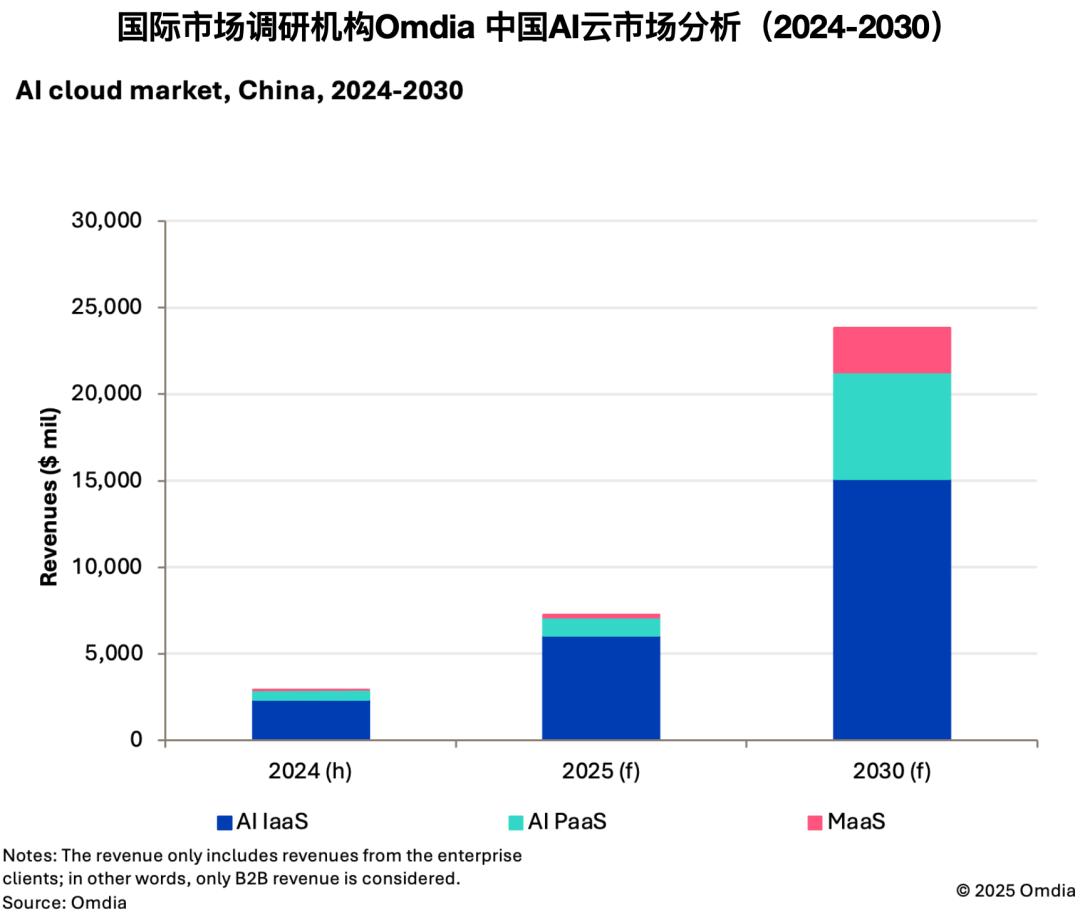
Core Insights - The AI cloud market is increasingly recognizing the importance of Token consumption as a key performance indicator, often referred to as the "North Star metric" for guiding strategic direction [2][3][4] - The rapid growth of Token consumption in China reflects the swift expansion of AI applications, with daily Token consumption projected to reach 30 trillion by mid-2025, up from 1 trillion at the beginning of 2024 [1][7] Token Consumption and Market Dynamics - Token is becoming a crucial metric for cloud service providers, with major companies like Amazon AWS and Alibaba Cloud actively expanding their MaaS (Model as a Service) offerings [6][10] - Despite the rapid growth in Token consumption, it currently represents a small fraction of overall cloud revenue, indicating that the Token market alone cannot sustain the growth of the broader cloud market [4][10] - The AI cloud market is projected to grow significantly, with estimates suggesting it will reach $72 billion by 2025 and $268 billion by 2030, although the MaaS segment will still only account for about 9% of the total by 2030 [7][11] Challenges and Limitations - There are significant blind spots in current Token consumption statistics, as they primarily rely on public cloud API data and do not fully capture private deployments or other AI computing scenarios [4][14] - The decision-making process for enterprises regarding AI cloud services often does not prioritize Token consumption as a core metric, focusing instead on business value and cost reduction [26][27] Future Outlook - The potential for Token revenue growth varies among cloud providers, with some optimistic forecasts suggesting that certain companies could see Token income rise to between 4 billion and 7 billion in the next 1-2 years [11][12] - The complexity of AI cloud services means that a singular focus on Token consumption may obscure other critical factors influencing market dynamics and enterprise adoption [19][22][29] - The long-term success of AI cloud services will depend on their ability to integrate seamlessly into business processes and deliver measurable value, rather than merely focusing on Token consumption metrics [30][31]

百度持有的昆仑芯值多少?高盛:若类比寒武纪估值,相当于百度市值的45%
硬AI· 2026-01-04 07:29
Core Viewpoint - Goldman Sachs' latest report indicates that Baidu's chip subsidiary, Kunlun Chip, has submitted a listing application in Hong Kong, marking a significant step in unlocking asset value for Baidu [2][3] Group 1: Kunlun Chip's IPO - Kunlun Chip officially submitted its listing application to the Hong Kong Stock Exchange on January 1, 2026, through a global offering of shares, including public offerings in Hong Kong and placements to institutional and professional investors [3][4] - Baidu holds a 59% controlling stake in Kunlun Chip, which is expected to remain a subsidiary post-IPO, allowing Baidu to release market value while maintaining control over its core computing infrastructure [4] Group 2: Financial Projections - Goldman Sachs estimates that Kunlun Chip's sales will reach approximately 35 billion RMB by 2025, with a projected increase to 65 billion RMB in 2026 due to strong growth in new products and orders [6][7] - External sales are expected to grow rapidly, accounting for 14% of total cloud sales by 2026, with high-quality recurring revenue from subscription services projected to make up 43% of Baidu Cloud's total revenue [9][20] Group 3: Valuation Insights - If Kunlun Chip is valued similarly to Cambricon at a 40x price-to-sales ratio, the value of Baidu's 59% stake could reach 22 billion USD, representing about 45% of Baidu's current market capitalization [2][19] - A conservative valuation range for Kunlun Chip's 100% equity is estimated between 5 billion to 20 billion USD, translating to a value of 3 billion to 11 billion USD for Baidu's stake, which is 6% to 23% of its current market cap [19] Group 4: Investment Catalysts - Investors should closely monitor four key catalysts: announcements regarding new orders or product upgrades from Kunlun Chip, progress on the IPO, updates on shareholder return policies in Q1 2026, and developments related to the Hong Kong listing and Southbound trading connections [21][22][24]


豆包,正在成为「新字节」
Tai Mei Ti A P P· 2025-12-29 12:33
Core Insights - ByteDance's Doubao APP has achieved over 100 million daily active users (DAU) within two and a half years, marking it as the largest AIGC application in China [1][2] - Doubao's user acquisition cost is reportedly the lowest among ByteDance's products with over 100 million DAU, indicating a shift towards organic user growth [2] - Doubao will be featured as a partner in the 2026 Spring Festival Gala, a significant strategic move for ByteDance [2] Investment and Resource Allocation - ByteDance has heavily invested resources, including computing power, funding, and talent, into Doubao, indicating a strategic pivot towards AI [4] - The company plans to purchase servers worth $8 billion in 2024, leading the domestic market in this area [5] - Doubao's growth is not solely reliant on paid user acquisition, as it has shown a unique growth curve compared to other AIGC products [6] Product Development and Features - Doubao has rapidly evolved from basic text and image generation capabilities to a multi-modal AI assistant, enhancing its functionalities significantly since its launch [9][11] - The app has undergone over 20 version iterations, maintaining a monthly update schedule to improve user experience [11] - Doubao's AI capabilities are being integrated into other ByteDance products, enhancing their functionalities and driving user growth [12][22] Strategic Positioning - Doubao represents ByteDance's ambitions in both consumer (B2C) and business (B2B) markets, positioning itself as a key player in the AI cloud services sector [17][22] - The app serves as a benchmark for ByteDance's cloud services, similar to how WeChat and Alipay functioned for Tencent and Alibaba, respectively [17] - Doubao is becoming a central traffic hub for ByteDance's ecosystem, potentially transforming into the company's largest traffic source [22]
阿里巴巴(BABA):阿里云全栈 AI+TOC 入口,AI 重估继续(阿里巴巴深度之四暨 GenAI 系列报告之 67)
Shenwan Hongyuan Securities· 2025-12-24 13:59
Investment Rating - The report maintains a "Buy" rating for Alibaba Group [6][9]. Core Views - The report emphasizes that Alibaba Cloud has emerged from its low point, with a positive outlook on its fundamentals and a consensus in the market regarding its revaluation [4][37]. - The growth of AI cloud services is expected to continue, driven by improvements in domestic AI penetration and the alleviation of upstream chip supply pressures [8][21]. - Alibaba's comprehensive self-research technology stack, which includes chips, servers, cloud computing operating systems, and large models, positions it favorably in the competitive landscape [12][32]. Financial Data and Earnings Forecast - Revenue projections for Alibaba Group are as follows: - FY2024: 941.2 billion CNY - FY2025: 996.3 billion CNY - FY2026E: 1,038.6 billion CNY - FY2027E: 1,143.4 billion CNY - FY2028E: 1,250.6 billion CNY - Year-on-year growth rates are projected at 8% for FY2024, 6% for FY2025, 4% for FY2026, 10% for FY2027, and 9% for FY2028 [5]. - Adjusted net profit forecasts are: - FY2024: 158.4 billion CNY - FY2025: 157.9 billion CNY - FY2026E: 101.9 billion CNY - FY2027E: 145.5 billion CNY - FY2028E: 183.6 billion CNY - The diluted earnings per share are expected to be 7.8 CNY for FY2024, 8.2 CNY for FY2025, 5.3 CNY for FY2026, 7.6 CNY for FY2027, and 9.6 CNY for FY2028 [5]. Market Position and Competitive Landscape - Alibaba Cloud is recognized as a leading domestic cloud provider, with revenue scale, growth rate, and profit margins in the top tier of the industry [32][37]. - The report highlights that despite competition from new entrants like ByteDance's Volcano Engine, Alibaba Cloud's advantages in full-stack solutions and ecosystem integrity are difficult to replicate in the short term [11][12]. - The domestic AI cloud market is expected to benefit from the increasing penetration of AI applications, with a significant user base projected to reach 515 million by June 2025, reflecting a penetration rate of 36.5% [22]. Valuation and Price Target - Using the SOTP valuation method, the target valuation for Alibaba Group is set at 34,124 billion CNY, corresponding to a target price of 203 USD per ADS and 197 HKD per share, indicating an upside potential of 34% [9][10].
【宏观经济】一周要闻回顾(2025年12月17日-12月23日)
乘联分会· 2025-12-23 08:40
Core Viewpoint - The article discusses the performance of China's general public budget revenue and expenditure for the first eleven months of the year, highlighting a modest growth in revenue and various trends in fiscal spending across different sectors [6]. Group 1: General Public Budget Revenue - In the first eleven months, the national general public budget revenue reached 200,516 billion yuan, reflecting a year-on-year growth of 0.8% [6]. - Tax revenue amounted to 164,814 billion yuan, showing a growth of 1.8%, while non-tax revenue was 35,702 billion yuan, which represents a decline of 3.7% [6]. - Central government budget revenue was 88,464 billion yuan, down by 1%, while local government budget revenue increased by 2.2% to 112,052 billion yuan [6]. Group 2: General Public Budget Expenditure - Total general public budget expenditure for the first eleven months was 248,538 billion yuan, marking a growth of 1.4% [6]. - Central government expenditure was 38,232 billion yuan, up by 6.2%, while local government expenditure grew by 0.6% to 210,306 billion yuan [6]. - Key expenditure areas included education (37,856 billion yuan, +4.4%), social security and employment (40,721 billion yuan, +8.1%), and health (18,687 billion yuan, +4.7%) [6]. Group 3: Government Fund Budget - National government fund budget revenue was 40,274 billion yuan, down by 4.9%, while expenditure increased by 13.7% to 92,124 billion yuan, driven by accelerated use of bond funds [7]. Group 4: E-commerce Development - In the first eleven months, online retail sales grew by 9.1%, with significant increases in digital product sales (8.2%) and online service consumption (21.7%) [9]. - The agricultural and industrial sectors saw a boost in digital transformation, with rural online retail sales increasing by 9.8% [10]. - The e-commerce sector is enhancing innovation, with major platforms achieving an average R&D intensity of 8.3% [10]. Group 5: Foreign Investment - In the first eleven months, foreign direct investment amounted to 693.18 billion yuan, a decrease of 7.5%, although November saw a 26.1% increase year-on-year [11]. - The manufacturing sector attracted 171.72 billion yuan, while the service sector received 506.29 billion yuan in foreign investment [11]. - High-tech industries, particularly e-commerce services, saw substantial growth in foreign investment, with increases of 127% in e-commerce services [11].