
牛市

Search documents
【光大研究每日速递】20251201
光大证券研究· 2025-11-30 23:06
Group 1: Market Strategy - The market is likely still in a bull phase, but may enter a wide fluctuation stage in the short term. Compared to previous bull markets, there is still significant room for index growth, but the duration of the bull market may be more important than the magnitude of the increase due to government guidance on a "slow bull" policy [5][6] - Short-term market catalysts may be lacking, and year-end investor behavior may trend towards caution, leading to a focus on consolidation in the stock market [5] Group 2: Financial Engineering - A-shares experienced a rebound this week, with the ChiNext index leading major broad indices. However, trading volume has decreased, indicating a mismatch between volume and market performance, which may limit the strength of future rebounds [5] - Financing amounts have turned positive this week, but stock-type ETFs continue to see net outflows, suggesting that the rebound may weaken and the market could re-enter a consolidation phase [5] Group 3: Oil and Chemical Industry - The resumption of peace talks between Russia and Ukraine has led to increased volatility in oil prices, although no progress has been made on core issues. OPEC+ is expected to slow down production increases, resulting in low-level fluctuations in oil prices [7] - As of November 28, Brent and WTI crude oil prices were reported at $62.32 and $58.48 per barrel, reflecting changes of -0.3% and +0.9% respectively from the previous week [7] Group 4: Basic Chemicals - A major contract for potash fertilizer was signed at $348 per ton for 2026, maintaining China's position as a "price lowland" globally. This secures winter storage and spring planting needs, reflecting tight supply and demand conditions [8] - From January to October, China imported 9.88 million tons of potassium chloride, with Laos's share increasing to 18%. Chinese enterprises are expanding production capacity in Laos, significantly enhancing China's potash supply capabilities [8] Group 5: Company Performance - Bosideng (3998.HK) reported a revenue of 8.93 billion yuan for the first half of the fiscal year 2026 (April to September 2025), a year-on-year increase of 1.4%. The net profit attributable to shareholders was 1.19 billion yuan, up 5.3% year-on-year [8] - The gross margin slightly increased by 0.1 percentage points, and a decrease in expense ratio contributed to a net profit margin increase of 0.5 percentage points to 13.3% [8]


【策略】多重利好因素叠加,市场探底回升——策略周专题(2025年11月第4期)(张宇生/郭磊)
光大证券研究· 2025-11-30 23:06
Market Overview - The A-share market experienced an overall increase this week, with major indices such as the ChiNext Index and the Small and Medium 100 Index showing significant gains, while the Shanghai Composite Index and the Shanghai 50 Index lagged behind [4] - The current valuation of indices like the Sci-Tech 50 and Wind All A is relatively high, with their PE (TTM) percentile exceeding 80% since 2010 as of November 28, 2025 [4] Sector Performance - Small-cap growth stocks outperformed this week, with most sectors in the Shenwan first-level industry index showing gains. The telecommunications and electronics sectors led the increases, while the oil, petrochemical, and banking sectors saw declines [4] - The market style this week favored small and mid-cap growth stocks, with major style indices mostly rising, except for large-cap value stocks which fell [4] Important Events - Recent policy announcements include the Ministry of Finance and the State Taxation Administration clarifying resource tax policies, and the National Development and Reform Commission working on standards for recognizing costs in price competition [5] - Economic data from the National Bureau of Statistics indicates a 1.9% year-on-year increase in profits for industrial enterprises above designated size from January to October [5] - The overall stability and improvement in China-U.S. relations were highlighted by a recent call between the leaders of both countries, signaling a commitment to maintaining international order and global stability [5] Market Sentiment and Outlook - The A-share market is currently in a bull market phase, driven by multiple favorable factors, including expectations of a Federal Reserve rate cut in December and easing concerns over the U.S. stock market's AI bubble [6] - Despite the bullish trend, the market may enter a phase of wide fluctuations in the short term, with a focus on defensive and consumer sectors in the near term, while TMT and advanced manufacturing sectors are expected to be key in the medium term [6] - The market is likely to experience a consolidation phase, with high dividend and consumer sectors potentially performing better during this period [6]

不出意外,A股会迎来12月关键时刻了
Sou Hu Cai Jing· 2025-11-30 16:20
Group 1 - The current stock market requires confidence rather than capital, as evidenced by the lack of trading volume and the significant decrease in bond funds by 100 billion [1] - The market sentiment is low, with a noticeable drop in daily trading volume by 1 trillion, indicating a lack of investor interest as the year ends [1][3] - The increase in deposits and money market funds suggests poor investment willingness, with many preferring to lend money at a low interest rate of 1.4% rather than investing in equities [3] Group 2 - A potential market rally may occur soon, reminiscent of the pre-Chinese New Year period in 2019, where market sentiment was similarly low [5] - The current market is being supported by major banks' protective actions and localized interest in AI hardware stocks, which do not significantly impact the broader market [5] - If favorable news in the securities and real estate sectors catalyzes a rally, the Shanghai Composite Index could rise above 4000 points, boosting overall market sentiment [5] Group 3 - The market is at a critical juncture, with a strong possibility of a rally around the Chinese New Year, as prolonged low sentiment could lead to a return to bear market trading volumes [7] - The enthusiasm for A-shares has recently increased, making it unlikely for the market to revert to a bear state easily [7]

与牛市共舞:一份给理性投资者的生存指南!
雪球· 2025-11-30 13:01
Core Viewpoint - The article emphasizes the importance of building a robust asset allocation strategy that can withstand market fluctuations, rather than merely chasing high returns during a bull market [4][5]. Group 1: Understanding Market Behavior - In a bull market, investors often feel anxious about whether to chase opportunities or hold back, leading to a binary mindset [7][8]. - The most dangerous behavior in a rising market is to remain completely inactive, as this can erode purchasing power over time [10]. - The distinction between a professional investor and an emotional trader lies in having a clear financial goal and understanding one's risk tolerance [11]. Group 2: Risk Management - True risk in investing often stems from asset misallocation rather than market downturns [12][13]. - Investors must align their investment horizon with the lifecycle of their funds to avoid mismatches that can lead to financial strain [15][17]. - A well-structured investment portfolio should clearly indicate the purpose and timeline for each allocation, serving as a protective measure against risks [17]. Group 3: Asset Allocation Strategy - Asset allocation should be viewed as an art of harvesting rather than merely a defensive strategy [24]. - A successful asset allocation consists of a stable foundation ("keel") and a dynamic growth component ("sail") [25][26]. - Regularly rebalancing the portfolio by taking profits from high-performing assets and reallocating them to safer investments is crucial for maintaining balance [29][31]. Group 4: Conclusion and Reflection - The journey of investing is continuous, reflecting not only market dynamics but also personal emotions and decision-making processes [35][36]. - The ultimate goal of asset allocation is to create a financial order that allows for a more fulfilling life, rather than just maximizing returns [35].

量化数据揭秘:牛市中80%人亏钱真相
Sou Hu Cai Jing· 2025-11-30 12:19
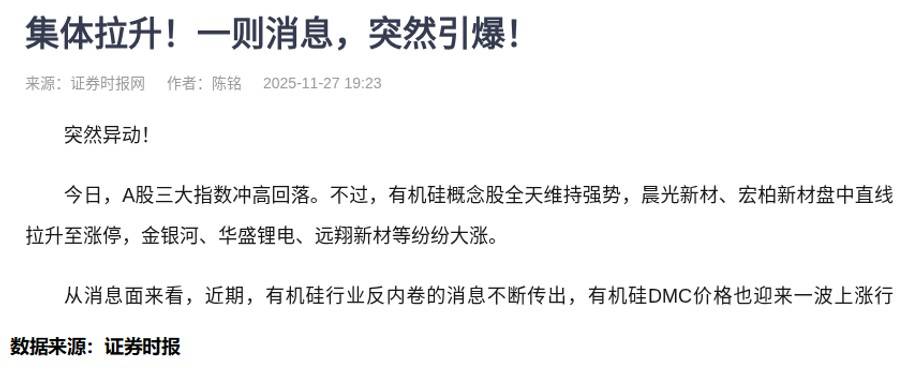
Group 1 - The core viewpoint of the article highlights the volatility and potential pitfalls in the market, particularly in the context of the silicon industry and stock price movements [1][2][3] - The article discusses the recent price surge in the silicon sector, driven by supply constraints and increased demand, but warns that this may not be sustainable as institutional investors may be offloading shares while retail investors rush in [2][4] - It emphasizes the discrepancy between index performance and individual stock movements, suggesting that a rising index does not necessarily indicate broad market strength, as evidenced by the decline in the percentage of stocks rising alongside the index [2][3] Group 2 - The article presents a cautionary tale about the dangers of following market trends blindly, particularly when media coverage is overwhelmingly positive, indicating a potential market peak [5][6] - It advises investors to be wary of unusual market behaviors, such as a rising index accompanied by falling individual stock prices, which could signal underlying weaknesses [5][6] - The importance of utilizing quantitative tools to track real capital flows and identify genuine market trends is stressed, as this can provide a competitive edge in an information-asymmetric environment [5][6]
股指:牛市新阶段,关注IC机会
Hua Tai Qi Huo· 2025-11-30 11:29
Report Industry Investment Rating No relevant content provided. Core Viewpoints - In 2026, the domestic and overseas macro - liquidity is expected to maintain a resonant and loose state, with sufficient market capital. The stock market has become an important outlet for funds, and the liquidity support for the stock market will be further strengthened. The securitization rate increase will be one of the core drivers [6]. - It is necessary to pay attention to the profit repair progress in the second stage of the bull market. The profit bottom of the entire A - share market is expected to appear at the end of 2025 or the beginning of 2026, and the market may shift from the previous structural differentiation to full - scale spread, driving the four major indexes upward. The Shanghai Composite 50 and CSI 300 indexes are expected to rise steadily, while the CSI 500 and CSI 1000 indexes may have stronger performance - driven market conditions [6]. - Under the guidance of the capital market policies promoted by the new "Nine - National - Point Plan", the stock index market will tend to the mid - and large - cap style in the long term. In 2026, the market driven by profit and industry policies will focus on the cycle and technology sectors, and the performance of the CSI 500 index will be more prominent [7]. Summary by Directory I. Internal and External Liquidity Remains Abundant 1. The US is Expected to Continue Cutting Interest Rates - The US labor market is weak, with indicators such as the continuous rise in the number of initial jobless claims and a peak in corporate lay - offs in October 2025. The unemployment rate of high - skilled groups has reached a new high since 2022 [12]. - The deterioration of the labor market has strengthened the Fed's expectation of interest rate cuts. The current round of interest rate cuts may last until the end of 2026, with the target rate possibly falling below 1%, and the cumulative rate cut may exceed 300 basis points [13]. 2. Domestic Liquidity Remains Ample - The domestic economy faces pressure in investment, export, and consumption, but still maintains a stable and progressive overall trend. New productive forces are growing, and the necessity of continuing loose monetary and active fiscal policies in 2026 is more prominent [17]. - The central bank has ensured reasonable and ample liquidity through various tools. The policy interest rate has remained stable, and the market interest rate has run at a low level. The M1 - M2 scissors - gap has continued to narrow, indicating an improvement in the activation of funds [23]. 3. The Ranking of Stock Index Investment Rises - The yields of traditional assets such as bonds and real estate have declined, while the performance of the equity market has been excellent. The gap in yields between traditional and equity assets has widened [26]. - Policy guidance, such as encouraging insurance funds to increase equity allocation and optimizing the investment scope of public funds, has accelerated the flow of funds into the equity market. Various types of funds are increasing their equity market allocation [27]. II. Focus on Profits in the Second Stage of the Bull Market 1. System Optimization Consolidates the Foundation for a Long - Term Bull Market - The new "Nine - National - Point Plan" in 2024 is a milestone for the capital market to turn to fundamental investment. In 2025, the regulatory authorities further optimized the system in terms of investment and financing reform, market stability, and opening - up [48]. 2. The Profit Inflection Point is Approaching - China's economic growth is expected to remain at around 4% in 2026, providing support for the capital market. The market is transitioning from a liquidity - driven to a fundamentals - driven stage, and corporate profit repair is the core concern [53]. - The prices of upstream industrial products and inflation levels are key factors. Metal prices have strengthened, and PPI is expected to enter a mild repair channel in 2026. The profit repair of the cycle sector is highly certain [54]. - The profit of the entire A - share market (excluding finance and petroleum and petrochemical sectors) is expected to bottom out at the end of 2025 or the beginning of 2026. The performance of the CSI 500 and CSI 1000 indexes may be stronger [62]. 3. Stock Index Investment Tends Towards Large - Cap Indexes - The "Buffett Indicator" of the A - share market shows that there is still room for the securitization rate to increase. The market investment style is tilting towards large - cap stocks, and the performance of the CSI 500 index may be more prominent in 2026 [68].
指数突破可能的三个条件
Xinda Securities· 2025-11-30 06:29
Core Conclusions - The market has experienced wide fluctuations since November, primarily due to entering an earnings and policy vacuum period, making it sensitive to uncertain events and negative factors. Weak economic data and overseas market disturbances may exacerbate market volatility. Additionally, the slowdown in resident capital inflows has extended the time for market consolidation after reaching a high turnover rate during the bull market [2][10][11]. Conditions for Index Breakthrough Condition 1: Incremental Policy Catalysts - The potential for unexpected stable growth policies to be implemented ahead of schedule could advance the spring market. The focus should be on the policy direction set by the Central Economic Work Conference in December. Historically, the probability of market success increases as the conference date approaches, with a significant rise expected post-conference [3][19][22]. Condition 2: Improvement in Economic Data (Earnings) - For a bull market driven by earnings, continuous improvement in economic data is essential. Current PMI is below the threshold, and other economic indicators such as industrial production and real estate data are weak. Significant improvements in economic data may not be seen until early 2026, as social financing and credit data typically peak at the beginning of the year [3][20][25]. Condition 3: Significant Inflows of Resident Capital - A breakthrough in a bull market, especially during a liquidity-driven phase, is often accompanied by substantial inflows of resident capital. Recent months have shown a slowdown in the inflow of funds, indicating that the current capital environment is not robust. The potential for increased capital inflows may be catalyzed by a December interest rate cut by the Federal Reserve, but improvements are more likely in Q1 2026 due to typically higher liquidity and activity levels at the start of the year [3][25][27]. Market Changes - The A-share market has seen all major indices rise, with notable gains in the ChiNext 50 and ChiNext Index. The communication and electronics sectors led the gains, while oil and banking sectors faced declines. Global markets also showed positive trends, with significant increases in major indices like the S&P 500 and Nikkei 225 [35][36]. Investment Strategy - The report suggests a tactical approach where the foundation of the bull market remains solid, with potential for earnings improvement and capital inflows to extend the bull market duration. Strategic positioning should consider the upcoming policy and capital changes that may present upward opportunities [29][32]. Sector Allocation - Recommended sectors for investment include non-bank financials, electric equipment, and machinery, with a focus on low-valuation value stocks. The report emphasizes the importance of monitoring policy catalysts and the potential for significant performance in low-valuation sectors as the market outlook evolves [34][33].
公募规模36.96万亿创历史新高 机构展望A股12月慢牛可期
2 1 Shi Ji Jing Ji Bao Dao· 2025-11-28 23:34
Group 1 - The total scale of public funds in China has reached a record high of 36.96 trillion yuan, marking the seventh time this year it has set a new record [2][3] - As of November 23, 2025, a total of 1,340 new funds have been established this year, with a total issuance scale of 1,044.598 billion yuan, continuing a trend of over 1 trillion yuan in annual new fund issuance for the seventh consecutive year [2][3] - The stock fund sector has shown remarkable performance, with 750 new stock funds established this year, raising 382.015 billion yuan, accounting for 36.57% of the total new fund scale [3] Group 2 - In November, the A-share market experienced high-level fluctuations, with major indices like the ChiNext Index and the STAR Market Index showing signs of recovery after a dip [4][5] - The financing activities in the A-share market have been positive, with net purchases exceeding 9.8 billion yuan, particularly in the electronics and communications sectors [4][5] - The market is currently viewed as being in a "second phase of a bull market," with institutions suggesting a focus on technology growth sectors and advanced manufacturing as key investment areas [6][7]
[11月28日]指数估值数据(牛市中后期,有哪些信号要注意;港股指数估值表更新;抽奖福利)
银行螺丝钉· 2025-11-28 14:07
文 | 银行螺丝钉 (转载请注明出处) 今天大盘整体上涨,截止到收盘,回到4.2星,距离4.3星比较近。 大中小盘股都上涨。 小微盘股上涨多一些。 前几天强势的价值风格略微下跌。 成长风格整体上涨。科创、创业板领涨。 港股略微下跌。 恒生红利等下跌,恒生科技略微上涨。 1. 有朋友问,牛市中后期,有什么信号,代表牛市可能到尾声或者结束呢? 如果想要精准的卖在牛市最高点,这个很难做到。 2. 不过在牛市中后期,有一些值得关注的、标志性的信号。 (1)一是市场的估值情况。 例如市场整体到了3点几星,那低估品种就没多少了。 像2021年牛市高位的时候,估值表里一个绿色低估的品种都没有。 2015年牛市高点也是如此。 其实每一轮牛市,时间长短、上涨幅度都不一样。 我们也很难预测市场的短期涨跌。 螺丝钉也汇总了关于港股指数的估值,供参考,见文章下方图片。 (2)二是资金面情况。 最近一年多A股港股的上涨,也是受益于资金面的宽松。 美元从2024年9月进入降息周期;咱们的存款、贷款利率也下降。 因为资金面的宽松带来的上涨,也会因为流动性收紧,导致短期下跌。 在5点几星,绿色低估品种一抓一大把。 4点几星,还有一些低估品种 ...

机构称市场仍有较大上涨空间,A500ETF易方达(159361)盘中成交额近40亿元
Mei Ri Jing Ji Xin Wen· 2025-11-28 06:14
Core Viewpoint - The A-share market continues to recover, with major indices showing a rebound, particularly in sectors such as energy metals, trade, beverage manufacturing, and semiconductors [1] Market Performance - The CSI A500 index rose approximately 0.3% as of 13:47, with notable stocks like Jereh Group, Putian Technology, and GAC Group hitting the daily limit [1] - The A500 ETF by E Fund (159361) recorded a trading volume of nearly 4 billion yuan, leading among similar products in the Shenzhen market [1] Analyst Insights - According to a recent report by Everbright Securities, the market may still be in a bull phase, but is expected to enter a period of wide fluctuations in the short term [1] - Compared to previous bull markets, there is still significant room for index growth; however, under the government's guidance for a "slow bull" market, the duration of the bull market may be more critical than the magnitude of the increase [1] - The market may lack strong catalysts in the short term, and year-end behavior of some investors may trend towards caution, leading to a focus on consolidation [1] Index Composition - The CSI A500 index consists of 500 stocks with large market capitalization and good liquidity, optimizing industry balance by selecting stocks based on industry and free float market capitalization [1] - The A500 ETF by E Fund (159361) ranks among the top in similar index products, with a management and custody fee rate of only 0.2% per year, facilitating low-cost investment in core A-share assets [1]