债券市场

Search documents
How does the government shutdown impact mortgage rates? Experts weigh in.
Yahoo Finance· 2025-10-02 16:29
Core Viewpoint - The ongoing government shutdown is influencing mortgage rates, with a decline in the 10-year Treasury yield potentially leading to lower mortgage rates, despite various market factors at play [1][4]. Impact of Government Shutdown on Mortgage Rates - The 10-year Treasury yield, which typically moves in tandem with mortgage rates, has been declining, suggesting that mortgage rates may also decrease [1]. - Mortgage rates have been falling since July but have recently seen slight increases due to aggressive lender actions rather than market movements [2]. - A government shutdown can lead to a drop in mortgage rates by approximately 0.125 to 0.25 percentage points, depending on the situation [4]. Economic Indicators and Market Sentiment - The shutdown may limit access to key economic data, which could shape investor sentiment and further influence mortgage rates [3]. - The ADP report indicating 32,000 job losses in September raises concerns about a weakening job market, especially with the absence of BLS job market numbers due to the shutdown [6]. - The bond market is currently fluctuating between concerns over the job market and inflation, both of which impact mortgage rates in different directions [8]. Predictions and Future Outlook - Predictions suggest that mortgage rates may continue to drift downward after the government shutdown, although various factors could affect this trend [7]. - The housing market is already under pressure from high home prices and elevated mortgage rates, and the uncertainty introduced by the shutdown may further discourage prospective buyers [7][8].
三季度债券市场平稳收官 跨季资金宽松无虞
Xin Hua Cai Jing· 2025-09-30 13:35
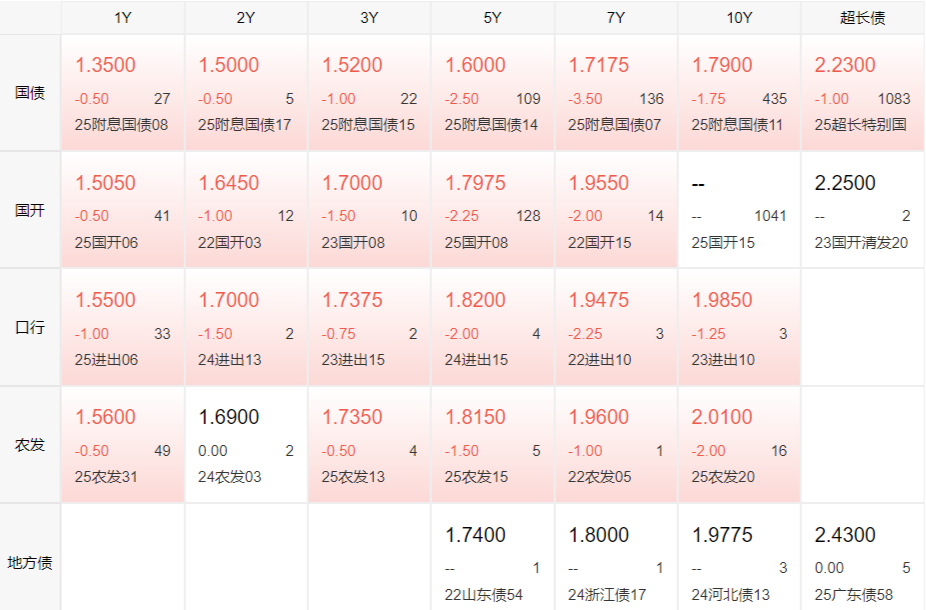
Core Viewpoint - The bond market showed positive performance on the last trading day of Q3, influenced by the central bank's proactive management of liquidity, but the market remains complex with mixed bullish and bearish signals as it heads into Q4 [1][3]. Market Performance - On September 30, all government bond futures closed higher, with the 30-year bond rising by 0.10% to 113.90, the 10-year bond up by 0.17%, the 5-year bond increasing by 0.11%, and the 2-year bond gaining 0.04% [1]. - The yields on major interbank bonds mostly declined, with the 10-year bond "25附息国债11" down by 1.75 basis points to 1.79%, and the 5-year bond "25附息国债14" down by 2.5 basis points to 1.60% [1][2]. Market Sentiment and Liquidity - There has been a shift in market sentiment towards the positive, driven by increased demand for safe-haven assets ahead of the holiday, leading to a recovery in the bond market [3]. - The liquidity environment is stable and supportive for the bond market, with the central bank's actions, including a 14-day reverse repo operation, boosting market confidence [3]. Outlook for Q4 - Analysts suggest that despite historical trends indicating rising rates post-holidays, the current market dynamics are more complex, necessitating caution from investors [5]. - The bond market may experience a mix of recovery and adjustment in Q4, with stable demand potentially leading to a downward trend in rates, while redemption pressures could cause fluctuations [5].

【立方债市通】河南正重组国企班子公布/证监会拟重奖吹哨人/中债资信领央行大罚单
Sou Hu Cai Jing· 2025-09-30 12:53
Financial Market Overview - In August 2025, the bond market issued a total of 74,281.4 billion yuan in various bonds, including 13,277.6 billion yuan in government bonds, 9,776.4 billion yuan in local government bonds, 11,550.3 billion yuan in financial bonds, 12,391.4 billion yuan in corporate credit bonds, 212.2 billion yuan in credit asset-backed securities, and 26,956.5 billion yuan in interbank certificates of deposit [1] Regulatory Developments - The China Securities Regulatory Commission (CSRC) and the Ministry of Finance proposed a new reward system for whistleblowers reporting securities and futures violations, increasing the maximum reward from 100,000 yuan to 1 million yuan and raising the reward percentage from 1% to 3% of the penalty amount [3] - The China Interbank Bond Market Dealers Association issued warnings to five institutions, including Tianjin Binhai Rural Commercial Bank and Guanghui Automobile, for regulatory non-compliance [5] Debt Issuance and Financial Tools - The National Development and Reform Commission allocated 69 billion yuan in special long-term bonds to support consumption upgrades, completing the annual target of 300 billion yuan [7] - The People's Bank of China announced a 1.1 trillion yuan reverse repurchase operation to maintain liquidity in the banking system, scheduled for October 9, 2025 [9] - The Shanghai Clearing House will continue to waive all bond issuance registration fees and reduce service fees for bond interest payments and redemptions by 50% from October 1, 2025, to September 30, 2026 [10] Local Government Financial Activities - The government of Yinchuan secured 12.648 billion yuan in transfer payment funds from central and regional authorities in the first half of 2025, achieving 53.02% of the annual target [15] - The first batch of new policy financial tools in Jiangsu and Guangxi has been implemented, with a total of 3.199 billion yuan allocated for projects, including a significant rail transit project in Jiangsu [12] Bond Market Dynamics - The issuance of land reserve special bonds has accelerated, reaching 280.476 billion yuan in 2025, with 1.096 billion yuan issued in the third quarter alone, accounting for 64% of the total issued in the first half of the year [25] - Several companies, including Kaifeng Urban Construction Group and Nanyang Industrial Investment Group, have initiated bond issuance projects, with amounts ranging from 5 billion to 35 billion yuan [16][18][22] Market Sentiment and Outlook - Investor sentiment in the bond market has slightly improved, with expectations for long-term government bond yields remaining stable, while preferences for medium and long-term bonds have increased [33]
10月债市调研问卷点评:投资者看多情绪上升
ZHESHANG SECURITIES· 2025-09-29 10:28
Group 1: Report Industry Investment Rating - Not provided in the given content Group 2: Core Viewpoints of the Report - Standing at the end of September and looking forward to October, investors' judgments on the bond market in the next stage are quite divided. There is a consensus on maintaining a preference for medium - short - term and long - term interest - rate bonds, and the proportion of bullish sentiment has increased. The funding situation, the equity market, and institutional behavior have become the core concerns of investors, and their preference for convertible bonds and low - grade urban investment bonds has marginally weakened [1]. - According to the bond market survey questionnaire results released at the end of September, there are four mainstream expectations for the bond market in October: 1) The expected range of the upper and lower limits of long - term treasury bond yields is relatively concentrated, and long - term treasury bond yields still show a state of "capped on the upper end and floored on the lower end"; 2) The bullish sentiment in the bond market has slightly increased, and the proportion of those who think it's time to increase positions has significantly risen, while expectations for reserve requirement ratio cuts and interest rate cuts are divided; 3) Investors' overall expectations for the economy in September have changed. Monetary policy, the funding situation, and the performance of the equity market are the core issues that investors focus on, and the game of institutional behavior has returned to the focus of investors; 4) Looking forward to October, investors unanimously expect to maintain their positions in medium - short - term interest - rate bonds and increase their preference for long - term interest - rate bonds, while their preference for convertible bonds has declined [2][10]. Group 3: Summary by Relevant Catalog 3.1 Investor Bullish Sentiment Rises - A bond market survey questionnaire "What to Expect from the Bond Market in October?" was released on September 25, 2025. By 00:00 on September 28, 204 valid questionnaires were received, covering various institutional investors and individual investors such as bank self - operations, securities firm self - operations, and public funds/special accounts [9]. 3.2 Expectations for Treasury Bond Yields 10 - year Treasury Bond Yields - Regarding the lower limit, 44% of investors think it will likely fall in the range of 1.70% - 1.75% (inclusive), 30% think it will be in the range of 1.75% - 1.80% (inclusive), 14% think it will fall below 1.70%, and about 12% think it will exceed 1.80%. Regarding the upper limit, 49% of investors think it will likely fall in the range of 1.85% - 1.90% (inclusive), about 29% think it will be below 1.85%, and 11% each think it will be in the range of 1.90% - 1.95% (inclusive) and above 1.95%. Current investors' expectations for the rise of 10 - year treasury bond interest rates have gradually increased compared with the August survey results, but they remain cautious about the judgment of breaking through key points [11]. 30 - year Treasury Bond Yields - Regarding the lower limit, 34% of investors each think it will fall in the ranges of 1.95% - 2.00% (inclusive) and 2.00% - 2.05% (inclusive), about 19% think it will be above 2.05%, and only 13% think it will be below 1.95%. Regarding the upper limit, about 35% of investors think it will fall in the range of 2.10% - 2.15% (inclusive), 33% think it will be in the range of 2.15% - 2.20% (inclusive), and about 19% think it will break through 2.20%. Since September, the 30 - year treasury bond yield has continued to rise, and investors are quite cautious about the expectation that it may further increase [13]. 3.3 Expectations for the Economic Situation in September - 54% of investors think the economy in September will show a situation of "both supply and demand weakening", 29% think it will be "demand weakening, supply strengthening", 9% think it will be "both supply and demand strengthening", and 8% think it will be "demand strengthening, supply weakening". In September, 83% of investors think the demand side has generally weakened, and only 38% expect the supply side to strengthen, indicating that the market is relatively cautious about the expectation of supply expansion [14][17]. 3.4 Expectations for Reserve Requirement Ratio Cuts and Interest Rate Cuts - Regarding reserve requirement ratio cuts, 36% of investors think there will be no more cuts this year, 27% think the next cut may occur in October, 23% think it will be in November, and 15% think it will be in December. Regarding interest rate cuts, 53% of investors think there will be no more cuts this year, 19% think the next cut may occur in October, 13% think it will be in November, and 15% think it will be in December. Compared with the August survey results, investors' expectations for reserve requirement ratio cuts have slightly increased, while their expectations for interest rate cuts have slightly decreased [18]. 3.5 Impact of the Fed's 25bp Interest Rate Cut on the Domestic Bond Market - 64% of investors think the Fed's 25bp interest rate cut has limited impact on the domestic bond market, and the domestic fiscal and supply rhythm still need to be considered. 13% think it is beneficial for the repair of the Sino - US interest rate spread and can ease the pressure on RMB depreciation. 12% think the interest rate cut signal strengthens the downward movement of the global interest rate center, which is beneficial for the long - duration trend in the domestic market. Another 12% think the external disturbance is difficult to determine. Most investors think the interest rate cut is not a significant surprise, and its impact on the domestic bond market is relatively limited [22]. 3.6 Expectations for the Bond Market in October - 32% of investors think the bond market in October will strengthen overall, among which 20% expect the yield curve to be bull - flattened (a slight decrease compared with the August survey results), and 12% expect the yield curve to be bull - steepened. 29% of investors think the bond market will be weak. 20% of investors think the bond market may show a differentiation between the short - end and long - end, favoring a strong short - end and a weak long - end, and 6% think the short - end will be weak and the long - end will be strong. Investors' expectations for the bond market are divided, and there is no obvious trend [24]. 3.7 Bond Market Operation Suggestions - 31% of investors think they should hold cash and wait for the market to correct to the expected level before increasing positions. 29% of investors think it's time to start increasing positions. 16% of investors think they should reduce the duration to control risks. 10% of investors think they should appropriately reduce positions, and about 15% of investors think they should keep their positions basically stable. Most investors' actual operations in October are relatively neutral, and the proportion of those who think it's time to start increasing positions has significantly increased [27]. 3.8 Preferred Bond Types in October - Compared with the August survey results, investors' preference for long - term interest - rate bonds, medium - short - term interest - rate bonds, and high - grade urban investment bonds has increased, while their preference for convertible bonds and low - grade urban investment bonds has significantly decreased. Looking forward to October, investors unanimously expect to maintain their positions in medium - short - term interest - rate bonds and increase their preference for long - term interest - rate bonds. Their preference for local government bonds, inter - bank certificates of deposit, and secondary capital bonds has slightly decreased [29]. 3.9 Main Logic of Bond Market Pricing in October - Monetary policy, the funding situation, and the performance of the equity market have become the core concerns of bond investors. Investors' attention to the game of institutional behavior has significantly increased. Their attention to fundamental data such as real estate and PMI remains basically the same, and their attention to the disturbance of US tariff policies has significantly decreased [32].
四季度债市能否突破震荡走势?
Southwest Securities· 2025-09-29 06:43
1. Report Industry Investment Rating No information provided in the content. 2. Core Viewpoints of the Report - The bond market may break through its downward space in the fourth quarter. After experiencing multiple "stress tests" in the third quarter, the bond market has shown strong resilience. With the improvement of the bond market's adaptability to the strengthening of the equity market and the decline of the excessive trading of long - term bonds, a more rational pricing logic may dominate the market again, and the stable allocation demand will become the "ballast stone" for the interest rate to decline. The interest rate is expected to be in a "moderate" downward state [8][46]. 3. Summaries Based on Relevant Catalogs 3.1 Can the Bond Market Break Through the Sideways Trend in the Fourth Quarter? 3.1.1 The Bond Market Fluctuated Widely in September, with Bulls and Bears in a Fierce Battle and a Wavy Uptrend - The valuation yield of the 10 - year treasury bond has basically completed the anchoring to the "new bond". The spread between the new bond (250016) and the old bond (250011) is basically stable at 5 - 8BP, and the yield - to - maturity compensation due to value - added tax is about 2.8% - 4.5% [1][11]. - The capital interest rate fluctuated significantly due to the cross - quarter effect, and the central level increased to some extent. The increase in the central level of the capital interest rate led to an upward trend in the bond market interest rate and a compression of the Carry space, resulting in bond market selling pressure [1][14]. - The bond cashing demand of the bank's OCI account is one of the factors pressuring the bond market. From September 1st to 26th, joint - stock banks, city commercial banks, and rural commercial banks were the main sellers in the bond market [2][18]. - Regulatory policy adjustments and the increasing expectation of restarting treasury bond trading also drove the bond market trend. The "new rule" led to a rapid correction in the bond market in early September, while the increasing expectation of the central bank restarting treasury bond trading supported the rebound in mid - September [2][21]. 3.1.2 The Bond Market May Break Through the Downward Space in the Fourth Quarter - The "see - saw" effect between stocks and bonds weakened in September. If the equity market turns into a slow - bull pattern in the fourth quarter, the suppression on the bond market from the equity market may ease [3][23]. - The price level is still in the repair stage, with PPI bottoming out and rising, but CPI has not shown signs of recovery. If the economic recovery slope is lower than expected or Sino - US economic and trade relations deteriorate unexpectedly, there is still a possibility of another interest rate cut this year [5][28]. - From the supply side, the fourth quarter is usually the "off - season" for government bond supply, but attention should be paid to the possible advance issuance of the special bonds for replacing hidden debts in 2026. Even if the supply pressure increases, the impact on the market may be relatively controllable, and the central bank may use open - market operations for hedging [6][33]. - From the demand side, even if the "new rule" is implemented in the fourth quarter, its impact on the bond market is likely to be short - term and frictional, not a trend - based decline in demand. The demand from core bond - market allocators such as wealth management and insurance remains strong [7][40]. 3.2 Important Matters - The net MLF injection was 300 billion yuan in September. On September 25th, the central bank conducted a 600 - billion - yuan MLF operation, with a maturity scale of 300 billion yuan in September [48]. 3.3 Money Market 3.3.1 Open - Market Operations and Capital Interest Rate Trends - From September 22nd to 26th, the central bank injected a total of 2.4674 trillion yuan through reverse repurchase operations, with a maturity of 1.8268 trillion yuan, and the net injection was 640.6 billion yuan. It is expected that 516.6 billion yuan of base money will be recalled from September 29th to 30th [50]. - The inter - bank liquidity was tight first and then loose last week, mainly due to the central bank's protection of liquidity. As of September 26th, R001, R007, DR001, and DR007 changed by - 16.49BP, 3.78BP, - 14.62BP, and 2.17BP respectively compared with September 19th [54]. 3.3.2 Certificate of Deposit Interest Rate Trends and Repurchase Transaction Situations - In the primary market, commercial banks' inter - bank certificates of deposit showed a net outflow, with a net financing scale of - 188.79 billion yuan last week. The issuing scale of state - owned banks was the largest, but they also had the largest net outflow [59][63]. - The issuing interest rate of inter - bank certificates of deposit increased last week. In the secondary market, the yields of inter - bank certificates of deposit at all maturities showed an upward trend [64][67]. 3.4 Bond Market - In the primary market, the supply of interest - rate bonds was relatively small last week. The total actual issuance was 60.834 billion yuan, with a maturity of 9.2 billion yuan and a net financing of 51.634 billion yuan [68]. - In the secondary market, the bond market sentiment was relatively weak last week, showing an upward trend in the shock, and the curve shape became steeper. The average daily turnover rates of the 10 - year treasury bond and 10 - year CDB bond active bonds decreased, and the liquidity premium of the 10 - year treasury bond active bond increased [68][77]. 3.5 Institutional Behavior Tracking - The institutional leverage ratio increased seasonally in August but was at a seasonal low year - on - year. The average daily trading volume of inter - bank pledged repurchase decreased last week, with an average of about 7.27 trillion yuan [94][99]. - In the cash bond market, state - owned banks increased their purchases of treasury bonds within 5 years and 5 - 10 years; rural commercial banks continued to sell but with a reduced intensity; insurance institutions continued to increase their holdings of treasury bonds and local bonds over 10 years; securities firms and funds sold significantly [104]. - The current average cost of major trading desks for adding positions in 10 - year treasury bonds is around 1.85% [107]. 3.6 High - Frequency Data Tracking - Last week, the settlement prices of rebar and wire rod futures decreased, while those of cathode copper, cement, and glass increased. The CCFI index decreased, and the BDI index increased [117]. - In terms of food prices, the pork wholesale price decreased, and the vegetable wholesale price increased. The settlement prices of Brent and WTI crude oil futures increased [117]. - The central parity rate of the US dollar against the RMB was 7.12 last week [117].
中国私募基金白皮书
Tou Bao Yan Jiu Yuan· 2025-09-28 12:14
Report Industry Investment Rating No relevant content provided. Core Viewpoints of the Report - In H1 2025, the global stock market showed an overall upward trend despite geopolitical conflicts and US tariff policies. The A-share market presented an "N-shaped" trend, the Hong Kong stock market was stronger, and the US stock market experienced a "V-shaped" reversal. The bond market was active with significant growth in issuance, and the futures market also saw increases in trading volume and turnover. The development of China's private securities investment fund industry showed mixed trends, with a decline in the number of registered fund managers but an increase in the number and scale of private securities investment fund filings in H1 2025. In terms of performance, the stock strategy had the strongest average return in H1 2025, while the futures and derivatives strategy was more dominant in the past 3 and 5 years [4][5][6]. Summary According to the Table of Contents Chapter 1: Overview of China's Securities Investment Foundation Market Stock Market - As of the end of June 2025, the number of A-share listed companies reached 5,420, an increase of 37 from the end of 2024, and the total market value exceeded 100 trillion yuan, up 6.5% from the end of 2024, hitting a record high. The growth was mainly due to the recovery of the IPO market [12][15]. - In H1 2025, the A-share market showed an "N-shaped" trend. The Shanghai Composite Index rose 2.76%, the Shenzhen Component Index rose 0.48%, the ChiNext Index rose 0.53%, and the North Exchange 50 Index soared 39.45%. The Hong Kong stock market was stronger, and the US stock market experienced a "V-shaped" reversal [16][17]. - As of the end of H1 2025, the Sci-Tech Innovation Comprehensive Index had the highest price-to-earnings ratio, and the North Exchange 50 and CSI 2000 were at historical high valuations, while the CSI 300 and Shanghai Composite Index were at medium to low historical levels [18][19]. - In H1 2025, the A-share trading volume reached 13 trillion shares, and the turnover reached 162.65 trillion yuan, with year-on-year increases of 37.64% and 59.9% respectively. The daily average turnover was 13,902 billion yuan, up about 61% year-on-year [20][24]. - In H1 2025, 23 out of 35 industries in the Wind secondary industry classification rose. The non-ferrous metals, enterprise services, and household products industries led the gains, while the coal, real estate, and daily consumer retail industries led the losses [32][35]. - In H1 2025, the small-cap growth style index of A-shares performed the strongest, followed by the large-cap value index. As of June 30, the margin trading balance of A-shares was 18,504.53 billion yuan, indicating the dominance of the long side [36][41]. Bond Market - In H1 2025, the total number of bond issuances in the market was 24,267, with an issuance amount of 44.6 trillion yuan. The issuance of interest rate bonds reached 16.9 trillion yuan, and short-term and medium-short-term bonds dominated the issuance [43][44]. - From March to June 2025, due to weak economic recovery momentum, the bidding interest rate of government bonds and the issuance interest rate of policy bank bonds declined [47][49]. - In H1 2025, the issuance interest rate of credit bonds showed a "first rising then falling" trend, mainly affected by liquidity tightening and policy uncertainty at the beginning of the year and then declining under the influence of loose monetary policy and improved market supply and demand [53][57]. - In H1 2025, the interbank bond market was the most active in the secondary market. Among different types of bonds, government bonds in interest rate bonds and financial bonds in credit bonds had the highest trading volumes [59][63]. - In H1 2025, the 1-year government bond yield rose 26BP to 1.34%, and the 10-year government bond yield fell 3BP to 1.65%. The yield curve showed different trends in different periods [65][66]. - In H1 2025, the Wande Short-term Pure Bond Fund Index and the Wande Medium and Long-term Pure Bond Fund Index both showed a "first falling then rising" trend, with an overall upward trend in oscillation. The short-term bond fund index had better gains and volatility than the medium and long-term pure bond fund index [67][69]. Futures Market - In H1 2025, the cumulative trading volume of the national futures market was 4.076 billion lots, and the cumulative turnover was 339.73 trillion yuan, with year-on-year increases of 17.82% and 20.68% respectively. The precious metals sector had the highest turnover, reaching 59.57 trillion yuan, up 66.05% year-on-year [70][74]. - As of the end of H1 2025, the domestic commodity futures market's settled funds were 428.366 billion yuan, a year-on-year increase of 16.05%. The precious metals industry had the largest inflow of funds, while the chemical industry had the largest outflow [76][81]. - In H1 2025, the commodity futures market showed a significant differentiation trend. Precious metals and some non-ferrous metals performed strongly, while coal, coke, steel, and energy and chemical products were dragged down by weak demand [82][86]. Chapter 2: Development Status of China's Private Securities Investment Fund Industry Private Securities Investment Fund Managers - The number of registered private securities investment fund managers in China has shown a significant downward trend in recent years, from 1,605 in 2017 to 49 in 2024, mainly due to tightened regulatory policies and intensified industry competition. In H1 2025, 25 managers were registered, an increase of 4 from the same period last year [88][92]. - The number of existing private securities investment fund managers in China has shown a trend of "first increasing then decreasing," from 8,467 in 2017 to 7,761 at the end of June 2025, due to tightened regulation and intensified market competition [93][97]. - Private securities investment fund managers in China are highly concentrated in economically developed and policy-advantaged regions. The top six regions in terms of managed fund scale are Shanghai, Beijing, Shenzhen, Zhejiang (excluding Ningbo), Guangdong (excluding Shenzhen), and Ningbo, with a CR6 of 88.7% [98][100]. Private Securities Investment Funds - The number and scale of private securities investment funds filed for approval in China have shown a trend of "first increasing then decreasing" in recent years. In H1 2025, both the number and scale increased significantly compared to the same period last year, mainly due to the recovery of the market environment [101][107]. - In H1 2025, the number of private securities products filed for approval reached 5,461, a year-on-year increase of 53.6%. The stock strategy was the mainstream strategy. The number of quantitative private products filed for approval was 2,448, a year-on-year increase of 67.1%, and the quantitative long strategy in the stock strategy was the mainstream [108][112]. - The number of existing private securities investment funds in China has shown a trend of "first increasing then decreasing," while the fund scale has fluctuated. In H1 2025, the number of existing funds continued to decrease, while the scale increased with the recovery of the A-share market [113][118]. Chapter 3: Performance of China's Private Securities Investment Funds Private First-level Strategies - According to investment targets and methods, private funds can be divided into 5 first-level strategies and 17 second-level strategies. In H1 2025, the stock strategy had the strongest average return. In the past 3 and 5 years, the futures and derivatives strategy was more dominant [120][123]. Stock and Bond Strategies - In H1 2025, among private companies meeting the ranking rules of Simuwang, the average return rate of stock strategy products was 14.04%, and small and medium-sized private funds performed better. In 2024, the average return of private bond strategy products was 11.89%, and the bond enhancement strategy performed the best [125][126]. Private Second-level Strategies - In H1 2025, the stock quantitative long strategy performed the best, with an average return of 16.31%. In the past 1 year, the quantitative long strategy was still the best, and in the past 3 years, the subjective CTA and other derivatives strategies had the best returns [127].
每日债市速递 | 央行连续七个月加量续做MLF
Wind万得· 2025-09-25 22:34
Open Market Operations - The central bank announced a reverse repurchase operation of 483.5 billion yuan for 7 days at a fixed rate of 1.40% on September 25, with a total bid amount of 483.5 billion yuan and a successful bid amount of 483.5 billion yuan. On the same day, 487 billion yuan of reverse repos matured, resulting in a net withdrawal of 3.5 billion yuan [1]. Funding Conditions - The central bank continued to conduct MLF operations, but liquidity improvement in the interbank market was limited. The overnight repo weighted average rate for deposit institutions rose by nearly 4 basis points to around 1.47%. The rates for 7-day and 14-day repos continued to rise as the month-end and the National Day holiday approached. The overnight quotes in the anonymous click (X-repo) system hovered around the DR001 level, with supply increasing by several hundred billion compared to the previous day [3]. Bond Market Overview - The yield on major interbank rates for bonds showed mixed movements, with the latest transaction for one-year interbank certificates of deposit at around 1.69%, a slight increase from the previous day [9]. - The closing prices for government bond futures mostly declined, with the 30-year main contract up by 0.11%, while the 10-year, 5-year, and 2-year main contracts all fell by 0.01% [14]. Recent Developments in Debt Financing - The central bank has increased MLF operations for seven consecutive months, with a net injection of 300 billion yuan in September, maintaining a stable liquidity release of 600 billion yuan through MLF and reverse repos, consistent with the previous month [15]. - The China Index Academy reported that the total bond financing in the real estate sector for August 2025 was 55.31 billion yuan, a year-on-year decrease of 4.3%. The average bond financing interest rate was 2.51%, down by 0.01 percentage points year-on-year and 0.03 percentage points month-on-month [15]. Global Macro Developments - The EU aims to establish free trade agreements with Malaysia and two other ASEAN countries by 2027, as part of its strategy to diversify trade and reduce dependence on the US [17]. - The Swiss National Bank maintained its interest rate at 0%, marking the first pause since the beginning of its rate-cutting cycle in March 2024, aligning with market expectations [17]. Bond Market Events - The Shanghai Clearing House successfully held a seminar on "Yulan Bonds" in Hong Kong. The Export-Import Bank plans to auction up to 2 billion yuan of 3-year floating rate bonds on September 26. Additionally, five new ETFs for Sci-Tech Innovation Bonds were launched, each exceeding 10 billion yuan in size [19].

国泰海通 · 晨报0926|债市、白酒
国泰海通证券研究· 2025-09-25 12:07
Group 1: Core Views - Mexico's debt market is one of the most mature and well-structured fixed income markets in Latin America, characterized by a diverse range of government bonds and a transparent debt management mechanism [2][3][4] Group 2: Macroeconomic and Debt Environment - Mexico experienced rapid economic expansion in the 1970s due to oil exports and foreign investment, leading to a significant increase in debt, with external debt exceeding 60% [2] - The debt crisis in 1982 was triggered by the oil crisis and rising U.S. interest rates, but reforms in the 21st century have gradually improved debt structure and management [2] - By 2025, the total amount of government bonds is projected to reach 14.5 trillion pesos, with an increasing proportion of fixed-rate and inflation-linked bonds, reflecting a strategy for long-term, low-interest financing [2] Group 3: Bond Market Characteristics - The Mexican bond market features a variety of instruments, including short-term treasury bills, floating-rate bonds, and inflation-linked bonds, with total government bonds exceeding 14.5 trillion pesos by September 2025 [4] - Domestic institutional investors dominate the market, while foreign investors play a crucial role in enhancing the market's internationalization and pricing transparency, holding approximately 1.76 trillion pesos of total government bonds [4] Group 4: Risks and Investment Strategies - The Mexican bond market faces multiple risks, including exchange rate, interest rate, credit, and liquidity risks, necessitating a focus on duration management as a core investment strategy [5] - Investors are advised to adjust bond portfolio duration to hedge against interest rate cycles and inflation expectations, while also considering credit spreads and macroeconomic data for optimal selection [5] - Diversifying currency risk and including hard currency-denominated bonds can help buffer against peso volatility, emphasizing a balanced approach to risk and return [5]


【立方债市通】6000亿元!央行明日操作/济源将打造AAA级信用企业/全球首单民营企业玉兰债发行
Sou Hu Cai Jing· 2025-09-24 13:19
Group 1: Bond Market Trends - Long-term bond yields have increased, with the 30-year government bond approaching 2.12% [1][2] - The 10-year government bond yield has surpassed 1.81%, with some non-active bonds reaching 2.0% [1] - The 50-year active bond yield has touched 2.29%, indicating a steepening yield curve [1] Group 2: Central Bank Actions - The People's Bank of China announced a 600 billion yuan MLF operation, marking the seventh consecutive month of increased MLF issuance [3] - In September, the central bank conducted a total of 6 billion yuan in liquidity injections through MLF and reverse repos, maintaining a moderately loose monetary policy stance [3] Group 3: Regional Developments - Jiyuan is focusing on strengthening state-owned capital and enhancing the competitiveness of state-owned enterprises [6] - Jilin is actively cultivating bond issuance entities to improve corporate willingness to issue bonds [6] - Jiangxi is expanding direct financing channels for forestry-related enterprises and encouraging eligible companies to issue bonds [6] Group 4: Issuance Dynamics - Xinyang Innovation Industry Group plans to issue 900 million yuan in technology innovation bonds [7] - Nanyang Urban Investment Holdings intends to issue up to 1 billion yuan in corporate bonds [8] - Yima City’s two state-owned enterprises are set to issue 360 million yuan in asset-backed notes [9] - Urumqi Urban Rail Group has completed the issuance of 1 billion yuan in high-growth industry bonds, marking a first in the rail transit sector [10][11] - Shanghai Fosun High Technology has issued the world's first "Yulan Bond" for private enterprises, totaling 1 billion yuan [12] Group 5: Market Sentiment - The bond market is expected to move away from the "low interest rate era," with long-term yields likely to rise due to inflationary pressures [19] - The 10-year government bond yield is anticipated to find a lower bound around 2% as economic conditions evolve [19][20]
国泰海通|固收:墨西哥债市全览:拉美地区成熟且结构完善的债券市场
国泰海通证券研究· 2025-09-24 12:25
Core Viewpoint - The article discusses the evolution of Mexico's macroeconomic and debt environment, highlighting the rapid expansion of debt leading to a crisis in the 1980s, followed by gradual improvements in debt structure and management through reforms [1] Group 1: Macroeconomic and Debt Environment - In the 1970s, Mexico experienced rapid economic growth driven by oil exports and foreign investment, resulting in a significant increase in debt, with external debt exceeding 60% [1] - The debt crisis in 1982 was triggered by the oil crisis and rising U.S. interest rates [1] - By 2025, the total amount of Mexican government bonds is projected to reach 14.5 trillion pesos, with an increased proportion of fixed-rate and inflation-linked bonds, indicating a strategy for long-term, low-interest financing and inflation hedging [1] - Current economic growth is moderate, with ongoing external financing needs, and the central bank's interest rate cuts are alleviating debt burdens, leading to improved overall debt sustainability [1] Group 2: Bond Market Characteristics - Mexico's bond market is one of the most mature and internationalized fixed-income markets in Latin America, with an independent central bank implementing flexible monetary policy [2] - The country has a flexible exchange rate system, low levels of foreign exchange controls, and a well-developed infrastructure for bond issuance, trading, and settlement [2] - The legal environment aligns with international standards, and the debt management mechanism is transparent, with a continuous introduction of new bond types, such as inflation-linked and green bonds [2] Group 3: Government Bond Types and Market Development - The variety of government bonds in Mexico includes short-term discount treasury bills, floating-rate bonds, inflation-linked bonds, and savings protection bonds [3] - By September 2025, the total amount of government bonds is expected to exceed 14.5 trillion pesos, with domestic institutional investors dominating the market [3] - Investment funds have rapidly expanded, holding over 2.5 trillion pesos in government bonds, while foreign investors play a crucial role in the internationalization and pricing transparency of the Mexican bond market, currently holding about 1.76 trillion pesos in total government bonds [3] Group 4: Risks and Investment Strategies - The Mexican bond market faces multiple risks, including exchange rate, interest rate, credit, and liquidity risks [4] - Exchange rate fluctuations require reliance on derivatives for hedging, while interest rate risk is managed through duration management [4] - Credit risk management is essential due to historical sovereign credit stability, but some corporate high-yield bonds may pose credit risks [4] - Investment strategies emphasize duration management based on the yield curve, optimizing bond selection by considering credit spreads and macroeconomic data [4] - Investors are advised to diversify currency risks and include hard currency-denominated bonds to buffer against peso volatility, balancing returns and risks through a multi-dimensional asset allocation approach [4]