
利率政策

Search documents
欧洲央行官员称通胀风险趋于平衡 近期不太可能再降息
Zhi Tong Cai Jing· 2025-11-11 11:24
智通财经APP注意到,两位欧洲央行政策制定者周二表示,欧元区通胀风险趋于平衡,经济增长比预期 更为强劲,这进一步强化了市场对近期不会再降息的预期。 武伊契奇认为,目前关税对欧洲经济的损害没有此前担心的那么严重,但关税生效前进口前置效应的后 续影响仍在持续显现。 鉴于储蓄率处于历史高位,家庭预计将支撑增长,但武伊契奇承认,欧洲央行难以理解为何消费持续疲 软。 关于中国,他表示欧洲正面临日益激烈的竞争,尤其是在汽车和机械生产等国内企业一直实力雄厚的领 域,这是一个难以解决的结构性问题。 市场认为今年降息的可能性接近零,但仍预计到2026年年中,将2%的存款利率进行最后一次下调的可 能性约为40%。 武伊契奇在伦敦表示:"就风险平衡而言,我们处于良好状态。目前,围绕通胀预测的风险是平衡的, 而且……经济增长已被证明比我们年初时想象的更具韧性。" 在关键风险中,武伊契奇强调了中国出口、美国关税以及家庭消费的不可预测性。 欧洲央行自6月以来一直维持利率不变,并表示政策处于"良好状态",尽管一些利率制定者仍担心通胀 可能回落过度,迫使他们在2026年的某个时候重新放松政策。 然而,欧洲央行执行委员会成员弗兰克.埃尔德森和 ...
股指黄金周度报告-20251107
Xin Ji Yuan Qi Huo· 2025-11-07 11:16
Report Industry Investment Rating - Not provided Core Viewpoints of the Report - In October 2025, China's import growth rate declined and exports turned negative year-on-year, indicating that the foundation of China's economic recovery is not solid, domestic demand remains weak, and external demand is under increasing downward pressure. The export will face downward pressure in the future. The stock index should be cautiously viewed for short - term rebounds and the risk of a new decline should be watched out for. Gold may be under short - term pressure and has a risk of deep adjustment in the medium - long term [40]. Summary by Relevant Catalogs 1. Macroeconomic Data - In October 2025, China's imports increased by 1% year - on - year, with the growth rate dropping by 6.4 percentage points from the previous month, and exports decreased by 1.1% year - on - year, the first negative growth since March, reflecting weakening domestic demand and increasing downward pressure on external demand [3][4]. 2. Stock Index Fundamental Data - From January to September 2025, the profits of industrial enterprises above a designated size turned positive year - on - year, and the growth rate of finished product inventories rebounded. However, after removing the impact of the low base effect in the previous year, corporate profitability remained weak, and enterprises were still in the stage of active inventory reduction [16]. - The margin trading balance in the Shanghai and Shenzhen stock markets rose slightly to 24725.92 billion yuan. The central bank conducted 495.8 billion yuan of 7 - day reverse repurchase operations this week, achieving a net withdrawal of 1572.2 billion yuan [18]. 3. Gold Fundamental Data - Many Fed officials made hawkish remarks, believing that the US economy is still robust, the inflation risk has not been eliminated, and caution is needed regarding future interest rate cuts. The yield of the 10 - year US Treasury bond has returned above the 4% mark [28]. - The warehouse receipts and inventory of Shanghai gold futures are slowing down, and the inventory of New York COMEX gold is continuously decreasing, reflecting a cooling of the market's bullish sentiment [39]. 4. Strategy Recommendations - Short - term: Due to the marginal weakening of domestic economic data, the stock index should be cautiously viewed for short - term rebounds. Fed officials' hawkish remarks have further dampened the market's expectation of another interest rate cut in December, and gold may continue to adjust after a short - term rebound [40]. - Medium - long term: The valuation of the stock index will still be dragged down by the decline in corporate profit growth at the molecular end, and the support at the denominator end mainly comes from the recovery of risk appetite. Gold has a risk of deep adjustment due to factors such as the cooling of the expectation of another Fed interest rate cut in December [40].
金融大佬突发噩耗,降息延续市场波动,黄金或成年底新机遇
Sou Hu Cai Jing· 2025-11-06 18:40
金融大佬突发噩耗,降息延引市场动荡,黄金会成为年底新风口吗? 先说重点,11月市场两件大事把人搅得坐不住,一是泉果基金创始人王国斌在11月3日病逝,震动圈内外,二是美联储降息预期被推迟,加上美 国政府停摆与香港经济回暖,市场在避险和风险偏好之间拉扯,让人摸不着头脑,接下来我把时间线和来龙去脉按白话讲清楚,让你知道到底 发生了什么,会往哪儿走。 11月3日,泉果基金官网突然变成黑白色调,接着公司公告写着总经理因病离任,任职截止日就是当天,这消息像晴天霹雳在基金圈炸开,年 仅57岁的王国斌告别了他打拼多年的舞台, 王国斌出身北大,干了27年证券行业,曾在万国证券、中金混过日子,2010年带着一股倔劲儿把东方红资产管理拉出来做成事儿,那会儿他敢 在股市高热时暂停权益类产品新发,颗粒归仓的决定后来被不少人当成避灾保命的选择, 2022年他又创了泉果基金,这是当年唯一过会的"个人系"公募,三年多把规模做到237亿,产品连续多年正收益,圈里人对他既敬又怕,觉得这 人靠谱又狠决, 关于他怎么去世,官方只写"病逝",后续讣告说是因病医治无效,没有具体病种,网络上有各种猜测,最后一次公开露面被人拍到憔悴、消 瘦、需助理搀扶离场 ...


欧元区经济现分化复苏:服务业PMI持续扩张 PPI疲软凸显通缩压力
Xin Hua Cai Jing· 2025-11-05 16:30
Core Insights - The Eurozone economy shows a clear divergence in early Q4, with significant recovery in business activity but ongoing pressure on industrial prices [1][2] - The composite Purchasing Managers' Index (PMI) for October rose to 52.5, indicating the fastest expansion since May 2023, driven mainly by a surge in service sector activity [1] - The Producer Price Index (PPI) for September declined for the second consecutive month, reflecting persistent deflationary pressures in the industrial sector [1][2] Economic Indicators - The final value of the Eurozone's October composite PMI was 52.5, up from the initial estimate of 52.2 and September's 51.2, signaling a notable acceleration in overall economic activity [1] - Service sector activity accelerated sharply, becoming the primary growth driver, while manufacturing output saw only a slight increase [1] - New business volumes grew at the fastest pace in two and a half years, contributing to a 16-month high in employment growth [1] Price Trends - The Eurozone's PPI for September fell by 0.1% month-on-month, marking the second month of negative growth, and the year-on-year decline was 0.2%, consistent with expectations [1][2] - Energy prices decreased by 0.2% month-on-month, continuing to be a major factor in the PPI decline, following a 1.5% drop in August [1] - Core PPI, excluding energy, remained flat month-on-month, with a year-on-year growth rate of 0.9%, indicating stability in non-energy industrial prices [1] Sector Analysis - Durable consumer goods prices increased by 0.3% month-on-month and 1.6% year-on-year, while non-durable consumer goods prices saw a slight rise of 0.1% [2] - Intermediate goods prices fell by 0.1% month-on-month, and capital goods prices remained stable, with a year-on-year increase of 1.8% [2] - The current economic structure in the Eurozone is characterized by strong service sector performance and weak manufacturing, with stable consumer demand but cautious investment in industrial sectors [2]
黄金4000美元关口胶着,美联储施压市场观望,中美政策走向成关键
Sou Hu Cai Jing· 2025-11-05 07:24
Group 1 - The global gold market is currently experiencing a stalemate, with prices hovering around $3996 per ounce, unable to break the $4000 mark due to various unseen forces at play [1][10] - The Federal Reserve's recent interest rate cut has led to internal disagreements, creating uncertainty about future monetary policy, which is affecting market sentiment [3][10] - Historical concerns about inflation and potential changes in leadership at the Federal Reserve are contributing to a tense atmosphere in the gold market [5][10] Group 2 - China's new gold tax policy is adding complexity to the market, potentially making gold purchases more expensive and dampening demand [7][10] - The market is waiting for clarity on both the U.S. interest rate outlook and the implications of China's new policies, which are critical for future gold price movements [10][12] - The interplay between U.S. and Chinese policies is seen as the primary driver of market direction, rather than technical analysis [14]
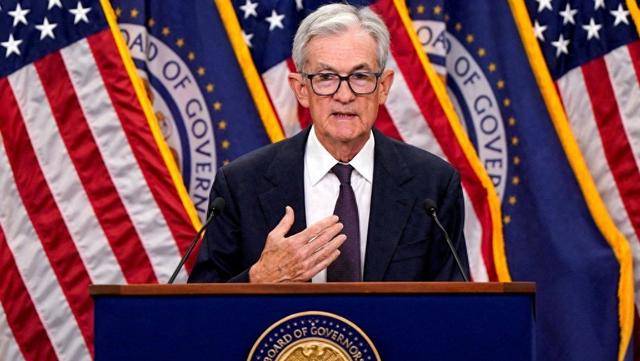
欧洲央行维持利率不变 政策前景趋于谨慎
Jin Tou Wang· 2025-11-04 09:21
Group 1 - The core viewpoint of the articles indicates that the Euro is experiencing a downward trend against the Yen, influenced by the Bank of Japan's potential interest rate hike and the new Japanese Prime Minister's fiscal expansion plans [1][2] - The Bank of Japan's Governor Ueda hinted at a possible interest rate increase in December or January 2026, which has led the market to reassess the outlook for the Yen [1] - The new Japanese Prime Minister, Suga, is expected to implement more aggressive fiscal spending, which may conflict with monetary tightening goals, potentially delaying the Bank of Japan's rate hike [1] Group 2 - The new Finance Minister, Katayama, clarified that she no longer adheres to the previous view of the Yen's fair value being in the 120-130 range, indicating a possible government intervention in the currency market to stabilize exchange rate fluctuations [1] - The European Central Bank (ECB) maintained interest rates during its October meeting for the third consecutive time, citing stable inflation prospects and ongoing economic growth, but acknowledged external uncertainties [1] - The technical analysis shows that the Euro to Yen exchange rate has fallen below short-term support levels, indicating a continued weak trend, with potential further declines if it breaks below 177.00 [2]
每日机构分析:11月3日
Xin Hua Cai Jing· 2025-11-03 14:13
Group 1 - UK manufacturing in October experienced its strongest month in a year, primarily due to Jaguar Land Rover's recovery from a cyberattack, leading to a "one-time rebound" in production. The manufacturing PMI output index returned to growth, driven by intermediate products, reflecting supply chain improvements from Jaguar Land Rover's gradual production restart. However, domestic and international demand remains weak, with companies relying on previous order backlogs to maintain operations [1][1][1] - Goldman Sachs analysts indicated that the current US government shutdown could have a record-breaking impact on the economy. This shutdown may last longer than the 35-day partial shutdown from 2018-2019 and is broader in scope, potentially affecting federal procurement and investment significantly, with spillover effects on the private sector. If the shutdown lasts about six weeks, it could reduce the annualized quarterly growth rate for Q4 2025 by 1.15 percentage points, with a further decline of 1.3 percentage points in Q1 2026 due to spillover effects from federal procurement and investment [1][1][1] Group 2 - HSBC Global Investment Research stated that the US dollar may bottom out in early 2026 due to anticipated further rate cuts by the Federal Reserve and uncertainty regarding the next chairperson. This week, dollar shorts will face new challenges as multiple Federal Reserve officials' speeches and US economic activity indicators will be market focal points. The sensitivity of the dollar may increase further [2][2][2] - Morgan Stanley MUFG strategists remain bullish on the mid-section of the Japanese government bond yield curve, believing that changes in the US economic landscape may lead to a downward repricing of the Bank of Japan's terminal rate. Despite some alleviation of fiscal issues under the new government, they remain cautious about long-term bonds, noting that Japan's top ten life insurance companies' investment plans for the second half of FY2025 suggest they are unlikely to be a stable demand source for ultra-long Japanese government bonds [2][2][2] Group 3 - The Indian rupee is nearing a record low, with recent interventions by the central bank proving limited in effectiveness. The rupee has depreciated for three consecutive days against the dollar, trading at 88.7988. Despite the Reserve Bank of India's recent unexpected sale of large amounts of dollars to stabilize the market, the rupee has failed to maintain its gains. Traders noted that the central bank has been selling dollars in smaller amounts to prevent the rupee from breaching the historical low of 88.8050 [3][3][3] - Switzerland's annual inflation rate unexpectedly dropped to 0.1% in October, down from 0.2% in September. Analysts suggest that the Swiss National Bank may not be influenced by this result, as the bank expects inflation to rise in the coming months. Factors such as declining rental inflation and anticipated electricity price reductions may lead to a further drop in inflation to -0.3% by February next year. However, the Swiss National Bank has indicated that it will only consider lowering key interest rates below 0% if mid-term inflation falls below zero [4][4][4]
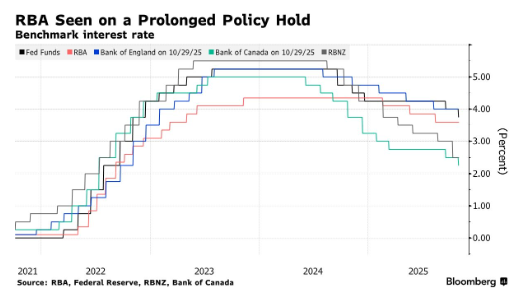
通胀粘性掣肘 澳洲联储本周料按下降息“暂停键”
Zhi Tong Cai Jing· 2025-11-03 07:02
Core Viewpoint - The Reserve Bank of Australia (RBA) is expected to maintain the cash rate at 3.6% during its upcoming meeting, with no forward guidance anticipated due to increasing economic uncertainty [1][3]. Economic Indicators - The core inflation rate in Australia rose from a revised 0.7% in Q2 to 1% in Q3, reaching the upper limit of the RBA's target range of 2-3% [3]. - Domestic demand remains strong, driven by government tax cuts and energy subsidies, contributing to persistent inflation, particularly in services [3]. - Recent data indicates a rise in credit growth and record-high housing prices, suggesting that the financial environment is not overly tight [3]. Labor Market Conditions - The labor market shows signs of loosening, with employment growth slowing and the unemployment rate rising to 4.5%, the highest level since September 2021 [4]. - A report indicated that the number of private sector job advertisements fell for the fourth consecutive month, down 7.4% year-on-year, reflecting labor market weakness [4]. Future Projections - Some economists predict that Australia may face a situation similar to the U.S., where moderate economic growth and rising unemployment could lead to a cooling of prices, prompting the RBA to consider rate cuts [4]. - The RBA is expected to maintain its current policy until there is clear evidence of economic direction, with some forecasts suggesting two rate cuts in the next year, bringing the rate down to 3.1% [5].
有色金属基础周报:宏观情绪降温,有色金属整体回归震荡-20251103
Chang Jiang Qi Huo· 2025-11-03 06:12
1. Report Industry Investment Rating No relevant content provided. 2. Core Views of the Report - Copper prices reached a record high this week and then declined. Although the long - term demand outlook for copper is optimistic due to factors such as tight copper concentrate supply and increasing demand from computing power construction, short - term high prices are suppressing downstream demand. It is expected that copper prices will remain in a high - level oscillation in the short term, with the main contract of Shanghai Copper operating in the range of 85,000 - 89,000. It is recommended to exit long positions at high levels or conduct short - term trading within the range [2]. - Aluminum prices are in a high - level upward oscillation. However, as the rainy season in Guinea ends and alumina prices weaken, there is downward pressure on ore prices. The operating capacity of alumina has decreased, and the inventory has increased. The operating capacity of electrolytic aluminum has increased slightly. It is recommended to reduce positions and take profits at high levels for aluminum - related products [2]. - Zinc prices are in a relatively strong oscillation. Although the processing fees of zinc ore have decreased, the production enthusiasm of smelters is high, and the output of refined zinc is expected to remain at a high level. Terminal consumption is weak, and inventory is at a high level. It is expected that Shanghai Zinc will maintain an oscillation, with the main contract operating in the range of 21,800 - 23,000, and it is recommended to conduct range trading [2]. - Lead prices are in a sideways oscillation. Supply is decreasing, but downstream procurement is cautious due to high prices. Considering the strong production and consumption demand and the temporary truce in the Sino - US trade war, lead prices may continue to rise after consolidation. It is recommended to go long at low levels within the range of 17,100 - 17,800 [2]. - Nickel prices are in an intra - range oscillation and decline. The cost of the nickel industry is relatively stable, but the nickel market remains in a surplus situation, with continuous inventory accumulation. It is recommended to hold short positions at high levels, with the main contract of Shanghai Nickel operating in the range of 119,000 - 123,000; for stainless steel, it is also recommended to hold short positions at high levels, with the main contract operating in the range of 12,400 - 12,900 [3]. - Tin prices are in a high - level oscillation and overall upward trend. Although tin ore supply is expected to improve, downstream consumption is weak. It is recommended to conduct range trading, with the reference operating range of the Shanghai Tin 12 contract being 275,000 - 295,000, and it is necessary to continue to pay attention to supply resumption and downstream demand recovery [3]. - Industrial silicon prices are in an oscillatory adjustment. The production and inventory of industrial silicon and related products such as polysilicon and organic silicon have changed. It is recommended to conduct range trading or wait and see, and pay attention to the implementation of the polysilicon storage platform and production reduction [3]. - Lithium carbonate prices are in a wide - range oscillation. The supply and demand are in a tight balance, and downstream demand is strong. It is recommended to trade cautiously and pay attention to the progress of mining certificates in Yichun and the resumption of production of the Ningde Jianxiawo lithium mine [3]. 3. Summary by Relevant Catalogs 3.1 Macro - From October 27th to November 2nd, important economic data were released. China's industrial enterprise profits in September increased by 21.6% year - on - year, and the profits of high - tech manufacturing and equipment manufacturing showed good growth. The Sino - US leaders held a meeting, and the Sino - US economic and trade teams reached a consensus on tariff and export control measures. China's official manufacturing PMI in October dropped to 49, while the non - manufacturing index rose to 50.1. The Federal Reserve cut interest rates by 25 basis points, and the eurozone's GDP in the third quarter increased by 0.2% quarter - on - quarter, exceeding expectations. The US Senate passed a resolution to terminate Trump's comprehensive tariff policy, but it is expected to face difficulties in the House of Representatives [11][12][13][14][15][16][17]. 3.2 Copper - Price trend: Reached a record high and then declined, expected to be in a high - level oscillation in the short term [2]. - Fundamental factors: Supply of copper concentrate is tight, but short - term high prices are suppressing downstream demand, and inventory is accumulating [2]. - Investment advice: Exit long positions at high levels or conduct short - term trading within the range [2]. 3.3 Aluminum - Price trend: High - level upward oscillation, with the oscillation range broken through [46]. - Fundamental factors: The rainy season in Guinea ends, alumina prices weaken, the operating capacity of alumina decreases, and the inventory increases. The operating capacity of electrolytic aluminum increases slightly, and downstream demand is affected by the transition from peak to off - peak season [2]. - Investment advice: Reduce positions and take profits at high levels [2]. 3.4 Zinc - Price trend: Relatively strong oscillation [2]. - Fundamental factors: Zinc ore processing fees have decreased, smelter production enthusiasm is high, terminal consumption is weak, and inventory is at a high level [2]. - Investment advice: Conduct range trading [2]. 3.5 Lead - Price trend: Sideways oscillation [2]. - Fundamental factors: Supply is decreasing, downstream procurement is cautious due to high prices, but production and consumption demand are strong [2]. - Investment advice: Go long at low levels within the range [2]. 3.6 Nickel - Price trend: Intra - range oscillation and decline [3]. - Fundamental factors: The cost of the nickel industry is relatively stable, but the nickel market is in a surplus situation, with continuous inventory accumulation [3]. - Investment advice: Hold short positions at high levels [3]. 3.7 Tin - Price trend: High - level oscillation and overall upward trend [3]. - Fundamental factors: Tin ore supply is expected to improve, but downstream consumption is weak [3]. - Investment advice: Conduct range trading [3]. 3.8 Industrial Silicon - Price trend: Oscillatory adjustment [3]. - Fundamental factors: The production and inventory of industrial silicon and related products have changed, and the production of polysilicon is expected to decrease in November [3]. - Investment advice: Conduct range trading or wait and see [3]. 3.9 Lithium Carbonate - Price trend: Wide - range oscillation [3]. - Fundamental factors: Supply and demand are in a tight balance, downstream demand is strong, and there are uncertainties in mining certificates [3]. - Investment advice: Trade cautiously [3].
黄金:关注美国银行风险,白银:震荡反弹
Guo Tai Jun An Qi Huo· 2025-10-31 05:52
1. Report Industry Investment Ratings No industry investment ratings are provided in the report. 2. Core Views of the Report - Gold: Monitor risks in US banks [2] - Silver: Oscillate and rebound [2] - Copper: With increasing disturbing factors, prices will oscillate [2] - Zinc: Range-bound oscillation [2] - Lead: Continuous reduction in domestic and foreign inventories supports prices [2] - Tin: Pay attention to macro - impacts [2] - Aluminum: Fluctuations will converge; Alumina: Slight decline; Cast aluminum alloy: Follow electrolytic aluminum [2] - Nickel: With the game between smelting inventory accumulation and nickel ore concerns, nickel prices will oscillate in a narrow range; Stainless steel: Limited downside potential, lack of upward drivers [2] 3. Summary by Related Catalogs Gold - **Fundamental Tracking**: Data on prices, trading volume, positions, ETF holdings, inventories, spreads, and exchange rates of gold - related products are presented. For example, the closing price of Comex gold 2512 yesterday was 4038.30, with a daily increase of 2.45% [4]. - **Macro and Industry News**: There were high - level meetings between China and the US, and central bank policies in Europe, Japan, etc. [4][7] - **Trend Intensity**: Gold trend intensity is 1 [6] Silver - **Fundamental Tracking**: Similar to gold, data on prices, trading volume, positions, ETF holdings, inventories, spreads, etc. of silver - related products are provided. For example, the closing price of Comex silver 2512 yesterday was 48.730, with a daily increase of 3.08% [4]. - **Trend Intensity**: Silver trend intensity is 1 [6] Copper - **Fundamental Tracking**: Data on prices, trading volume, positions, inventories, spreads, etc. of copper - related products are shown. For example, the closing price of the Shanghai copper main contract yesterday was 87,960, with a daily decline of 0.85% [8]. - **Macro and Industry News**: High - level meetings between China and the US, European central bank policies, and news in the copper industry such as potential copper concentrate exports in Indonesia, policy changes in the US, and production data from major copper producers [8][10] - **Trend Intensity**: Copper trend intensity is 0 [10] Zinc - **Fundamental Tracking**: Information on prices, trading volume, positions, spreads, inventories, etc. of zinc - related products is given. For example, the closing price of the Shanghai zinc main contract was 22365, with a decline of 0.29% [11]. - **News**: High - level meetings between China and the US and related tariff agreements [11] - **Trend Intensity**: Zinc trend intensity is 0 [13] Lead - **Fundamental Tracking**: Data on prices, trading volume, positions, spreads, inventories, etc. of lead - related products are provided. For example, the closing price of the Shanghai lead main contract was 17350, with a decline of 0.03% [14]. - **News**: High - level meetings between China and the US and European central bank policies [14] - **Trend Intensity**: Lead trend intensity is 0 [14] Tin - **Fundamental Tracking**: Data on prices, trading volume, positions, inventories, spreads, etc. of tin - related products are presented. For example, the closing price of the Shanghai tin main contract was 283,600, with a daily decline of 1.09% [16]. - **Macro and Industry News**: High - level meetings between China and the US, central bank policies in Europe, Japan, etc., as well as corporate news [17] - **Trend Intensity**: Tin trend intensity is 0 [19] Aluminum, Alumina, and Cast Aluminum Alloy - **Fundamental Tracking**: Comprehensive data on prices, trading volume, positions, spreads, inventories, etc. of aluminum, alumina, and cast aluminum alloy - related products are provided. For example, the closing price of the Shanghai aluminum main contract was 21245 [20]. - **Comprehensive News**: Japan's central bank policy and US Senate's resolution on tariffs [21] - **Trend Intensity**: Aluminum trend intensity is 0; Alumina trend intensity is - 1; Aluminum alloy trend intensity is 0 [21] Nickel and Stainless Steel - **Fundamental Tracking**: Data on prices, trading volume, positions, spreads, etc. of nickel and stainless - steel - related products are shown. For example, the closing price of the Shanghai nickel main contract was 120,980 [23]. - **Macro and Industry News**: Incidents in the Indonesian nickel mining industry, China's policy on imports, and potential US tariff policies [23][25] - **Trend Intensity**: Nickel trend intensity is 0; Stainless steel trend intensity is 0 [25]