
AI投资

Search documents
「中国英伟达」们的估值叙事:从寒武纪走势看摩尔线程、沐曦股份
3 6 Ke· 2025-12-12 07:57
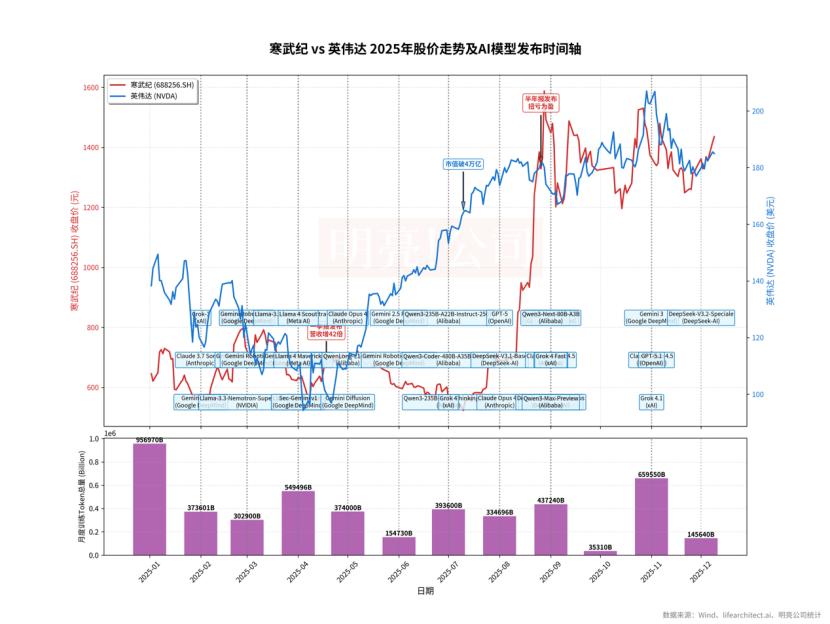
Group 1: AI Infrastructure Growth - The latest report from CMB International predicts that AI infrastructure will continue to grow strongly at least until 2026, with major overseas cloud providers' capital expenditures expected to increase by over 60% in 2024 and 2025, followed by a growth of over 30% in 2026 [1] - The market is looking for the "next Cambricon" following the rapid market capitalization growth of Cambricon (688256.SH) this year, with the recent listing of Moore Threads (688795.SH) on the STAR Market leading to significant stock price increases [1][2] Group 2: Stock Performance Comparison - Cambricon's stock price has increased by over 100% this year, driven by explosive revenue growth, with total revenue reaching 4.607 billion yuan in Q3, compared to only 185 million yuan in the same period last year [2][10] - The stock price of Cambricon began to rise significantly in early August, prior to the release of its semi-annual report, indicating that profitability was not the direct driver of its stock price increase [4] - In contrast, Nvidia's stock price has shown a divergence from Cambricon's, with Nvidia's market capitalization reaching over $5 trillion while Cambricon's market cap is approximately 588 billion yuan [4][10] Group 3: Capital Expenditure Insights - The narrative in the U.S. capital markets suggests that tech giants' capital expenditures on AI infrastructure, particularly core computing hardware, have supported the rise in AI hardware stock prices [6] - Among the top 20 companies in the S&P 500, those with significant capital expenditure increases are primarily related to AI data center assets, including energy, storage, and semiconductors [7] - The overall capital expenditure of the CSI 300 companies was approximately 2.031 trillion yuan, showing a slight decrease of 0.5% compared to last year, indicating that the data may not fully reflect the true state of AI capital expenditures in Chinese tech companies [9][10] Group 4: New Market Entrants - Newly listed companies Moore Threads and Muxi Co. reported revenues of 784.6 million yuan and 1.236 billion yuan respectively for the first three quarters, indicating they are in the early stages of commercialization but have entered a revenue-generating phase [14] - Both companies have shown a sales rate exceeding 100% in 2025, reflecting their acceleration into the commercialization phase [15] Group 5: R&D and Profitability - Moore Threads and Muxi Co. are currently operating at a loss, with net profit margins of -92.22% and -27.95% respectively, while Cambricon achieved a net profit margin of 34.81% this year [18] - The R&D expense ratios for Moore Threads and Muxi Co. are significantly higher than the average of comparable companies, indicating ongoing investment in research and development [16][17]


新手基金交易软件排名及选择指南:这三家平台值得推荐
Xin Lang Cai Jing· 2025-12-12 06:51
Core Insights - The article emphasizes the importance of selecting the right investment app for novice investors, highlighting that good tools can aid decision-making and foster proper investment habits [1][12] Group 1: Software Selection Criteria - New investors should evaluate fund trading software based on multiple key dimensions rather than a single metric [2][13] - Data coverage and real-time capabilities are fundamental; an excellent platform should cover over 98% of market fund products and integrate data from multiple leading fund companies [2][13] - The quality and timeliness of information directly impact investment decisions, with real-time news and in-depth reports forming an essential information matrix [3][14] - Smart tools are a core competitive advantage, with AI assistants capable of summarizing lengthy reports and adjusting investment amounts based on market conditions [3][14] - User-friendliness is crucial, with the purchasing process for a fund ranging from 4 to 8 steps, affecting overall user experience [3][14] Group 2: Comparison of Platform Types - Fund sales platforms can be categorized into three main types: third-party independent platforms, brokerages, and bank-affiliated platforms, each with unique features [4][15] - Third-party platforms excel in product variety and ease of use, with examples like Ant Fortune and Tencent Wealth [4][15] - Brokerage platforms are known for research depth and professional tools, with notable mentions including Huatai Securities and Guotai Junan [4][15] - Bank-affiliated platforms emphasize security and comprehensive services, with offerings like asset allocation reports from China Merchants Bank [4][15] Group 3: Unique Advantages of Sina Finance APP - Sina Finance APP scored 9.56 in comprehensive evaluations, ranking high in data coverage, information quality, and smart tools [5][16] - It supports seamless integration across over 40 global markets and monitors over 10,000 fund dynamics, covering 98% of market fund products [5][16] - The app provides timely interpretations of major events, with a speed advantage of 5-10 seconds over competitors [5][17] - The "Xina AI Assistant" can quickly distill complex information, and the smart investment feature adjusts amounts based on market conditions [6][17] Group 4: Other Noteworthy Platforms - Other notable fund trading apps include Huatai Securities' AI Zhangle, which features a stock selection tool with a 62% probability of hitting the daily limit [7][18] - Guotai Junan's Junhong platform boasts 10.29 million monthly active users and supports multiple markets [7][18] - Ant Fortune stands out for its user-friendly interface, allowing fund purchases in just four steps [7][18] Group 5: New Investor Selection Guide - New investors should prioritize platforms that are easy to use and offer systematic educational content [8][19] - User interface and purchasing process simplicity are critical, with third-party apps generally being more streamlined [8][19] - Educational resources and smart assistance are vital for novice growth, with various platforms providing comprehensive learning materials [8][19] - Investors should be cautious of hidden fees and ensure data security by choosing platforms with appropriate certifications [8][19] Conclusion - A good fund trading app offers more than just numerical data; it provides insights into market trends and investment strategies, enabling new investors to make informed decisions quickly [9][20]
“人在‘C位’,话却不多”!科技投资经理急寻新叙事
Sou Hu Cai Jing· 2025-12-12 05:04
"人在'C位',但是能说的新内容却不多。" 2025年接近尾声,公私募机构近期密集举行年度策略会,总结2025年的投资得失,展望2026年的投资布 局。 其中,包括AI在内的科技投资,占据机构策略会的"C位"。但是,在科技行情如火如荼的大环境下,投 资经理们想要寻找让人耳目一新的新叙事却不容易,不少投资经理"词穷"。科技行情行至当下,投资需 要新的"兴奋点"催化。 科技投资占据"C位" 近期,多家公私募机构举行年度策略会,科技投资、AI机遇等话题成为重头戏。 近日,有私募机构在分享2026年宏观策略后,后续所有的议程就是"AI+XX行业"的形式。"AI in All, All in AI"的口号,展现得淋漓尽致。 12月12日,朱雀基金举行年度策略会。会议议程显示,AI成为其中的重点议题,包括"理性AI繁荣""AI 浪潮下的电力机遇""AI in All,人机交互方式的创新"等。 有机构人士表示:"人在'C位',话却不多。不是不想说,而是想在有更多充分案例、数据的时候,再好 好说。" 急寻新叙事 不过,不少科技投资经理则感叹站在"C位",能说的新内容却不多。 "包括AI在内的科技投资,已经在叙事和逻辑上演绎得 ...
东海证券晨会纪要-20251212
Donghai Securities· 2025-12-12 04:11
Group 1: Key Recommendations - Huide Technology (603192) is a leading provider of polyurethane solutions, actively seizing industry trends. The company focuses on differentiated competition strategies and collaborates with downstream customers for customized solutions. Its production of polyurethane for leather accounts for 10.9% of the domestic total, ranking fourth in market share [5][6][7]. Group 2: Industry Insights - The domestic new energy vehicle (NEV) industry is expected to drive significant growth, with NEVs accounting for 26%, 32%, 41%, and 47% of total domestic vehicle production from 2022 to October 2025. Huide Technology's products are widely used in automotive applications, with estimated polyurethane material costs per NEV ranging from 1,000 to 3,000 yuan [6][7]. - The company is well-positioned to benefit from structural supply-demand mismatches in the polyurethane market, with projections indicating that by 2030, China's MDI capacity will account for 52% of global capacity, and TDI capacity will reach 59%. This is coupled with strong demand for artificial leather and insulation materials, particularly in the automotive sector [8]. Group 3: Financial Projections - The company is expected to maintain high-quality growth, with projected net profits of 126 million yuan, 131 million yuan, and 136 million yuan for 2025, 2026, and 2027, respectively. The corresponding EPS is estimated to be 0.89, 0.93, and 0.96, leading to a PE ratio of 26.39x, 25.32x, and 24.52x for the same years [8].

12月美国FOMC点评:美联储谨慎鸽派降息,预期明年经济转好
Dongxing Securities· 2025-12-12 01:55
美联储谨慎鸽派降息,预期明年经济转好 ——12 月美国 FOMC 点评 2025 年 12 月 12 日 宏观经济 事件点评 分析师 康明怡 电话:021-25102911 邮箱:kangmy@dxzq.net.cn 执业证书编号:S1480519090001 事件: 美联储降息 25bp,政策利率降至 3.5~3.75%。 主要观点: 一、美联储观点 美联储对经济预期略有上升。美联储评估近期经济继续温和增长,其中消费者支出保持稳健,商业固定投资继续扩张,但地 产市场仍旧疲软。劳动力市场逐渐冷却,通胀略有上行。联邦政府临时关门可能会对当前季度 GDP 有所影响,但这种影响 大概率被政府重新开门后下个季度更高的增长所抵消。在 SEP 中,参与者对 GDP 增速的中位数略有提高,分别为今年 1.7% 以及明年 2.3%。鲍威尔认为明年经济更好来自四个因素,分别是财政政策刺激、AI 投资、政府重新开门,以及消费仍然稳 健。 继续降息仍主要源自非农数据疲软。鲍威尔对就业市场的观点与前两次记者会基本一致。失业率略有上升,工作报酬相比于 年初显著下降。鲍威尔继续认为目前劳动力供需双方均明显减少。劳动供给的下降来自移民下降 ...
道指涨超600点,甲骨文市值蒸发超4800亿,加密货币近14万人爆仓
2 1 Shi Ji Jing Ji Bao Dao· 2025-12-11 23:35
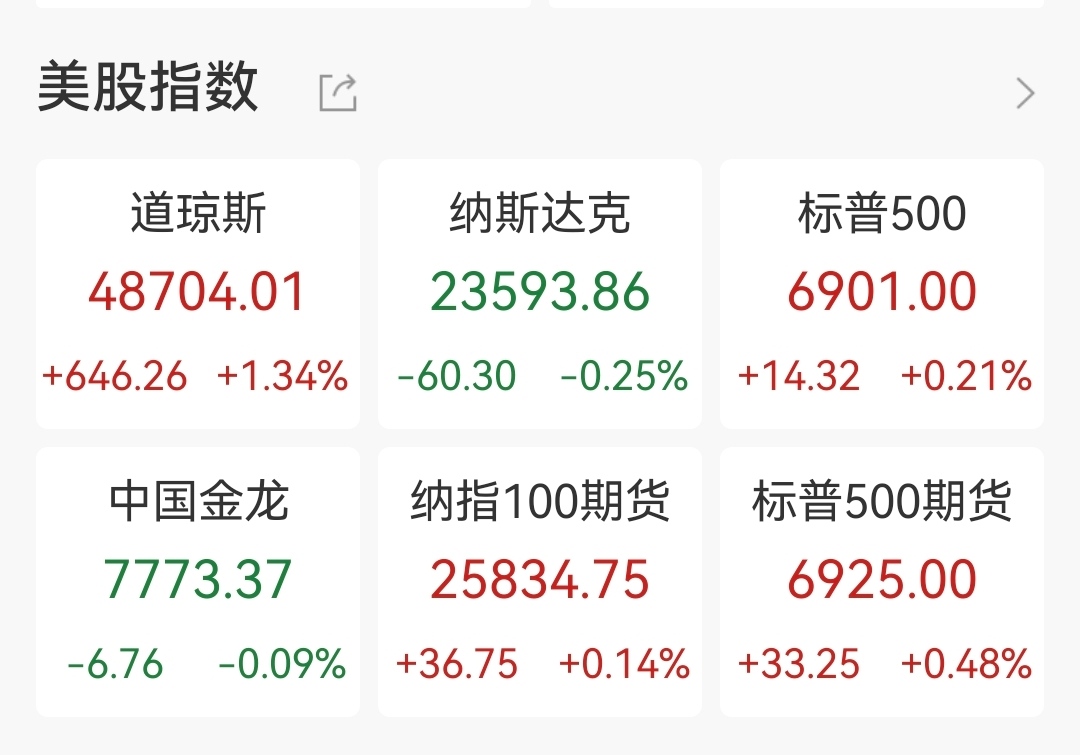
Market Performance - The Dow Jones increased by 646.26 points (+1.34%), while the Nasdaq fell by 60.30 points (-0.25%) and the S&P 500 rose by 14.32 points (+0.21%) [1] - Major tech stocks mostly declined, with the "Big Seven" tech index down 0.71%, and Oracle's stock plummeting over 10% after disappointing cloud revenue and a significant increase in capital expenditure guidance [1] Chinese Stocks - The Nasdaq Golden Dragon China Index decreased by 0.09%, with mixed performances among popular Chinese stocks; notable gainers included Canadian Solar and NIO, while Alibaba and Bilibili saw declines [2] Commodity Market - Gold and silver prices strengthened, with spot gold rising by 1.27% to $4282.49 per ounce and spot silver increasing by 2.82% to $63.543 per ounce, reaching historical highs [2] - Crude oil prices fell, with West Texas Intermediate (WTI) down 0.92% to $57.92 per barrel and Brent crude down 1% to $61.59 per barrel [2] Cryptocurrency Market - Bitcoin rose over 1% to $93,005.06, while Ethereum fell by 1.94% to $3,259.60, with significant liquidation events occurring in the crypto market [3] Economic Indicators - The U.S. labor department reported an increase in initial jobless claims to 236,000, up by 44,000 from the previous week [3] - U.S. trade data showed imports at $342.1 billion and exports at $289.3 billion, resulting in a narrower trade deficit, the lowest since 2020 [3] Federal Reserve Actions - The Federal Reserve lowered the federal funds rate by 25 basis points and announced the resumption of Treasury purchases to enhance market liquidity [3] - Future economic indicators will be crucial in determining the Fed's monetary policy direction, with upcoming employment and consumer price index reports being particularly significant [4] AI Investment Trends - The performance of major tech stocks, particularly in AI, is critical as they contribute significantly to the S&P 500 index [6] - The ongoing debate about AI's potential bubble and Oracle's recent stock performance may impact market sentiment and cryptocurrency valuations [6]

道指涨超600点,甲骨文市值蒸发超4800亿,加密货币近14万人爆仓
21世纪经济报道· 2025-12-11 23:30
Market Overview - On December 11, US stock indices closed mixed, with the Dow Jones rising by 1.34% (over 600 points), the S&P 500 up by 0.21%, and the Nasdaq down by 0.25% [1] - Major tech stocks mostly declined, with the Wande American Technology Seven Giants Index falling by 0.71%, and Oracle's stock dropping over 10%, resulting in a market cap loss of approximately $68.9 billion (about 48.63 billion RMB) [3][4] Oracle's Performance - Oracle's stock price fell sharply, initially dropping by 16% and later closing down by over 10% due to disappointing cloud business revenue and a significant increase in capital expenditure guidance for 2026, raised by $15 billion to $50 billion [3][4] Commodity Market - Gold and silver prices strengthened, with spot gold rising by 1.27% to $4,282.49 per ounce and spot silver up by 2.82% to $63.543 per ounce, reaching historical highs [5] - Crude oil prices declined, with WTI crude oil down by 0.92% to $57.92 per barrel and Brent crude down by 1% to $61.59 per barrel [6][7] Cryptocurrency Market - Bitcoin increased by over 1% to $93,005.06, while Ethereum fell by 1.94% to $3,259.6, with significant liquidation events occurring in the crypto market [7] Economic Indicators - The US Department of Labor reported an increase in initial jobless claims to 236,000, up by 44,000 from the previous week [7] - Recent trade data showed September imports at $342.1 billion and exports at $289.3 billion, leading to a narrower trade deficit, the lowest since 2020 [8] Federal Reserve Actions - The Federal Reserve cut the federal funds rate by 25 basis points and announced the resumption of Treasury purchases to ease market liquidity [8] - Future economic indicators will be crucial in determining the Fed's monetary policy direction, with upcoming employment and CPI reports being particularly significant [10] AI Investment Trends - The performance of major tech stocks, particularly in AI, is critical as they contribute over 50% to the S&P 500 index's gains [11] - The ongoing debate about potential AI market bubbles continues, with Oracle's recent performance expected to have lasting effects on the stock market [11]

宋雪涛:2026中国经济展望,走出价格低谷
Xin Lang Cai Jing· 2025-12-11 15:03
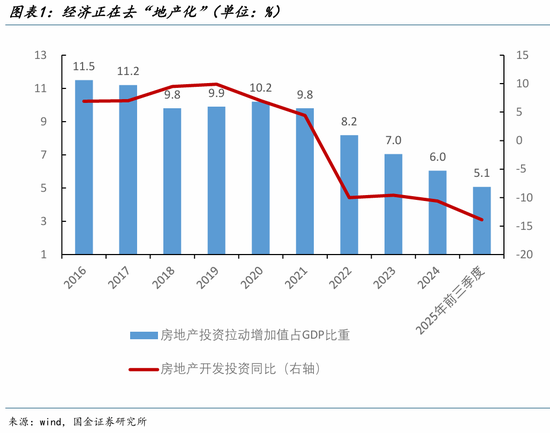
Economic Transformation - The economic transformation during the 14th Five-Year Plan is characterized by a shift from real estate as the main economic driver to the "three new economies" (new industries, new business formats, and new models) becoming the new engine of growth [2][3][4] - The GDP growth rate in Guangdong has been around 4%, significantly lower than the 5.5% growth rates in Jiangsu, Shandong, Zhejiang, and Sichuan, indicating regional disparities in economic transformation [2][3] - The contribution of real estate development to GDP is projected to decline from 10.2% in 2020 to approximately 5.1% by 2025, reflecting a diminishing impact of the real estate sector on the economy [2][3][4] Credit Market and De-leveraging - The credit market is showing a clear trend of de-leveraging from real estate, with new real estate loans decreasing by 330 billion yuan from 2023 to the first three quarters of 2025 [3][4] - The shift towards low-leverage industries indicates a transition in economic drivers, with the financial sector moving away from high-leverage real estate industries [3][4] New Economic Sectors - The "three new economies" are expected to increase their share of China's GDP from 16% in 2020 to 18% by 2024, with high-tech manufacturing growth rates significantly outpacing overall industrial growth [4][6] - Investment in information transmission, software, and IT services is growing at a rate much higher than the overall fixed asset investment growth [4][6] Export Dynamics - The export share of China is expected to continue rising, with the automotive sector, particularly in new energy vehicles, playing a crucial role in this growth [9][10] - Despite trade tensions, China's export share remains stable at 14.2%, with a combined share with Hong Kong rising to 17% [9][10] - China is projected to become the world's largest automobile exporter, surpassing Germany and Japan, with exports expected to reach 586 million vehicles by 2024 [9][10] Regional Price Disparities - Different regions are experiencing varying pressures on price levels, with provinces reliant on traditional industries facing greater deflationary pressures compared to more dynamic regions like Beijing and Shanghai [10][11] - The GDP deflator index in regions like Shanxi and Inner Mongolia is significantly lower than the national average, indicating economic challenges in these areas [10][11] Future Economic Outlook - The economic growth trajectory for 2026 is expected to follow a "V" shape, with initial low growth followed by a recovery, driven by resilient export growth and adjustments in the real estate sector [13][14] - The GDP growth target for 2026 is set at around 5%, aligning with the long-term goal of doubling per capita GDP by 2035 [13][14]
2026中国经济展望:走出价格低谷(国金宏观孙永乐)
雪涛宏观笔记· 2025-12-11 14:29
Core Viewpoint - The article discusses the transformation of the Chinese economy during the 14th Five-Year Plan, highlighting the shift from real estate as the main economic driver to the emergence of the "three new economies" (new industries, new business formats, and new business models) as the new engine of growth [4][7]. Group 1: Economic Transformation - The real estate sector has gradually exited the central stage of the economy, with GDP growth rates in regions heavily tied to real estate, such as Guangdong, lagging behind others like Jiangsu and Zhejiang [4]. - By 2025, the contribution of real estate development investment to GDP is expected to drop significantly from 10.2% in 2020 to around 5.1% [4][30]. - The "three new economies" are projected to increase their share of China's GDP from 16% in 2020 to 18% by 2024, indicating a growing importance of high-tech manufacturing and information technology investments [7]. Group 2: Credit Market and De-leveraging - The credit market is showing a clear trend of de-leveraging from real estate, with new real estate loans decreasing by 330 billion yuan from 2023 to the first three quarters of 2025 [5]. - The shift reflects a broader economic transition where low-leverage sectors are becoming the main drivers of growth, as households work to reduce debt [5]. Group 3: Export Dynamics - Despite trade tensions, China's export share remained stable at 14.2% in the first half of 2025, with significant growth in exports to Africa and the Middle East [13][21][24]. - The automotive sector, particularly in new energy vehicles, has become a key player in boosting China's export performance, with exports projected to reach 586 million units by 2024, surpassing Germany and Japan [13]. Group 4: Real Estate Market Trends - The real estate market is experiencing a second downturn, with housing prices expected to revert to levels seen in 2016, and total sales area projected to decline by nearly 50% from 2020 highs [30][31]. - The overall demand for real estate is stabilizing, with indicators like the price-to-income ratio and rental yields approaching mid-term stability [30]. Group 5: Consumer Behavior and Spending - The impact of real estate on consumer spending is diminishing, as evidenced by rising retail sales growth in first-tier cities despite falling housing prices [36]. - Service consumption is expected to grow, supported by policy measures, while traditional goods consumption faces challenges due to the decline in "old-for-new" subsidies [43][44]. Group 6: Price Trends and Inflation - The article anticipates a gradual recovery in prices driven by economic recovery, with CPI expected to rise to around 0.2% in 2026, influenced by various factors including the stabilization of housing prices [45][55]. - The PPI is projected to show a "front low, back high" trend, with overall PPI expected to be around -1.3% for the year [55].

OEXN:利率中性区间与政策分歧下的市场脉动
Xin Lang Cai Jing· 2025-12-11 09:31
Core Viewpoint - The Federal Reserve's recent 25 basis point rate cut has led to a reassessment of the interest rate path, with a focus on upcoming macroeconomic data, while the market shows little pricing for further rate hikes but has mixed expectations for additional easing [1][4]. Group 1: Interest Rate Decisions - Powell emphasized that the policy rate is now in a neutral range, and future adjustments will depend on data [1][4]. - There is a notable division within the FOMC, with one-quarter of voting members dissenting against the rate cut, highlighting a rare tension between inflation concerns and signs of a cooling labor market [1][4]. - The committee's predictions range from maintaining rates to varying degrees of further cuts, with no consensus on rate hikes as a baseline scenario [2][5]. Group 2: Economic Outlook - The SEP forecasts for growth in 2026 are higher than those for 2025, attributed to fiscal impacts, ongoing AI investment, and sustained consumer momentum [1][4]. - Powell noted that the labor market has shown signs of cooling, with the unemployment rate rising by 0.3 percentage points since summer, and inflation has slightly eased, particularly in services [2][5]. - Structural issues in the housing market, such as long-term supply shortages and high relocation costs due to low mortgage rates locked in during the pandemic, will not be significantly improved by the recent rate cut [2][5]. Group 3: Market Reactions - Gold prices surged during the press conference, rising above $4,238 per ounce, reflecting market sensitivity to the prospect of looser monetary policy and increased demand for safe-haven assets [3][6]. - The meeting underscored the Fed's challenges in balancing growth, inflation, and employment, with future market movements likely to depend heavily on data and subtle policy signals [3][6].
