
股债跷跷板

Search documents
查惠俐:“股债跷跷板”再现,债市后续怎么看?
Sou Hu Cai Jing· 2025-08-30 16:32
Group 1: Market Overview - The recent bond market correction from mid-July to mid-August was primarily driven by sentiment rather than fundamentals, with the ten-year government bond yield surpassing 1.7% [1][4] - Concerns have arisen about a potential negative feedback loop similar to 2022, but the current market dynamics suggest limited long-term impacts on the bond market due to the "stock-bond seesaw" effect [1][5] - The current interest rates are perceived as overshooting, making the bond market more attractive for investment after the recent correction [2][6] Group 2: Economic Indicators - Recent economic data shows a decline in retail sales, fixed asset investment, and industrial output growth, with credit experiencing rare negative growth, indicating weak economic recovery [2][15] - The central bank's monetary policy remains accommodative, with a focus on maintaining liquidity, which supports the bond market [2][17] - The anticipated economic growth for the second half of the year is lower than the first half, with expectations around 4.7% to 4.8% [15] Group 3: Investment Strategies - The ten-year government bond ETF (511260) is highlighted as a suitable investment vehicle due to its low fees and high liquidity, making it an attractive option for bond investors [3][21] - The ETF has shown strong historical performance, with significant returns over various time frames, indicating its reliability as a bond investment [22][24] - Investors are encouraged to consider a balanced asset allocation strategy, combining bonds and equities to mitigate risk while participating in market opportunities [20][21] Group 4: Market Dynamics - The bond market's largest allocation comes from banks, which are less affected by stock market fluctuations, ensuring a stable demand for bonds [7][9] - Despite some trading funds reducing their bond holdings, institutional investors like banks and insurance companies are actively increasing their bond positions during the market correction [9][10] - The "stock-bond seesaw" effect is recognized as a temporary sentiment-driven phenomenon, with historical patterns suggesting that bond pricing will ultimately revert to fundamental economic conditions [6][11]
“股债跷跷板”对债券中长期冲击有限,关注十年国债ETF(511260)
Mei Ri Jing Ji Xin Wen· 2025-08-29 13:07
Group 1 - The recent bond market adjustment is primarily driven by emotional factors and the "stock-bond seesaw" effect, with limited impact on the bond market from stock market fluctuations [1][2] - Historical data indicates that stock market gains are based on expectations of improved policies and economic fundamentals, with some flexible funds shifting from bonds to stocks, but the long-term pricing of stocks and bonds will revert to fundamental logic [2][3] - The main force behind bond allocation is banks, which held over 99 trillion yuan in bonds by the end of July, accounting for more than half of China's total bond market [2][3] Group 2 - The current loan rates do not significantly increase the attractiveness of bonds for banks, meaning there is no substantial crowding out effect on bond investments from loans [3] - Despite some flexible funds withdrawing from the bond market, banks and insurance companies are actively buying bonds, indicating that allocation-type funds are seizing the opportunity presented by the market adjustment [4][5] - Data shows that while some trading-type funds are reducing their duration, banks and insurance companies are increasing their bond duration, suggesting a strategic shift towards bond accumulation during market volatility [4][5] Group 3 - The ten-year government bond ETF (511260) is highlighted as a favorable investment option due to its low fees and ease of trading, with ten-year bonds offering higher coupon rates compared to shorter-duration bonds [5]
利率量化择时系列三:跨资产维度下的利率交易择时策略
ZHESHANG SECURITIES· 2025-08-29 05:07
Core Insights - The report focuses on cross-asset timing strategies for interest rates, systematically backtesting various assets (including stock indices, commodities, and bonds) to identify performance under different market conditions [1]. Group 1: Cross-Asset Rotation Effects - The "stock-bond seesaw" effect arises from shifts in risk appetite, where strong economic expectations lead to capital flowing into equity markets, putting pressure on bond prices and raising yields [2][14]. - The relationship between commodities and bonds is closely tied to inflation expectations, with rising commodity prices typically leading to higher inflation and interest rates, which suppress bond valuations [2][14]. Group 2: Timing Strategies in Commodity and Equity Markets - In equity markets, strategies focused on volatility structures yield higher excess returns compared to trend-based moving average strategies, particularly in high-volatility environments [3]. - For commodities, timing strategies exhibit high odds and low win rates, aligning with the trend-driven nature of commodity trading. Multi-signal strategies outperform in various market conditions due to their adaptability [3][51]. Group 3: Cross-Asset Timing Strategies - The report employs a "cross-validation signal triggering method" for each asset, enhancing the robustness of cross-asset timing strategies. The "look at stocks, trade bonds" and "look at commodities, trade bonds" approaches aim to mitigate drawdowns while maintaining excess returns [4][86]. Group 4: Future Optimization Outlook - A dynamic weighting mechanism is proposed to adjust the importance of different market signals based on macroeconomic conditions, enhancing the adaptability of strategies over time [5]. - The report suggests exploring pair trading strategies in the foreign exchange market to provide additional support for cross-asset trading logic [5].

中金 :中美流动性共振的窗口期
中金点睛· 2025-08-29 00:07
Core Viewpoint - The article discusses the implications of the Federal Reserve's shift towards a dovish stance, indicating a potential interest rate cut in September, which may lead to a temporary easing of dollar liquidity and impact various asset classes positively [2][4][6]. Group 1: Federal Reserve and Inflation Outlook - The Federal Reserve's recent comments suggest a preference for stabilizing growth over controlling inflation, which may reduce recession risks but increase stagflation risks [4]. - Market expectations for a September rate cut have risen to 86%, reflecting investor sentiment towards a more accommodative monetary policy [2]. - The article predicts that inflation in the U.S. may have reached an upward turning point, with an expected upward cycle lasting nearly a year [4][6]. Group 2: Market Reactions and Asset Performance - Historical data indicates that during periods of "inflation rising + growth declining," the dollar typically depreciates, U.S. Treasury yields decline, and gold prices increase, while stock market performance can be mixed [6]. - The article highlights that the current liquidity in the U.S. market is robust, with bank reserves significantly higher than during the 2019 liquidity crisis, which reduces liquidity risks [13][15]. Group 3: China’s Economic Environment - China's fiscal policies have been proactive, enhancing macro liquidity and shifting it towards the stock market, which has improved market sentiment and reduced downside risks for equities [18][21]. - The article notes that the correlation between stocks and bonds in China may turn negative in a low-inflation environment, leading to a "stock-bond seesaw" effect [24]. Group 4: Investment Recommendations - The article recommends overweighting A-shares and Hong Kong stocks, maintaining a standard allocation to U.S. and Chinese bonds, and adjusting U.S. stocks from underweight to standard weight due to improved liquidity conditions [29][42]. - It emphasizes the potential for gold to perform well in a declining interest rate environment, suggesting a continued overweight position in gold [34][40].


【财经分析】弱势行情如何演绎?信用债布局建议关注中短端品种
Xin Hua Cai Jing· 2025-08-28 16:14
Core Viewpoint - The credit bond market is undergoing a significant adjustment, characterized by a "catch-up" decline, with heightened bearish sentiment being released [1][2]. Group 1: Market Trends - The credit bond market has entered a "catch-up" phase, with a notable increase in issuance costs across various credit ratings. For instance, the average coupon rates for AAA and AA+ rated bonds rose to 2.23% and 2.59%, respectively, marking increases of 10 basis points and 13 basis points compared to the previous week [2]. - The liquidity of credit bonds has further declined, with turnover rates decreasing by 0.09 percentage points to 1.64% [2]. - Despite the current bearish sentiment, analysts suggest that the market's configuration demand remains, and there are opportunities to reallocate into credit bonds after the recent declines [1][2]. Group 2: Institutional Behavior - Institutional actions have exacerbated the current market adjustment, with mid-to-long-term pure bond funds experiencing significant net value declines, triggering redemption signals [3]. - While funds have been selling off credit bonds, wealth management and insurance funds have continued to net buy credit bonds, with a total net purchase of 540.15 billion yuan in credit bonds, particularly favoring short-term bonds [3]. Group 3: Future Outlook - Analysts maintain a cautious but not overly pessimistic view on the credit bond market, suggesting that the current downturn is a phase of adjustment rather than a trend reversal [3]. - Recommendations for future investment strategies include focusing on high-yield assets with maturities of two years or less, as these are less affected by the current market adjustments and offer better defensive value [5]. - The market is expected to experience fluctuations due to the "stock-bond seesaw" effect, but there are still opportunities for structural accumulation in the credit bond market [5].
债市大调整!
Sou Hu Cai Jing· 2025-08-28 15:15
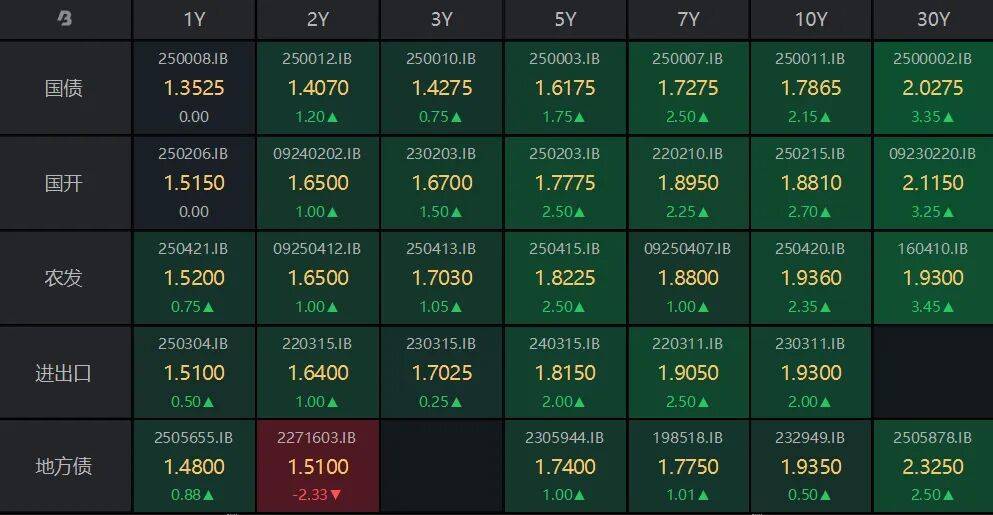
Group 1 - The core viewpoint of the news is that the bond futures market is experiencing a significant decline, influenced by a shift of funds from the bond market to the stock market due to a V-shaped rebound in A-shares and rising inflation expectations driven by domestic policies [1][2][3] - As of August 28, the 30-year main contract fell by 0.72%, the 10-year main contract fell by 0.19%, and the yields on major government bonds increased, with the 10-year government bond yield rising by 2.15 basis points to 1.7865% [1][2] - The bond market adjustment shows that short-term bonds have smaller declines while long-term and ultra-long-term bonds experience larger drops, indicating a close correlation between long bonds and the stock market [3] Group 2 - Analysts suggest that the current bond market adjustment is primarily driven by sentiment and changes in fund flows rather than a deterioration in the fundamentals, with a steepening yield curve indicating concerns over long-term inflation and fiscal pressures [3] - In the context of a strong stock market, the bond market is expected to remain weak in the short term, with potential for repeated bottom testing [3] - Investment strategies recommended include cautious observation for conservative investors, while aggressive investors may consider small positions for bottom-fishing, and combining bond investments with stock market strategies to hedge against potential downturns [4]
【笔记20250828— 股民不寒而栗,债农寒风刺骨】
债券笔记· 2025-08-28 14:36
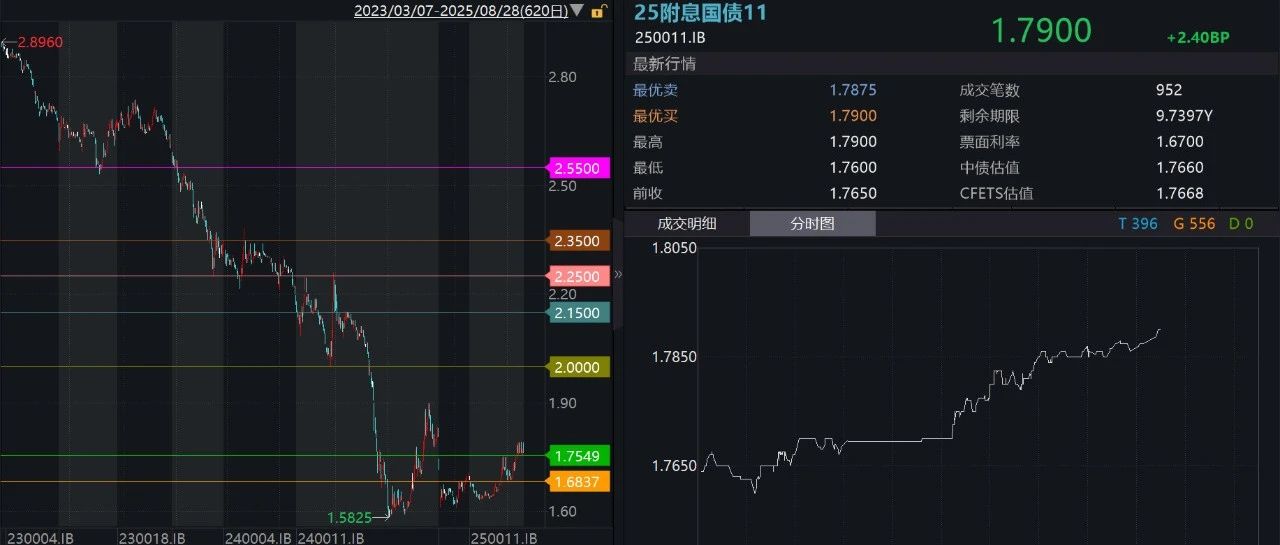
Core Viewpoint - The article discusses the current market dynamics, highlighting the contrasting movements in the stock and bond markets, and the implications of China's potential steel production cuts on these markets [3][5]. Group 1: Market Overview - The stock market experienced a strong rebound in the afternoon after a shaky morning, with the Shanghai Composite Index rising over 1% by the end of the day [6]. - The bond market showed signs of stability, with the 10-year government bond yield fluctuating around 1.764% to 1.790% during the day [5][6]. - The People's Bank of China conducted a net injection of 163.1 billion yuan through reverse repos, indicating a balanced and slightly loose liquidity environment [3][4]. Group 2: Interest Rates and Trading Activity - The weighted average rates for various repos were reported as follows: R001 at 1.36%, R007 at 1.56%, and R014 at 1.56%, with R007 showing a slight increase of 3 basis points [4]. - The trading volume for R001 was approximately 57,361.58 million yuan, reflecting a decrease of 6,995 million yuan, while R007 had a trading volume of 12,517.58 million yuan, increasing by 3,884 million yuan [4]. - The article notes a "see-saw" effect between stocks and bonds, where stock declines are often followed by bond price increases, and vice versa, although this relationship appeared to falter on the day in question [6]. Group 3: Sector-Specific Insights - Reports from foreign media suggest that China is planning to cut steel production, which could have significant implications for related sectors and overall market sentiment [5][6]. - The stock of Hanwha Techwin surged over 15%, indicating strong investor interest and market confidence in specific sectors despite broader market fluctuations [6].
押注存款替代、含权类产品,存款搬家下理财市场能否接住“泼天富贵”
Di Yi Cai Jing· 2025-08-28 12:42
Core Viewpoint - The migration of deposits to wealth management products is increasing, driven by lower deposit rates and the search for higher returns, but the wealth management market faces challenges such as market volatility and declining asset yields [1][2][3]. Group 1: Deposit Migration Trends - In July, household deposits decreased by 1.1 trillion yuan, while non-bank institution deposits increased by 2.14 trillion yuan, indicating a shift of funds from traditional savings to other asset classes [2][3]. - The growth rate of household deposits has been declining for three consecutive months, with July's growth rate at 10.3%, down 0.5 percentage points from June [2][3]. - The gap between household deposit growth and M2 growth has narrowed significantly, suggesting a potential confirmation of the deposit migration trend if it falls into negative territory [2][3]. Group 2: Wealth Management Market Dynamics - The scale of bank wealth management products is expected to grow significantly, with estimates suggesting an increase of approximately 2 trillion yuan by July 2025, reaching 32.67 trillion yuan [3][6]. - The average performance benchmark for open-ended wealth management products is 2.27%, while closed-end products average 2.51%, both showing slight declines [5]. - The current market is experiencing an "asset shortage," with declining yields on underlying assets, leading to challenges in meeting investor demand for higher returns [5][6]. Group 3: Product Trends and Investor Behavior - There is a notable shift towards low-volatility and stable short-term fixed-income products as investors seek alternatives to traditional deposits [6][7]. - The popularity of rights-embedded products is increasing, driven by the recent strong performance of the A-share market and the growing demand for enhanced returns [7]. - Cash management products are experiencing negative growth, while open-ended fixed-income products remain the main growth driver due to their liquidity advantages [7].
国债期货日报:反弹中断-20250828
Nan Hua Qi Huo· 2025-08-28 10:23
国债期货日报 2025年8月28日 反弹中断 观点:反复探底 南华研究院 徐晨曦(Z0001908) 投资咨询业务资格:证监许可【2011】1290号 盘面点评: 周四期债早盘走弱,午后跌幅加剧,品种全线收跌。现券收益率全线上行,长端上行幅度较大。公开市场净 投放1631亿。资金面宽松,DR001保持在1.31%附近。 日内消息: 1.上海发布《关于加快推进本市城中村改造工作的实施意见》。 行情研判: 今日A股午后一度下探,但此后大幅上扬,将昨日跌幅收复大半,尽显强势,导致债市再度大幅走弱。前期有 部分资金选择做多国债期货对冲股市波动风险,这些资金的出逃可能亦是导致期债下跌的原因之一。目前债 市尚不能完全摆脱股债跷跷板的影响,可能需要反复探底。但近两日大盘波动超百点亦表明股市高位后风险 加剧,债市不必过度悲观。操作思路上,反弹有利即可出场,可小仓保留部分低位多单,空仓者可关注前期 低点。 国债期货日度数据 source: wind,南华研究 元 TS基差:主连 TS IRR:主连(右轴) % 02/28 04/30 06/30 -0.5 -0.25 0.25 -1 0 1 2 3 长债与超长债利率走势 sou ...

长城基金吴冰燕:债市短期或反复震荡,不必过度悲观
Xin Lang Ji Jin· 2025-08-28 08:07
近期股市持续走高,沪指站上3800点再创10年新高,与股市一路走强形成鲜明对比的是,债市却同步经 历显著调整。那么,近期债市回调的原因是什么?后市会如何走?投资者该如何应对?一起来看长城基 金固定收益研究部副总经理吴冰燕的分析。 近期债市经历大幅回调,主要原因有哪些? 吴冰燕:主要因素在于"股债跷跷板"和风险偏好抬升。四月初中美关税冲击以来,股票市场稳定修复, 呈现"高收益,低波动"的反常表现,其风险收益比明显高于债券,造成资金分流。同时,商品市场同步 上涨也进一步压制了债市情绪。另一方面,债券收益率去年12月一定程度上以大斜率超速下行,今年债 市整体呈"N"型走势,即使有关税冲击等突发利好,10Y国债收益率也未曾突破1月初低点,总体上其实 是在对去年底透支的下行空间进行修复,利率中枢在降准降息等重大利好出台之前难创新低。因此,债 券与股票、商品资产的不同表现带来一定的资产配置转移倾向。此外,虽然部分经济指标还有待改善, 但政治局会议明确"反内卷"决心,需求端政策陆续推出,引发市场对于供需矛盾改善的预期,也提振了 市场风险偏好。 吴冰燕:目前债券市场虽暂时受到压制,但经济数据显示宏观经济运行周期仍在市场预期内 ...