
美联储利率政策

Search documents
深观察丨“关税绝非解决美国问题的万灵药”
Sou Hu Cai Jing· 2025-07-03 07:09
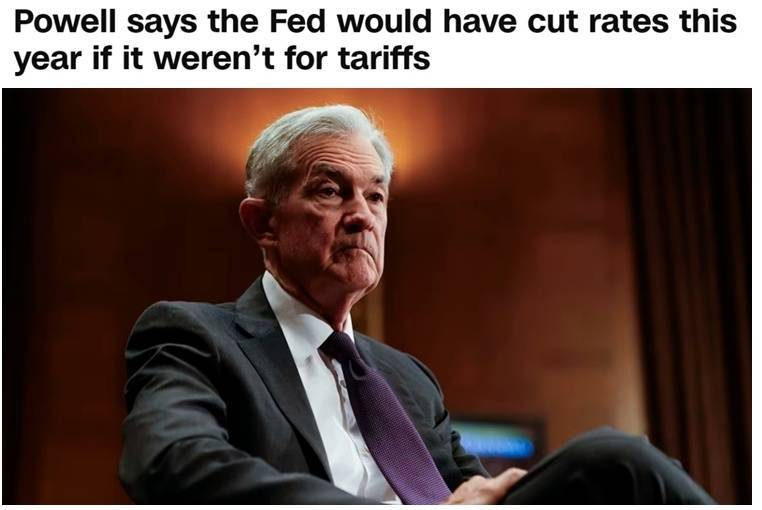
Core Viewpoint - The Federal Reserve's decision to maintain interest rates is influenced by President Trump's tariff policies, which have created significant economic uncertainty and impacted inflation forecasts [1][4][6]. Group 1: Federal Reserve's Position - Federal Reserve Chairman Jerome Powell stated that the central bank has refrained from cutting interest rates this year primarily due to the uncertainties brought about by the government's changing tariff agenda [4][5]. - Powell emphasized that the Fed's approach is data-driven rather than politically motivated, receiving support from other central bank leaders, including European Central Bank President Christine Lagarde [4][6]. - The Fed's decision to keep rates unchanged has occurred four times since the beginning of the year, despite increasing pressure from the White House for rapid rate cuts [4][5]. Group 2: Economic Impact of Tariffs - The ongoing trade tensions and tariffs have led to a reduction in the total inventory of goods in the U.S., with companies experiencing price increases of approximately 8% to 15% on many products [8]. - Consumer confidence in the U.S. has declined, with the Consumer Confidence Index (CCI) dropping to 93, the lowest level since the onset of the COVID-19 pandemic, primarily due to concerns over tariffs and their impact on personal finances [9]. - The unpredictability of the current administration's policies has cast a shadow over the economic and employment outlook, raising fears of a potential recession [9]. Group 3: Manufacturing Sector Concerns - Experts warn that tariffs are not a panacea for U.S. economic issues, as the return of manufacturing jobs will require significant time and investment, which is hindered by the unstable economic environment [12]. - Even if manufacturing were to return to the U.S., it may not lead to an increase in jobs due to higher operational costs and a shift towards automation to offset tariff impacts [13]. - Historical data indicates that during Trump's previous term, while manufacturing jobs increased by 0.4%, this was offset by rising costs and job losses due to retaliatory tariffs, suggesting that significant job growth in manufacturing is unlikely in the foreseeable future [13][14].

机构:预计关税推高通胀之后美元有望暂获喘息
news flash· 2025-07-02 20:17
Core Viewpoint - The dollar is expected to strengthen over the next few months due to tariffs driving inflation and delaying interest rate cuts by the Federal Reserve [1] Group 1: Economic Impact - Tariffs are anticipated to accelerate consumer price increases starting in August, which will limit the Federal Reserve's ability to cut interest rates [1] - The strategist predicts that the euro to dollar exchange rate will temporarily fall to the range of 1.13-1.15, while the yen to dollar exchange rate will decline to 145-150, indicating a drop of approximately 4% for both currencies [1] Group 2: Federal Reserve Outlook - The Federal Reserve is expected to maintain interest rates until December, with a potential slight adjustment for the dollar at that time [1]
7月1日电,随着鲍威尔重申美联储将对利率保持耐心,美国国债收益率小幅回吐涨幅。
news flash· 2025-07-01 13:47
智通财经7月1日电,随着鲍威尔重申美联储将对利率保持耐心,美国国债收益率小幅回吐涨幅。 ...
综合晨报-20250701
Guo Tou Qi Huo· 2025-07-01 06:41
国投期货研究院 (责金属) 隔夜贵金属小幅反弹。近期随着伊以停火市场风险偏好向好,金价回吐战争溢价,市场关注点将转 向关税谈判和美联储。特朗普对关税延期不置可否,鲍威尔认为利率的变化仍取决于经济走向,关 注本周一系列重要数据验证,今晚将公布美国ISM制造业PMI和JOLTs职位空缺数。 【铜】 隔夜铜价收复盘中跌幅,美元指数因财政法案与7月降息概率延续弱势,同时,加拿大取消数字关 税,美股再创历史新高。沪铜夜盘阳线,昨日现铜79990元,上海铜升水130元,精废价差扩至2100 元以上,SMM社库12.61万吨。技术上,短线沪铜涨势可能打开到8.1万。中长期趋势交易仍建议关 注高位空配。 【铝】 隔夜沪铝震荡。周初铝锭铝棒社库较上周四小幅增加,华东现货升水继续下降30元至70元,华南铝 棒加工费跌至负值,终端消费前置和淡季负反馈初步显现。近期宏观风险偏好向好推动有色强势, 沪铝指数持仓处于近年高位显示市场分歧大, 警惕阶段性回调风险。 gtaxinstitute@essence.com.cn 综合晨报 2025年07月01日 (原油) 隔夜国际油价延续震荡偏弱走势,布伦特09合约涨0.44%。伊以冲突降温后原 ...
六月收官,七月牛市?比特币短线飙升在即!以太坊三次冲高2500!LEVER收益2034%!抓金狗,提前布局稳赚十倍!
Sou Hu Cai Jing· 2025-07-01 04:00
Group 1: Federal Reserve Policy - The market is focused on the Federal Reserve's interest rate policy, with officials indicating a cautious approach to potential rate cuts in July, with a probability of less than 20% [1] - Most expectations lean towards a rate cut in September or later, with a slight probability of over 50% for a September cut [1] - Labor market shows signs of slowing but remains strong, supporting the Fed's wait-and-see approach [1] Group 2: Cryptocurrency Market - Grayscale's ETH sell-off has been accounted for, but buying power remains, indicating a net inflow, although the amount is low, reflecting limited interest from traditional investors [4] - ETH has outperformed BTC in terms of net inflow, with ETH's inflow increasing by 8 times compared to BTC's 2 times [4] - BTC has not experienced large-scale liquidations recently, suggesting a potential for 20% volatility, typically indicating a trend [5] - BTC closed above 107,000, with a short-term upward wedge pattern indicating potential support [5] - ETH's holdings by U.S. ETF investors have surpassed 4 million, marking a historical high [6] Group 3: Market Sentiment and Strategy - The current market sentiment shows a divergence, with skepticism towards BTC's future while maintaining optimism for altcoins [8] - Strategies suggest a dual approach of long and short positions, especially in a volatile market [9] - Recent projects in the primary market have shown promising performance, contrasting with the sluggish secondary market [9]

【真灼港股名家】以伊战火解除 美元重新步入下跌浪
Sou Hu Cai Jing· 2025-06-26 01:25
Group 1 - The core viewpoint of the articles revolves around the recent ceasefire agreement between Israel and Iran, which has alleviated tensions in the Middle East and led to a significant drop in oil prices, benefiting global inflation control efforts [2] - Following the ceasefire, oil prices fell nearly 3%, after a previous drop of nearly 9%, bringing U.S. crude futures close to their lowest point before the Israeli attacks on Iran [2] - The U.S. dollar weakened due to the easing geopolitical tensions, with notable declines against the Japanese yen and British pound, as investors shifted their focus to the upcoming congressional testimony of Federal Reserve Chairman Jerome Powell [2] Group 2 - In the context of uncertain interest rate outlooks, the U.S. dollar index fell from 99.40 to below 98, indicating a potential downward trend if it breaches the 97.60 level [3] - The Federal Reserve has not taken action on interest rates this year, influenced by inflation from Trump's tariff policies, but there are emerging divisions within the Fed regarding potential rate cuts, with some officials leaning towards a reduction in July [2] - Powell is expected to face questions regarding the Fed's decision to maintain interest rates and its future borrowing cost outlook, especially after Trump's call for a significant rate cut [2]

别为中东停火高兴太早!下一个引爆市场的“靴子”又将落下
Sou Hu Cai Jing· 2025-06-25 10:26
有三大主要原因可能让关税问题重新咆哮着回到投资者的视野中。 第一便是地缘政治近期盖过了贸易战的风头。近几周的以色列-伊朗冲突占据了投资者的大量注意力, 但该事件的风险似乎正在减弱。就波动性而言,下一只落地的靴子很可能就是特朗普贸易战的"新篇 章"。 其次,关税对通胀的影响可能存在滞后性。经济学家警告说,近几个月显示通胀降温的数据可能不会持 久。摩根士丹利表示,这是因为关税对价格的影响可能需要一段时间才能显现,并补充说,他们认为通 胀可能在今年夏末有所回升。美联储主席鲍威尔也表示,在6月、7月和8月将会看到关税对通胀产生显 著影响。 最后,美联储的政策可能因关税的滞后影响而变得复杂。市场,以及特朗普本人一直在呼吁美联储降低 利率,但如果通胀抬头,那将成为美联储和鲍威尔维持利率不变的又一个理由。 近期,关于关税的大部分焦点都集中在美联储维持利率不变的决定上,而特朗普对此一直持高度批评态 度。 摩根士丹利发出警告:注意7月9日!届时一场新的风暴将重新席卷全球市场…… 尽管市场因周二以色列与伊朗达成停火而松了一口气,但投资者很快就要重新思量另一个曾在今年早些 时候引爆市场波动的问题。 摩根士丹利在近期发表的一份报告中 ...


威尔鑫点金·׀ 避险需求退潮致金价美元同跌 特朗普能否摁住通胀?
Sou Hu Cai Jing· 2025-06-25 08:57
Group 1 - The core viewpoint of the article highlights the simultaneous decline of gold and the US dollar due to a decrease in safe-haven demand, influenced by geopolitical events and market reactions to statements from President Trump and Federal Reserve Chairman Powell [1][5][12] - On Tuesday, the international spot gold price opened at $3368.34, reaching a high of $3370.56 and a low of $3295.29, closing at $3323.74, down $44.45 or 1.32% [1] - The US dollar index opened at 98.38 points, with a high of 98.40 and a low of 97.69, closing at 97.96, down 420 points or 0.43% [3] Group 2 - The Wellxin precious metals index opened at 6747.72 points, with a high of 6776.92 and a low of 6604.47, closing at 6703.65, down 46.85 points or 0.69% [4] - The article notes that the market's reaction to the Israel-Iran conflict and subsequent ceasefire has led to a significant drop in gold prices, suggesting an overreaction in market sentiment [5][12] - Trump's comments on oil prices and the Federal Reserve's monetary policy have had a notable impact on market dynamics, with Powell's statements influencing expectations around interest rate changes [12][19] Group 3 - The article discusses the unusual market behavior where both the dollar and commodity prices, including oil, are declining simultaneously, which is typically rare and indicates a potential economic downturn [5][17] - The relationship between the dollar and commodity markets is analyzed, suggesting that if the dollar enters a macro depreciation trend, commodity prices may not follow the same downward trajectory [16][19] - The article concludes that the current economic environment does not show clear signs of a financial crisis, and the macro bullish structure of commodity markets remains intact despite recent fluctuations [19]

商品市场:上周整体涨2.29%,多板块走势分化
Sou Hu Cai Jing· 2025-06-23 22:12
Group 1: Overall Market Performance - The commodity market saw an overall increase of 2.29% last week, with significant gains in the energy sector at 4.11% [1] - Agricultural products and black metals rose by 2.10% and 0.91% respectively, while precious metals and non-ferrous metals experienced declines of 1.76% and 0.09% [1] Group 2: Specific Commodity Movements - Crude oil, methanol, and short fibers had the highest closing price increases at 8.82%, 5.86%, and 5.31% respectively [1] - Precious metals like gold, pulp, and silver saw notable declines of 1.99%, 1.50%, and 1.44% respectively [1] Group 3: Market Outlook and Influencing Factors - The evolving situation in the Middle East, particularly the U.S. attack on Iranian nuclear facilities, is expected to influence short-term asset pricing and market direction [1] - There are expectations of Iranian responses that could impact energy prices, with a focus on monitoring implied volatility in energy markets and offshore dollar liquidity [1] Group 4: Precious Metals and Investment Trends - International gold prices are stabilizing at high levels, supported by dovish signals from Federal Reserve officials and rising expectations for interest rate cuts [1] - Geopolitical tensions and ongoing global central bank gold purchases continue to provide support for gold prices, while silver is affected by fluctuations in manufacturing data [1] Group 5: Non-Ferrous Metals and Market Dynamics - The non-ferrous metals sector is experiencing narrow fluctuations, with copper prices stabilizing due to tight overseas inventories and ongoing global investment in new energy [1] - Aluminum prices are supported near the cost line for electrolytic aluminum, with market attention on electricity costs and inventory depletion [1] Group 6: Black Metals and Policy Impacts - Steel futures are rebounding, driven by expectations of "stabilizing growth" policies and production restrictions in Tangshan [1] - Iron ore prices are influenced by seasonal rainfall in Brazil, leading to decreased port inventories and price stabilization alongside steel [1] Group 7: Energy Sector Developments - Crude oil futures have surged significantly due to geopolitical tensions in the Middle East and unexpected declines in U.S. oil inventories [1] - OPEC+ production cuts are being effectively implemented, with positive expectations for summer oil demand driving prices higher [1] Group 8: Chemical and Agricultural Products - The chemical sector is generally strong, buoyed by rising energy prices, with methanol, PTA, and fuel oil seeing price increases [1] - Agricultural products show a mixed performance, with oilseeds and oils experiencing strength due to domestic production cuts and policy support, while corn faces pressure from import competition [1]
大宗商品周度报告:流动性和需求均承压,商品短期或震荡偏弱运行-20250623
Guo Tou Qi Huo· 2025-06-23 14:02
1. Report Industry Investment Rating No relevant content provided. 2. Core Viewpoints of the Report - The commodity market may fluctuate weakly in the short - term due to pressure on liquidity and demand [1]. - The evolution of the Israel - Iran situation is crucial, determining the short - term direction and pricing logic of major asset classes. There is uncertainty in the short - term, and the subsequent counter - attack strength of Iran needs to be observed [1]. - Risk appetite is under short - term pressure, but the impact is limited with a stable RMB. The implied volatility of energy and the stability of offshore US dollar liquidity should be continuously tracked [1]. 3. Summary by Related Catalogs 3.1 Market Performance Review - The overall commodity market rose 2.29% last week. The energy and chemical sector had a relatively large increase of 4.11%, while the agricultural products and black sectors rose 2.10% and 0.91% respectively. The precious metals and non - ferrous metals sectors fell 1.76% and 0.09% respectively [1][5]. - Among specific varieties, crude oil, methanol, and short - fiber led the gains with increases of 8.82%, 5.86%, and 5.31% respectively. Gold, pulp, and silver were the top decliners with drops of 1.99%, 1.50%, and 1.44% respectively [1][5]. - The funds in the market decreased, mainly affected by the outflow of funds from precious metals [1][5]. 3.2 Market Outlook by Sector Precious Metals - International gold prices consolidated at high levels due to dovish signals from Fed officials, increased market expectations of interest rate cuts this year, a decline in the US dollar index, and continued gold purchases by global central banks. Silver showed a relatively differentiated performance, fluctuating within a range affected by manufacturing data [2]. Non - Ferrous Metals - The non - ferrous metals sector fluctuated narrowly. Copper prices consolidated at high levels, supported by tight overseas inventories and continued global new energy investment, but the upward momentum slowed due to the Fed's interest rate policy and weak high - level consumption. Aluminum prices found support near the electrolytic aluminum cost line, and the market focused on power costs and inventory destocking [2]. Black Metals - Steel futures continued to rebound, driven by increased expectations of "stable growth" policies and the fermentation of Tangshan production restriction news. Iron ore prices stabilized following steel as port inventories decreased due to the Brazilian rainy season. The fifth round of coke price increases was implemented, and coking coal was more willing to follow the price increase, maintaining the resilience of the black metal industry chain, but the recovery of terminal demand still requires policy support [2]. Energy - Crude oil futures rose significantly due to the escalating geopolitical tensions in the Middle East and the unexpected decline in US crude oil inventories. OPEC+ implemented production cuts well, and the market had positive expectations for the summer oil - using peak season, keeping oil prices strong in the short - term and driving the联动上涨 of fuel oil, asphalt and other varieties [3]. Chemicals - Driven by rising energy prices, the chemical sector generally strengthened. Some varieties such as methanol, PTA, and fuel oil made up for lost ground, and the inventory destocking speed accelerated due to some device overhauls and cost increases. Weak varieties such as PVC and ethylene glycol got short - term support, but the substantial recovery of the downstream has not been clear, and the market is more trading - driven [3]. Agricultural Products - The oil and oilseed sector fluctuated strongly. Although US soybean export data was weak, domestic rapeseed varieties rose supported by domestic production cuts and policy expectations, with rapeseed meal and rapeseed oil leading the gains. Corn prices were under pressure due to import substitution and declining deep - processing profitability. Pig prices fluctuated and corrected due to the off - season consumption and the pressure of slaughter, and industry confidence was still insufficient [3]. 3.3 Commodity - Related Fund Situation - Most gold ETFs had negative weekly returns, with the overall gold ETF having a - 1.86% to - 1.95% decline, and the total scale decreased by 1.06%. The trading volume of gold ETFs decreased significantly [42]. - The energy - chemical futures ETF had a positive weekly return of 5.34%, and its scale increased by 2.07%, but the trading volume decreased by 78.24% [42]. - The soybean meal futures ETF had a weekly return of 0.73%, and its scale increased slightly by 0.17%, with a small decrease in trading volume [42]. - The non - ferrous metal futures ETF had a weekly return of - 0.20%, and its scale increased by 1.19%, with a 23.67% decrease in trading volume [42]. - The silver futures (LOF) had a weekly return of - 0.99%, and its trading volume increased by 64.13% while the scale remained unchanged [42].