智能驾驶

Search documents
央行:继续实施好适度宽松的货币政策;葛卫东10亿元认购江淮汽车定增股票……盘前重要消息一览
证券时报· 2026-02-11 00:20
Group 1 - The People's Bank of China (PBOC) released the "2025 Q4 China Monetary Policy Implementation Report," emphasizing the continuation of a moderately loose monetary policy to support economic governance and the "14th Five-Year Plan" [5][6] - The report highlights the importance of counter-cyclical and cross-cyclical adjustments to enhance macroeconomic governance effectiveness [5] - The report aims to integrate incremental and stock policy effects to achieve a good start for the "14th Five-Year Plan" [5] Group 2 - Five departments issued the "Implementation Opinions on Strengthening the Capacity Building of the Information and Communication Industry to Support Low-altitude Infrastructure Development," focusing on the collaborative development of information infrastructure and low-altitude applications [6] - The plan includes achieving a ground mobile communication network coverage rate of no less than 90% for low-altitude public air routes by 2027, along with the development of at least 10 standards for information infrastructure [6] - The initiative aims to enhance low-altitude navigation service levels and create typical low-altitude application scenarios in urban governance, logistics, and cultural tourism [6] Group 3 - Data shows that from the stock registration date of December 1, 2025, to February 9, 2026, approximately 270 A-share listed companies implemented cash dividends totaling over 370 billion yuan, a year-on-year increase of about 9.6% [8] - The "15th Five-Year Plan" for Zhejiang Province aims to cultivate trillion-level industrial clusters, focusing on core industries like embodied intelligence and smart driving, with a target of achieving 1.2 trillion yuan in revenue from the core AI industry by 2030 [8]






20cm速递|科技+顺周期主线价值凸显,科创创业ETF国泰(588360)盘中涨超1%
Mei Ri Jing Ji Xin Wen· 2026-02-10 17:30
Group 1 - The core viewpoint emphasizes that the combination of technology and cyclical sectors remains a key investment theme, with expectations of PPI turning positive driving EPS growth and liquidity support [1] - The article highlights the importance of focusing on stable growth in end-user sectors and the commercialization of ToB applications, particularly in areas such as computing hardware, energy storage, AI applications, and intelligent driving [1] - The Guotai Science and Innovation ETF (588360) tracks the Science and Innovation 50 Index (931643), which includes 50 large-cap emerging industry companies from the Sci-Tech and ChiNext boards, reflecting the overall performance of representative emerging industries [1] Group 2 - The index focuses on industries such as electronics, power equipment, communications, and biomedicine, emphasizing technological attributes and innovative growth, with a relatively balanced industry allocation [1] - The cyclical sectors are expected to show significant price and valuation elasticity during the phase of PPI turning positive, with reduced competition potentially leading to improved performance in sectors like non-ferrous metals, chemicals, machinery, steel, and building materials [1]

两只港股新股上市!“钓鱼佬”撑起一家IPO,大涨超100%
证券时报· 2026-02-10 15:48
Core Viewpoint - The article discusses the contrasting performances of two newly listed stocks on the Hong Kong Stock Exchange: Lexin Outdoor and Aixin Yuan Zhi, highlighting Lexin's significant price increase on its debut and Aixin's flat closing price [1][12]. Group 1: Lexin Outdoor - Lexin Outdoor's stock surged by 102.29% on its first trading day, closing at HKD 24.78 [1][2]. - The company is positioned as the global leader in the fishing equipment industry, with a market share of 23.1% projected for 2024 [5]. - Lexin's revenue model heavily relies on OEM/ODM, accounting for 94.1% of its total revenue in 2022, and is expected to remain above 90% through 2025 [5][6]. - The company reported a revenue of CNY 818.41 million in 2022, which is projected to decline to CNY 573.46 million in 2024, with a slight recovery to CNY 460.27 million in the first eight months of 2025 [7]. - Despite a peak profit of CNY 113.85 million in 2022, profits are expected to drop to CNY 59.41 million in 2024 and CNY 56.24 million in the first eight months of 2025 [7][6]. - Lexin Outdoor's IPO was oversubscribed by 3,654.23 times in the public offering, raising approximately HKD 346 million [8][9]. Group 2: Aixin Yuan Zhi - Aixin Yuan Zhi, the first edge computing AI chip company listed on the Hong Kong Stock Exchange, had a lackluster debut, closing at its issue price with a market capitalization of HKD 16.6 billion [12]. - The company raised approximately HKD 2.959 billion through its IPO, with a subscription rate of 104.82 times in the public offering and 6.8 times in the international offering [12][13]. - Aixin Yuan Zhi has seen rapid revenue growth, from CNY 50 million in 2022 to CNY 473 million in 2024, with a compound annual growth rate of 206.8% [14][15]. - Despite revenue growth, the company reported significant losses, with losses of approximately CNY 6.12 billion in 2022 and projected losses of CNY 8.56 billion in the first nine months of 2025 [15]. - The company has invested heavily in R&D, with expenditures of CNY 4.46 billion in 2022 and expected to reach CNY 5.89 billion in 2024 [15]. - Aixin Yuan Zhi has developed a flagship chip for high-level intelligent driving applications, marking a significant advancement in its automotive business [18].

雷军宣布初代小米SU7正式停产:最后一辆正在运送途中
Sou Hu Cai Jing· 2026-02-10 14:22
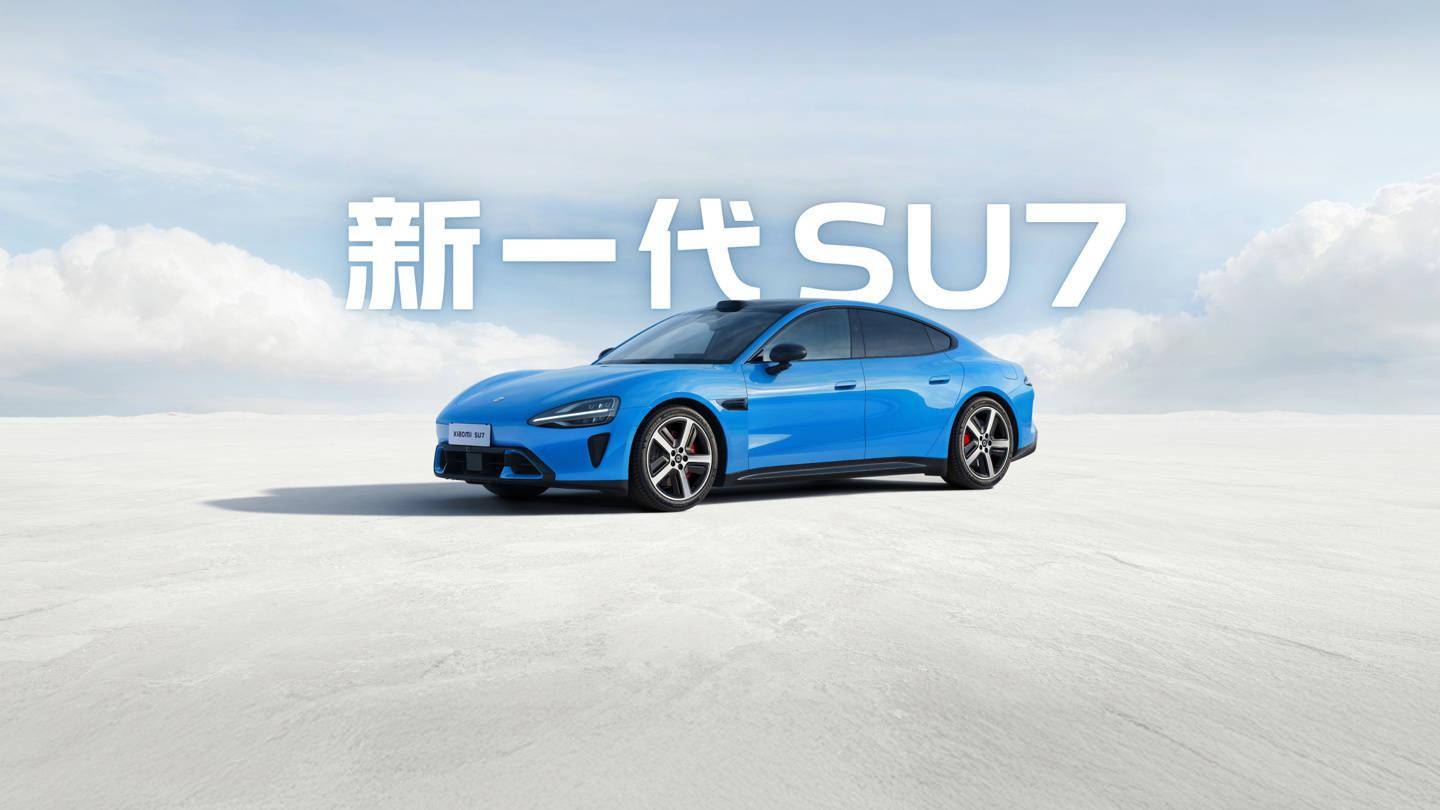
Core Insights - Xiaomi's founder and CEO Lei Jun announced the completion of the production of the last initial generation Xiaomi SU7, which has reached nearly 370,000 units produced, and the production line is being upgraded for the new generation SU7 [1][2] Group 1: New Generation SU7 Launch - The new generation SU7 was opened for pre-orders on January 7, with three versions priced at 229,900 yuan for the standard version, 259,900 yuan for the Pro version, and 309,900 yuan for the Max version [1] - Compared to the previous model, the standard and Pro versions have seen a price increase of 14,000 yuan, while the Max version's price has increased by 10,000 yuan [1] Group 2: Technical Specifications - The new generation SU7 features the V6s Plus super motor, replacing the previous V6 and V6s motors [2] - Power specifications have improved, with the standard and Pro versions' maximum power increased from 220 kW (299 horsepower) to 235 kW (320 horsepower), and the Max version's total power increased from 495 kW (673 horsepower) to 507 kW (690 horsepower) [2] - All models are now equipped with laser radar and a driving assistance chip with a computing power of 700 TOPS, which is approximately a 38% increase from the previous maximum of 508 TOPS [2] - The new generation SU7 will upgrade to the Xiaomi HAD driving assistance system, enhancing the overall intelligent driving experience [2]

承泰科技港股IPO获备案,毫米波雷达龙头冲刺资本市场
Sou Hu Cai Jing· 2026-02-10 11:06
Core Viewpoint - Chengtai Technology has received approval from the China Securities Regulatory Commission for its Hong Kong IPO and "full circulation" of unlisted shares, marking a significant step in its listing process after previous delays [2] Company Overview - Chengtai Technology plans to issue up to 38.33 million overseas listed ordinary shares and convert a total of 300 million unlisted shares held by 29 shareholders into overseas listed shares [2] - The company specializes in the field of millimeter-wave radar, focusing on automotive applications, including forward millimeter-wave radar and 4D high-resolution radar, which are widely used in Advanced Driver Assistance Systems (ADAS) for passenger and commercial vehicles [2][4] - Chengtai Technology is the largest domestic supplier of automotive forward millimeter-wave radar in China, holding a market share of 9.3%, and ranks third in the overall automotive millimeter-wave radar market with a share of 4.5% [2] Financial Performance - The company's revenue for the years 2022 to 2024 is projected to be 57 million, 157 million, and 348 million yuan respectively, with losses of 79 million, 97 million, and 22 million yuan during the same period [3] - In the first half of 2025, the company reported a revenue of 539 million yuan, indicating rapid growth despite not yet achieving profitability [3] Shareholding Structure - The controlling shareholder, Chen Chengwen, holds 15.48% of the shares, making him the largest individual shareholder among the top ten [3] - Other significant shareholders include Cai Youliang and Zhou Ke, holding 5.3% and 4.98% respectively, along with various investment firms [3] Technological Capabilities - Chengtai Technology has mastered a complete know-how in millimeter-wave radar materials, processes, structures, antennas, RF, algorithms, testing/calibration, automation production, and functional applications [3] - The company has successfully integrated its systems with visual and domain controllers, enhancing its technological capabilities [3] Market Outlook - The automotive millimeter-wave radar market is expected to grow rapidly with the increasing adoption of intelligent driving technologies, projected to reach a market size of 63 billion yuan by 2029 [4] - Chengtai Technology is well-positioned to benefit from ongoing technological advancements and sustained market demand in the millimeter-wave radar sector [4]
德赛西威(002920.SZ):有相关智能驾驶域控产品可向无人物流公司供货
Ge Long Hui A P P· 2026-02-10 10:24
Core Viewpoint - Desay SV Automotive has launched its Chuanxing Zhiyuan S6 series of low-speed unmanned vehicles, which have garnered significant attention and received customer orders [1] Group 1: Product Launch - The Chuanxing Zhiyuan S6 series of low-speed unmanned vehicles has been released [1] - The product launch has attracted widespread attention from the market [1] - The company has received related customer orders for the new vehicle series [1] Group 2: Supply Capabilities - Desay SV Automotive has intelligent driving domain control products available for supply to unmanned logistics companies [1]
深度梳理!均胜电子的投资版图:智驾+机器人双线发力
Feng Huang Wang Cai Jing· 2026-02-10 09:56
Core Viewpoint - The listing of Aisin Yuan Zhi, a leading AI chip company in Hong Kong, highlights the strategic investments of Junsheng Electronics in the smart automotive and robotics sectors, aiming to strengthen its industry position through diversified investments and acquisitions [1][8]. Investment in Core Sectors: Focus on Smart Driving and Chips - Junsheng Electronics emphasizes smart driving as a primary focus, with chips being crucial for intelligent driving systems, creating a comprehensive ecosystem from perception to decision-making [2]. - Aisin Yuan Zhi is a global leader in AI inference system chips, enhancing Junsheng's AI perception and computing capabilities through its proprietary NPU technology [2]. - Junsheng has increased its stake in New Chip Hangtu, a company specializing in autonomous driving chip design, which has developed a high-performance chip for urban NOA, positioning Junsheng in the high-end vehicle market [2]. - The collaboration with Hezhima Smart, a domestic leader in intelligent driving chips, has led to the mass production of integrated cockpit solutions, enhancing Junsheng's domestic chip ecosystem [3]. - Tuda Technology, a provider of long-range lidar solutions, has delivered over 600,000 units, supporting advanced autonomous driving and robotics applications, thus enhancing Junsheng's perception capabilities [3]. - Ouyue Semiconductor focuses on the third-generation E/E architecture for smart vehicles, significantly reducing development costs and time for Junsheng's new products [3]. Investment in Emerging Fields: Focus on Embodied Intelligent Robots - Junsheng Electronics is strategically investing in embodied intelligent robots, leveraging its existing automotive technology to gain a competitive edge in this sector [4]. - The company is also exploring onboard optical module communication, aligning with trends in high-level smart driving and vehicle networking, with plans to develop a 1.6T silicon photonic chip for automotive applications by 2026 [4]. Expanding Investment Boundaries through Industry Funds - Junsheng is participating in the establishment of industry funds to integrate resources and broaden its investment scope, achieving a win-win through professional investment and industry collaboration [5]. - The Fund for Service Trade Phase II, with a total investment of 10 billion yuan, aligns with Junsheng's focus on digital economy and smart transportation, allowing for the identification of quality targets in intelligent driving and robotics [6]. - The Zhaoshang Zhiyuan Industry Fund, with a total commitment of 800 million yuan, enables Junsheng to leverage investment management expertise to target high-quality enterprises in the smart automotive and robotics sectors [6]. Financial Backing: Hong Kong Listing and Accelerated Acquisition Strategy - Junsheng Electronics raised 3.41 billion HKD through its Hong Kong listing, with part of the funds earmarked for potential investments and acquisitions, providing a solid financial foundation for expanding its investment landscape [7]. - The company is expected to continue focusing on smart automotive and embodied intelligent robotics sectors, aiming to fill industry gaps and enhance core technological advantages through strategic investments and acquisitions [7]. Summary: Industry Logic as Core, Capital as Wings - Junsheng Electronics maintains a clear investment logic centered on its core businesses in smart automotive and robotics, utilizing a three-dimensional approach of direct investments, industry fund establishment, and capital from its Hong Kong listing to achieve technological synergy and industry collaboration [8]. - The company's projected net profit for 2025 is approximately 1.35 billion yuan, indicating a continuous improvement in profitability that supports its investment strategy [8]. - Each investment is strategically aligned with Junsheng's industry needs, aiming to either fill gaps, strengthen advantages, or explore new growth opportunities, ultimately reinforcing its global position in the automotive and robotics sectors [8].

博世中国的选择题
Xin Lang Cai Jing· 2026-02-10 08:02
Core Viewpoint - Bosch China is reallocating resources in its power systems business amid the automotive industry's transformation, leading to rumors of layoffs, which the company clarifies as normal business adjustments rather than mass layoffs [1][2]. Group 1: Resource Allocation and Adjustments - Bosch has made personnel adjustments in its Wuxi operations since October last year, affecting over a hundred frontline and technical staff, primarily through negotiated contract terminations with enhanced compensation [1][2]. - The adjustments are mainly focused on traditional fuel and hydrogen fuel cell-related businesses, reflecting Bosch's response to declining demand for fuel vehicles and slow commercialization of hydrogen technology [2][3]. - Bosch's powertrain division in Wuxi is a significant manufacturing and R&D base for traditional fuel and hydrogen fuel cell businesses, indicating the strategic importance of these adjustments [2][3]. Group 2: Market Trends and Business Impact - The demand for fuel vehicles is declining, with the penetration rate of new energy vehicles expected to reach 54.07% by 2025, putting pressure on traditional fuel vehicle manufacturers [3][4]. - Bosch's fuel injection and related products are primarily supplied to major automotive clients, and the decline in fuel vehicle orders is prompting Bosch to adjust its production capacity accordingly [3][5]. - The shift in market dynamics is also reflected in the performance of Bosch's partners, such as Weifu High-Tech, which reported an 8.52% decline in revenue from fuel injection systems in 2024 [5]. Group 3: Hydrogen Fuel Cell Developments - Bosch has invested in hydrogen fuel cell technology, with plans for local production of key components, including a planned investment of 1.133 billion yuan for a new production facility in Wuxi [6][7]. - Despite the initial enthusiasm for hydrogen energy, the commercialization of hydrogen fuel cells remains uncertain, with infrastructure and demand still in early stages [7][8]. - Bosch is adjusting its resource allocation towards more immediate and clear-return technologies, such as electric and intelligent driving solutions, while still maintaining some presence in traditional fuel and hydrogen sectors [8][9]. Group 4: Future Directions - Bosch China aims to increase its business investment in the Chinese market, shifting focus from traditional power routes to smart driving, electrification, and control technologies [8][9]. - The company anticipates a 4.9% year-on-year growth in sales to 149.8 billion yuan by 2025, with smart mobility being a core growth driver [8]. - Current job openings at Bosch China are increasingly concentrated in digital manufacturing and AI applications, indicating a strategic pivot towards advanced technologies [9].
比亚迪2025年销量跻身全球前五,创中国车企集团历史纪录
Xin Lang Cai Jing· 2026-02-10 06:13
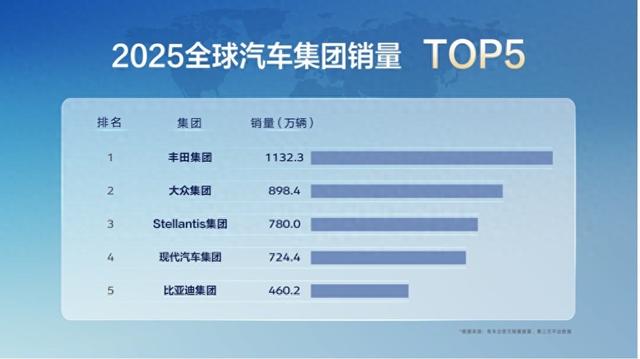
Core Insights - BYD has achieved a historic milestone by becoming the first Chinese automotive group to enter the global top five in vehicle sales, with an annual sales figure of 4.602 million units in 2025, marking a significant shift in the global automotive industry landscape [1][9] - The company has consistently ranked first in global new energy vehicle sales for four consecutive years, demonstrating its dominance in the sector [2][4] Sales Performance - In 2025, BYD's new energy vehicle sales reached 4.602 million units, maintaining its position as the global leader in this category [2] - The company surpassed Tesla in pure electric vehicle deliveries with 2.257 million units in 2025, indicating a shift in market leadership [4] - BYD's sales growth is notable, with an 18.3% year-on-year increase, contrasting with the stagnation or decline seen among traditional automotive giants [1][2] Market Expansion - BYD's overseas sales exceeded 1 million units for the first time, accounting for over 22% of total sales, with a remarkable 145% year-on-year growth [4][8] - In Europe, BYD registered 187,657 new vehicles in 2025, reflecting a 268.6% increase, and it leads in several emerging markets [5][6] Strategic Focus - The company aims to prioritize overseas expansion and high-end market penetration over low-cost strategies, emphasizing technology and value recognition [7] - BYD's success is attributed to its comprehensive capabilities across the entire supply chain, from battery production to vehicle manufacturing, which enhances its competitive edge [8] Technological Advancements - BYD has invested in core technologies and maintains a strong focus on R&D, developing advanced systems such as the fifth-generation DM hybrid technology and various intelligent driving solutions [7][8] - The company has established a vertically integrated supply chain, allowing it to remain competitive even in the face of tariffs [8] Future Outlook - BYD's entry into the global top five signifies a new phase for the Chinese automotive industry, driven by technological innovation and a focus on global competition [9] - With ongoing investments in overseas production facilities and continuous product development, BYD is positioned for further breakthroughs in the global market [9]

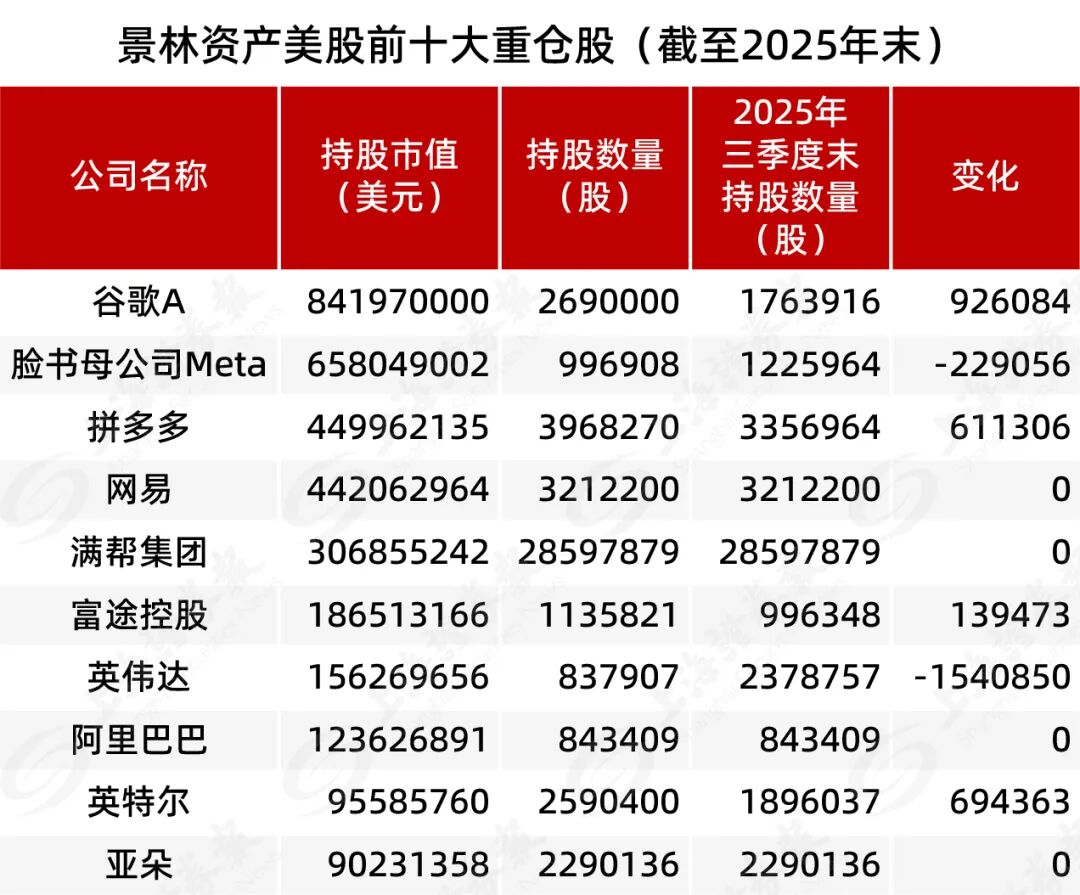
千亿级景林密集调仓换股
Shang Hai Zheng Quan Bao· 2026-02-10 04:56
Core Viewpoint - Jinglin Asset has made significant adjustments to its stock holdings in the fourth quarter of 2025, increasing its positions in key technology stocks while reducing exposure to others, reflecting a strategic focus on sectors like AI and new energy [1][6][9]. Group 1: Stock Holdings and Changes - As of the end of 2025, Jinglin Asset held stocks in 28 companies in the US market, with a total market value exceeding $4 billion [1]. - The top ten holdings include Google A, Meta, Pinduoduo, NetEase, Manbang Group, Futu Holdings, NVIDIA, Alibaba, Intel, and Atour, with Chinese stocks still dominating the portfolio [1][10]. - The largest holding shifted from Meta to Google A, with Google A valued at approximately $841.97 million, reflecting an increase of 926,084 shares from the previous quarter [2][3][10]. Group 2: Investment Strategy and Focus Areas - Jinglin Asset is focusing on sectors such as AI, new energy, smart driving, and humanoid robots, believing these areas will continue to see rapid growth and investment from both China and the US [1][9]. - The firm emphasizes a balanced global investment strategy, selecting companies with strong valuations and cash flows to mitigate risks while capitalizing on growth opportunities [9]. - The CEO highlighted the importance of major AI application platforms like Google, Apple, ByteDance, Tencent, and OpenAI, predicting that 2026 could be a pivotal year for AI agents [9]. Group 3: Recent Trading Activity - In Q4 2025, Jinglin Asset increased its holdings in Intel by 694,363 shares and in Futu Holdings by 139,473 shares, while also initiating a position in Broadcom [6]. - The firm significantly reduced its holdings in NVIDIA by 1.54 million shares and in Meta by 229,056 shares, alongside partial reductions in other stocks like TSMC and UnitedHealth [6].