
供给侧结构性改革

Search documents
浙商证券:产能置换约束煤炭供给 储备产能释放弹性
智通财经网· 2025-09-17 07:20
Core Viewpoint - The coal industry in China is facing potential risks related to the newly increased coal mine capacities, which may be revoked if companies fail to fulfill their capacity replacement commitments by the end of 2025 [1][5]. Group 1: Capacity Replacement Policy - The capacity replacement policy is a key tool for supply-side structural reform, aiming to "control total volume and optimize stock" by ensuring that new advanced capacities are built only after eliminating outdated capacities [2]. - The policy promotes high-quality development in the coal industry by limiting total capacity while improving capacity quality through market and legal means [2]. Group 2: Historical Context - During the supply-side structural reform period (2016-2020), coal production exceeded demand, leading to tighter capacity allocation policies and the implementation of reduction replacement policies [3]. - The government provided financial incentives for exiting coal mines to reduce capacity replacement ratios and required that closed mines' capacities be at least 120% of the new mines' capacities [3]. Group 3: Current and Future Capacity Management - In the current production increase and supply guarantee period (2021-2025), the government maintains the "reduction replacement" or "equal replacement" principles while implementing a commitment system for capacity indicators [4]. - Companies can initially commit to increased coal mine capacities, with subsequent fulfillment of capacity replacement indicators [4]. Group 4: Capacity Constraints - Based on the 2015 capacity baseline and the "13th Five-Year Plan" exit situation, the legal capacity limits are estimated at 4.7, 4.5, and 4.4 billion tons per year, which is below the projected production of 4.76 billion tons in 2024 [6]. - Strict enforcement of capacity replacement policies may necessitate future production cuts, while a coal capacity reserve system has been established to alleviate some capacity replacement indicator constraints [6]. Group 5: Investment Targets - Key companies to focus on in the thermal coal sector include China Shenhua (601088.SH), Shaanxi Coal and Chemical Industry (601225.SH), and others [7]. - In the coking coal sector, companies such as Huaibei Mining (600985.SH) and Shanxi Coking Coal (000983.SZ) are highlighted for investment consideration [7].

行业专题报告:产能置换约束供给,储备产能释放弹性
ZHESHANG SECURITIES· 2025-09-17 04:56
Investment Rating - The industry investment rating is "Positive" (maintained) [3] Core Viewpoints - The capacity replacement policy is a core tool for supply-side structural reform, aiming to "control total volume and optimize stock" through "reduction replacement" or "equal replacement" principles, ensuring that new advanced capacity is built while eliminating outdated capacity [3][8] - During the supply-side structural reform period (2016-2020), coal production exceeded demand, leading to tighter capacity allocation policies and the implementation of reduction replacement policies [3][21] - In the production increase and supply guarantee period (2021-2025), the policy continues to adhere to reduction replacement principles while implementing a commitment system for capacity indicators [3][23] - The capacity replacement commitment system is crucial for optimizing coal capacity management and ensuring national energy security [3][30] - The coal industry's supply and demand are expected to gradually balance, with coal prices steadily rising under the current policy framework [3][40] Summary by Sections Capacity Replacement Policy - The capacity replacement policy is essential for addressing overcapacity in industries like coal, steel, and cement, focusing on controlling new capacity while phasing out outdated capacity [8][10] - Specific policies were introduced from 2016 to 2018, mandating "reduction replacement" for the coal industry [15][16] Supply-Side Structural Reform Period (2016-2020) - The coal industry faced a situation of oversupply, prompting the implementation of tighter capacity allocation policies and reduction replacement measures [21][24] - Policies during this period included incentives for exiting coal mines to reduce capacity indicators [24][25] Production Increase and Supply Guarantee Period (2021-2025) - The commitment system allows coal mines to promise capacity increases without immediate compliance with replacement indicators, aiming to expedite the release of quality capacity [30][31] - The policy encourages the establishment of a coal capacity reserve system to enhance supply flexibility and resilience [39] Investment Recommendations - The report suggests prioritizing investments in companies such as China Shenhua, Shaanxi Coal, and others in the thermal coal sector, as well as companies in the coking coal sector like Huabei Mining and Shanxi Coking Coal [3][40]
稳住70%工业基本盘!十大行业放大招
2 1 Shi Ji Jing Ji Bao Dao· 2025-09-16 09:48
Core Viewpoint - The government is launching a new round of "stabilizing growth" policies targeting ten key industries to support economic stability and future industrial upgrades, which collectively account for 70% of the industrial economy [1][2]. Group 1: Key Industries Benefiting - The ten key industries identified include steel, non-ferrous metals, petrochemicals, chemicals, building materials, machinery, automobiles, power equipment, light industry, and electronic information manufacturing [1]. - These industries are crucial as they not only stabilize the industrial economy but also serve as a foundation for new productive forces and technological innovations [1]. Group 2: Rationale for Policy Implementation - The timing of the new policies is strategic, coinciding with the end of the "14th Five-Year Plan" and the tenth anniversary of supply-side structural reforms, amidst increasing economic pressures in the third quarter [2]. - The government aims to counter potential economic downturns while ensuring both growth and quality improvements, emphasizing a dual focus on quantity and quality for genuine growth [2]. Group 3: Policy Focus and Implementation - The policies are designed to be precise, addressing supply and demand, technology, and market needs, with a strong emphasis on innovation, quality enhancement, and the integration of artificial intelligence in traditional industries [2]. - On the demand side, the policies promote consumption, expand application scenarios, and encourage major engineering projects to stimulate investment and consumption [2]. Group 4: Market Environment and Competition - The policies signal a rejection of irrational competition, urging industries to focus on technology, brand differentiation, and quality rather than price wars [2]. - Support is provided for XR equipment, smart grids, and pilot projects for first-time equipment, creating opportunities for businesses of all sizes [2].
年均增长6.2%,北京市经营主体总量达到268.6万户
Zhong Guo Jing Ying Bao· 2025-09-16 04:57
Core Insights - During the "14th Five-Year Plan" period, Beijing's economy is expected to exceed 5 trillion yuan, with a growth increment of approximately 1.4 trillion yuan, equivalent to the economic output of a district like Haidian [2][5] Economic Growth and Structure - The average annual growth rate of business entities in Beijing from 2021 to 2024 is projected to be 6.2%, reaching a total of 2.686 million entities [3][8] - The information service industry is anticipated to surpass 1 trillion yuan in added value, becoming the largest pillar industry in the city [5] - High-tech industry investment is expected to rise from 9.5% in 2020 to 22.6% by 2024, marking a historical high [6] Investment and Projects - Beijing has promoted 1,030 major projects to private capital during the "14th Five-Year Plan," with total investments exceeding 1.3 trillion yuan [8] - The city has seen the establishment of over 8,000 foreign-funded enterprises and the expansion of comprehensive bonded zones from 1 to 4 [4] Trade and Consumption - The total import and export scale of goods trade in Beijing has exceeded 3.6 trillion yuan for three consecutive years, with service trade growing at an average annual rate of 9.4% from 2021 to 2024 [3] - The market consumption is expected to surpass 3 trillion yuan by 2025, with fixed asset investment projected to exceed 1 trillion yuan [5] Innovation and Technology - Over 60% of key core technology projects in various industries are expected to involve private enterprises by 2024 [2][8] - The city has implemented various reforms to enhance the investment environment, including the establishment of a national data factor comprehensive reform [7]

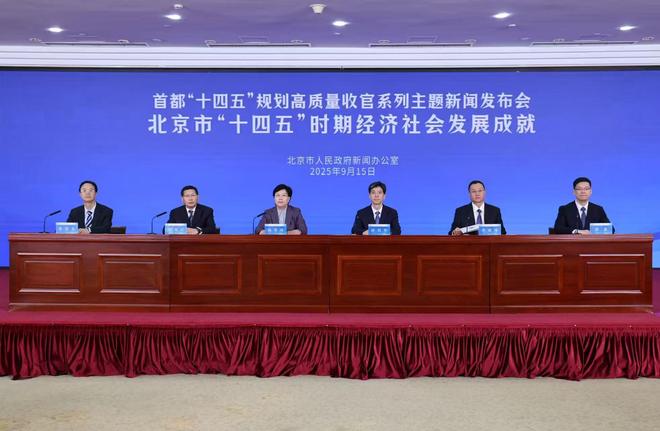
“十四五”时期北京GDP预计超5万亿!经济增量等于“新增一个海淀区”
证券时报· 2025-09-15 13:33
Core Viewpoint - Beijing's economic development during the "14th Five-Year Plan" has made significant progress, with high-value patents and economic growth exceeding expectations, leading to a solid step towards high-quality development [1][2]. Economic Growth and Performance - Beijing's GDP is expected to exceed 5 trillion yuan, with an economic increment of approximately 1.4 trillion yuan over five years, equivalent to the total economic output of a district like Haidian [2]. - By 2024, the per capita GDP of Beijing is projected to reach $32,000, with labor productivity at 444,000 yuan per person, ranking first among provinces and cities in China [2]. Industrial and Demand Dynamics - The capital's economy is supported by strong industries and driven by demand, with an average annual GDP growth of 5.2% from 2021 to 2024 despite various challenges [5]. - The information service industry has become the largest pillar of Beijing's economy, with its added value surpassing 1 trillion yuan [5]. - The financial sector's asset scale exceeds 220 trillion yuan, accounting for about half of the national total [5]. - By 2025, total market consumption in Beijing is expected to exceed 3 trillion yuan, with fixed asset investment surpassing 1 trillion yuan [5]. Investment Trends - The proportion of high-tech industry investment in Beijing has increased from 9.5% in 2020 to 22.6% in 2024, marking a historical high [6]. Technological Innovation - Beijing has positioned itself as an "Artificial Intelligence Capital," with significant advancements in technology and industry integration, including a strong focus on R&D investment [8][9]. - The city has maintained a R&D investment intensity of around 6%, ranking among the top global innovation cities [8]. - The information service, technology service, and advanced manufacturing sectors now account for 38.8% of GDP, up from 32.7% in 2020 [9]. Regional Collaboration - The collaboration among Beijing, Tianjin, and Hebei has led to a combined economic total of 11.5 trillion yuan by 2024, with all three regions' GDP growth rates exceeding the national average [13]. - The "Beijing R&D, Tianjin-Hebei Manufacturing" model is maturing, with technology contract transaction amounts increasing significantly [16].

钢矿周报:旺季及长假特征或更趋明显叠加稳增长政策或加码发力,钢矿期价或震荡偏强-20250915
Chang An Qi Huo· 2025-09-15 11:13
Report Industry Investment Rating No relevant information provided. Core View of the Report - Both steel and iron ore futures prices may fluctuate with a bullish bias. For steel, although the terminal demand in August was under pressure, the "Golden September and Silver October" peak season characteristics may become more obvious in mid - to late September, and the replenishment demand before the National Day holiday may be released. The strengthening of counter - cyclical adjustment policies may also support the demand. For iron ore, despite the long - term pressure on demand due to the upcoming steel industry stability - growth plan, the short - term demand may remain resilient due to the peak season and policy support [1][2][3]. Summary According to the Directory 1. Fundamental Production, Sales, and Inventory Changes Lead to Differentiated Performance of Steel and Iron Ore Futures Prices - Last week, affected by fundamental production, sales, and inventory changes, the futures prices of steel and iron ore main contracts showed differentiation. The futures price of the rebar main contract fluctuated weakly, down 0.51% for the week, while the futures prices of hot - rolled coil and iron ore main contracts fluctuated strongly, up 0.72% and 1.27% respectively for the week. The decline of rebar was due to weak consumption and inventory accumulation, while the rise of hot - rolled coil was due to increased consumption and inventory destocking. The rise of iron ore was supported by tight supply caused by a sharp drop in overseas ore shipments and increased demand from the resumption of production of steel mills in North China [4]. 2. The Pressure of Inventory Accumulation of Steel and Iron Ore May Be Limited Due to the Improvement of Supply - Demand, Peak Season Characteristics, and Policy Support (1) Steel: The Peak Season and Holiday Characteristics Become More Obvious, and the Strengthening of Stability - Growth Policies May Lead to a Bullish Bias in Futures Prices - **Terminal demand may be supported**: Although the terminal demand for steel in August was under pressure, in mid - to late September, the "Golden September and Silver October" peak season characteristics may become more obvious, and the replenishment demand before the National Day holiday may be released. The strengthening of counter - cyclical adjustment policies, such as the possible restart of Fed rate cuts, the adequacy of fiscal policy space, and the implementation of relevant policies, may support the demand for steel [10][11]. - **Steel production may be under pressure**: Although the profitability of steel mills is in doubt and the "Golden September and Silver October" peak season is approaching, the improvement of steel mill profits still faces challenges due to the uncertain terminal demand and supply disturbances of raw materials. The upcoming steel industry stability - growth plan may also put pressure on steel production, especially for building materials [22][23]. - **The pressure of inventory accumulation of rebar and hot - rolled coil may be limited**: Although the terminal demand in August was under pressure and the apparent demand for rebar continued to decline last week, the peak season characteristics and policy support may lead to marginal improvement in demand, and the overall inventory accumulation pressure of rebar and hot - rolled coil may be limited [37]. (2) Iron Ore: Steel Mill Profits Are Still Supported, and the Strengthening of Stability - Growth Policies May Lead to a Bullish Bias in Futures Prices - **Iron ore demand may be resilient in the short term but under pressure in the long term**: Although the upcoming steel industry stability - growth plan may suppress iron ore demand in the long term, in the short term, the peak season characteristics, the release of replenishment demand before the National Day holiday, and policy support may keep the iron ore demand resilient. However, the uncertain terminal demand and supply disturbances of raw materials may still pose challenges to steel mill profits and iron ore demand [40][42]. - **The pressure of tight supply of iron ore may be limited**: Overseas ore shipments are entering the peak season, and the new production capacity of overseas mines and domestic "Cornerstone Plan" may increase the supply of iron ore, so the pressure of tight supply may be limited [48]. - **The short - term inventory accumulation of iron ore ports may be limited**: Although there is long - term pressure on iron ore demand and inventory accumulation, the short - term demand may remain resilient due to the peak season and policy support, so the short - term inventory accumulation amplitude of iron ore ports may be limited [53]. 3. The Peak Season and Holiday Characteristics Become More Obvious, and the Strengthening of Stability - Growth Policies May Lead to a Bullish Bias in Steel and Iron Ore Futures Prices - **Steel**: The futures price may fluctuate with a bullish bias. Steel producers and traders with high inventory levels are advised to speed up the sales rhythm, while traders with low inventory levels and downstream and terminal procurement enterprises can slow down the procurement rhythm or establish short - term buying hedging positions on the futures market. Investors are advised to take short - term long positions on dips, and arbitrageurs can try to go long on the rebar - to - iron - ore ratio, all with attention to stop - profit and stop - loss [55][56]. - **Iron Ore**: The futures price may fluctuate with a bullish bias. Steel mills or traders with low inventory levels are advised to slow down the procurement rhythm or establish short - term buying hedging positions on the futures market, while traders with high inventory levels can speed up the sales rhythm. Investors are advised to use a range - trading strategy of high - selling and low - buying, and arbitrageurs can try to go long on the rebar - to - iron - ore ratio, all with attention to stop - profit and stop - loss [57].
以全面深化改革推动“十五五”时期高质量发展
Zhong Guo Jing Ji Wang· 2025-09-15 01:39
Group 1 - The forum emphasized the need for comprehensive deepening of reforms in the context of the "15th Five-Year Plan," focusing on institutional construction as a central theme [1][2] - Economic system reform is highlighted as a driving force, with an emphasis on its significant impact on other areas of reform [2] - The establishment of a national unified market and the deepening of factor market-oriented reforms are prioritized to transform the domestic market from large to strong [2] Group 2 - The promotion of healthy and high-quality development of the private economy is crucial, with the implementation of the "Private Economy Promotion Law" to create a fair competitive environment for various ownership enterprises [2] - The integration of education, technology, and talent reforms is essential for fostering innovation and development [2] - Collaborative efforts are needed to advance reforms related to carbon reduction, pollution reduction, green expansion, and economic growth, facilitating a comprehensive green transformation of economic and social development [2]
进一步全面深化改革 推动“十五五”时期高质量发展——第二十二届中国改革论坛在京举行
Xin Hua Cai Jing· 2025-09-14 14:13
Core Viewpoint - The 22nd China Reform Forum emphasizes the need for comprehensive deepening of reforms to promote high-quality development during the "14th Five-Year" and "15th Five-Year" periods, highlighting the importance of continuous reform efforts and the leadership of the Communist Party of China [1][2]. Group 1: Key Themes of the Forum - The forum discusses the significance of institutional construction as a mainline for further reforms, focusing on economic system reforms and their impact on other areas [3]. - It stresses the importance of developing new productive forces and establishing new production relations that meet these requirements [3]. - The forum aims to accelerate the construction of a unified national market and deepen market-oriented reforms [3]. Group 2: Major Reform Topics - The forum addresses critical issues such as the construction of a high-level socialist market economy, supply-side structural reforms, and state-owned enterprise reforms [4]. - It shares research findings on enhancing consumption, social security, and stabilizing the stock market through coordinated reforms [4]. - Discussions include the need for a fair competitive market environment and preventing "involution" in competition [5]. Group 3: Specialized Forums - Three specialized forums are set up to discuss collaborative reform measures, enhancing economic development sustainability, and building support for comprehensive innovation [5]. - Topics include the evaluation system for state-owned enterprises, rural revitalization, and financial support for green and low-carbon development [5][6]. - Experts from various institutions participate in these discussions, contributing to a diverse range of insights and recommendations [6].
宏观专题:对照供给侧改革,本轮综合整治内卷行动有望引领行情走向
Xiangcai Securities· 2025-09-10 10:47
Group 1: Overview of Actions - The current comprehensive rectification of involution is a continuation and deepening of the supply-side structural reform initiated in November 2015[1] - The root cause of both actions is the overcapacity resulting from chaotic capital expansion, with the previous reform targeting upstream raw materials and the current action focusing on downstream manufacturing[2] - The previous reform utilized administrative orders to control production, while the current action requires industry self-regulation and detailed management due to the diversity of enterprises involved[2] Group 2: Economic Indicators and Market Trends - The Producer Price Index (PPI) is a crucial indicator of economic health, showing a correlation with stock market trends, particularly the CSI 300 index[3] - Historical analysis indicates that from 2014 to 2015, the stock market rose despite declining PPI, leading to a market correction when the fundamentals returned[3] - As of August 2025, the PPI's year-on-year decline has narrowed, indicating positive changes that may support stock market growth[3] Group 3: Investment Opportunities - The comprehensive rectification action is expected to transform and boost the Chinese economy, particularly benefiting emerging industries such as new energy vehicles, lithium batteries, and photovoltaics, as well as traditional industries like steel and coal[4] - This action is anticipated to create a series of investment opportunities in sectors historically plagued by overcapacity[4] Group 4: Risks and Challenges - The transition towards a non-involutionary development model involves significant changes in development concepts and institutional frameworks, which may be a lengthy and complex process[5] - Local governments and enterprises may face difficulties and resistance in implementing these reforms effectively[5]
港股异动 | 纸业股早盘走高 理文造纸(02314)涨超5% 玖龙纸业(02689)涨超4%
智通财经网· 2025-09-08 02:41
Group 1 - The paper industry stocks experienced a rise in early trading, with Lee & Man Paper (02314) up 5.17% to HKD 3.05, Nine Dragons Paper (02689) up 4.63% to HKD 5.88, and Chenming Paper (01812) up 4.6% to HKD 0.91 [1] - Major paper manufacturers, including Nine Dragons Paper, Shanying International, Lee & Man Paper, and Wuzhou Special Paper, have announced price increases for certain products starting in early September [1] - Since August, domestic paper manufacturers have implemented multiple rounds of price hikes, indicating a trend towards rising prices in the industry [1] Group 2 - According to Industrial Securities, as the fourth quarter approaches the traditional peak season, both pulp and paper prices are expected to continue rising, supported by anti-involution policies [1] - Huashan Securities previously noted that under the national "anti-involution" backdrop and supply-side structural reforms, the packaging paper industry may see the exit of outdated production capacity, improving supply-demand balance and driving up paper prices, which would enhance profitability for paper companies [1]