
信贷

Search documents
9月金融数据解读:社融承压,结构现暖意
Guoxin Securities· 2025-10-16 08:13
Financial Data Overview - In September, China's new social financing (社融) reached CNY 3.53 trillion, exceeding the expected CNY 3.27 trillion[2] - New RMB loans amounted to CNY 1.29 trillion, slightly below the expected CNY 1.39 trillion[2] - M2 growth year-on-year was 8.4%, slightly below the expected 8.5%[2] Economic Trends - Social financing growth rate fell to 8.7%, with a year-on-year decrease of CNY 229.7 billion, indicating weak overall financing demand[5] - Corporate credit structure improved, with short-term loans increasing by CNY 250 billion year-on-year, while medium to long-term loans for residents increased by CNY 20 billion, reflecting positive effects from recent real estate policy adjustments[5][15] - M1 growth rate rose by 1.2 percentage points to 7.2%, indicating enhanced liquidity in the economy[5][25] Government and Fiscal Policy - Government financing through bonds contributed significantly to social financing, with CNY 1.19 trillion in new government bond financing, although this was CNY 347.1 billion less than the previous year[19] - Fiscal deposits decreased by CNY 604.2 billion, suggesting an acceleration in government spending[6][25] Future Outlook - Continued focus on fiscal policy strength and the impact of new policy financial instruments is necessary[6] - The real estate market's performance in the "golden September and silver October" period will be crucial for sustaining credit recovery[6]
25年9月金融数据:非银存款同比回落
Ping An Securities· 2025-10-16 06:32
Group 1: Financial Data Overview - In September 2025, new social financing (社融) totaled 3.53 trillion RMB, a year-on-year decrease of 229.7 billion RMB, exceeding market expectations of 3.28 trillion RMB[3] - New RMB loans amounted to 1.29 trillion RMB, a year-on-year decrease of 300 billion RMB, which was 100 billion RMB lower than market expectations[3] - The year-on-year decrease in social financing was primarily due to a reduction in credit and government bond supply, with a decrease of 3.66 trillion RMB in loans and 3.47 trillion RMB in government bonds[4] Group 2: Credit Performance - Resident short-term loans decreased by 127.9 billion RMB, marking the lowest level since 2019, indicating a need for consumer spending stimulation[5] - Corporate short-term loans increased by 250 billion RMB, likely supported by a recent loan interest subsidy policy[5] - The overall credit performance was weaker than expected, with corporate bill financing decreasing by 471.2 billion RMB[5] Group 3: Monetary Supply Trends - M1 growth rate rose by 1.2 percentage points to 7.2%, benefiting from a low base effect[6] - M2 growth rate fell by 0.4 percentage points to 8.4%, primarily due to a decrease in non-bank deposits and government deposits[6] - The structure of deposits showed an increase in resident deposits while non-bank deposits significantly decreased, suggesting a potential reduction in capital inflow to the stock market[6] Group 4: Market Strategy Recommendations - It is advised to observe the market within a volatile framework and avoid excessive chasing of price increases[7] - Recent inflation data indicates a mild recovery in core CPI and PPI, while financial data reflects weak credit characteristics[7] - The bond market showed weak overall performance, with the yield on 10Y government bonds rising by 0.55 basis points to 1.7580%[7]
前三季度新增社融超30万亿元
Bei Jing Shang Bao· 2025-10-15 15:54
Core Insights - The People's Bank of China released financial statistics for the first three quarters of 2025, indicating a robust growth in loans and deposits, with total social financing exceeding 30.09 trillion yuan [1][8] - The report reflects a stable credit environment and an ongoing adjustment in monetary policy, suggesting that there is ample room for moderate easing without immediate concerns about high inflation [1][3] Loan and Deposit Growth - As of the end of September, the balance of RMB loans reached 270.39 trillion yuan, with a year-on-year growth of 6.6% [2] - In the first three quarters, RMB loans increased by 14.75 trillion yuan, with household loans rising by 1.1 trillion yuan and corporate loans increasing by 13.44 trillion yuan [2][3] - The total RMB deposits increased by 22.71 trillion yuan, with household deposits contributing 12.73 trillion yuan [6] Monetary Supply and Policy - The M2 money supply stood at 335.38 trillion yuan, growing by 8.4% year-on-year, while M1 grew by 7.2% [5][7] - The "scissors gap" between M1 and M2 has narrowed to 1.2 percentage points, the lowest since 2021, indicating increased activity in the economy [7] - The current monetary policy remains moderately accommodative, supporting economic recovery and growth [9] Social Financing and Economic Support - The total social financing scale reached 437.08 trillion yuan, with a year-on-year growth of 8.7% [1][8] - In September, the new social financing amounted to 35.34 billion yuan, reflecting a slight decrease compared to the previous year [8] - The structure of social financing shows a shift towards more diversified financing channels, with loans accounting for about 48% of the new social financing, while government and corporate bonds accounted for approximately 43% [9]
美国消费行业8月跟踪报告:信心指数连续下滑,整体继续谨慎
Haitong Securities International· 2025-09-28 23:30
Investment Rating - The report maintains a cautious investment stance on the consumer sector, reflecting concerns over declining consumer confidence and a cooling job market [3]. Core Insights - The consumer confidence index has declined for two consecutive months, indicating ongoing worries about the economic outlook [1][6]. - Retail sales data shows resilience, with August retail sales reaching $732.01 billion, a year-on-year increase of 5.0% [1][6]. - Core inflation is rising, with the core CPI reaching 2.9%, the highest level in three months, driven primarily by housing costs [1][8]. - Non-farm employment growth has significantly slowed, with only 22,000 new jobs added in August, far below the expected 140,000 [1][12]. Macroeconomic Overview - The Michigan consumer confidence index for September is at 55.4, down 4.8% from August [1][6]. - August CPI rose by 0.4% month-on-month and 3.1% year-on-year, while core CPI increased by 0.3% month-on-month [1][8]. - Non-farm employment growth is at its lowest since December 2024, with the unemployment rate slightly rising to 4.3% [1][12][14]. - Consumer credit saw a moderate increase of $10.48 billion in July, indicating cautious borrowing behavior [1][19]. Industry Performance Essential Consumption - Alcohol sales in July were $6.23 billion, down 0.5% year-on-year, but the decline is slowing [2][26]. - Tobacco sales remained stable at $6.02 billion in July, with a CPI increase of 6.3% [2][31]. - Dairy product shipments reached $13.37 billion in July, showing moderate year-on-year growth [2][28]. - Beverage shipments totaled $12.05 billion in July, with a notable CPI increase of 4.6% [2][28]. Discretionary Consumption - Restaurant sales in August were $99.52 billion, up 6.5% year-on-year, indicating strong consumer demand for dining out [2][33]. - Department store sales in August were $76.78 billion, showing a year-on-year increase of 1.9% but a slight month-on-month decline [2][36]. - Apparel sales in August reached $27.18 billion, up 8.3% year-on-year, reflecting a strong rebound in clothing consumption [2][38]. Market Trends - The consumer sector shows a mixed performance, with discretionary consumption outperforming essential consumption [3][42]. - Essential consumption ETFs experienced a net outflow of $1.1 billion, indicating investor caution [3][48]. - The report highlights that the essential consumption sector is facing significant outflows, reflecting a more cautious investment sentiment [3][48].
经济继续修复筑底 消费和投资仍需加力
Jing Ji Guan Cha Wang· 2025-09-19 15:51
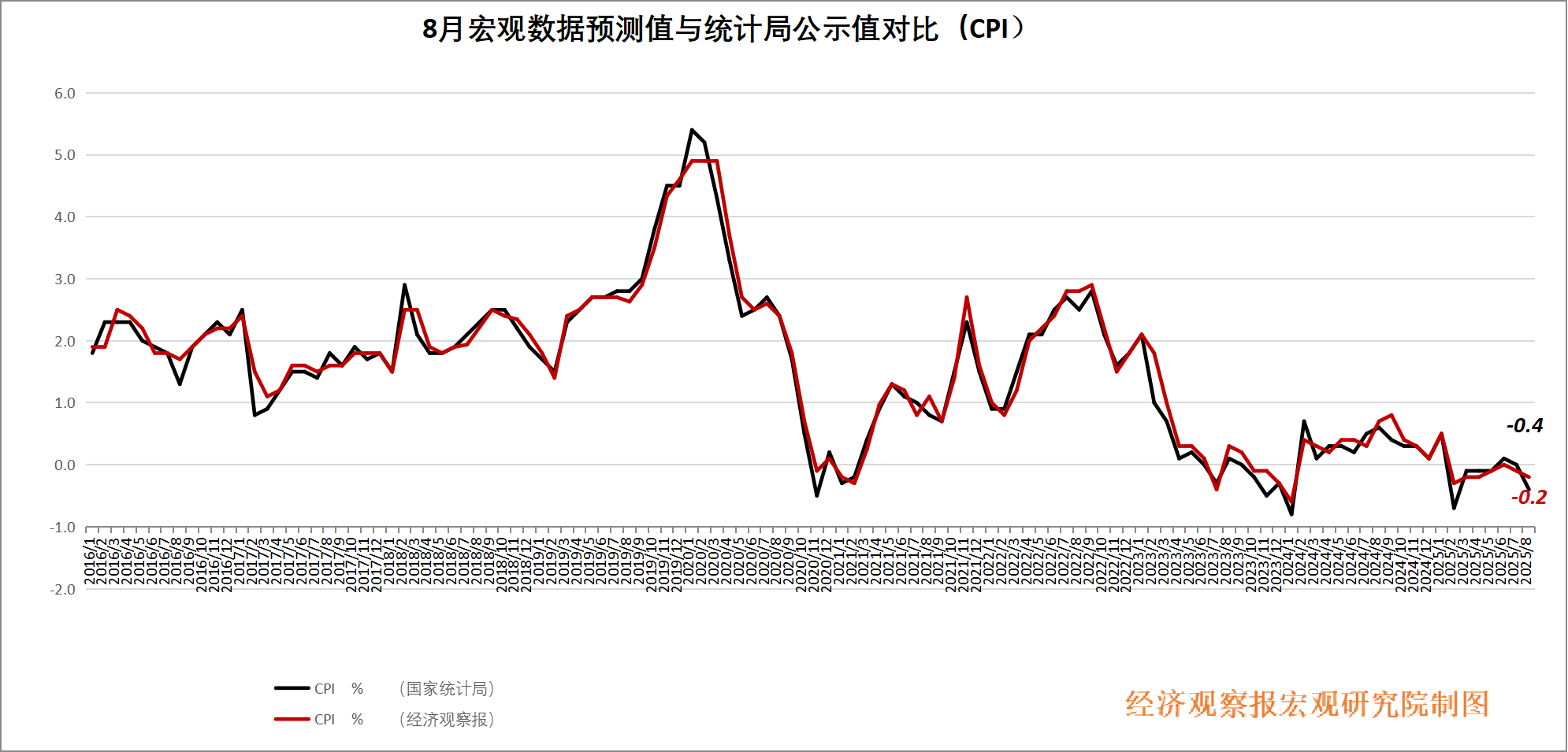
Economic Overview - The economy is in a critical phase of bottoming out and recovery, with some indicators showing marginal improvement, but still facing multiple challenges [1] - Consumer internal momentum is weak, with household credit affected and housing prices expected to face significant downward pressure in Q4 [1] - Key factors for financial data improvement include corporate profitability and fiscal stimulus [1] CPI Analysis - August CPI year-on-year growth decreased to -0.4%, down from 0%, with a month-on-month change remaining flat [4] - Pork prices fell by 0.5% month-on-month, while egg prices increased by 1.5%, below the seasonal average [4] - Future CPI trends will depend on pork price stability, overall food price stability, supply-demand challenges, and weak consumer internal momentum [4] PPI Insights - August PPI year-on-year growth improved to -2.9% from -3.6%, marking the highest level since May [7] - The month-on-month PPI remained flat, ending an eight-month decline, influenced by improved supply-demand relationships in some sectors [7][8] - Expectations for PPI in October suggest a narrowing decline to -2.6%, with potential recovery in Q4 [8] PMI Developments - August manufacturing PMI rose to 49.4%, indicating slight recovery in both supply and demand sides [11] - New orders and export orders showed minor increases, but overall demand recovery remains weak [11] - Production activities are expanding, with positive business expectations continuing [11] Fixed Asset Investment - Fixed asset investment growth slowed to 0.5% year-on-year, down from 1.6% [15] - Real estate investment continues to decline, with signs of improvement in new home sales [15] - Manufacturing investment is constrained by tariff disruptions and internal competition policies [15] Credit and Financial Data - New credit in August was 590 billion yuan, a significant increase from a negative value in the previous month [18] - Corporate loans showed divergence, with short-term loans increasing significantly [18] - Overall financial data reflects a pattern of government debt supply reduction and insufficient credit demand [18] M2 Growth - M2 growth remained steady at 8.8% year-on-year, with a slight decrease in the M2-M1 spread [21] - Government debt financing has been a key factor in maintaining M2 and social financing growth [21] - Future M2 growth may face challenges due to reduced government debt financing and insufficient loan demand [21]

银行行业:社融过峰,信贷偏弱
Dongxing Securities· 2025-09-15 06:58
Investment Rating - The industry investment rating is "Positive" [1] Core Viewpoints - The report highlights that the growth rate of social financing (社融) has peaked, with a year-on-year increase of 8.8% as of the end of August, but a slight month-on-month decline of 0.2 percentage points [1][12] - The report indicates that the contribution of government bonds to social financing is diminishing, with a net financing of 1.37 trillion yuan in August, accounting for 53% of the new social financing, which is a decrease compared to the previous year [1][7] - The report notes that credit demand remains weak, with new RMB loans of 590 billion yuan in August, a year-on-year decrease of 310 billion yuan [2][10] Summary by Sections Social Financing and Credit - As of the end of August, social financing increased by 2.57 trillion yuan, which is 463 billion yuan less than the same month last year [1][12] - The report states that the new RMB loans in August were 590 billion yuan, with a year-on-year decrease of 310 billion yuan, indicating a weak credit environment [2][10] - The report mentions that the growth of M1 and M2 remains stable, with M1 increasing by 6% and M2 by 8.8% year-on-year [3][12] Loan Demand and Rates - The weighted average interest rate for new corporate loans in August was approximately 3.1%, showing a slight decrease of 0.1 percentage points [3] - The report highlights that the demand for residential loans remains weak, with new loans of 30.3 billion yuan in August, a year-on-year decrease of 159.7 billion yuan [2][10] - The report suggests that while there are policies to lower financing costs for personal consumption loans, the sustainability of this improvement is uncertain [2] Investment Recommendations - The report recommends a focus on high-quality small and medium-sized banks with regional advantages and performance release potential in the short term [7] - In the medium to long term, it suggests favoring state-owned banks with strong operational resilience and sustainable profitability [7] - The report anticipates increased allocation demand for the banking sector from insurance asset management and public funds, which could benefit sector performance [7]
8月社融新增2.57万亿元,信贷环比多增6400亿
2 1 Shi Ji Jing Ji Bao Dao· 2025-09-13 04:00
Group 1: Financial Data Overview - As of the end of August 2025, the total social financing scale reached 433.66 trillion yuan, with a year-on-year growth of 8.8%, maintaining a high growth trend since the beginning of the year [1] - In the first eight months of 2025, the cumulative increase in social financing was 26.56 trillion yuan, with an additional 2.57 trillion yuan in August, which was 4.63 billion yuan less than the previous year but significantly increased by 1.44 trillion yuan month-on-month [1] - The broad money supply (M2) stood at 331.98 trillion yuan at the end of August, also growing by 8.8% year-on-year, while the narrow money supply (M1) was 111.23 trillion yuan, with a year-on-year growth of 6% [1] Group 2: Credit and Loan Dynamics - In August, the balance of domestic and foreign currency loans reached 273.02 trillion yuan, with a year-on-year increase of 6.6%, while the balance of RMB loans was 269.1 trillion yuan, growing by 6.8% year-on-year [2] - The increase in RMB loans for the first eight months of 2025 was 13.46 trillion yuan, with August alone seeing a new addition of 590 billion yuan, which was 3.1 billion yuan less than the previous year but 6.4 trillion yuan more than the previous month [2] - The recovery in credit growth in August was attributed to improved macroeconomic conditions, reduced overdraw effects from previous loan disbursements, and a decrease in the downward pressure from hidden debt replacement [2][3] Group 3: Government and Corporate Bonds - By the end of August, the balance of corporate bonds reached 33.47 trillion yuan, growing by 3.7% year-on-year, while government bonds increased significantly by 21.1% to 91.36 trillion yuan [6] - In the first eight months of 2025, net financing from corporate bonds was 1.56 trillion yuan, a decrease of 2.21 trillion yuan year-on-year, while government bonds saw net financing of 10.27 trillion yuan, an increase of 4.63 trillion yuan [6] - The issuance of local government bonds was robust, with 7.68 trillion yuan issued nationwide, including 3.26 trillion yuan in new special bonds, completing 74% of the annual quota [6][7] Group 4: Economic and Sectoral Insights - The advanced manufacturing sector, particularly high-tech and equipment manufacturing, showed strong demand for financing, supporting credit growth [4] - Personal loans in August saw a slight increase, with short-term loans adding 10.5 billion yuan and medium to long-term loans increasing by 20 billion yuan [5] - The issuance of special bonds for land reserves has accelerated since June, contributing to stabilizing the real estate market [7] Group 5: Monetary Policy and Future Outlook - The M1-M2 spread narrowed to its lowest level in nearly four years, indicating increased monetary activity and potential for funds to flow into consumption and investment [8] - The current monetary policy is expected to remain supportive, with room for further easing given the low domestic price levels [9] - Financial institutions are encouraged to adapt to changing credit demands due to economic structural transformations, focusing on effective demand in emerging sectors [9]
【广发宏观钟林楠】8月金融数据的亮点与短板
郭磊宏观茶座· 2025-09-12 15:04
Core Viewpoint - The article highlights the mixed performance of social financing and credit growth in August, indicating a need for policy adjustments to stimulate economic activity and improve credit demand, particularly in the household sector [1][6][15]. Summary by Sections Social Financing - In August, social financing increased by 2.57 trillion yuan, a year-on-year decrease of 463 billion yuan, aligning closely with market expectations of 2.53 trillion yuan [1][6]. - The stock growth rate of social financing was 8.8%, down by 0.2 percentage points from the previous month [1][6]. Credit Performance - The increase in real credit was 623.3 billion yuan, showing significant improvement from July but still below historical averages for the same period [7][9]. - The year-on-year decrease in real credit was 417.8 billion yuan, indicating ongoing challenges in credit demand [7][9]. Corporate Credit - Corporate short-term loans increased by 70 billion yuan, the highest for the same period since 2017, driven by factors such as inventory replenishment and banks' preference for short-term loans under stable interest margins [9][10]. - Corporate medium and long-term loans rose by 470 billion yuan, with a slight year-on-year decrease of 20 billion yuan, suggesting a recovery in financing demand for major projects [9][10]. Government and Corporate Bonds - Government bond financing increased by 1.37 trillion yuan, a year-on-year decrease of 251.9 billion yuan, primarily due to a high base from the previous year [3][10]. - Corporate bond financing rose by 134.3 billion yuan, with a year-on-year decrease of 36 billion yuan, reflecting increased costs and difficulties in issuing bonds [3][10]. Foreign Currency Loans - Foreign currency loans decreased by 9 billion yuan, but showed a year-on-year increase of 52.2 billion yuan, continuing a trend of improvement since April [3][12]. - The increase in non-discounted bank acceptance bills was 197.4 billion yuan, with a year-on-year increase of 132.3 billion yuan, indicating a shift in financing patterns [3][12]. Monetary Aggregates - M1 growth rate was 6%, up by 0.4 percentage points from the previous month, driven by a low base effect and increased corporate foreign exchange settlements [4][12]. - M2 growth rate remained stable at 8.8%, supported by increased fiscal spending, while household deposits showed a significant decrease [4][12]. Overall Economic Outlook - The financial data for August indicates signs of fiscal strength and a recovery in corporate financing demand, but low leverage willingness in the household sector remains a concern [15][6]. - Upcoming policies, such as consumer loan interest subsidies and adjustments in real estate regulations, may influence household leverage willingness, with September and October data being critical for observation [15][6].

前8个月新增社融超26.5万亿元,政府债券支撑作用较强
Sou Hu Cai Jing· 2025-09-12 09:44
Core Insights - The People's Bank of China reported that the growth rate of social financing remains high due to ongoing fiscal policy efforts [1][2] - The total social financing scale reached 433.66 trillion yuan by the end of August 2025, with a year-on-year growth of 8.8% [2] - The increase in RMB loans to the real economy was 12.93 trillion yuan in the first eight months, which is a decrease of 4.85 trillion yuan compared to the previous year [4] Monetary Supply - As of the end of August, the broad money supply (M2) was 331.98 trillion yuan, with a year-on-year growth of 8.8% [1] - The narrow money supply (M1) was 111.23 trillion yuan, showing a year-on-year increase of 6%, up by 0.4 percentage points from the previous month [1] Loan and Deposit Trends - In the first eight months, RMB loans increased by 13.46 trillion yuan, with household loans rising by 711 billion yuan and corporate loans increasing by 12.22 trillion yuan [1] - Total RMB deposits rose by 20.5 trillion yuan, with household deposits increasing by 9.77 trillion yuan [1] Financing Structure - By the end of August, the balance of RMB loans to the real economy was 265.42 trillion yuan, growing by 6.6% year-on-year [2] - The net financing of corporate bonds was 1.56 trillion yuan, which is a decrease of 2.21 trillion yuan compared to the previous year [4] Economic Outlook - Analysts expect the central bank to maintain a supportive monetary policy stance in the second half of the year, focusing on reducing financing costs and increasing credit availability [4] - There is an anticipation of a new round of interest rate cuts and reserve requirement ratio reductions by the central bank in the fourth quarter [4]
中信建投:7月社融表现较好但信贷承压
Zheng Quan Shi Bao Wang· 2025-08-15 00:03
Core Viewpoint - The report from CITIC Securities indicates a positive performance in social financing in July, with a year-on-year growth of 9% in the total social financing scale and an 8.8% year-on-year increase in M2 money supply, suggesting a shift of "sedentary" funds in the financial system towards "active" funds [1] Summary by Relevant Categories Social Financing - In July, the total social financing scale showed a year-on-year increase of 9% [1] - The M2 money supply also increased by 8.8% year-on-year, indicating a healthy liquidity environment [1] Credit Performance - Credit performance in July was generally average, with several credit data points showing negative growth [1] - The seasonal nature of credit scale is highlighted, as July is traditionally a credit off-peak season [1] - Financial institutions are moving away from intense competition and the "scale obsession," which may lead to a "watered-down" effect on credit data [1] Economic Support - Despite fluctuations in monthly credit increment data, the overall financial system continues to provide strong support to the real economy, particularly with the increase in government bonds [1]
