全球制造业复苏

Search documents
金银、油价、加密货币集体大涨,中概股拉升,特斯拉创新高,市值超1.65万亿美元
2 1 Shi Ji Jing Ji Bao Dao· 2025-12-22 15:29
Group 1: US Tech Giants and Market Performance - The seven major US tech companies experienced a broad increase, with Nvidia rising by 1.2% and Tesla reaching a historic high with a 3.38% increase, bringing its market value to $1.65 trillion, reflecting a cumulative gain of 57% over the last 120 trading days [2] - The Nasdaq China Golden Dragon Index rose by 0.4%, with many popular Chinese stocks also seeing gains, including Qihoo 360 up 3.24% and Trip.com up 2.23% [2] Group 2: Goldman Sachs' Predictions on Chinese Stocks - Goldman Sachs predicts that Chinese stocks will continue to rise through 2026, although at a slower pace, transitioning from an "expectation-driven" phase to a "profit-driven" phase [2] - The report forecasts a 14% growth in Chinese corporate profits next year and a further 12% in 2027, with a potential 10% expansion in valuations [2] - By the end of 2027, Goldman Sachs analysts anticipate a 38% increase in the Chinese stock market [2] Group 3: Gold and Silver Market Dynamics - Gold and silver prices reached new historical highs, with gold surpassing $4427.80 per ounce and silver exceeding $69 per ounce, driven by deeper factors beyond mere geopolitical concerns [6] - The rise in gold prices is attributed to three main factors: the fragmentation of the global financial system, record-high US fiscal interest payments exceeding $1 trillion, and the transition of gold from an asset to collateral in financial markets [6] - Goldman Sachs analysts expect gold prices to rise further next year, with a baseline scenario of $4900 per ounce, indicating potential upward risks [7] Group 4: Cryptocurrency Market Trends - Multiple cryptocurrencies experienced collective gains, with Bitcoin approaching the $90,000 mark, reflecting a positive trend in the crypto market [7][8]


周末!利好来啦!
中国基金报· 2025-12-21 14:33
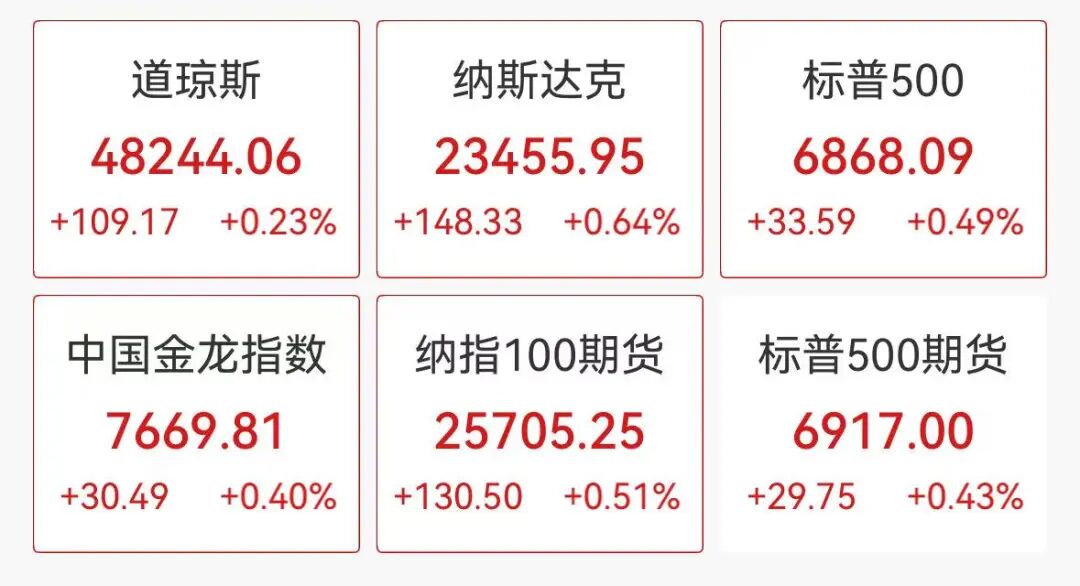
Group 1 - The State Council emphasizes the need for all departments to align their actions with the central government's economic work requirements and policies for the upcoming year, enhancing responsibility and urgency in implementing specific plans [2] - The "Internet Platform Pricing Behavior Rules" have been issued, allowing platform operators to set their own prices while prohibiting unreasonable restrictions on pricing behavior [3] - The National Internet Information Office and the China Securities Regulatory Commission have taken action against 17 accounts involved in spreading rumors and illegal stock recommendations, highlighting the importance of maintaining market integrity [4] Group 2 - Fujian Province has introduced a financial support plan for technological innovation, aiming for a 10% annual growth rate in loans for technology-related industries from 2025 to 2027, and enhancing the quality of financial services [5] - Researchers at Shanghai Jiao Tong University have achieved a breakthrough in optical computing chips, which are expected to meet the high computational demands of deep neural networks and large-scale generative models [6] - Moore Threads has launched a new GPU architecture that supports large-scale intelligent computing clusters, with a 50% increase in computing density and a tenfold improvement in energy efficiency [7] Group 3 - China Shenhua plans to acquire 100% equity of Guoyuan Power and Inner Mongolia Construction Investment through a combination of A-share issuance and cash payment, with a total transaction value of 133.598 billion yuan [8] - The first L3-level autonomous driving license has been issued in Chongqing, marking a significant step towards the commercialization of L3 autonomous driving in China [9] Group 4 - U.S. stock markets saw collective gains, with the Dow Jones up 0.38%, Nasdaq up 1.31%, and S&P 500 up 0.88%, driven by strong performances from major tech stocks [10][11] - Elon Musk praised a performance featuring humanoid robots at a concert, indicating growing interest in robotics and AI applications in entertainment [12] Group 5 - Major brokerages have provided insights on market trends, with Citic Securities suggesting that industries benefiting from a strengthening yuan should be prioritized, while Shenyin Wanguo highlights the potential for a "spring surge" in the market [14][15] - Guotai Junan emphasizes the importance of embracing diverse investment narratives as the market prepares for 2026, focusing on sectors like AI, consumer recovery, and capital market expansion [16][19]



国金策略:单一产业叙事能够带来的收益已经越来越不稳定和难以把握 抓住行情的窄幅波动期布局2026年新主线
Sou Hu Cai Jing· 2025-12-21 12:44
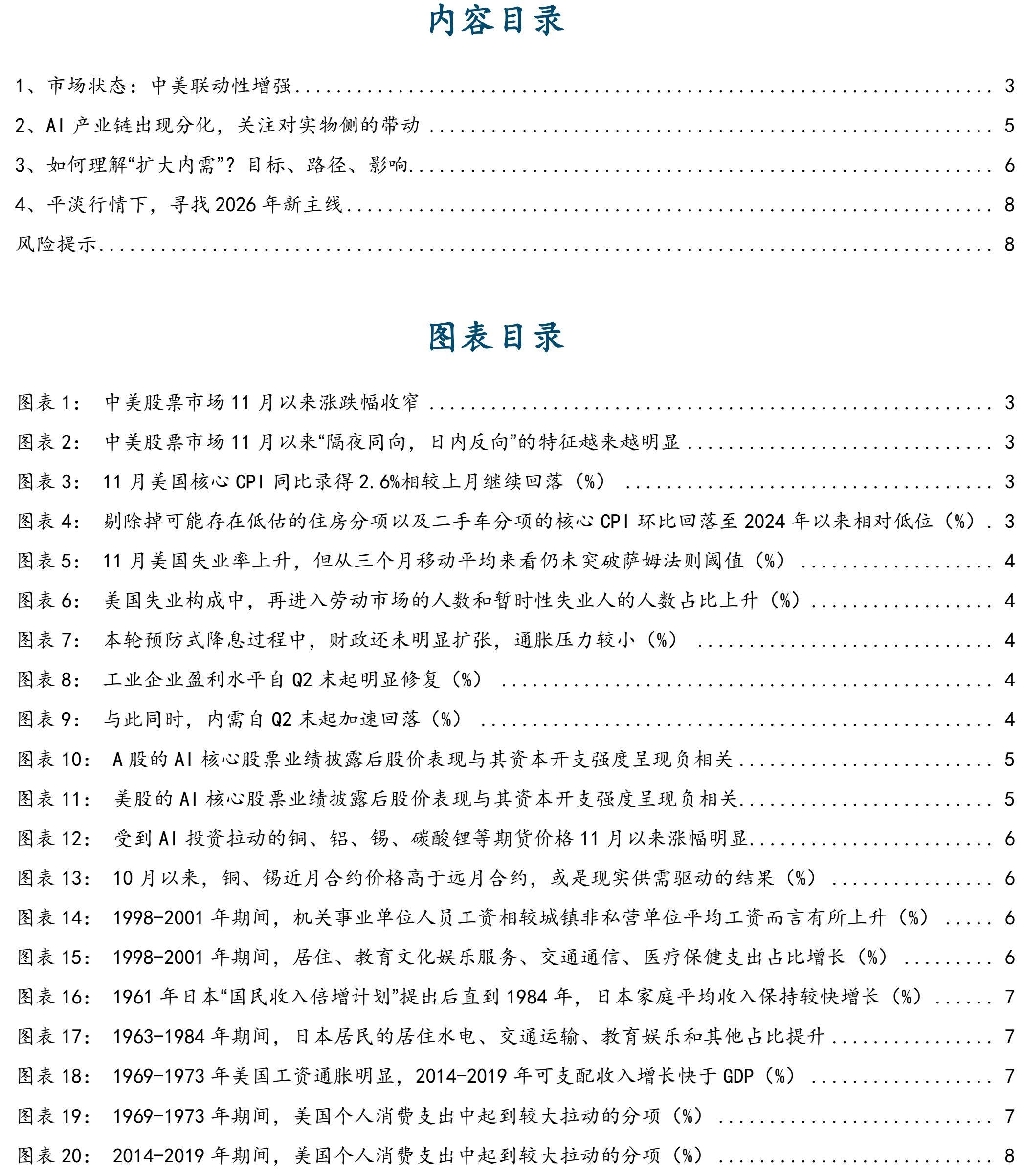
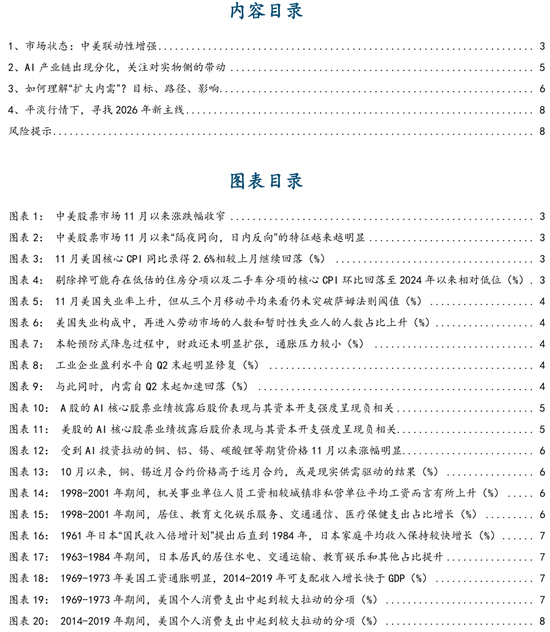
Group 1 - The market status indicates an increased correlation between the US and Chinese markets, with the 20-day rolling correlation of the CSI 300 and S&P 500 rising above the 90th percentile, reflecting a new normal of "overnight alignment and intraday reversal" [2][10][13] - The US core CPI has decreased to 2.6%, the lowest in three and a half years, while the unemployment rate has risen to 4.6%, primarily due to increased labor participation and temporary unemployment, indicating a stable economic environment without significant inflationary pressures [2][10][13] - China's economic fundamentals show a combination of corporate profit bottoming out and a decline in domestic demand, which opens a window for further policy support [2][10][13] Group 2 - The AI industry chain is experiencing a divergence, with broader AI-related assets (copper, lithium, aluminum, energy storage, and electrical equipment) performing better than core AI assets (computing chips, optical modules, PCB) [3][24][25] - Investors are becoming less tolerant of the contradiction between aggressive capital expenditures and the lack of revenue growth in companies within the AI industry chain, leading to a negative correlation between stock performance and capital expenditure as a percentage of revenue [3][24][25] - Commodity prices for copper, aluminum, tin, and lithium carbonate have been rising since late October, driven by demand from AI investments, with near-term contracts for copper and tin outperforming longer-term contracts [3][24][25] Group 3 - The concept of "expanding domestic demand" is emphasized as a strategic move, with a focus on increasing consumer demand supported by income growth and effective investment [4][31][32] - The government plans to enhance the second distribution of income by increasing minimum pension standards and implementing childcare subsidies, while future efforts may focus on optimizing the first distribution through wage reforms [4][31][32] - Historical examples from Japan and the US illustrate that income growth leads to increased service and new-type consumption, suggesting that China's current income growth initiatives could similarly boost consumer spending [4][31][32] Group 4 - The current market environment, characterized by limited macro elasticity and increased industry differentiation, suggests a shift in investment strategy towards tangible demand and domestic policy benefits as the new focus for 2026 [5][42][43] - Recommendations include investing in industrial resource products (copper, aluminum, tin, lithium, crude oil) that benefit from AI investment and global manufacturing recovery, as well as sectors poised for recovery in consumer spending (airlines, hotels, duty-free, food and beverages) [5][42][43] - Non-bank financial institutions (insurance, brokerage) are expected to benefit from capital market expansion and a rebound in long-term asset returns, alongside opportunities in China's equipment export chain and manufacturing sectors [5][42][43]
国金证券:迎接2026,告别单一叙事
Xin Lang Cai Jing· 2025-12-21 09:36
Group 1: Market Status - The correlation between A-shares and U.S. stocks has increased, with the 20-day rolling correlation of the CSI 300 and S&P 500 rising to over 90% since November, indicating a new norm of "overnight same direction, intraday reverse" [2][11][45] - Both the U.S. and Chinese economies are in a phase of "limited upward elasticity and reduced downward risk," with the U.S. core CPI falling to 2.6%, the lowest in three and a half years, and the unemployment rate rising to 4.6% primarily due to increased labor participation and temporary unemployment [2][13][47] - The Chinese economy shows signs of a bottom in corporate profits, while domestic demand is weakening, creating a favorable environment for subsequent policy support [2][13][47] Group 2: AI Industry Chain - The investment in the AI industry chain is showing two notable characteristics: first, "pan-AI" assets (copper, lithium, aluminum, energy storage, and electrical equipment) are performing better than core AI assets (computing chips, optical modules, PCB) [2][18][52] - Investors are becoming less tolerant of the contradiction between aggressive capital expenditures and the lack of revenue growth in companies within the AI industry chain, as evidenced by the negative correlation between stock performance and capital expenditure as a percentage of revenue [2][18][52] - Commodity prices for copper, aluminum, tin, and lithium carbonate have been rising since late October, driven by supply-demand dynamics, with near-term contracts for copper and tin outperforming longer-term contracts [2][19][53] Group 3: Understanding "Expanding Domestic Demand" - The articles published in "Qiushi" magazine emphasize the importance of consumer demand as a primary focus for expanding domestic demand, highlighting the need for a complete domestic demand system [3][24][58] - The strategy includes enhancing secondary distribution to increase residents' net transfer income and optimizing primary distribution to improve labor income, with potential reforms in state-owned enterprises to guide wage adjustments [3][25][58] - Historical examples from Japan and the U.S. show that periods of rising resident income lead to increased service and new-type consumption, indicating that the current "income increase plan" may boost demand for service consumption and technology-driven durable goods [3][27][58] Group 4: Preparing for 2026 - The current market conditions, characterized by limited macro elasticity and increased industry differentiation, suggest a shift in investment strategy towards "physical demand-driven" and "domestic demand policy dividends" as more certain avenues for growth [2][39][40] - Recommendations include focusing on industrial resource products (copper, aluminum, tin, lithium, crude oil, and oil transportation) that benefit from AI investment and global manufacturing recovery, as well as sectors like aviation, hotels, duty-free, and food and beverage that will benefit from increased consumer spending [2][32][39] - The non-bank financial sector (insurance, brokerage) is expected to benefit from capital market expansion and a bottoming out of long-term asset returns, alongside opportunities in China's equipment export chain and domestic manufacturing sectors [2][32][39]

国金证券A股策略周报:新的变化正在到来
Xin Lang Cai Jing· 2025-12-08 00:21
Group 1 - The A-share market exhibited a shrinking and fluctuating pattern last week, with trading sentiment significantly cooling down, indicating that structural signals may become clearer than overall trends in the future [1] - The relaxation of constraints on non-bank financial institutions in the domestic market is expected to create a positive feedback loop with the recovery of profits across the A-share market [1] - The probability of a resonance between domestic production and exports and the global manufacturing recovery trend is increasing [1] Group 2 - In the overseas market, the pricing of interest rate cuts by the Federal Reserve has been fully reflected, which may lead to a short-term rebound in the dollar, putting some pressure on risk assets [1] - However, the persistent weakness in the U.S. labor market remains a critical issue, and any disturbances in the pace of interest rate cuts will not affect the long-term trend of rate reductions [1] - The recovery in manufacturing, coupled with the resulting growth in global physical consumption, presents a certain investment opportunity [1]
国金策略:新的变化正在出现,未来结构上的信号可能比总量更加清晰
Sou Hu Cai Jing· 2025-12-07 11:00
Group 1 - The A-share market is experiencing a period of low trading volume and volatility, with a significant decrease in trading activity and market sentiment due to the lack of new economic or financial data and the upcoming key policy meetings [2][10] - In contrast to the A-share market's stagnation, commodity prices, particularly silver and copper, have seen strong increases, driven by low inventory levels and changing demand dynamics influenced by new industries and policy shifts [2][13] Group 2 - Recent changes in the financial market include a relaxation of constraints on non-bank financial institutions, which is expected to bring more incremental capital into the market and benefit the long-term asset side of non-bank institutions as A-share earnings recover [3][19] - Historical data suggests that after previous relaxations of risk factors for insurance companies and increased leverage for brokerages, the market has performed well, indicating potential for excess returns in the non-bank sector compared to the overall market [3][21] Group 3 - Positive marginal changes in external demand are emerging, with significant improvements in new export orders and related indicators, suggesting a rebound in China's export growth [4][22] - Long-term trends indicate that the onset of a U.S. interest rate cut cycle typically leads to a loosening of global liquidity, which can stimulate foreign direct investment and trade demand, benefiting China's exports [4][24] Group 4 - Despite some fluctuations in overseas interest rate cut expectations, the focus remains on the U.S. labor market, which is currently weak, with recent data showing job losses and high unemployment rates [5][37] - The market anticipates that even if there are short-term fluctuations in the interest rate cut pace, the overall trend towards lower rates is likely to continue, supporting global investment and manufacturing recovery [5][42] Group 5 - The A-share market's current low trading volume and cooling sentiment may lead to clearer structural signals in the future, with potential benefits from the relaxation of constraints on non-bank institutions and the recovery of overall A-share earnings [6][48] - Recommendations for investment include focusing on industrial resource chains, non-bank capital expansion, China's equipment exports, and sectors benefiting from increased consumer spending as capital flows back into the market [6][48]
A股策略周报20251207:新的变化正在到来-20251207
SINOLINK SECURITIES· 2025-12-07 09:24
Group 1: A-shares and Commodity Markets - The A-share market is experiencing a significant reduction in trading volume, with the average turnover rate dropping to the lowest level since July 2023, indicating a cooling in market activity [3][15] - In contrast, commodity markets, particularly metals like silver and copper, are witnessing strong price increases due to historically low inventory levels, which reflect the industry's adaptation to a relatively stable policy environment [3][18] - The recent surge in commodity prices is attributed to the low inventory situation and the potential for new demand driven by emerging industries and policy changes, challenging traditional static supply-demand pricing perspectives [3][18] Group 2: Financial Market Changes - Recent changes in the financial market include a reduction in risk factors for insurance companies and discussions about expanding capital space and leverage limits for brokerages, which may lead to increased market liquidity [4][32] - Historical data suggests that past relaxations of risk factors and leverage policies have resulted in positive market performance, with non-bank financial institutions outperforming the overall A-share market [4][32] Group 3: Domestic Economic Fundamentals - There are positive signs in the domestic economy, particularly in exports, with the November manufacturing PMI showing significant improvement in new export orders, indicating a potential rebound in China's export growth [5][33] - The recovery in external demand is supported by rising export growth rates in South Korea and increased container throughput at major Chinese ports, suggesting a broader recovery in global trade [5][33] Group 4: Global Economic Outlook - The expectation of a shift to a looser global liquidity environment as the Federal Reserve enters a rate-cutting cycle is anticipated to boost foreign direct investment (FDI) and global trade demand [6][36] - Emerging markets, particularly in Africa and ASEAN, are beginning to see increased FDI inflows, which are expected to contribute to China's export growth [5][36][37] Group 5: Interest Rate Expectations - Recent dovish comments from Federal Reserve officials have led to a rise in December rate cut expectations, although the employment market remains a critical concern, with recent data showing a decline in job numbers [6][52][60] - The market is currently pricing in a higher likelihood of rate cuts in 2026 compared to previous forecasts, indicating a more optimistic outlook for monetary policy adjustments [6][57]
红利景气跷跷板再现,关注矿业ETF(561330)
Mei Ri Jing Ji Xin Wen· 2025-12-04 02:32
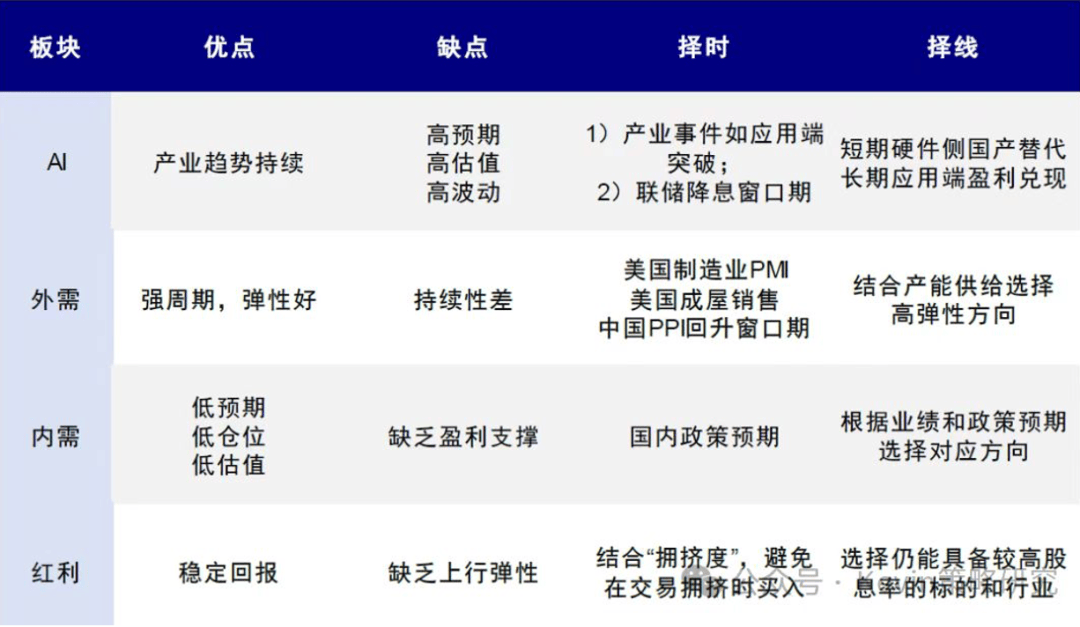
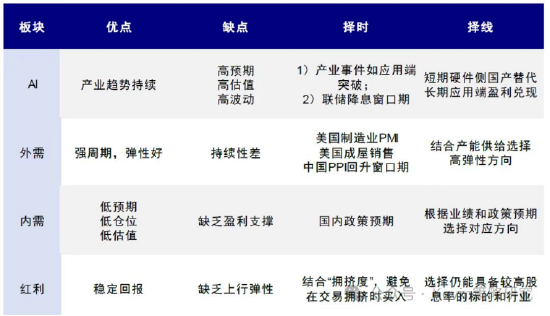
Group 1 - The core viewpoint indicates a "K"-shaped economic recovery, with a recommendation for balanced asset allocation amidst market volatility [1] - The sectors with growth potential include technology (driven by AI and policy support), upstream industries (like photovoltaic and lithium), and export-related sectors due to global manufacturing recovery [1] - The report suggests monitoring specific ETFs such as the non-ferrous metals ETF (561330) and cash flow ETF (159399) for investment opportunities [1][4] Group 2 - The analysis highlights the advantages and disadvantages of various sectors, noting that the AI sector has high expectations but also high volatility and valuation concerns [2] - The report emphasizes that the resumption of the U.S. credit cycle could lead to a global manufacturing rebound, supported by increased physical investment and a potential Fed rate cut [2] - The copper industry is noted for its strong profitability, while aluminum is more affected by the domestic real estate sector, suggesting a focus on mining ETFs for investment [4]
ETF日报:有色板块的景气度正在逐渐兑现,国内铜产业盈利能力较强,建议关注有色板块
Xin Lang Cai Jing· 2025-12-03 12:14
Market Overview - A-shares experienced a decline today, with the Shanghai Composite Index down 0.51% to 3878.00 points, the Shenzhen Component Index down 0.78%, the ChiNext Index down 1.12%, and the STAR Market Index down 0.95% [1][10] - The trading volume in the Shanghai and Shenzhen markets was approximately 16699.62 billion yuan, an increase of about 765.32 billion yuan compared to the previous trading day [1][10] - The market showed a low risk appetite, with 1443 stocks rising and 3876 stocks falling [1][10] Sector Performance - Dividend sectors performed well today, with transportation, non-ferrous metals, oil, mining, and coal showing positive results [1][10] - High-volatility sectors, including gaming, film and television, new energy vehicles, and computers, underperformed [1][10] - The market style showed that small-cap stocks lagged behind large-cap stocks, and growth stocks underperformed value stocks [1][10] Economic Outlook - The current macroeconomic state is characterized by a transition between old and new growth drivers, with a "K" shaped economic recovery [2][10] - Three sectors with growth potential identified are technology (AI revolution, policy support, overseas mapping), upstream anti-involution (solar, lithium batteries), and exports (global manufacturing recovery, positive overseas fiscal expectations) [2][10] - The technology and upstream sectors are still on an upward trend but carry risks due to previous significant gains [2][10] Investment Recommendations - Investors are advised to maintain a balanced allocation strategy, utilizing the "seesaw effect" to hedge daily volatility and optimize holding experiences [10] - Suggested ETFs for potential opportunities include non-ferrous metals 60 ETF (159881), mining ETF (561330), chemical leading ETF (516220), and industrial mother machine ETF (159667) [2][10] - As a hedging option, cash flow ETF (159399) is recommended [2][10] Bond Market Insights - The recent bond market environment shows a divergence between macro conditions and trading sentiment, with a weak nominal growth rate and a low interest rate environment supported by macro realities [7][16] - The People's Bank of China announced the purchase and sale of 50 billion yuan in government bonds, with the 30-year government bond yield rising by 2.40 basis points to 2.23% [14][16] - Financial institutions maintain a moderately optimistic outlook for the bond market in December, with a downward trend in funding rates observed since November [16][8]
市场风格切换了?要调仓吗?券商最新观点出炉
券商中国· 2025-11-05 04:12
Core Viewpoint - The A-share market is experiencing a significant style switch in November, with the banking sector leading the market gains while previously strong sectors like metals and new energy are declining [1][2]. Group 1: Market Trends - On November 4, the banking sector rose by 2.03%, leading the market, while the metals sector fell by 3.04% [1]. - Historical data shows that in bull markets, style switches are common at year-end, primarily driven by policy, industry trends, and fund reallocation [2][3]. Group 2: Institutional Behavior - In the fourth quarter, there is often pressure to realize gains in leading sectors, as these sectors have accumulated significant increases [4]. - As of Q3 2025, the electronic sector's holding ratio reached 25%, and TMT sector holdings exceeded 40%, both at historical highs [4]. Group 3: Investment Strategy - Investors are advised to adopt a balanced allocation strategy to navigate market volatility during the style switch period, while still recognizing the ongoing value in technology growth stocks [5]. - The macroeconomic environment is expected to favor growth stocks due to the anticipated easing of monetary policy in the U.S., which could enhance liquidity [5]. Group 4: Sector Recommendations - Current recommendations include focusing on traditional industries that show improved capital returns, such as non-bank financials, steel, basic chemicals, and machinery, despite their lack of investor interest [5][6]. - The recovery of global manufacturing is uneven but moving towards alignment, with the U.S. benefiting from AI spillover and emerging markets seeing a return of capital and capacity rebuilding [6].