
内需复苏

Search documents
越跌越买!资金,抄底ETF
Xin Lang Cai Jing· 2025-12-21 23:18
Core Insights - The satellite-related ETFs and tourism-related ETFs showed strong performance with gains exceeding 6% during the period from December 15 to 19, while cross-border ETFs faced declines [1][7] - The overall market experienced fluctuations, but there was a significant net inflow of over 87 billion yuan into ETFs, indicating a clear bottom-fishing sentiment among investors [8] - Broad-based ETFs attracted the most capital, with seven out of the top ten ETFs by net inflow being broad-based ETFs, including the A500 ETF and the ChiNext ETF [8] Performance Summary - The top-performing ETFs included: - Satellite ETF (E Fund) with a weekly gain of 7.04% and a turnover rate of 146.49% [9] - Tourism ETFs with gains of 6.77% and 6.71% respectively [9] - Other notable performers included the satellite industry ETF and the aerospace ETF, both showing gains above 5% [9] - Conversely, cross-border ETFs, particularly the Hong Kong Information Technology ETF and the S&P Oil & Gas ETF, experienced significant declines, with the Hong Kong Information Technology ETF down by 5.24% [10] Fund Flow Analysis - From December 15 to 19, several broad-based ETFs saw substantial net inflows, with the A500 ETF (E Fund) and the ChiNext ETF leading with net inflows of 27 billion yuan and 31 billion yuan respectively [11] - The inflow into cross-border ETFs and innovative bond ETFs was also notable, with several ETFs in these categories exceeding 10 billion yuan in net inflows [11] Trading Volume Insights - The trading volume for ETFs tracking the CSI A500 index was significantly high, with multiple ETFs achieving average daily trading volumes exceeding 70 billion yuan [12] - The top three ETFs by trading volume included the Hong Kong Securities ETF, A500 ETF (E Fund), and ChiNext ETF, with weekly trading volumes of 520 billion yuan, 290 billion yuan, and 191 billion yuan respectively [12] Market Outlook - Investment firms like Invesco Great Wall Fund maintain an optimistic outlook for the market, particularly in the equity sector, emphasizing technology as a key focus area for future growth [13] - Recommendations include a shift from defensive to aggressive positioning, with a focus on technology indices and sectors benefiting from domestic demand recovery [13]


机构持续看好2026年A股市场,上证180ETF指数基金(530280)备受关注
Xin Lang Cai Jing· 2025-12-18 03:44
Group 1 - The Shanghai Composite Index (000010) experienced a slight decline of 0.01% as of December 18, 2025, with mixed performance among constituent stocks [1] - Shanghai Airport (600009) led the gains with an increase of 6.70%, while Shengyi Technology (600183) saw the largest decline at 4.86% [1] - The industrial added value for November showed a year-on-year growth of 4.8%, with the equipment manufacturing sector growing by 7.7%, contributing 56.4% to industrial growth [1] Group 2 - The outlook for 2026 indicates a key policy resonance due to the start of China's 14th Five-Year Plan and the U.S. midterm elections, which is expected to drive PPI upward and transition the A-share market into a profit improvement-driven bull market phase [2] - A significant net inflow of funds into the A-share market is anticipated, supported by a favorable liquidity environment and a focus on "domestic demand recovery" and "technological self-reliance" as investment themes [2] - The top ten weighted stocks in the Shanghai 180 Index (000010) account for 26.13% of the index, with notable companies including Kweichow Moutai (600519) and China Ping An (601318) [2]
长城基金2026年度投资策略会: 市场转向盈利与估值双轮驱动 科技与价值共筑投资新锚
Zheng Quan Shi Bao· 2025-12-17 19:18
Core Insights - The investment strategy for 2026 will shift from valuation-driven to a dual focus on earnings and valuation, emphasizing technology autonomy, domestic demand recovery, and high-dividend assets [1][2] Group 1: Market Dynamics - The low interest rate environment is prompting a reassessment of asset values, with a focus on stable returns while managing risks [2] - The "fixed income +" products are expected to experience a third round of expansion, with the scale surpassing 2 trillion yuan by mid-2025, driven by demand for alternatives following regulatory changes and a recovering equity market [2] Group 2: A-Share Market Outlook - The A-share market is anticipated to transition from external demand-driven growth to a balance of internal and external demand, with a potential earnings growth turning point in 2026 [2] - After three years of decline, A-share earnings showed signs of stabilization in 2025, with expectations for further growth in 2027 [2] Group 3: Investment Directions - Four main domestic investment themes have been identified: 1. Semiconductor and military industries, with significant demand expected in 2026 [3] 2. "Anti-involution" sectors like chemicals and new energy, benefiting from policy-driven supply-demand improvements [3] 3. Service sector consumption, with increased policy support expected to boost recovery in travel and dining [3] 4. Real estate industry chain, projected to rebound in the second half of 2026 after a prolonged downturn [3] Group 4: International Investment Strategy - The "barbell strategy" emphasizes investments in U.S. tech stocks, which are pivotal in the AI revolution, and Hong Kong stocks, known for their high dividend yields, which have outperformed tech indices over the past decade [3] Group 5: Technology Sector Opportunities - The technology sector is expected to see sustained momentum, driven by global AI advancements and China's technological rise, with a balanced focus on domestic and international capabilities [4] - Key developments in AI, such as the emergence of DeepSeek and advancements in reusable rockets, are seen as critical milestones for the industry [4] Group 6: AI Industry Growth - The AI industry is still in its early growth phase, with no substantial bubble present, as current valuations are reasonable compared to historical tech bubbles [5][6] - The focus on AI infrastructure is strong, with significant opportunities anticipated in cloud applications, edge devices, and autonomous technologies [6] Group 7: Investment Strategies - Investment strategies include a focus on established "white horse" stocks while diversifying into promising second-tier leaders and hidden champions [7] - Attention is drawn to the "sweet spot" of the industry cycle, with a focus on high-growth potential in the application phase of AI technologies [7]
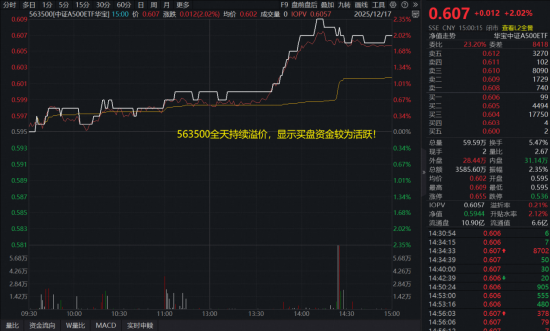
A股大反攻,CPO概念全天强势,新易盛涨超9%,中证A500ETF华宝(563500)迎本月单日最大涨幅!
Xin Lang Cai Jing· 2025-12-17 11:53
Market Overview - The market experienced a significant rise, with all three major indices increasing by over 1% by the end of the trading day [1] - The CPO concept showed strong performance throughout the day, contributing to market momentum [1] ETF Performance - The China Securities A500 ETF (563500) saw a notable increase of over 2%, closing above all moving averages with a trading volume of 35.85 million yuan [1] - The A500 ETF has experienced a significant inflow of over 22 billion yuan since December 1, indicating strong investor interest [2][8] Key Stocks - Among the top-performing stocks, Tianhua New Energy surged over 14%, while other stocks like Meinian Health, Guangxun Technology, and Yinvik hit the daily limit [10] - Notable gains were also seen in leading stocks such as Xinyi Technology and Zhongji Xuchuang, which rose by 9.55% and 6.92% respectively [10] Investment Strategy - According to招商证券, the outlook for 2026 suggests a key policy resonance that could support significant net inflows into the A-share market, driven by a favorable liquidity environment [3][9] - The investment strategy should focus on "style switching to seek cycles" and emphasize opportunities around "domestic demand recovery" and "technological self-reliance" [3][9] ETF Product Offerings - The "3A" ETF series includes the China Securities A500 ETF, A100 ETF, and A50 ETF, providing diverse options for investors to access core assets in the A-share market [5][11] - These ETFs are available for margin trading, allowing leveraged participation, and are also accessible to northbound capital [11] Regulatory Environment - Continuous regulatory efforts to encourage long-term capital inflows are expected to boost market confidence and improve the capital market ecosystem [5][9]


飞天茅台批价连续3日企稳!参照历史或为逐渐筑底信号
Mei Ri Jing Ji Xin Wen· 2025-12-17 09:12
12月17日,今日酒价最新披露数据显示,飞天茅台(2025散)批价连续3日企稳在1550元/瓶,飞天茅台 (2025散)批价上涨至1570元/瓶,蛇茅生肖酒批价上涨至1720元/瓶。贵州茅台股价及食品饮料ETF (515170.SH)也连续展开反弹。 回顾白酒行业历史上四起三落,三次调整周期都是经济与政策双向负面挤压的结果。参照上一轮调整周 期(2012~2016年)的三阶段演绎路径——阶段一,动销与批价加速下跌&报表端开始出清;阶段二, 动销与批价跌幅收窄&报表端持续出清;阶段三,动销与批价回升&报表端随后转正。 展望2026年,中国银河证券表示,12月重要会议将"扩大内需"放在重点工作首位,并且提出"制定实施 城乡居民增收计划""扩大优质商品和服务供给",看好人均收入改善与内需复苏对食品饮料整体带来的 贝塔修复。 投资方面,关注食品饮料ETF(515170.SH),标的指数为中证细分食品饮料产业主题指数 (000815.CSI)。与酒ETF相比,食品饮料ETF(515170.SH)放弃三四线酒企,更加聚焦"茅五泸汾 洋"等一二线白酒龙头企业,合计权重近六成,在行业调整周期,龙头公司有望充分受益尾部出清后的 ...

12月17日:沪深三大指数均涨超1%,创业板指涨超3%
Xin Lang Cai Jing· 2025-12-17 07:48
♨博时基金市场异动陪伴 市场表现: 责任编辑:江钰涵 ♨博时基金市场异动陪伴 市场表现: 12月17日,沪深三大指数均涨超1%,创业板指涨超3%。 解析: ‼今日A股全线上涨,其背后是政策预期强化、资金面积极信号与科技板块情绪催化共同作用的结果。 一方面,中央经济工作会议精神的具体解读陆续释放,清晰传递了稳增长、扩内需的政策优先级,有效 稳定并提振了市场预期。另一方面,社保基金会明确将发挥长期资金作用支持科技创新,为成长股提供 了重要的资金面与信心支撑。同时,科技领域新股上市后的强劲表现,激发了市场对相关产业链的关注 热度,带动了通信、算力等板块的情绪。综合来看,市场在前期调整后,随着政策细节明朗与积极信号 累积,迎来了情绪与估值的同步修复。 ‼中央财办有关负责同志在中央经济工作会议后详解明年政策重点,清晰传递了扩大内需作为明年首要 任务的政策导向,要从供需两侧协同发力,包括提振消费、扩大投资及稳定房地产市场,明确对于新型 消费、新基建等领域的结构性支持。同时,关于货币政策保持流动性充裕、促进融资成本下行的表述, 进一步缓解了市场对资金环境的担忧。这一系统性阐述强化了经济回升向好的政策预期,有助于推动市 场风 ...

A股盘前播报 | 扩内需成首要任务!消费再迎利好 长期资金有望持续发力
智通财经网· 2025-12-17 00:37
盘前要闻 1、中央财办有关负责同志:扩大内需是明年排在首位的重点任务 类型:宏观 情绪影响:正面 中央财办有关负责同志详解2025年中央经济工作会议精神。针对内需发展现状等问题,中央财办有关负 责同志表示,扩大内需是明年排在首位的重点任务,要提高养老、托育、医疗等民生类投资比重。房地 产方面表示,从供需两端发力稳市场,积极推动房地产企业转型发展,加快构建房地产发展新模式。 2、社保基金会表态:充分发挥长期资金、耐心资本作用 类型:宏观 情绪影响:正面 社保基金会党组召开会议传达学习中央经济工作会议精神。会议强调,充分发挥长期资金、耐心资本作 用,在守住安全底线的基础上,积极服务国家发展需要,更好支持科技创新和产业创新深度融合。系统 谋划社保基金事业"十五五"规划,推动社保基金事业高质量发展。 3、美国就业市场疲弱!交易员坚持押注:美联储在2026年会降息两次 类型:宏观 情绪影响:正面 投资日历 人工智能产业创新发展大会 投资锦囊 投资锦囊:获得巨额财富需要极大的胆识和谨慎的态度,当你一旦拥有大量财富,则需要有十倍的智慧 来留住它。 美国11月新增非农就业6.4万人,失业率意外升至4.6%为四年来新高,10月 ...
茅台控量,批价回升!机构看好传统消费底部贝塔修复
Mei Ri Jing Ji Xin Wen· 2025-12-15 01:26
Group 1 - The core message indicates that after the recent news regarding Moutai's control measures, the price of Moutai has started to rebound, with a cumulative increase of nearly 100 yuan over two days, bringing the price of the 25-year Flying Moutai from 1495 yuan to close to 1600 yuan as of December 14 [1] - Moutai's stock price stabilized and rebounded around 1400 yuan per share as of December 12 [1] - A recent meeting of Moutai's provincial distributors discussed the sales strategy for next year, focusing on three core products: Moutai 1935, Flying Moutai, and premium Moutai, while reducing the supply of non-standard products [1] Group 2 - China Galaxy Securities noted a slight adjustment in the food and beverage index since December, primarily due to a minor slowdown in monthly sales data, attributed to the timing of the Mid-Autumn Festival [1] - Looking ahead to 2026, China Galaxy Securities expects that the focus on expanding domestic demand and improving residents' income will positively impact the food and beverage sector, leading to a beta recovery [1] - In the context of the liquor industry, if sales and price declines narrow, it may gradually enter a bottoming phase, with liquidity improvements potentially driving slight valuation recovery [2]

招商证券:展望2026年 A股从牛市II阶段向以盈利改善为驱动力的“牛市III阶段”过渡
Ge Long Hui A P P· 2025-12-14 15:44
格隆汇12月14日丨招商证券研报指出,展望2026年作为中国"十五五"规划开局之年与美国中期选举年, 将形成关键的政策共振,推动PPI上行,A股从牛市II阶段向以盈利改善为驱动力的"牛市III阶段"过渡。 在过往两年赚钱效应不错和中高回报率资产荒的背景下,A股资金供需有望延续较大规模净流入,为实 现慢牛带来流动性支持。投资策略应把握"风格切换觅周期,双轮驱动看长远"的核心思路,投资机会围 绕"内需复苏"与"科技自立"两大主轴展开。风格方面,大小盘均衡,顺周期风格有望持续占优,行业层 面,关注顺周期与产能出清、科技创新与优势制造、扩内需三条线索,重点关注有色金属、机械设备、 电力设备、电子、传媒、社会服务等行业。 ...


ETF甄选 | 三大指数震荡走弱,卫星、港股消费、创新药等相关ETF表现亮眼
Xin Lang Cai Jing· 2025-12-11 10:00
Group 1: Market Overview - The market experienced a decline with major indices closing lower: Shanghai Composite Index down 0.70%, Shenzhen Component Index down 1.27%, and ChiNext Index down 1.41% [1] - Sectors showing gains included superconductors, controllable nuclear fusion, and non-metallic materials, while real estate services, real estate development, and commercial retail sectors faced declines [1] - Main capital inflows were observed in controllable nuclear fusion, superconductors, and wind power equipment industries [1] Group 2: Commercial Aerospace Investment - Guojin Securities noted that China is at a pivotal moment similar to SpaceX's network formation phase from 2018 to 2020, with a shift from custom satellite manufacturing to mass production [1] - The upcoming launch of the Wenchang Super Satellite Factory and SpaceX's planned IPO next year indicate a significant acceleration in global commercial aerospace investment and industrialization [1] - Key investment areas include commercial aerospace, low-altitude economy, and military trade, with advancements in reusable rocket technology expected to lower launch costs and accelerate satellite constellation deployment [1] Group 3: Consumer Market Trends - Multiple regions have introduced policies to boost consumption, with Jiangsu's "14th Five-Year Plan" focusing on expanding and upgrading consumer goods, particularly in automobiles and home appliances [2] - Haitong Securities highlighted a structural growth opportunity in the consumer sector driven by technological advancements and the emergence of new consumption trends, such as trendy toys and beauty products [2] - The outlook for 2026 suggests that ongoing consumption policies will stimulate supply and demand, leading to a steady recovery in domestic demand [2] Group 4: Innovation in Pharmaceuticals - Aijian Securities expressed optimism about the trend of Chinese innovative drugs entering international markets, noting that A/H innovative drug companies' valuations have returned to reasonable levels after adjustments [2] - The focus for 2026 will be on investment opportunities in key areas such as antibody-drug conjugates (ADC), bispecific antibodies, small nucleic acids, and weight-loss drugs [2] - CITIC Securities indicated that innovative drugs are expected to be a major upward trend in the cross-year market, supported by China's pharmaceutical industry's transition to "innovation realization + global layout" [3]