
市场回调

Search documents
【策略】短期调整,无需悲观——策略周专题(2025年10月第2期)(张宇生/王国兴)
光大证券研究· 2025-10-19 23:04
Core Viewpoint - The A-share market has experienced a pullback due to declining risk appetite, increased uncertainty in US-China relations, and a general market sentiment decline, with major indices showing a downward trend [4][5]. Market Performance - The A-share market saw a significant decline this week, with the STAR Market 50 index dropping the most at 6.2%, while the Shanghai 50 index fell the least at 0.2%. The overall valuation of the market is at a historically high level since 2010 [4]. - Market styles have diverged, with value stocks performing better. Large-cap value stocks increased by 2.1%, while mid-cap growth stocks decreased by 5.8% [4]. Short-term Market Outlook - The A-share market has shown notable volatility, with the Shanghai Composite Index briefly surpassing 3900 points, a level not seen since August 2015, before falling back below that threshold [5]. - Increased market volatility is attributed to high valuations and rising uncertainties in US-China relations, with the VIX index also showing a significant increase [5]. - Historically, pullbacks during bull markets are common, typically occurring after 60-80 trading days into a bull market, with a usual retracement of 6-7% before resuming upward movement [5][6]. Current Market Phase - The market is likely still in a bull phase, although it may enter a wide-ranging fluctuation stage in the short term. The maximum drawdown observed so far is 4.01%, which is within historical norms [6]. Sector Focus - In the short term, the focus should be on defensive and consumer sectors, as historically, these sectors perform better during market fluctuations. High-dividend stocks and consumer sectors such as food and beverage, social services, and beauty care are expected to benefit from increased domestic demand [7][8]. - In the medium term, attention should be directed towards TMT (Technology, Media, and Telecommunications) and advanced manufacturing sectors, which may gain traction due to liquidity-driven trends and ongoing developments in AI [8].


标普500指数短期波动风险未散 华尔街警示逢低买入者需谨慎
Zhi Tong Cai Jing· 2025-10-14 13:11
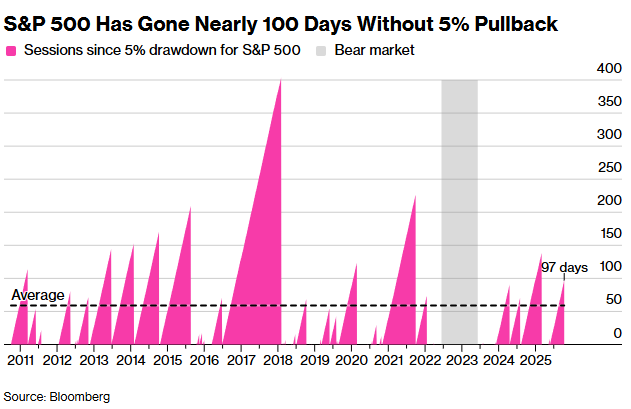
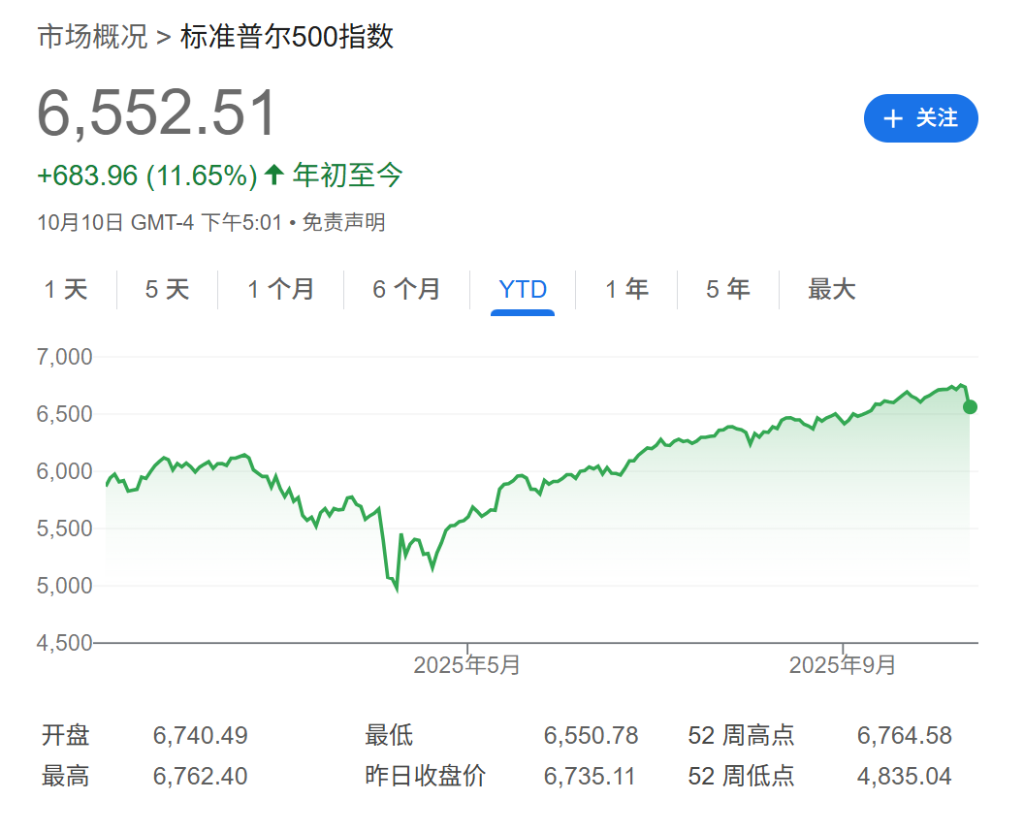
Group 1 - The S&P 500 index rebounded by 1.6% on Monday, recovering from a 2.7% drop the previous Friday due to renewed tariff tensions, marking the largest single-day decline since April [1] - Market observers from Morgan Stanley, Evercore ISI, and JPMorgan caution that investors eager to "buy the dip" should remain vigilant, as short-term volatility risks have not dissipated, compounded by high valuations and uncertainties surrounding government shutdowns and trade [1][4] - The S&P 500 index has not experienced a 5% pullback for 97 consecutive trading days, significantly exceeding the long-term average of 59 days, indicating accumulating pressure for a correction [1] Group 2 - Morgan Stanley strategist Michael Wilson suggests that while pullbacks may present long-term buying opportunities, short-term risks persist, with a pessimistic scenario predicting the S&P 500 could drop to 5800 points, a 13% decline from Monday's close if U.S.-China trade tensions remain unresolved before the November deadline [4] - JPMorgan's global market intelligence head Andrew Tyler maintains a bullish stance but warns of high valuations, concentrated positions, and the difficulty of achieving a trade truce, urging caution among investors [4] - Evercore ISI's chief strategist Julian Emanuel notes that the sell-off from last Friday is not fully over, with increased uncertainty potentially leading to reductions in active fund holdings, and highlights that the S&P 500 is currently in an overbought state after a 36% increase since April's low [4] Group 3 - On a technical level, Fundstrat's global technical strategist Mark Newton observes that the recent sell-off brought the S&P 500 down to a critical trendline support level, suggesting a 5% pullback could pave the way for further gains by year-end [5] - The Chicago Board Options Exchange's volatility index (VIX) closed at 21.66 last week, which is considered "calm" by historical standards, but there is an increase in demand for "right-tail hedging," indicating that the market is beginning to guard against extreme downside risks [5] - Hedge fund telemetry founder Thomas Thornton emphasizes that the influx of computer strategies, hedge funds, and retail investors into large tech stocks could lead to painful reversals if the market turns, and the expansion of leveraged ETF assets adds to the risk [5]


大摩Wilson警告:若贸易冲突不能在11月前解决,标普500将最多跌至5800点
Hua Er Jie Jian Wen· 2025-10-13 10:31
Core Viewpoint - Michael Wilson from Morgan Stanley warns that if trade tensions are not resolved before November, the U.S. stock market faces a potential decline of up to 11% [1][4]. Group 1: Market Predictions - In a pessimistic scenario, the S&P 500 index could drop to a range of 5800 to 6027 points, representing a decline of 8% to 11% from last Friday's closing price [1]. - Wilson highlights that the market is under pressure for a correction due to high investor exposure and elevated valuation levels [1][4]. Group 2: Recent Market Performance - The U.S. stock market experienced a significant drop last Friday, with the S&P 500 index falling by 2.7% and the Nasdaq 100 index plummeting by 3.5%, ending a record bull market driven by AI investments [3]. - As of the report, U.S. stock index futures showed an upward trend, with Nasdaq 100 futures rising by 2%, Dow futures up by 1.05%, and S&P 500 futures increasing by 1.5% [3]. Group 3: Trade Tensions and Economic Outlook - Wilson notes that the recent escalation in trade friction was unexpected, but the fundamental outlook remains optimistic [4]. - He emphasizes that if trade uncertainties persist into early November, a larger correction than most expect could occur [4]. - Despite short-term warnings, Wilson maintains that once trade tensions ease, the economy is expected to recover by 2026, supported by a strong argument that can withstand short-term tactical trade escalations [4].
IMF/世行峰会的焦点话题:全球央行探讨“股市崩盘怎么办?”
美股IPO· 2025-10-12 04:23
随着人工智能热潮推动全球股市估值飙升至历史高位,各国央行行长们正共同面对一个新的担忧:市场崩盘的危险。据媒体分析,他们或将重点讨论如 何应对一场潜在的市场崩盘及其对全球经济的冲击。 IMF总裁Kristalina Georgieva在近日的演讲中,已为未来几天的讨论定下基调。她直言不讳地承认了金融稳定面临的风险,并警告称: 资产估值正逼近我们25年前在互联网热潮中看到的水平。 全球央行行长将在下周IMF和世界银行秋季年会上重点讨论股市泡沫及潜在的崩盘风险。IMF总裁Kristalina Georgieva已经警告,当前资产估值已接近 25年前互联网泡沫时期的水平,市场若大幅回调将拖累全球经济。美联储、欧洲央行、英国央行等主均已对市场估值过高和回调风险表示担忧。 她表示,如果市场发生急剧回调,金融环境收紧可能会拖累世界经济增长,暴露脆弱性,并使发展中国家的处境尤为艰难。 这一次,Georgieva的警告比IMF在2000年10月会议上的评论更加直白。当时,在该基金组织的《世界经济展望》报告中,仅将股权估值描述为"仍然很 高",并提示失衡可能"以无序方式"释放。 在官员讲话方面,美联储主席鲍威尔定于下周二就经济和 ...
Major analyst drops 5-word take on market pullback
Yahoo Finance· 2025-10-11 16:02
The stock market never ceases to amaze, and with President Donald Trump in the driver’s seat, the script can flip at a moment's notice. Friday, Oct. 10 was one of those days when the screens bled red, traders went into crisis mode, and the “buy-the-dip” muscle memory came up against arguably its toughest test since spring. The spark was that President Trump announced his administration would slap 100% tariffs on Chinese imports, tightening U.S. software exports following Beijing’s move to curb rare-earth ...
帮主郑重:美股遭遇“黑色星期五” 纳指暴跌3.56% 这波回调该慌吗
Sou Hu Cai Jing· 2025-10-11 01:35
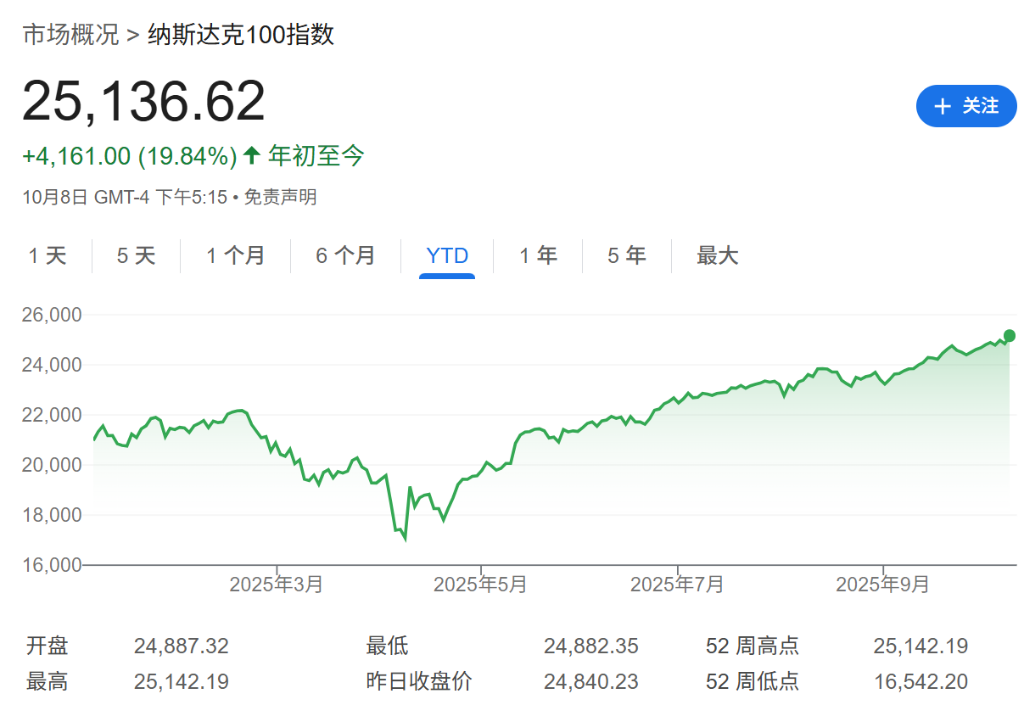
各位朋友早上好,我是帮主郑重——干了20年财经记者,也靠中长线投资摸爬滚打了这些年,凌晨美股那波跳水,估计不少人手机一震,心都跟着紧了 紧。毕竟纳指直接跌了3.56%,创下4月以来最大单日跌幅,这"黑色星期五"来得可一点不含糊。 其实早上打开行情软件时,盘面看得还挺清楚:不只是纳指,标普500跌了2.71%,道琼斯也跌了1.9%,等于三大指数集体"踩刹车"。更让人揪心的是连 带反应——原油跌超4%,眼看要摸到年内低点;比特币日内一度跌超10%,波动得让人眼晕;反倒是国债和黄金成了"避风港",十年期美债收益率跌了 近8个基点,现货黄金直接站上4000美元/盎司,这避险情绪算是拉满了。 再说说大家常关注的热门股,昨晚算是"集体遇冷"。科技巨头里,英伟达跌了4.89%,亚马逊跌4.99%,特斯拉跌5.06%,最狠的是台积电,直接跌了 6.41%;更麻烦的是盘后还在跌,英伟达、特斯拉又跌超2%,新思科技那些甚至跌超3%,科技股这波调整确实有点疼。中概股也没躲过,纳斯达克中国 金龙指数跌了6.10%,蔚来跌10.05%,富途控股跌11.15%,持仓的朋友估计昨晚没少盯盘。 顺便提两个值得留意的小消息:一是特斯拉在欧洲推 ...


Markets are seeing a needed correction and pullback, says 3Fourteen's Warren Pies
Youtube· 2025-10-10 20:26
Warren Pies is 314 Research's co-founder. He joins us now. I'm looking at 3.3% down on the NASDAQ.Is that what catches your eye the most. >> Yeah, thanks for having me. It it does.I mean, that's where the leadership's been. So, it's not surprising to see that's what's um giving the most back. You know, when I when I I it's a little bit of a stressful day, I guess, but when I zoom out and look at the market and where we've come from, we've gone now 119 trading days in a row without a 3% pullback on the S&P 5 ...
英国央行警告:AI估值"过高",数据中心"瓶颈"或引发市场回调
Hua Er Jie Jian Wen· 2025-10-09 13:12
Core Insights - The Bank of England has issued a clear warning that AI-related stock valuations are "overheated" and that the critical infrastructure supporting AI, such as data centers, faces "bottleneck" risks, which could lead to a significant market correction [1][4] - The central bank highlighted that the optimistic market expectations surrounding AI have pushed stock valuations to "tense" levels, with increasing market concentration making the stock market particularly vulnerable to shifts in sentiment [1][4] - The Bank of England emphasized that substantial bottlenecks in AI development, such as limitations in electricity, data, and commodity supply chains, could negatively impact company valuations, especially those reliant on high investment expectations in AI infrastructure [1][4] Valuation Concerns - The Bank of England believes that stock market valuations appear quite tense, particularly for technology companies focused on AI, with high valuations combined with increasing market concentration amplifying market fragility [4] - The current optimism in the market is largely based on expectations of continued large-scale investments in AI infrastructure, but the central bank warns that real-world resources required for AI development may not keep pace with explosive demand growth [4] - Concerns have been echoed by investment banks, with Goldman Sachs analysts identifying the power grid as a "vulnerable link" and warning it could become the next "bottleneck" [4] Diverging Opinions on AI Bubble - There is a significant divide among market giants regarding whether AI constitutes a bubble. Jeff Bezos views it as a potential "industrial bubble" that could drive societal progress, while other seasoned investors like Ray Dalio and David Einhorn express caution, likening current conditions to the late 1990s bubble [5] - Despite warnings, the complexity of financing mechanisms and strong government support may allow the current AI boom to continue expanding in the short term [5]
金价与美股罕见同步创历史新高,小心抛售潮也席卷一切!
Jin Shi Shu Ju· 2025-10-09 03:49
Core Viewpoint - The surge in gold prices to historic highs is seen as a hedge against the current concerns of the stock market being at historical peaks, driven by factors such as tariffs, inflation, and geopolitical instability [2][3]. Group 1: Market Dynamics - Gold futures reached a record high of $4,070.50 per ounce, while the S&P 500 index also hit a historical peak at 6,753 points [2]. - The uncertainty in the policy environment, including rising U.S. debt and geopolitical tensions, is prompting investors to seek hedging tools against market volatility [2][3]. - Historical data indicates that gold futures and the S&P 500 index have never both reached historical highs on the same day before 2024, despite brief instances in 2007 and 2020 [3]. Group 2: Investment Sentiment - The increase in gold prices, which have risen over 50% this year, is attributed to factors like "de-dollarization" and reduced exposure to U.S. debt [4]. - Gold is traditionally viewed as an asset with low or zero correlation to the stock market, but recent trends show a positive correlation between the two [4]. - Analysts express caution as both gold and the stock market are in an "melt-up" phase, raising concerns about potential market corrections if a triggering factor occurs [4][5].
FPG 财盛国际:金银价格强势攀升再创新高
Xin Lang Cai Jing· 2025-09-30 07:57
Core Insights - Gold and silver prices have reached new highs due to increased market risk aversion, driven by concerns over a potential U.S. government shutdown [1] - The political landscape is tense as bipartisan negotiations are ongoing to avoid a government shutdown, with differing priorities between Democrats and Republicans [1] - The weakening U.S. dollar and falling oil prices have provided additional upward momentum for gold and silver [2] Group 1: Market Performance - As of September 30, December gold futures rose by $47.00 to $3,855.80, while December silver futures increased by $0.434 to $47.09 [1] - The market sentiment is bullish for both gold and silver, with gold's next target being $4,000 and silver aiming for $50.00 [2] Group 2: Technical Analysis - December gold futures show strong bullish momentum, with resistance levels at $3,875 and $3,900, and support levels at $3,800 and $3,785.50 [2] - December silver futures also exhibit a strong bullish trend, with key support at $44.00 [2] Group 3: Market Outlook - The current bull market for gold and silver is maturing, indicating potential for a price correction in the short term, but still possessing upward potential [2] - Investors are advised to balance short-term risk aversion with long-term value allocation, while being mindful of possible high-level fluctuations and corrections [2]
