
盈利驱动

Search documents
上证指数13连阳打破记录 多路资金合力助推春季行情开启
Cai Jing Wang· 2026-01-07 02:05
Core Viewpoint - The A-share market has achieved significant milestones, with the Shanghai Composite Index closing at 4083.67 points, marking a ten-year high and a record 13 consecutive days of gains, indicating strong investor sentiment and a potential shift towards a balanced bull market in 2026 [1][2]. Market Performance - On January 6, all three major A-share indices rose, with the Shanghai Composite Index up by 1.50%, surpassing last year's high and reaching a ten-year peak [2]. - The market saw a surge in trading volume, reaching 2.83 trillion yuan, reflecting heightened investor enthusiasm [1]. - Notable sectors included brain-computer interfaces and commercial aerospace, with significant stock price increases and multiple stocks hitting their daily limit [2]. Fund Inflows - There is a strong expectation for capital inflows into the market, particularly from insurance and financing sectors, which are seen as core support for the current market rally [5]. - As of January 5, 2026, the financing balance reached a historical high of 2.54 trillion yuan, indicating robust market participation [5]. - Insurance funds have also seen substantial growth, with stock and fund allocations increasing by 1.49 trillion yuan since the beginning of the year [5]. Institutional Analysis - Analysts suggest that the current market dynamics are shifting from valuation-driven to profit-driven growth, with a more balanced market style expected [6][7]. - The ongoing economic recovery in China, supported by positive PMI data and industrial growth, provides a solid foundation for the stock market [7]. - Institutions recommend a balanced investment strategy, focusing on sectors like technology, consumer recovery, and high-dividend stocks [8][10]. Investment Strategies - Investment firms are advocating for a diversified approach, emphasizing sectors such as AI, semiconductor, and cyclical assets like metals and chemicals [8][10]. - There is a consensus on avoiding short-term speculation and focusing on long-term value in industries poised for growth [10]. - The recommendation includes a "barbell strategy," targeting both growth sectors and defensive assets to mitigate risks [8].
沪指13连阳创历史,业内人士:在向更均衡的全面牛市演进
21世纪经济报道· 2026-01-07 00:32
Core Viewpoint - The A-share market has achieved significant milestones, with the Shanghai Composite Index closing at 4083.67 points, marking a ten-year high and a record 13 consecutive days of gains, indicating strong investor confidence and a potential shift towards a balanced bull market in 2026 [1][3][7]. Market Performance - On January 6, all three major A-share indices rose, with the Shanghai Composite Index up 1.50%, surpassing last year's high and achieving a new ten-year peak [3]. - The market saw a trading volume of 2.83 trillion yuan, reflecting heightened investor enthusiasm [1]. - The brain-computer interface sector experienced a surge, with nearly 20 stocks hitting the daily limit, while the commercial aerospace sector also saw significant gains [3]. Sector Analysis - Key sectors leading the market included non-ferrous metals, non-bank financials, basic chemicals, and defense industries, driven by expectations of global supply chain restructuring and strong performance in the insurance and brokerage sectors [4][6]. - The Wenke Brain-Computer Interface Index rose by 12.97%, and the Commercial Aerospace Index increased by 9.49% in the first two trading days of 2026 [3]. Fund Flow and Investment Strategies - There is a strong expectation for capital inflow into the market, particularly from insurance companies, which saw a significant increase in new premium funds available for market allocation [5][6]. - As of September 2025, insurance funds allocated to stocks and funds reached 5.59 trillion yuan, an increase of 1.49 trillion yuan since the beginning of the year [6]. - The financing balance reached a historical high of 2.54 trillion yuan on January 5, 2026, indicating robust market liquidity [6]. Future Market Outlook - Analysts predict a transition from valuation-driven growth in 2025 to profit-driven growth in 2026, with a more balanced market style emerging [7]. - The market is expected to maintain an upward trend, supported by macroeconomic recovery, with key sectors such as technology, consumer goods, and new energy likely to see rotation and valuation recovery [7][9]. Investment Recommendations - Investment firms suggest a balanced allocation strategy, focusing on growth sectors like AI, while also considering defensive assets such as non-ferrous metals and chemicals [11][12]. - Emphasis is placed on long-term investment in sectors with strong fundamentals, avoiding short-term speculative trading [11][12].


公募基金勾勒2026年A股投资路径:盈利接棒,科技主线依旧
2 1 Shi Ji Jing Ji Bao Dao· 2026-01-05 12:37
Core Viewpoint - The consensus among public funds is that the A-share market in 2026 will transition from "valuation-driven" to "profit-driven," with expectations of a "slow bull" or "oscillating upward" market characterized by gradual improvement in corporate earnings [2][3][4]. Market Outlook - Public funds are generally optimistic about the A-share market in 2026, predicting a shift in market drivers from "valuation repair" in 2025 to "profit-driven" growth, leading to a potential upward trend [1][2]. - The market is expected to experience a gradual upward movement, with corporate earnings recovery being a key factor for stable growth [2][3]. Sector Focus - The technology sector is identified as the core investment theme, with a shift in focus from generalized computing infrastructure to specific applications and cutting-edge technologies [4][5]. - AI is highlighted as a critical mid-level variable influencing market resilience, with expectations for significant returns from AI applications [5][6]. Balanced Investment Strategy - There is a growing emphasis on a balanced investment strategy, moving from a growth-dominant approach in 2025 to a more equitable distribution between growth and value stocks in 2026 [7][8]. - The resource and dividend asset sectors are gaining attention, driven by expectations of a global manufacturing recovery and domestic policy improvements [8]. Consumer Sector Insights - The consumer sector, previously underperforming, is now viewed positively, with expectations for recovery in consumption growth as supportive policies are implemented [8].
内需消费板块或将“结构性崛起”
Sou Hu Cai Jing· 2026-01-02 00:20
Group 1 - The core viewpoint is that the A-share market is expected to continue its upward trend in 2026, shifting from "expected overshoot" to "profit realization" as the main driver of market pricing [2][5] - The investment opportunities are identified in the new productivity sectors (electronics, high-end equipment) and midstream manufacturing and upstream resource products [3][5] - The market structure in 2025 showed a significant divergence, with technology growth stocks leading the way, as the Sci-Tech 50 and ChiNext indices rose nearly 40% and about 50% respectively, outperforming blue-chip indices [4] Group 2 - The investment strategy should focus on sectors with strong profit certainty, moving from a narrative-driven approach to one based on profit verification [5][6] - The consumer sector is expected to experience a "structural rise" rather than a full recovery, with traditional consumption facing challenges despite potential rebounds in valuation [6][7] - The recommendation for asset allocation includes prioritizing new productivity sectors and cyclical products benefiting from PPI recovery, while maintaining low-volatility dividend assets as a base [8]

创金合信基金魏凤春:“盈利驱动”接棒 看好新质生产力和中游制造
Sou Hu Cai Jing· 2026-01-01 23:47
Core Viewpoint - The A-share market is expected to continue its upward trend in 2026, driven by a shift in market logic towards profit-driven growth, with a focus on new productive forces and midstream manufacturing [5][6]. Market Performance in 2025 - In 2025, the A-share market showed a strong performance, with the Shanghai Composite Index rising nearly 20% and the ChiNext Index increasing by approximately 50% [5]. - The technology growth stocks led the market, significantly outperforming blue-chip indices like the Shanghai 50 and CSI 300 [5]. Structural Changes in Market Dynamics - The structural divergence in the market was attributed to three main factors: a shift towards technology growth, a consensus narrative around tech innovation, and policy guidance that favored sectors with research barriers and growth potential [5][6]. - The market's focus shifted from liquidity-driven expectations to profit realization, with performance certainty becoming the core basis for valuation [6]. Investment Opportunities for 2026 - Investment strategies should focus on sectors benefiting from cyclical resonance, particularly in new productive forces (electronics, high-end equipment) and midstream manufacturing [6]. - The approach should follow the logic of "offensive relies on profit, defensive relies on liquidity," with a focus on dividend-paying state-owned enterprises as a base [6]. Consumer Sector Outlook - The consumer sector is expected to experience a "structural rise" in 2026 rather than a full recovery, with new consumption trends emerging as the main line of growth [7][8]. - Traditional consumption sectors, such as high-end liquor, may see a rebound due to valuation recovery rather than a significant improvement in end-demand [8]. Asset Allocation Strategy - The recommended asset allocation strategy emphasizes "offensive relies on profit, defensive relies on liquidity, and structural focus on divergence" [9]. - In the stock market, priority should be given to new productive forces and cyclical goods benefiting from PPI recovery, while maintaining low-volatility dividend assets as a foundation [9]. - For bonds, a strategy focusing on low volatility and narrow fluctuations is advised, with an emphasis on short-term high-rated credit bonds [9]. - Gold is suggested as a strategic allocation to hedge against extreme risks, supported by geopolitical risks and expectations of Federal Reserve easing [9].

工业利润累计增速连续4个月增长,装备制造业带动明显
Di Yi Cai Jing· 2025-12-27 02:34
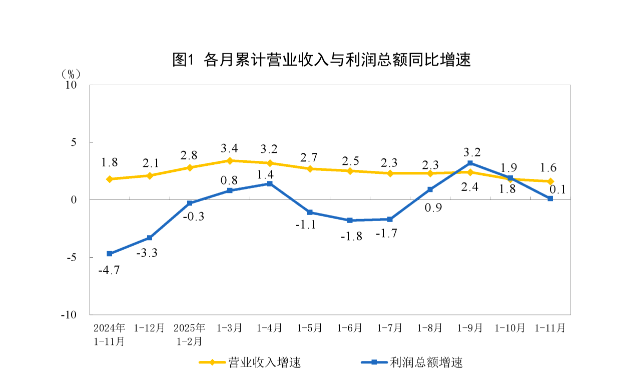
Core Insights - In November, profits of industrial enterprises above designated size decreased by 13.1% year-on-year, with the decline expanding by 7.6 percentage points compared to the previous month [1] - From January to November, profits of industrial enterprises above designated size grew by 0.1%, maintaining a growth trend for four consecutive months since August [1] Group 1: Profit Trends - In the manufacturing sector, profits increased by 5.0% from January to November, while the electricity, heat, gas, and water production and supply sector saw an 8.4% profit growth [3] - The mining industry experienced a profit decline of 27.2%, although the decline was narrowed by 0.6 percentage points compared to the first ten months of the year [3] Group 2: Sector Performance - The equipment manufacturing sector significantly contributed to profit growth, with a 7.7% increase in profits from January to November, accounting for a 2.8 percentage point increase in overall industrial profits [3] - High-tech manufacturing profits accelerated, with a 10.0% year-on-year increase, surpassing the average growth rate of all industrial enterprises by 9.9 percentage points [3] - The raw materials manufacturing sector also saw a robust profit growth of 16.6%, contributing 2.0 percentage points to the overall industrial profit growth [4] Group 3: Future Outlook - The overall profit growth of industrial enterprises indicates a continued upward trend, supported by new industrial dynamics, although challenges remain due to international uncertainties and structural adjustments [5] - The Ministry of Industry and Information Technology has set goals for 2026, prioritizing the stabilization of the industrial economy, with an expected 5.9% year-on-year growth in industrial added value for the year [5] - Analysts predict that industrial profits may recover from low levels, potentially achieving around 10% growth by the end of 2026, indicating a shift from policy-driven to profit-driven market dynamics [5]
股指转向进攻
Ge Lin Qi Huo· 2025-12-26 08:51
Report Industry Investment Rating No relevant content provided. Core Viewpoints of the Report - The stock index is turning offensive, and an upward market is expected to start before New Year's Day [65]. - China's stock market cycle is shifting from 'expectation-driven' to 'profit-driven', with profit realization and moderate valuation expansion as the core drivers of returns [20]. - Global funds are re - investing in China's stock market, and the technology sector is becoming a new battlefield for global funds to layout AI [20]. Summary by Related Contents Market and Index Information - Among the four stock index futures, the CSI 500 Index has the highest 'technology content' and is approaching its previous high [11]. - Institutional funds entered the market on a large scale through A500ETF, pushing the Shanghai Composite Index above 3950 points [14]. - As of December 19, the total scale of listed ETFs in the entire market reached 5.83 trillion yuan, a year - to - date increase of 2.09 trillion yuan, an increase of 56% [20]. - The trading strategy for stock index futures is to turn offensive and opportunistically establish long positions in stock index futures mainly based on growth - type indices [21]. - The trading strategy for stock index options is to turn offensive and opportunistically open call options on the CSI 1000 Index [22]. Economic Data in China - In November, the year - on - year growth rate of the core CPI was 1.2%, the real interest rate has been negative for consecutive periods, and the PPI increased by 0.1% month - on - month [23]. - The margin trading balance exceeded 2.5 trillion yuan, reaching a new high, and 2.38 million new A - share accounts were opened in November [25]. - China's export value in November was 330.3 billion US dollars, with a year - on - year growth rate of 5.9%, indicating that exports still have resilience [28]. - In November, the monthly value of manufacturing fixed - asset investment was 2.94 trillion yuan, with a year - on - year growth rate of - 4.4%, showing a stall in manufacturing investment [31]. - In November, the monthly value of infrastructure investment was 2.08 trillion yuan, with a year - on - year growth rate of - 11.9%, indicating a stall in infrastructure investment and reflecting local fiscal difficulties [34]. - In November, the year - on - year growth rate of real estate development investment was - 31.3%, hitting a new low [37]. - The total retail sales of consumer goods in November was 4.38 trillion yuan, with a year - on - year growth rate of 1.3%. Consumption has become the main driving force for economic growth [40]. Economic Data in the United States - The US core CPI in November was 2.6%, far lower than the expected 3.0% [43]. - The number of initial jobless claims in the US in a week was 224,000, and the unemployment rate rose to 4.6% [46]. - In November, the newly - added ADP employment in the US showed negative growth, and the number of active corporate lay - offs increased rapidly [49]. - In October, the total retail and food sales in the US had zero month - on - month growth, indicating a weakening of US consumption [52]. - In September, both the year - on - year and month - on - month growth rates of US capital goods import value decreased rapidly, suggesting a poor manufacturing outlook [55]. - In November, the ISM manufacturing PMI price index continued to expand, and the service PMI price index still expanded rapidly, indicating an acceleration of inflation in the US [58]. Situation in Japan - The Bank of Japan raised interest rates by 25 basis points to 0.75%, and the yield of Japan's 10 - year government bonds soared above 2.0%. The large - scale return of yen carry trades will have a negative impact on US bonds and stocks [61][62]. Industry - Specific Events - On December 6, LandSpace Technology verified the vertical recovery technology of the first - stage rocket [7]. - The US and China are in a fierce space infrastructure competition, and the commercial space industry has entered a high - growth phase led by national will [4].
华安证券刘超:2026年A股切换至盈利时间,紧扣AI与涨价双主线
Sou Hu Cai Jing· 2025-12-25 22:36
Core Viewpoint - The Chinese economy is transitioning from a liquidity-driven valuation expansion to a profit recovery cycle, with structural changes in consumption, precise policy support, and broad profit recovery as the three pillars for understanding the market dynamics leading to 2026 [1]. Group 1: Consumption Dynamics - Investment and exports are expected to stabilize or face mild pressure by 2026, while internal structural changes in consumption will be key to economic resilience [4]. - Consumption is entering a slow upward trajectory, with policy support shifting from goods to services. The marginal impact of traditional consumption stimulus policies, such as trade-in subsidies, is diminishing [5]. - Consumption growth is projected to maintain a rate of around 4% in 2026, reflecting a significant transformation in growth dynamics, aligning with the "14th Five-Year Plan" focus on developing a strong domestic market and fostering new consumption types [5][6]. Group 2: Profit Recovery - Broad profit recovery among enterprises is expected to provide a solid foundation for the market, with nominal GDP significantly rising due to price improvements and sustained profit recovery [7]. - The overall profit growth for the A-share market is forecasted to increase from 8.2% in 2025 to 10.3% in 2026, with the ChiNext and STAR Market expected to see profit growth rates of 31.7% and 34.3%, respectively [7][8]. - The improvement in profit growth is attributed to a new industrial cycle driven by AI and internal profit recovery among companies [7]. Group 3: Investment Strategies - The core investment strategy for A-shares in 2026 will focus on the new growth cycle in technology industries and the price increase chain driven by supply-demand logic [9]. - The AI industry chain is identified as a strong technology focus, with significant potential in the computing power sector, while auxiliary equipment demand is expected to rise alongside infrastructure development [9]. - The storage industry is facing structural supply-demand contradictions, with AI-driven demand expected to sustain long-term growth, alongside opportunities in sectors benefiting from high overseas growth and national defense industries [10].


招商证券首席策略分析师张夏:市场驱动力切换 布局顺周期与科技自立双主线
Mei Ri Jing Ji Xin Wen· 2025-12-25 17:40
Core Viewpoint - The year 2026 will mark a critical turning point for the A-share market, transitioning from liquidity-driven to profit-driven growth, driven by a rebound in PPI and a dual focus on domestic demand recovery and technological self-reliance [1] Group 1: Macroeconomic Environment - The growth model reliant on real estate and infrastructure credit expansion has weakened, with government spending becoming the core marginal force for total demand fluctuations since 2022 [2] - The "14th Five-Year Plan" is expected to maintain an expansionary fiscal policy, with infrastructure and major projects driving investment and countering export decline [2] - The year 2026 coincides with the U.S. midterm elections, historically leading to expansionary fiscal and monetary policies in the U.S., which will resonate with China's policies, potentially boosting global demand for industrial metals [2] Group 2: Market Transition - The A-share market is transitioning from a liquidity-driven phase to a profit-driven phase, with PPI recovery being a key variable indicating substantial improvement in corporate profits [4] - Historical patterns show that industries like oil, non-ferrous metals, coal, and basic chemicals are highly correlated with PPI and commodity prices [4] - The market is expected to enter a profit-driven phase, with small-cap growth stocks likely to outperform as PPI improves [4] Group 3: Investment Opportunities - Investment strategies should focus on the dual drivers of domestic demand recovery and technological self-reliance, particularly in the domestic computing power industry [5] - The recovery of the consumer services sector is anticipated to be driven by multiple factors, including policy goals to enhance consumer spending and structural trends like aging populations and the rise of younger consumers [6] - The domestic AI chip market is expected to gain historical market share against foreign competitors, with key areas including integrated circuits and foundational software [6] Group 4: Industry Focus - Recommended sectors for investment include cyclical industries, technology innovation, and consumer recovery, with a focus on non-ferrous metals, machinery, power equipment, electronics, media, and social services [6]

星石投资副总经理方磊:2026年驱动A股的核心变量是盈利要素
Mei Ri Jing Ji Xin Wen· 2025-12-25 14:54
Core Viewpoint - The A-share market is expected to enter a bull market in 2025, supported by policies, valuations, earnings, and capital, with a notable differentiation in market segments anticipated in 2026 as the "14th Five-Year Plan" begins [1] Group 1: Market Drivers - The core variable driving the stock market in 2026 is expected to be earnings, transitioning from valuation-driven to earnings-driven performance, with all sectors presenting investment opportunities [2] - The market style in 2026 is anticipated to be more balanced compared to 2025, as various sectors, including traditional industries, are expected to show earnings recovery and valuation repair [2] Group 2: Investment Opportunities - In 2026, institutional funds are likely to shift towards new consensus areas beyond just technology growth sectors, expanding into traditional industries as the overall market enters an earnings release phase [2] - The "14th Five-Year Plan" emphasizes improving domestic consumption and technological self-reliance, indicating significant long-term investment opportunities in these areas [3] Group 3: Investment Strategies for Ordinary Investors - Ordinary investors should focus on balancing long-term and short-term investment strategies, adjusting their portfolio based on individual risk preferences and return expectations [4] - For long-term investments, attention should be paid to industry trends and fundamental changes, while short-term opportunities require monitoring of price fluctuations and relative valuations [4] Group 4: Changes in Valuation Logic - The emphasis on "technological self-reliance" in the "14th Five-Year Plan" is expected to reshape the valuation system of A-shares, with a potential reduction in mid-term volatility of technology stock valuations [6] - The focus on core technology autonomy and industry policy support may increase the weight of non-financial indicators in valuation assessments [6] - Valuation logic in the technology sector may evolve from a focus on individual segments to a more integrated approach across entire industry chains, creating a linked valuation framework [6] Group 5: Recommendations for 2026 - A balanced and long-term investment approach is recommended for 2026, with a focus on fundamental factors such as corporate earnings, while avoiding speculative trading [7] - The current market conditions suggest that equity assets still hold mid-to-high investment value, despite some high valuations potentially leading to short-term volatility [7]