
货币政策分化

Search documents
“特朗普变量”搅得金融市场天翻地覆 美联储与全球央行政策路径愈发分化
智通财经网· 2026-01-12 03:03
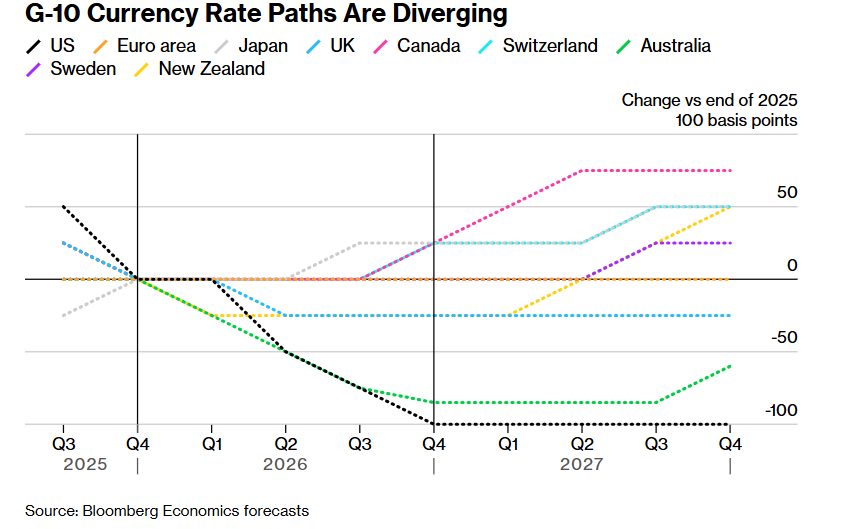
Group 1 - The core viewpoint of the articles highlights the divergence in global central bank monetary policies due to the influence of U.S. President Trump's administration and its impact on economic uncertainty and market volatility [1][5][8] - Bloomberg Economics predicts that the monetary policy paths of major economies will become increasingly diverse over the next two years, moving away from the synchronized approach seen in recent years [4][8] - The "Trump variable" is identified as a significant factor affecting global central bank policy decisions, particularly regarding interest rate expectations and the independence of the Federal Reserve [5][9] Group 2 - The articles indicate that the Federal Reserve's monetary policy may be more flexible than previously anticipated, with expectations of potential rate cuts in 2026 exceeding market predictions [11][12] - Other major central banks, such as those in Canada, Japan, and Switzerland, are expected to announce continued rate hikes, while the Eurozone may maintain its current policy rates [11][12] - Emerging market countries, including Brazil and Nigeria, are anticipated to implement significant rate cuts, further contributing to the divergence in global monetary policy [11][12]

突发瑞郎创三月新低跌破关口
Jin Tou Wang· 2026-01-09 02:27
经济基本面表现与美元指数走势进一步加剧汇率分化。瑞士经济展现出较强韧性,2025年三季度GDP虽 受制药行业拖累收缩,但制造业和服务业增长形成有效对冲,央行预计全年增速略低于1.5%,且12月 KOF经济领先指标升至103.4,创下自2024年9月以来的最高水平,预示经济前景向好。更关键的是, 2025年11月美瑞贸易协议生效,美国对瑞士商品关税从39%大幅降至15%,显著缓解出口压力,为瑞郎 提供基本面支撑。而美元端则承压明显,2025年美元指数累计下跌幅度超10%,叠加美国ISM制造业 PMI持续收缩,进一步压制美元兑瑞郎走势。 全球避险情绪变化与央行干预预期也在短期影响汇率走势。当前全球避险情绪阶段性降温,削弱了美元 的避险需求,而瑞郎凭借其传统避险货币属性,仍获得部分资金青睐,进一步拉大与美元的走势分化。 值得注意的是,瑞士央行在2025年三季度曾买入7500万瑞士法郎外汇以减缓瑞郎升值节奏,虽干预力度 有限,但市场始终关注其后续干预动作,这成为抑制瑞郎过度升值的潜在因素,也对美元兑瑞郎形成短 期制衡。 展望2026年,美元兑瑞郎大概率维持中长期弱势格局,核心变量集中在三大方面。其一,美联储降息节 奏 ...
加元偏强震荡政策原油成关键
Jin Tou Wang· 2026-01-09 02:25
Core Viewpoint - The USD/CAD exchange rate is expected to maintain a strong oscillating trend until January 9, 2026, influenced by the divergence in monetary policies between the US and Canada, changes in oil supply expectations, and differences in economic growth rates [1][2]. Monetary Policy Divergence - The divergence in monetary policy is the primary driver of the exchange rate. In 2025, the Federal Reserve cut rates by a total of 75 basis points, bringing the federal funds rate to a range of 3.5%-3.75% by year-end, with expectations of two more cuts in 2026. In contrast, the Bank of Canada was more aggressive, cutting rates by 100 basis points over four occasions, ending the year at 2.25%, with no further cuts expected before March 2026 [1][2]. Economic Growth Disparities - Economic growth differences and oil supply expectations exacerbate exchange rate volatility, creating a "policy support" versus "commodity suppression" dynamic. The OECD forecasts US GDP growth at 1.6% for 2025 and 1.5% for 2026, while Canada is projected to grow by 1% in 2025 and slightly increase to 1.1% in 2026. Both countries face slowing growth pressures, but Canada is more vulnerable due to its high dependency on US exports [2]. Oil Supply Sensitivity - The Canadian dollar, as a commodity currency, is highly sensitive to oil supply and demand dynamics. Recent signals from the US regarding the potential re-importation of Venezuelan oil have raised concerns about increased competition for Canadian oil demand, significantly suppressing the performance of the Canadian dollar [2]. Geopolitical and Global Risk Factors - Geopolitical issues and global risk sentiment are currently influencing exchange rate movements. Concerns over the return of Venezuelan oil have led to a risk-averse stance towards the Canadian dollar, providing temporary upward momentum for the USD/CAD exchange rate. However, the potential for further rate cuts by the Federal Reserve limits the upside for the dollar [2]. Outlook for 2026 - The USD/CAD exchange rate is likely to remain in a high oscillating trend, with three core variables influencing this outlook: uncertainty in the Federal Reserve's rate-cutting pace, changes in oil supply dynamics, and differences in the monetary policy paths of the US and Canada. Additionally, potential changes in the Federal Reserve chairmanship and reviews of the US-Mexico-Canada Agreement could trigger short-term volatility [3].
澳元走强通胀成博弈点
Jin Tou Wang· 2026-01-07 02:46
2026年开年以来,澳元兑美元延续2025年的强势格局,呈现震荡偏强态势。截至1月7日10时35分,该货 币对报0.6749,较前一交易日上涨0.0012,涨幅达0.1930%,日内最高触及0.6752,最低下探0.6714,展 现出较强韧性。回顾2025年,澳元兑美元上演惊艳V型反转,从4月的五年低点0.5922美元一路反弹,年 末突破0.67关键关口创下14个月新高,全年累计涨幅超7%,跻身全球主要货币表现前列。 本轮澳元走强的核心驱动力源于澳美两国货币政策的显著分化。澳大利亚联储(澳联储)全年释放明确鹰 派信号,连续维持基准利率于3.6%不变,12月会议纪要强调通胀风险偏向上行,宣告降息周期彻底终 结,行长Bullock更明确表态"完全没有考虑过降息",甚至讨论2026年加息可能性。当前市场对澳联储 政策定价持续调整,2月加息概率升至32%,3月逼近50%,澳新银行等机构预测基准利率或上调至 3.85%。与之形成鲜明对比的是,美联储在2025年累计降息75个基点,当前政策利率维持在3.5%-3.75% 区间,尽管部分官员释放偏鹰信号,但市场仍预期2026年可能继续降息两次,这种政策分歧直接推动澳 美利差 ...
2026宏观年度报告:经济复苏缓慢,美国中期选举年
Ning Zheng Qi Huo· 2026-01-07 01:40
宁证期货投资咨询中心 投资咨询业务资格: Z0012851 F3008987 2026 宏观年度报告 Buge 经济复苏缓慢,美国中期选举年 摘 要: 2025 特朗普的第二任期内,再次发动针对全球的关税大战,并以中美元首釜 山会晤告一段落。上半年全球经济复苏较为强劲,下半年关税效应凸显,经济有 所承压,整体来看 2025 年全球经济依然具有较大韧性,展望 2026 年,全球经济 或依然处于缓慢复苏的阶段,压力与挑战并存,但是主要经济体的发展阶段和央 行策略或有所分化。 证监许可【2011】1775 号 2025 年,美国经历了历史上最长政府停摆,很多经济数据无法及时追踪,从 目前来看,虽然美国通胀有持续走高的压力,就业数据也有所恶化,但整体来看 美国经济依然具有较大韧性,展望 2026 年,在中期选举及美联储高层更换的背 景下,降息周期持续,财政刺激不会缺席,美国经济依然不悲观。欧盟 2025 年 经济复苏整体不及预期,俄乌冲突没有根本性解决,拖累了欧盟的复苏动力和进 程,2026 年如果俄乌冲突彻底画上句号,那么全球经济增长动能或有所增加,欧 元区处于一个经济缓慢复苏,货币政策较为稳定的局面。日本由于通胀 ...
ETO Markets 外汇:英镑25年涨7% 26年核心看英美央行政策分化
Sou Hu Cai Jing· 2026-01-06 03:37
Core Viewpoint - The British pound is expected to exhibit a volatile upward trend against the US dollar in 2025, supported by a weaker dollar and diverging monetary policies between the UK and the US [1][3]. Group 1: External Environment - The US dollar index is projected to decline significantly in 2025, with an annual drop of approximately 9% [3]. - The Federal Reserve is anticipated to cut interest rates by a total of 75 basis points during the year, leading to decreased attractiveness of dollar assets and a shift towards non-US currencies, benefiting the pound [3]. - The Bank of England is expected to maintain a cautious approach to monetary easing, with only a 50 basis point rate cut for the year and a stable rate at the end of the year, reflecting ongoing concerns about inflation risks [3]. Group 2: Monetary Policy Outlook - The Federal Reserve's policy will remain a key variable influencing the GBP/USD exchange rate in 2026, with market expectations of potential further rate cuts, though inflation risks may limit the extent of easing [3][5]. - The Bank of England's easing expectations are relatively moderate, with some institutions predicting possible rate cuts in 2026, but actual adjustments may be less than initially anticipated due to sticky service sector inflation and economic recovery uncertainties [3]. Group 3: Market Focus and Technical Analysis - In the short term, market attention will be on signals from the US and UK central banks and key economic data [4]. - US manufacturing and consumer confidence indicators will impact perceptions of the Federal Reserve's policy path, while UK inflation trends will influence the Bank of England's future policy [5]. - Technically, the GBP/USD pair has support around 1.3350 and resistance near 1.3480, indicating that the exchange rate will be closely tied to policy expectations and fundamental changes [5].

政策分化叠加油价波动 加元震荡拉锯
Jin Tou Wang· 2026-01-06 01:57
Group 1 - The USD/CAD exchange rate is currently in a volatile range, driven by the divergence in monetary policies between the Federal Reserve and the Bank of Canada, along with fluctuations in international oil prices and the structural trends of the US dollar index [1][2] - The Federal Reserve has initiated a monetary easing cycle, with a cumulative rate cut of 75 basis points expected by 2025, while the Bank of Canada is maintaining its benchmark rate at 2.25% after four rate cuts in 2025, indicating a cautious policy stance [1][2] - The Canadian dollar's performance is closely linked to oil prices, which have recently declined due to OPEC+ production plans and weakening demand expectations, thereby reducing the attractiveness of the CAD [2] Group 2 - The USD index has seen a cumulative decline of over 9% in 2025, with predictions of a further 10% depreciation by the end of the year, which indirectly affects the USD/CAD exchange rate [2] - The technical analysis indicates that the USD/CAD exchange rate is currently stable within a range, with no clear trend signals, and short-term indicators suggest a lack of momentum for significant breakthroughs [2] - Looking ahead, the USD/CAD exchange rate is expected to maintain its volatile range, with key resistance at 1.38 and support at 1.3750, while monitoring the monetary policy statements from the Federal Reserve and the Bank of Canada, as well as economic data from both countries [3]
瑞郎年初走势平稳2025累计跌幅超12% 政策避险成核心驱动
Jin Tou Wang· 2026-01-05 02:30
经济基本面与贸易环境的变化进一步夯实了瑞郎的支撑。瑞士经济展现出分化韧性,2025年三季度GDP 虽受制药行业拖累收缩,但制造业和服务业的增长形成有效对冲,央行预计全年增速略低于1.5%。更 关键的是,2025年11月美瑞贸易协议生效,美国对瑞士商品关税从39%大幅降至15%,显著缓解了瑞士 的出口压力,为瑞郎基本面注入强心剂。同时,瑞士2025年12月KOF经济领先指标升至103.4,创下自 2024年9月以来的最高水平,超出市场预期,反映出制造业与建筑业表现强劲,预示瑞士经济在2026年 初前景向好,进一步强化了瑞郎的吸引力。而美元端则受广谱弱势拖累,2025年美元指数累计下跌约 9%,兑十国集团货币普遍走弱,叠加美国双赤字与高估值问题未得到根本解决,构成了美元的结构性 压制。 展望后续,市场需重点关注三大核心线索:一是美联储政策动向,包括1月议息会议结果、会议纪要释 放的政策信号以及延后发布的非农就业报告,这些将直接影响市场对降息节奏的预期,进而重塑美瑞利 差格局;二是瑞士通胀数据与央行表态,若通缩压力上升引发降息预期,可能改变瑞郎的短期走势;三 是全球避险情绪与美瑞贸易协议执行进展,突发风险事件或政策 ...
曲径分岔:政策分化中把握中久期良机
国泰海通· 2026-01-03 08:43
Group 1 - The report highlights the divergence in global monetary policies, with the Bank of Japan raising interest rates by 25 basis points to 0.75%, marking a 30-year high, while the European Central Bank maintained rates and the Bank of England cut rates by 25 basis points [7][8] - Emerging market bonds have shown strong performance, with a weekly return of 0.32%, outperforming U.S. Treasuries by 2 basis points, and an annual return of 10.9%, leading U.S. Treasuries by 454 basis points [9][10] - The report suggests a focus on 5-7 year medium to long-term bonds to balance duration and reinvestment risks, aiming for a yield close to 4% [36] Group 2 - The U.S. Treasury yield curve has flattened, with the 10-year yield dropping by 1.7 basis points to 4.13%, while the 1-year yield fell significantly by 2.4 basis points to 3.49% [10][11] - In contrast, UK government bond yields surged, with the 20-year yield rising by 14.24 basis points to 5.15%, reflecting increased inflation expectations and fiscal pressures [10][11] - Japanese government bonds saw a rise in yields across the board, with the 10-year yield increasing by 7 basis points to 2.04% following the central bank's rate hike [10][11] Group 3 - The report notes that the corporate bond market in the U.S. is expected to see daily trading volumes surpassing $50 billion, driven by record issuance levels [9][10] - Investment-grade credit spreads in the U.S. have narrowed, indicating a recovery in risk appetite, while high-yield spreads decreased significantly by 14 basis points to 6.53% [10][11] - The report emphasizes the importance of selecting medium to long-term, high-quality credit and high-yield assets from emerging markets to construct a balanced investment portfolio [36]
加元震荡整理油价成核心博弈点
Jin Tou Wang· 2025-12-31 02:33
Core Viewpoint - The USD/CAD exchange rate is experiencing narrow fluctuations, influenced by international oil prices, divergent monetary policies, and geopolitical risks [1] Group 1: Currency Fluctuations - The USD/CAD exchange rate closed at 1.3696, with a slight increase of 0.09%, and reached a peak of 1.3700 during the day [1] - The Canadian dollar, as a commodity currency, is highly correlated with oil prices, which have stabilized around $57.80 per barrel [1] - Geopolitical risks, including conflicts in Venezuela and Ukraine, are providing support for the Canadian dollar [1] Group 2: Oil Prices and Economic Indicators - WTI crude oil prices rose by 1.6% the previous day, but there are concerns about OPEC+ increasing production, which could lead to a decline in oil prices and weaken support for the Canadian dollar [1] - The Canadian economy shows positive indicators with a November CPI of 2.2%, an addition of 53,000 jobs, and a GDP growth of 2.6% in Q3, supporting the Canadian dollar [1] Group 3: Monetary Policy Divergence - The Federal Reserve has cumulatively cut interest rates by 75 basis points in 2025, with expectations for continued easing in 2026, which diminishes the dollar's interest rate advantage [1] - The Canadian central bank has maintained a benchmark interest rate of 2.25%, with a cautious neutral tone, and there are market expectations for a potential rate cut in Q1 2026 [1] Group 4: Technical Analysis - The exchange rate is in a high-level consolidation phase, trading within the range of 1.3620 to 1.3800, with the 50-day moving average providing medium-term support [2] - Key support levels are identified at 1.3650 to 1.3620, with potential declines to 1.3550 to 1.3580 if these levels are breached [2] - Resistance levels are noted at 1.3720 and 1.3800, with analysts suggesting that the exchange rate may continue to oscillate within this range [2]