
通缩风险

Search documents
超长债周报:情绪压制,超长债小跌-20250714
Guoxin Securities· 2025-07-14 07:39
Report Industry Investment Rating No relevant content provided. Core Viewpoints - This week, there were many negative factors in the bond market, including a tightening of the capital market, relatively smooth progress in tariff updates, and a certain increase in the stock market and commodities during the domestic "anti-involution" movement, which suppressed bond market sentiment. The bond market fell rapidly throughout the week, with ultra-long bonds experiencing a slight decline [1][3][12][35]. - As of July 11, the spread between the 30-year Treasury bond and the 10-year Treasury bond was 21BP, at a historically low level. The 5-month domestic GDP year-on-year growth rate was about 5.0%, slightly lower than April but still higher than the annual economic growth target. There is still a risk of deflation. The bond market has more opportunities than risks as the 10-year Treasury bond approaches 1.7%, but the term spread protection for the 30-year Treasury bond is limited [2][13]. - As of July 11, the spread between the 20-year China Development Bank bond and the 20-year Treasury bond was 3BP, at a historically extremely low level. The domestic economy still shows resilience, but there is still downward pressure. The bond market has more opportunities than risks as the 10-year Treasury bond approaches 1.7%, but the spread protection for the 20-year China Development Bank bond is limited [3][14]. Summary by Directory Weekly Review - **Ultra-long Bond Review**: This week, the bond market was affected by multiple negative factors, resulting in a rapid decline in the bond market and a slight decline in ultra-long bonds. Last week, the trading activity of ultra-long bonds decreased slightly but remained quite active. The term spread of ultra-long bonds remained flat, and the variety spread narrowed [1][12]. - **Ultra-long Bond Investment Outlook**: For 30-year Treasury bonds and 20-year China Development Bank bonds, the spreads are at historically low levels. The domestic economy shows resilience but also faces downward pressure. The bond market has more opportunities than risks as the 10-year Treasury bond approaches 1.7%, but the spread protection is limited [2][3][13][14]. - **Ultra-long Bond Basic Overview**: As of June 30, the balance of outstanding ultra-long bonds exceeded 22.2 trillion yuan, accounting for 14.5% of the total bond balance. Local government bonds and Treasury bonds are the main varieties. The 30-year variety has the highest proportion [15]. Primary Market - **Weekly Issuance**: Last week (July 7 - July 11, 2025), the issuance of ultra-long bonds increased slightly, totaling 83 billion yuan. By variety, local government bonds accounted for the majority. By term, 30-year bonds had the largest issuance volume [20]. - **This Week's Planned Issuance**: The announced ultra-long bond issuance plan for this week totals 224.1 billion yuan, including 123 billion yuan of ultra-long Treasury bonds and 101.1 billion yuan of ultra-long local government bonds [24]. Secondary Market - **Trading Volume**: Last week, the trading of ultra-long bonds was quite active, with a trading volume of 1.0286 trillion yuan, accounting for 12.5% of the total bond trading volume. The trading activity decreased slightly compared to the previous week [27]. - **Yield**: This week, due to multiple negative factors, the bond market fell rapidly, and ultra-long bonds declined slightly. The yields of different types of ultra-long bonds changed to varying degrees [35]. - **Spread Analysis**: Last week, the term spread of ultra-long bonds remained flat, and the variety spread narrowed, both at low absolute levels [44][47]. 30-year Treasury Bond Futures - Last week, the main 30-year Treasury bond futures contract TL2509 closed at 120.61 yuan, with a decline of 0.49%. The total trading volume increased significantly, and the open interest increased slightly compared to the previous week [50].
刘元春、张军、连平、陆挺最新发声!
Sou Hu Cai Jing· 2025-07-06 07:38
Group 1 - The 2025 China Macroeconomic Mid-Year Forum highlighted the need for a balance between short-term demand stabilization and long-term reforms to address the prominent supply-demand imbalance in the economy [1] - The report suggests accelerating the construction of a unified national market to foster a differentiated and healthy competitive environment, avoiding resource waste and inefficient allocation [1] - Experts at the forum emphasized the importance of high-quality economic development and proposed various strategies to enhance domestic demand and manage competition [1][2] Group 2 - Liu Yuanchun pointed out that traditional macroeconomic research models are inadequate for guiding current economic development due to the profound changes in the global landscape [3] - He advocated for a new approach that focuses on the microeconomic foundations of government, enterprises, and households, while also emphasizing the importance of the "new three drivers" of economic growth: basic research, industrial upgrading, and financial innovation [5] - Liu also stressed the need for macroeconomic governance to address "involution" competition, which has led to a decline in corporate profit margins despite falling costs [6] Group 3 - Zhang Jun highlighted the urgency of boosting domestic demand as both an immediate and long-term strategy, emphasizing the need for stable markets, expectations, and investment [10] - He proposed reforms in income distribution and social security systems to ensure steady growth in residents' consumption, including improving wage mechanisms and establishing a unified basic social security system [10][11] - Zhang also noted the importance of continuing supply-side structural reforms to enhance supply quality, which is essential for promoting demand-side reforms [11] Group 4 - Lian Ping discussed the complex interplay of structural opportunities and challenges facing the Chinese economy in the second half of the year, influenced by both certain certainties and uncertainties in the external environment [13][15] - He emphasized the need for China to maintain strategic determination and leverage its economic resilience and innovation capabilities to navigate external complexities [15] Group 5 - Lu Ting indicated that while the first half of 2025 showed decent economic performance, significant downward pressure on growth and deflation risks are expected in the second half [17] - He identified challenges such as a severe export outlook, ongoing issues in the real estate market, and potential declines in investment and production due to capacity adjustments [19] - Lu suggested a multi-faceted policy approach to address these challenges, including reforms in the real estate sector and improvements in social security to support consumption [19]


图说中国宏观专题:5月结构分化
2025-06-26 15:51
Summary of Key Points from the Conference Call Industry Overview - The macroeconomic data for May 2025 in China shows structural differentiation, with consumption outperforming expectations while investment and exports weaken, leading to a steady slowdown in industrial production [2][11] - The automotive industry remains resilient due to improved consumer spending, despite a decline in retail sales growth [4][6] Core Insights and Arguments Industrial Production - In May 2025, the industrial added value growth rate was 5.8%, a slight decline from the previous month, influenced by a slowdown in exports [3] - Labor-intensive manufacturing saw a decrease in growth rate by 0.2 percentage points to 6.9% [3] - Traditional infrastructure and real estate-related sectors, such as black metals and non-metallic mineral products, experienced weakened production [3] Consumption Data - Retail sales of consumer goods grew by 6.4% year-on-year in May, exceeding market expectations and marking a new high for the year [5] - Categories such as home appliances and communication equipment showed significant growth, reflecting the release of policy dividends [5] - The automotive retail growth rate was only 1.1%, indicating a price contraction despite a sales growth of 11.13% [6] Fixed Asset Investment - Fixed asset investment growth continued to decline to 3.7%, with manufacturing, infrastructure, and real estate investments all weakening [7] - Real estate investment saw a cumulative year-on-year decline of 11.1%, significantly dragging down overall investment performance [7] Real Estate Market - The real estate market showed slight recovery on the supply side, but demand remained weak, with both sales area and sales revenue declining year-on-year [8] - The price index for second-hand residential properties continued to show negative growth, although the rate of decline has narrowed [8] Price Levels and Inflation Risks - The Consumer Price Index (CPI) remained flat, while the Producer Price Index (PPI) continued to decline, indicating a widening gap between the two [9] - The PPI for production materials saw an expanded decline, raising concerns about deflation risks and the impact of price levels on corporate profitability [9] Other Important Insights - The financial data indicates that while social financing growth remains resilient, credit expansion has not significantly started [12] - Government fiscal data shows a decline in both revenue and expenditure growth, with a notable increase in the fiscal deficit scale, reaching a six-year high [14][15] - The government’s reliance on non-tax revenue has decreased, with non-tax revenue turning negative for the first time since 2024 [14] - The employment market showed marginal improvement, with the urban unemployment rate slightly decreasing to 5.0% [9] Conclusion - The macroeconomic landscape in May 2025 reflects a complex interplay of strong consumer demand against a backdrop of weakening investment and export performance, with significant implications for future economic policy and investment strategies [17]
金晟富:6.21黄金探底回升考验关键位置!下周黄金趋势展望
Sou Hu Cai Jing· 2025-06-21 05:03
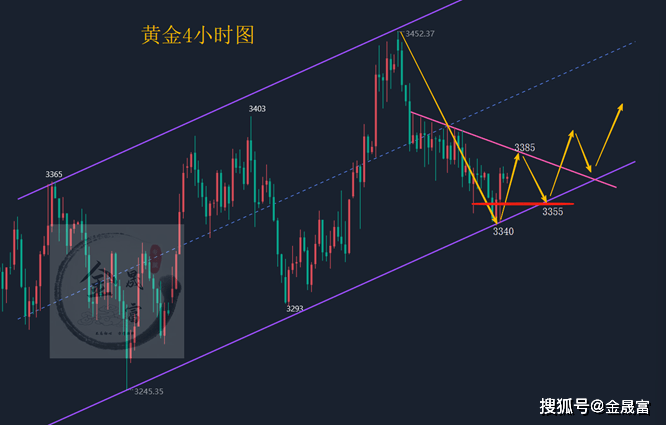
Group 1 - The recent FOMC statement reinforced the Federal Reserve's cautious stance, maintaining interest rates in the 4.25%-4.50% range, while also lowering the expected number of rate cuts for the year, putting downward pressure on gold prices [1] - Gold prices have stabilized but fell 1.8% this week, closing around 3368, influenced by rising U.S. Treasury yields and a stronger dollar, which typically exert pressure on non-yielding assets like gold [1] - The 10-year Treasury yield rose over 2 basis points to 4.421%, and the 30-year yield increased to 4.924%, indicating a stabilization of market risk sentiment [1] Group 2 - A recent World Gold Council survey indicated that central banks have increased their gold reserves by over 1000 tons annually for the past three years, double the average growth rate of the previous decade, with 95% of respondents expecting further increases in the next 12 months [2] - The Federal Reserve has maintained interest rates steady in its four meetings of 2025, with officials divided on when to resume rate cuts, predicting an average of two cuts by the end of the year [2] - Recent U.S. CPI and retail data showed unexpected declines, raising concerns about economic slowdown and increasing expectations for rate cuts, which could support a bullish outlook for gold prices [2] Group 3 - Technical analysis suggests that gold has formed a double bottom support at 3340, with the market expected to remain in a consolidation phase, indicating that the bullish trend is still intact despite recent fluctuations [2][4] - The key resistance level for gold is identified at 3385, and a breakout above this level could signal a stronger bullish momentum, while failure to break could lead to further declines [4][5] - The trading strategy for the upcoming week suggests focusing on buying on dips around 3350-3355 and selling on rebounds near 3385-3390, emphasizing the importance of market conditions and real-time adjustments [5][6]
张尧浠:降息仍具前景地缘局势紧张、金价调整仍待走强
Sou Hu Cai Jing· 2025-06-20 00:13
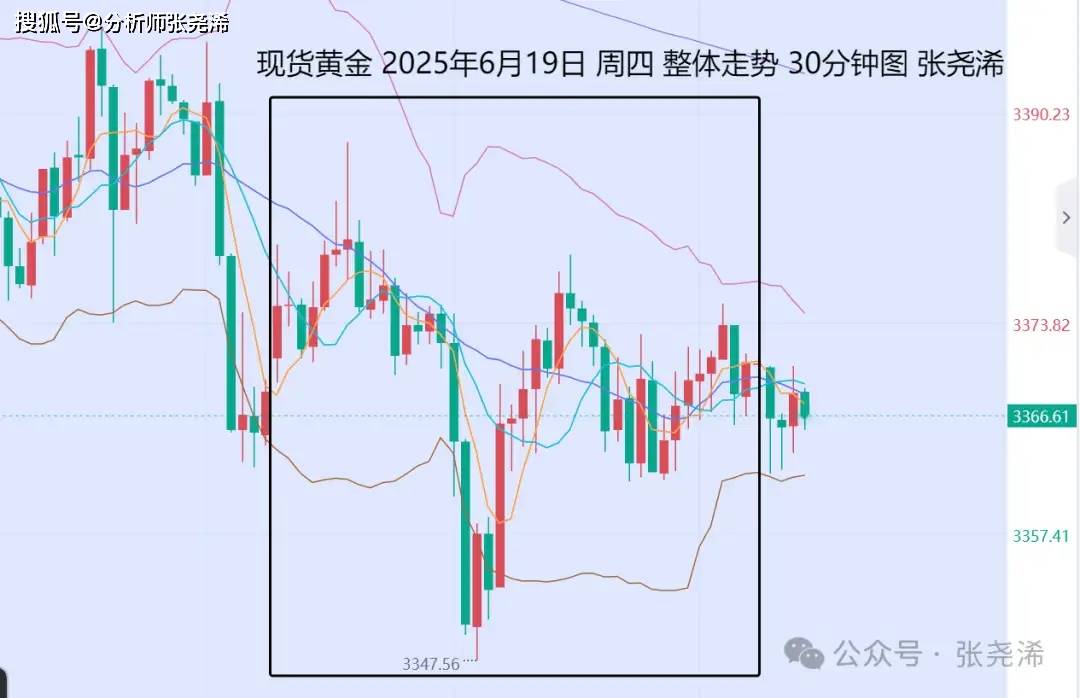
Core Viewpoint - The outlook for gold prices remains bullish due to potential interest rate cuts and ongoing geopolitical tensions, despite recent fluctuations in price [5][9]. Group 1: Market Performance - On June 19, gold opened at $3368.92 per ounce, reached a high of $3387.63, and closed at $3368.74, with a daily fluctuation of $40.03 [1]. - The market showed signs of support above the mid-line, indicating limited downside potential and a risk of upward movement [1][3]. - The gold price is expected to experience a period of adjustment but may rise again, supported by favorable fundamentals [3]. Group 2: Economic Indicators - The Federal Reserve has maintained interest rates but indicated two potential rate cuts this year, which supports a bullish outlook for gold [5]. - Recent U.S. CPI and retail data showed unexpected declines, raising concerns about economic slowdown and increasing deflation risks, which could lead to further rate cuts [5]. Group 3: Technical Analysis - Monthly charts indicate that gold prices have maintained support above the 5-month moving average, suggesting a continued bullish trend [7]. - Weekly charts show that despite recent pullbacks, gold remains above the 5-10 week moving average, indicating a potential for further upward movement [9]. - Daily charts reflect reduced bearish pressure, with multiple support levels suggesting a likelihood of bullish rebounds if prices retrace [10]. Group 4: Future Projections - The ongoing geopolitical conflicts and economic uncertainties are expected to sustain demand for gold, with projections suggesting prices could exceed $4000 per ounce within the next year [5]. - The market is anticipated to remain volatile, with potential resistance levels at $3380 and $3391, and support levels at $3355 and $3325 [10].
超长债周报:隔夜利率回落至1.4%以下,超长债小涨-20250615
Guoxin Securities· 2025-06-15 11:20
Report Industry Investment Rating No relevant content provided. Core View - Last week, the release of May inflation and export data showed persistent deflationary pressure and an accelerated decline in exports. The first meeting of the China - US economic and trade consultation mechanism was held, with tariffs remaining at the level of the Geneva talks. The weakening economy supported a continued decline in bond yields, and ultra - long bonds rose slightly. The trading activity of ultra - long bonds increased slightly last week and was quite active. The term spread of ultra - long bonds narrowed, while the variety spread widened [1][11][37]. - For the 30 - year treasury bond, as of June 13, the spread between the 30 - year and 10 - year treasury bonds was 20BP, at a historically low level. Considering domestic economic data, the estimated year - on - year GDP growth rate in April was about 4.1%, down 0.8% from March but still higher than the annual economic growth target. In May, CPI was - 0.1% and PPI was - 3.1%, indicating persistent deflation risks. With the recent accelerated decline in May exports, a negative month - on - month change in domestic housing prices, and a continued decline in capital interest rates, bond market sentiment improved. It is expected that the bond market is more likely to continue rising in the short term. However, the current term spread of the 30 - year treasury bond is still low, with limited spread protection [2][12]. - For the 20 - year CDB bond, as of June 13, the spread between the 20 - year CDB bond and the 20 - year treasury bond was 4BP, at a historically extremely low level. Considering domestic economic data, the estimated year - on - year GDP growth rate in April was about 4.1%, down 0.8% from March but still higher than the annual economic growth target. In May, CPI was - 0.1% and PPI was - 3.1%, indicating persistent deflation risks. With the recent accelerated decline in May exports, a negative month - on - month change in domestic housing prices, and a continued decline in capital interest rates, bond market sentiment improved. It is expected that the bond market is more likely to continue rising in the short term. However, the current variety spread of the 20 - year CDB bond is still low, with limited spread protection [3][13]. Summary by Relevant Catalogs 1. Super - long Bond Review - Last week, due to the release of May inflation and export data showing deflationary pressure and an accelerated decline in exports, along with the China - US economic and trade consultation mechanism meeting and stable tariffs, the weak economy led to a decline in bond yields, and ultra - long bonds rose slightly. The trading activity of ultra - long bonds increased slightly and was quite active. The term spread of ultra - long bonds narrowed, and the variety spread widened [1][11]. 2. Super - long Bond Investment Outlook - **30 - year Treasury Bond**: As of June 13, the 30 - 10 - year treasury bond spread was 20BP, at a low historical level. April's economy showed resilience with an estimated GDP growth of 4.1% year - on - year, down 0.8% from March but above the annual target. May's CPI was - 0.1% and PPI was - 3.1%, with deflation risks. With export decline, negative housing price growth, and falling capital rates, the bond market is likely to rise in the short term, but the term spread protection is limited [2][12]. - **20 - year CDB Bond**: As of June 13, the 20 - year CDB - treasury bond spread was 4BP, at an extremely low historical level. April's economy showed resilience with an estimated GDP growth of 4.1% year - on - year, down 0.8% from March but above the annual target. May's CPI was - 0.1% and PPI was - 3.1%, with deflation risks. With export decline, negative housing price growth, and falling capital rates, the bond market is likely to rise in the short term, but the variety spread protection is limited [3][13]. 3. Super - long Bond Basic Overview - As of May 31, the balance of super - long bonds exceeded 21.6 trillion yuan, accounting for 14.4% of the total bond balance. Local government bonds and treasury bonds are the main varieties. By variety, treasury bonds account for 26.1%, local government bonds 67.8%, etc. By remaining term, the 30 - year variety has the highest proportion [14]. 4. Primary Market - **Weekly Issuance**: Last week (June 9 - 13, 2025), 641 billion yuan of ultra - long bonds were issued, a significant decrease compared to the previous week. By variety, local government bonds were 306 billion yuan, government - supported institutional bonds 50 billion yuan, etc. By term, 15 - year bonds were 359 billion yuan, 20 - year bonds 32 billion yuan, and 30 - year bonds 250 billion yuan [19]. - **This Week's Pending Issuance**: The announced issuance plan for this week is 1029 billion yuan, including 500 billion yuan of ultra - long treasury bonds, 449 billion yuan of ultra - long local government bonds, and 80 billion yuan of ultra - long corporate bonds [24]. 5. Secondary Market - **Trading Volume**: Last week, ultra - long bonds were actively traded, with a turnover of 8968 billion yuan, accounting for 10.9% of the total bond turnover. By variety, ultra - long treasury bonds had a turnover of 6290 billion yuan, ultra - long local bonds 2411 billion yuan, etc. The trading activity increased slightly compared to the previous week [26][27]. - **Yield**: Due to economic factors, bond yields declined last week. For treasury bonds, 15 - year, 20 - year, 30 - year, and 50 - year yields changed by - 3BP, - 4BP, - 3BP, and - 3BP respectively. Similar changes occurred in CDB bonds, local bonds, and railway bonds [37]. - **Spread Analysis**: - **Term Spread**: The term spread of ultra - long bonds narrowed last week, with an absolute low level. The 30 - 10 - year treasury bond spread was 20BP, down 2BP from the previous week, at the 4% percentile since 2010 [44]. - **Variety Spread**: The variety spread of ultra - long bonds widened last week, with an absolute low level. The 20 - year CDB - treasury bond spread was 4BP, and the 20 - year railway - treasury bond spread was 8BP, up 3BP from the previous week, at the 6% and 5% percentiles since 2010 respectively [49]. 6. 30 - year Treasury Bond Futures - Last week, the main 30 - year treasury bond futures contract TL2509 closed at 120.50 yuan, an increase of 0.60%. The total trading volume was 321,700 lots (36,864 lots), and the open interest was 124,600 lots (6,864 lots). Both trading volume and open interest increased slightly compared to the previous week [52].
【UNFX课堂】本周展望:美国通胀数据成焦点,全球经济指标密集发布
Sou Hu Cai Jing· 2025-06-09 02:29
Group 1 - The core focus of global financial markets this week is the US inflation data for May, which will provide insights into the impact of tariffs on prices and influence the Federal Reserve's interest rate decisions [1][2] - The market expects the May Consumer Price Index (CPI) data to reflect the price pressures from tariffs, particularly in core categories such as clothing, household goods, and new cars [2][3] - The upcoming week will also see the release of the Producer Price Index (PPI) and weekly initial jobless claims in the US, amidst mixed signals from recent economic data [3][10] Group 2 - In Europe, the focus will be on the Eurozone's industrial production and trade data for April to assess the economic impact of tariffs [6][7] - France and Spain will release their final CPI data for May on Friday, contributing to the overall understanding of inflation trends in the region [8] - The UK will publish significant data including employment figures, GDP, industrial production, and trade data, with expectations of a 0.2% contraction in April due to the effects of US tariffs on manufacturing [9][10] Group 3 - In Asia, Japan is expected to confirm a 0.7% contraction in its first-quarter GDP, indicating a risk of technical recession, alongside other economic indicators [10] - China's inflation and trade data for May will be released, with expectations of further declines in CPI and PPI, highlighting weak domestic demand and deflation risks [10][11] - Overall, global markets will closely monitor key economic data, especially US inflation figures, and their implications for Federal Reserve policy, while evaluating the ongoing impact of trade tensions on global economic growth and inflation trajectories [11]
欧洲央行管委兼法国央行行长Villeroy:未发现通缩风险。
news flash· 2025-06-06 05:54
Core Viewpoint - The European Central Bank (ECB) has not identified any risks of deflation in the current economic environment [1] Group 1 - ECB Governing Council member and Bank of France Governor Villeroy stated that there are no signs of deflation risks [1]
高盛:由于对美出口骤减,就业压力接下来会非常大
Sou Hu Cai Jing· 2025-04-27 22:41
Group 1 - In March, China's exports surged unexpectedly, with a year-on-year growth of 12.4%, significantly exceeding the anticipated 4% increase, driven by exporters rushing to ship goods before new U.S. tariffs took effect [2][3] - The trade surplus for March reached $102.6 billion, indicating a strong export performance, but also reflecting exporters' fears of high tariffs imposed by the U.S. [2][3] - The ongoing decline in commodity prices poses a significant challenge to the macroeconomic environment, potentially compressing corporate profits and affecting employee incomes [4][5] Group 2 - The economic landscape is characterized by cautious consumer behavior, exacerbated by rising household savings and a downturn in the real estate sector, leading to reduced consumption [6][7] - The U.S. tariffs on Chinese exports are expected to severely impact export growth, which has been a crucial driver of China's economic growth, accounting for nearly one-third of GDP last year [9][11] - The potential decline in exports could lead to significant job losses, with estimates suggesting that up to 20 million workers may be affected due to the high tariffs [17][19] Group 3 - The current economic situation necessitates a shift towards stimulating domestic consumption, which remains low compared to other major economies, with only 39% of GDP coming from consumer spending [13][18] - Long-term solutions involve transitioning towards a consumption-driven economy, requiring structural changes such as enhancing social security systems and balancing labor wages with corporate profits [19][20] - The need for diversification in trade partnerships is emphasized to mitigate risks associated with reliance on the U.S. market, suggesting a strategic pivot towards non-U.S. trade relationships [17][19]

企业信贷需求改善政策力度再创新高
Xiangcai Securities· 2025-03-11 09:55
Investment Rating - The report indicates a positive outlook for the industry, suggesting a focus on potential investment opportunities following the "Two Sessions" policy signals [3]. Core Insights - The manufacturing sector has returned to an expansion phase, with a PMI of 50.2 in February 2025, indicating improved production and new orders [8]. - The construction industry has shown significant improvement, with a PMI of 52.7 in February 2025, driven by post-holiday resumption of work and supportive fiscal policies [13]. - There has been a notable increase in corporate credit demand, with new RMB loans reaching 4.78 trillion yuan in January 2025, reflecting a recovery in the real economy [16]. - The government work report highlights a commitment to maintaining a GDP growth target of around 5% for 2025, alongside a historic high fiscal deficit rate of 4% [27][28]. Summary by Sections 1. Manufacturing Sector Recovery - The manufacturing PMI rose to 50.2 in February 2025, with production and new orders indices at 52.5 and 51.1 respectively, indicating a return to expansion [8]. - Export orders have improved, with a new export orders index at 48.6, suggesting better-than-expected export performance despite tariff impacts [8]. 2. Significant Growth in Corporate Credit - In January 2025, the new social financing scale reached 7.06 trillion yuan, with new RMB loans contributing significantly to this growth [16]. - The increase in corporate credit demand is attributed to enhanced confidence in the economy and supportive government policies [23]. 3. Government Work Report Highlights - The report sets a GDP growth target of 5% for 2025, maintaining consistency with previous years [27]. - The fiscal deficit rate is set to rise to 4% in 2025, reflecting a strong commitment to fiscal expansion [28]. - The government plans to increase the special bond quota to 4.4 trillion yuan in 2025, with a focus on infrastructure and debt resolution [29].