AI热潮

Search documents
金价直指5000美元?ATFX 2026 Q1《交易杂志》解析金价飙升背后的秘密
Sou Hu Cai Jing· 2026-01-16 08:51
Core Viewpoint - The ATFX Q1 2026 Trading Magazine highlights that the overall opportunities in the gold market outweigh the challenges, driven by global central bank gold purchasing trends, potential interest rate cuts, and safe-haven demand, with gold prices expected to challenge the $5000 mark [1][4]. Economic Context - The global economy is entering a phase of heightened uncertainty due to escalating geopolitical tensions, diverging monetary policies among major central banks, and rising fiscal pressures [3]. - The differentiation in global central bank monetary policies is reshaping capital flows, with some economies maintaining a tightening stance to combat inflation while others are initiating rate cuts to stimulate growth [3]. Gold Market Analysis - Opportunities for gold are supported by macroeconomic factors such as global economic slowdown, advancing central bank easing policies, increasing fiscal deficits, and frequent geopolitical risks [4]. - 43% of global central banks plan to increase their gold holdings, with 95% of reserve managers expecting an increase in global central bank gold reserves, providing long-term support for gold prices [5]. Challenges in the Gold Market - Key challenges include uncertainty in monetary policy, where a resilient U.S. economy and stubborn inflation could lead the Federal Reserve to maintain a hawkish stance, potentially suppressing gold prices [5]. - The AI-driven surge in risk assets like U.S. stocks may divert funds away from gold and other safe-haven assets [5]. - Geopolitical developments, such as the pace of peace agreements in Ukraine, could impact central bank gold purchasing speed, weakening upward momentum for gold prices [5]. Technical Analysis - Gold prices breaking above $4600 could lead to a potential challenge of the $5000 mark if favorable fundamental conditions exceed expectations [6]. - A key support level during fluctuations is identified at the $4000 mark, which serves as an initial defense line [7]. Magazine Content Overview - The magazine provides a professional analytical framework to dissect the interplay between policy divergence, key economic data, and geopolitical risks, capturing core variables driving short-term market volatility [8]. - It includes a comprehensive asset allocation guide covering stocks, CFDs, commodities, and indices, outlining key investment themes and predicting potential market reactions [8]. - Insights into global regional markets focus on the U.S., Europe, Asia-Pacific, and emerging markets, comparing fundamental differences across regions to identify cross-market investment opportunities [8]. - Practical risk management strategies are offered through scenario simulations and strategy development, equipping traders with position management plans before and after significant data releases [8].


杨华曌:美联储降息预期受挑战 通胀加速或打破市场平衡
Xin Lang Cai Jing· 2026-01-16 06:34
Group 1: Silver and Gold Market Dynamics - The recovery of silver, reaching a recent high of over $93 per ounce, has pushed the gold-silver ratio down to 50, the lowest level since March 2012 [1][6] - Silver prices surged nearly 150% last year, continuing to rise into early 2026, while gold prices remain above $4,600 per ounce, up over 6% this year [7] - The increase in metal prices, geopolitical risks, and threats to the independence of the Federal Reserve are raising concerns about potential inflation acceleration in 2026 [7] Group 2: Inflation Concerns and Market Reactions - The current inflation rate remains stubbornly above the Federal Reserve's 2% target, raising fears that anticipated rate cuts in 2026 may be jeopardized [7][8] - Despite some fund managers taking precautions, broader financial markets have not fully priced in inflation concerns, as evidenced by the slight increase in the 10-year U.S. Treasury yield to 4.16% [2][7] - The market is awaiting Trump's nomination for the new Federal Reserve chair, who is expected to favor significant rate cuts [8] Group 3: Japanese Monetary Policy Outlook - Concerns about the new leadership potentially undermining the independence of the Bank of Japan are prevalent, with the yen's depreciation influencing future policy decisions [9] - A Bloomberg survey indicates that all economists expect the Bank of Japan to maintain the benchmark interest rate at 0.75% during the upcoming meeting [9] - July is seen as the most likely month for the next interest rate hike, with 48% of economists supporting this view [9]
ATFX发布:2026 年首季《交易杂志》洞察全球市场指引交易方向
Xin Lang Cai Jing· 2026-01-15 16:20
Core Insights - The ATFX report focuses on the global market dynamics for Q1 2026, highlighting the complex interplay of geopolitical tensions, trade conflicts, and divergent monetary policies among central banks [1][11][12] - The report anticipates increased volatility in various asset classes, including stocks and commodities, as well as heightened activity in derivative markets [1][12] Geopolitical and Economic Context - Ongoing geopolitical tensions and trade frictions contribute to uncertainty in global economic recovery [1][11] - Central banks are exhibiting a split in monetary policy, with some maintaining a tightening stance to combat inflation while others initiate rate cuts to stimulate growth [1][12] Gold Market Analysis - The overall outlook for gold is positive, with potential for prices to continue rising, driven by Federal Reserve policy signals and the performance of the US dollar [4][15] - Macro factors such as global economic slowdown, central bank easing, and geopolitical risks provide foundational support for gold prices [6][15] Opportunities in Gold - 43% of central banks plan to increase gold holdings, and 95% of reserve managers expect an increase in global central bank gold reserves, which supports long-term gold price stability [6][15] - If economic recession risks rise or inflation declines rapidly, expectations for rate cuts could further boost gold prices [6][15] Challenges Facing Gold - Uncertainty in monetary policy could suppress gold prices if the US economy experiences a soft landing and inflation remains persistent, leading to a potential pause in rate cuts by the Federal Reserve [7][16] - The AI boom may divert funds from gold to riskier assets, and geopolitical developments could impact central bank gold purchasing speed, affecting gold price momentum [8][17] Technical Analysis of Gold - A breakthrough above $4600 could lead to a potential surge towards $5000 if favorable fundamentals exceed expectations [8][17] - The $4000 level serves as an initial key support line during periods of price adjustment [9][18] Magazine Content Overview - The magazine provides a comprehensive analysis framework, examining the interplay of policy divergence, key economic data, and geopolitical risks to identify core variables driving short-term market fluctuations [10][19] - It includes an asset allocation guide covering various asset classes, insights into regional market differences, and practical risk management strategies for traders [10][19]

美国“电荒”,中国“电卷”
投中网· 2026-01-15 06:23
Core Viewpoint - The article discusses the contrasting electricity pricing trends in the United States and China, highlighting the impact of different market mechanisms and regulatory environments on electricity costs and consumption [6][8][18]. Group 1: Electricity Pricing in the U.S. - In the U.S., electricity prices are driven by a market mechanism that reflects supply and demand, leading to significant price increases when demand outstrips supply [10][12]. - The average electricity price in the U.S. has been rising over the past two years, attributed to necessary infrastructure upgrades and the costs associated with transitioning to AI technologies [11][12]. - The pricing mechanism in the U.S. serves as a signal for investment in power generation and encourages consumers to reduce usage during peak times [10][12]. Group 2: Electricity Pricing in China - In contrast, China's electricity prices are experiencing a downward trend, with a reported 10% year-on-year decrease in purchasing prices since the beginning of 2025 [6][15]. - The decline in electricity prices in China is a result of aggressive supply-side expansions, particularly in coal and renewable energy sectors, without a corresponding surge in demand [15][16]. - The Chinese electricity market operates under a macroeconomic framework where electricity is treated as a public utility, leading to lower prices that benefit manufacturing but pressure power generation companies [19][20]. Group 3: Implications of Pricing Mechanisms - The article emphasizes that in the U.S., consumers bear the immediate costs of rising electricity prices, which can lead to public protests and demands for regulatory changes [18][20]. - In China, the burden of low electricity prices is shifted to the supply side, where power generation companies and equipment manufacturers face reduced profitability, impacting their operational viability [19][20]. - The contrasting approaches to electricity pricing reflect broader economic strategies, with the U.S. prioritizing market-driven signals and China focusing on maintaining low costs for consumers and industries [8][20].

美国“电荒”,中国“电卷”
华尔街见闻· 2026-01-14 10:40
Core Viewpoint - The article contrasts the electricity pricing dynamics in the United States and China, highlighting the stark differences in how each country manages electricity supply and demand, leading to divergent pricing trends [3][5][19]. Group 1: United States Electricity Market - In Loudoun County, Virginia, residents express concerns over rising electricity costs due to the influx of data centers, which are consuming significant power resources [2][8]. - The pricing mechanism in the U.S. is characterized by a transparent and immediate reflection of supply shortages, where electricity prices surge when reserve margins fall below safety thresholds [8][10]. - The average electricity price in the U.S. has been on the rise over the past two years, driven by necessary infrastructure upgrades to support increasing demand from AI and other sectors [9][10][11]. - The burden of higher electricity costs falls on end-users, who face immediate financial impacts, leading to public protests and calls for regulatory hearings [19][22]. Group 2: China Electricity Market - In contrast, China's electricity prices are experiencing a downward trend, with a reported 10% year-on-year decrease in purchasing prices since the beginning of 2025 [3][14]. - The Chinese electricity market is undergoing a "passive clearing" process, where supply-side expansions, particularly in coal and renewable energy, are outpacing demand growth, resulting in lower prices [14][16]. - The role of data centers in China is seen as beneficial, as they help absorb excess electricity generated from renewable sources, particularly in regions with surplus capacity [17][20]. - The financial burden of low electricity prices is shifted to the supply side, where power generation companies and equipment manufacturers face squeezed profit margins, leading to a "utility-like" operational model [20][21].

国泰君安期货商品研究晨报-20260112
Guo Tai Jun An Qi Huo· 2026-01-12 02:33
Report Industry Investment Ratings No specific industry investment ratings are provided in the report. Core Views of the Report The report offers a comprehensive analysis of various commodities in the futures market, including precious metals, base metals, energy, agricultural products, and more. It presents the current market trends, fundamental data, and macro - industry news for each commodity, along with short - term and medium - term outlooks and trading suggestions [2][10][30]. Summary by Commodity Category Precious Metals - **Gold**: Safe - haven sentiment has rebounded. The prices of domestic and international gold futures and spot have increased. ETF holdings have decreased slightly. Market sentiment has been affected by factors such as the US economic data and geopolitical tensions [2][6]. - **Silver**: It is testing new highs again. Both domestic and international silver prices have risen significantly, with strong performance in the night - trading session [2][6]. - **Platinum**: ETF holdings have continued to flow out, and the price is in a range - bound oscillation [2][25]. - **Palladium**: After rising to a high, the price has fallen back. Attention should be paid to the price transmission related to tariffs [2][25]. Base Metals - **Copper**: The demand expectation has strengthened, and the price has increased. The production of a major copper smelter has increased, and the US economic data has also had an impact on the market [2][10]. - **Zinc**: It is running strongly. The inventory has decreased, and the price has been supported [2][13]. - **Lead**: The overseas inventory has decreased, which supports the price [2][16]. - **Tin**: It is oscillating and strengthening. The inventory has decreased, and the price has shown an upward trend [2][19]. - **Aluminum**: The center of gravity has significantly moved up. The prices of electrolytic aluminum, alumina, and aluminum alloy have all shown different degrees of increase [2][22]. - **Nickel**: There is a game between industrial and secondary funds, and the price is in a wide - range oscillation [2][29]. - **Stainless Steel**: The price of ferronickel has lifted the oscillation center, and the market is gaming the Indonesian policy [2][30]. Energy and Chemicals - **Crude Oil - related**: The geopolitical conflict between the US and Venezuela has fermented, and the short - term international energy prices may be strong, which has an impact on related products such as methanol and fuel oil [98][99]. - **Methanol**: It is expected to be strong in the short term. The geopolitical conflict and the expected improvement of port inventory support the price, but the MTO fundamentals are weak [99]. - **Urea**: The price is expected to correct in the short term but remain strong in the medium term. The agricultural demand provides support [103][104]. - **PTA**: It is unilaterally strong. The future supply and demand are expected to be weak, but the current low - inventory de - stocking situation supports the price [65]. - **MEG**: It is short - term strong in a rebound. The supply pressure has been relieved, and the price has support at a low level [66]. - **Rubber**: It is in a wide - range oscillation. The raw material prices of tires have risen, which has affected the cost and profit of the tire industry [67][71]. - **Synthetic Rubber**: It is oscillating at a high level. The raw material price and inventory have an impact on the market [73][74]. - **LLDPE**: The standard product production ratio remains low, and the import profit has been significantly repaired. The market is affected by factors such as raw materials and demand [76][77]. - **PP**: Propylene is stronger than ethylene, and there is a strong expectation of PDH maintenance in the first quarter. The market is affected by cost and demand [79][80]. - **Caustic Soda**: It is oscillating weakly. The market is in a pattern of high production and high inventory [81][83]. - **Paper Pulp**: It is in a wide - range oscillation. The supply and demand fundamentals have not improved substantially, and attention should be paid to factors such as capital trends [86][89]. - **Glass**: The price of the original sheet is stable. The domestic float glass price has shown minor fluctuations [92][93]. Agricultural Products - **Soybean - related**: The price of soybeans and related products is affected by factors such as the US USDA report and Chinese procurement. The market is waiting for the release of the report [160][162]. - **Corn**: Attention should be paid to the spot market. The price of corn has shown minor fluctuations, and the market is affected by factors such as supply and demand and policies [163][165]. - **Sugar**: It is in a narrow - range consolidation. The global sugar supply and demand situation and import and export policies have an impact on the market [167][168]. - **Cotton**: It is waiting for the end of the adjustment. The cotton spot price has declined slightly, and the downstream demand is weak [172][173]. - **Eggs**: The sentiment in the far - month contracts has weakened [176]. - **Hogs**: There is a negative feedback in demand, and the supply is expected to increase. The price of hogs has shown minor fluctuations [179]. - **Peanuts**: It is oscillating. The spot price of peanuts has shown minor fluctuations, and the market is affected by factors such as supply and demand [182][183]. Shipping - **Container Freight Index (European Line)**: It may be strong in a short - term oscillation. The 02 long positions and 04 short positions should be reduced appropriately. The market is affected by factors such as shipping capacity, demand, and policies [126][135].
铜价涨幅远超预期!高盛上调上半年目标价,但仍然坚持“美国关税后回调”
Hua Er Jie Jian Wen· 2026-01-09 00:55
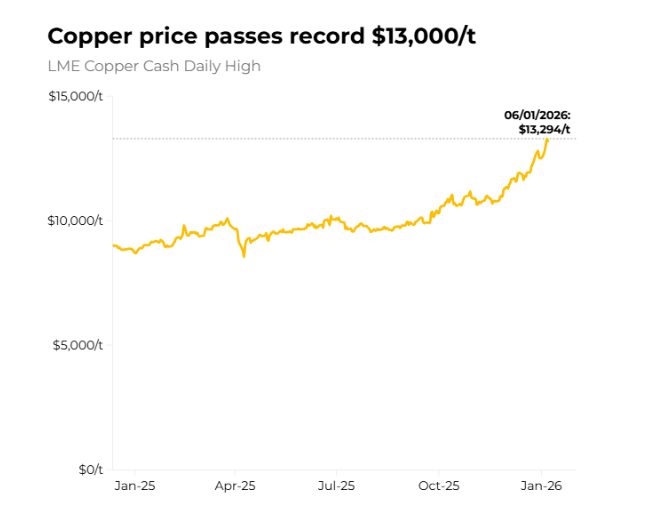
Core Viewpoint - Goldman Sachs has revised its short-term copper price forecast due to a significant price surge, but maintains that once U.S. tariffs are implemented, supply and demand fundamentals will regain influence [1][6]. Group 1: Price Movements and Predictions - Copper prices have experienced extreme volatility, rising from under $11,000 per ton at the end of November to a peak of $13,387 per ton on January 6, marking a 22% increase [1]. - Goldman Sachs has adjusted its 2026 mid-year LME copper price forecast from $11,525 per ton to $12,750 per ton [1]. - Despite the current price surge, Goldman Sachs does not expect prices above $13,000 to be sustainable and maintains a forecast of $11,200 per ton for Q4 2026 [1]. Group 2: Factors Driving Price Increase - Three main themes are driving the current copper price increase: 1. Tight signals in the spot market, evidenced by a surge in metal withdrawal requests from LME warehouses in early December, indicating supply tightness outside the U.S. [4]. 2. The AI and data center boom continues to attract significant investment into the copper market, despite some fluctuations in mid-December [4]. 3. The macro narrative of "running the economy hot" is fueling expectations of accelerated U.S. economic growth and a rebound in cyclical demand, positively impacting copper and broader risk assets [5]. Group 3: Tariff Implications - The anticipated U.S. tariff decision on refined copper is expected to be a turning point, potentially ending the current stockpiling behavior in the U.S. [6]. - The U.S. Commerce Department has suggested delaying the imposition of tariffs on refined copper, increasing the likelihood that these tariffs may not be implemented [6]. - If tariffs are postponed, it could negatively impact LME copper prices as the market would refocus on global supply abundance [7]. Group 4: Market Fundamentals and Risks - Despite the current price boom, the global copper market fundamentals appear weak, with a projected surplus of 600,000 tons in 2025, the largest since 2009 [8]. - The surplus expectation for 2026 has been revised from 160,000 tons to 300,000 tons, and U.S. stockpiling expectations have been reduced from 7.5 million tons to 6 million tons [8]. - Speculative positions in the market have reached historical highs, indicating a potential late-stage market phase, although prices may still find support until key economic pillars collapse [9].

铝价或陷入上涨螺旋,推手是AI热潮?
日经中文网· 2026-01-08 07:55
Core Viewpoint - The international price of aluminum is rising significantly, driven by strong demand as a substitute for copper, alongside concerns about electricity supply for aluminum smelting due to the increasing power consumption of AI data centers [2][4][9]. Group 1: Price Trends and Influencing Factors - The London Metal Exchange (LME) three-month futures for aluminum have shown a clear upward trend, surpassing $3,000 per ton on January 2 and reaching a peak of $3,138 per ton, the highest since April 2022 [4]. - The primary factor for the price increase is the significant rise in copper prices, which have seen a projected increase of 42% by 2025 due to supply-demand tensions [4]. - Investment funds are shifting towards aluminum, which has seen a more modest annual increase of 17% compared to copper [4]. Group 2: Electricity Consumption and Supply Concerns - Producing one ton of aluminum requires approximately 15,000 kilowatt-hours of electricity, equivalent to the annual electricity consumption of 3 to 4 average households [6]. - Concerns about electricity supply are becoming a reality, with companies like Rio Tinto considering shutting down the Tomago aluminum smelter in Australia due to rising electricity costs, which account for 40% of the country's aluminum production [6]. - South32 announced the suspension of operations at its smelter in Mozambique starting March 2026 due to significant increases in electricity supply contract costs [6]. Group 3: Competition for Electricity and Future Outlook - The International Energy Agency (IEA) predicts that global data centers' electricity consumption will more than double by 2030 compared to 2024, creating a competitive disadvantage for aluminum smelting plants [8]. - Major tech companies like Amazon and Microsoft are willing to pay over $100 per megawatt-hour for electricity, while aluminum smelting operations typically secure long-term contracts at around $40 per megawatt-hour [8]. - The environment for the aluminum smelting industry is becoming increasingly challenging, with predictions that aluminum prices could reach $3,200 per ton by 2028, and concerns that maintaining existing smelting operations may become difficult [8].

“一盒内存条可买上海一套房”
Guan Cha Zhe Wang· 2026-01-07 09:12
Core Insights - The price of high-capacity DDR5 server memory modules has surged dramatically, with some units exceeding 40,000 yuan, leading to comparisons with real estate prices in Shanghai [1] - The ongoing AI boom is driving a "super cycle" in the global memory market, with significant price increases observed in DRAM products [8][10] Price Trends - Hynix and Samsung's 256G DDR5 6400MHz server memory modules are priced above 40,000 yuan, with some listings reaching 49,999 yuan per unit [1] - The average price of new homes in Shanghai is approximately 58,524.58 yuan per square meter, indicating that a box of 256G DDR5 server memory could purchase an 80 square meter apartment [1] Market Dynamics - Since February 2025, DRAM prices have been on the rise, with some segments increasing by over 100% [8] - The price of DDR5 memory chips has surged by 307% since September 2025, while DDR4 chips have seen a 158% increase [8] - Major manufacturers like Samsung and SK Hynix are shifting production capacity towards AI server memory, tightening supply in other markets [8][10] Future Projections - DRAM contract prices are expected to increase by 55-60% in Q1 2026, driven by high demand from cloud service giants [9][10] - The price hikes are anticipated to affect other sectors, with smartphone and PC manufacturers facing increased costs, leading to price increases for new devices [10] Industry Impact - Companies like Xiaomi, OPPO, and Dell have already raised prices on new products due to rising memory costs, with increases ranging from 100 to 600 yuan [10] - The global smartphone shipment is projected to decline by 2.1% in 2026, while PC manufacturers are also planning price hikes, with Dell announcing increases of 10% to 30% [10] - Analysts predict that the current "super cycle" in memory pricing may last until 2027 [10]

百利好丨2025年全球经济和货币政策回顾
Sou Hu Cai Jing· 2026-01-07 07:16
Group 1 - Global economic growth is expected to moderate in 2025, with increasing uncertainty and significant divergence in forecasts from various institutions [2] - The OECD and IMF both predict a global growth rate of 3.2% for 2025, citing resilience but also accumulating risks [3] - The UN forecasts a lower growth rate of 2.4% for 2025, emphasizing the negative impact of trade conflicts and policy uncertainty [3] Group 2 - Developed economies are projected to grow at 1.8% in 2025, with the U.S. showing a higher probability of a "soft landing" [2] - The U.S. is expected to have a growth rate of 2.6%, driven by consumer spending and AI-related investments, while core PCE inflation is projected to decrease to 3.5% [4] - The Eurozone's growth rate is forecasted at 1.2%, with high borrowing costs and inflationary pressures limiting consumer and investment activity [4] Group 3 - Central banks in developed economies are shifting from accommodative to a more cautious stance, while emerging economies in the Asia-Pacific are primarily maintaining accommodative policies [5] - The Federal Reserve has ended its balance sheet reduction and is cautious about further rate cuts, while the European Central Bank has signaled the end of its easing cycle [6] - The Bank of Japan faces a dilemma between managing high inflation and supporting economic growth, with core inflation at 2.8% [6] Group 4 - Trade tensions and supply chain pressures are impacting inflation and consumer costs, with gold prices rising as a hedge against uncertainty [7] - Central banks are in a dilemma of controlling inflation while stimulating economic growth, contributing to the strength of the U.S. dollar [7] - The AI boom is supporting global demand and tech stock valuations, but also increasing the risk of asset bubbles and volatility in risk assets [7] Group 5 - The global economy is transitioning from strong recovery to moderate growth, with increasing divergence between developed and emerging markets [8] - Monetary policy in developed economies is becoming more restrictive, with a shift from broad easing to targeted adjustments [8] - Key risks include persistent core inflation, geopolitical conflicts, debt pressures, and fluctuations in the U.S. dollar, with a focus on policy shifts and sustainable economic recovery in 2026 [8]