
财政赤字

Search documents
申万期货品种策略日报:贵金属-20250822
Shen Yin Wan Guo Qi Huo· 2025-08-22 03:22
Report Summary 1. Report Industry Investment Rating - Not mentioned in the provided content 2. Core View - Gold and silver are oscillating, and the market is waiting for signals from Powell's speech at the Jackson Hole meeting. Last week's unexpectedly high US inflation data pressured gold and silver, while positive signals from recent US - Russia negotiations eased geopolitical risks. The July non - farm payrolls data was below expectations and the previous value was significantly revised down. The Fed kept interest rates unchanged in July, but there are divided views within the Fed, and Trump's personnel appointments affect market expectations. Trade negotiations have made progress in multiple aspects, but the overall trade environment is still deteriorating. The "Big and Beautiful" bill has increased the expectation of the US fiscal deficit. The continuous increase in gold holdings by the People's Bank of China provides long - term support for gold, but gold is hesitant to rise at current high prices. Overall, gold and silver may show an oscillating trend as the expectation of interest rate cuts intensifies [3] 3. Summary by Related Catalogs Futures Market - **Prices and Changes**: The current prices of沪金2510 and沪金2512 are 776.08 and 778.06 respectively, with daily changes of 0.96 and 0, and daily change rates of 0.12% and 0.00%. The current prices of沪银2510 and沪银2512 are 9233.00 and 9253.00 respectively, with daily changes of 71.00 and 69.00, and daily change rates of 0.77% and 0.75% [2] - **Positions and Volumes**: The positions of沪金2510 and沪金2512 are 183215 and 133322 respectively, and the trading volumes are 128755 and 23298 respectively. The positions of沪银2510 and沪银2512 are 307098 and 228190 respectively, and the trading volumes are 311338 and 67972 respectively [2] - **Spot Premiums**: The spot premiums of沪金2510 and沪金2512 are - 4.42 and - 6.40 respectively, and those of沪银2510 and沪银2512 are - 89.00 and - 109.00 respectively [2] Spot Market - **Prices and Changes**: The previous day's closing prices of Shanghai Gold T + D and London Gold were 771.66 and 770.79 respectively, with daily changes of 1.83 and - 1.59, and daily change rates of 0.24% and - 0.21%. The previous day's closing price of London Gold (in dollars per ounce) was 3338.935, with a daily change of - 8.4 and a daily change rate of - 0.25%. The previous day's closing prices of Shanghai Silver T + D and London Silver were 9144.00 and 38.12 respectively, with daily changes of 122.00 and 0.27, and daily change rates of 1.35% and 0.70% [2] - **Price Ratios**: The current values of沪金2512 - 沪金2510,沪银2512 - 沪银2510, gold/silver (spot), Shanghai Gold/London Gold, and Shanghai Silver/London Silver are 1.98, 20, 84.39, 7.19, and 7.46 respectively, compared with previous values of 2.08, 22, 85.33, 7.15, and 7.41 [2] Inventory - **Changes**: The current inventories of Shanghai Futures Exchange gold and silver are 36,642 kg and 1,115,055 kg respectively, with changes of 60.00 kg and - 25,144.00 kg compared to the previous values. The current inventories of COMEX gold and silver are 38,573,764 and 508,499,193 respectively, with a change of 9,952.03 for COMEX gold and 0 for COMEX silver [2] Related Assets - **Values and Changes**: The current values of the US dollar index, S&P index, US Treasury yield, Brent crude oil, and US dollar - RMB exchange rate are 98.6526, 6370.17, 4.33, 67.67, and 7.1833 respectively, with changes of 0.42%, - 0.40%, 0.93%, 0.01%, and 0.03% compared to the previous values [2] Derivatives - **Holdings and Changes**: The current holdings of the SPDR Gold ETF and SLV Silver ETF are 44315 tons each, with an increase of 1.00 ton compared to the previous values. The current net positions of CFTC speculators in silver and gold are 33486 and 32895 respectively, with changes of 481 and - 1451 compared to the previous values [2] Macroeconomic Information - **Trade Agreement**: The EU and the US issued a joint statement detailing a new trade agreement reached in July. The US will impose a 15% tariff on most EU goods such as automobiles, pharmaceuticals, semiconductors, and timber. The EU promised to cancel tariffs on US industrial products, provide preferential market access for US seafood and agricultural products, and plans to purchase $750 billion worth of US liquefied natural gas, oil, and nuclear products and $40 billion worth of US artificial intelligence chips by 2028 [3] - **Renewable Energy Stance**: US President Trump criticized renewable energy as a "century - long scam". Even though the electricity demand in some US regions significantly exceeds supply, the US government will not approve new wind or photovoltaic projects. Trump blames the rising electricity prices in the US on renewable energy [3] - **PMI Data**: The preliminary US S&P Global Manufacturing PMI for August reached 53.3, the highest since May 2022, far exceeding the expected 49.5. The service industry PMI slightly dropped to 55.4, but the significant rebound in manufacturing pushed the composite PMI to a 9 - month high of 55.4 [3] - **Unemployment Data**: The number of initial jobless claims in the US last week increased by 11,000 to 235,000, the highest since June, higher than the market expectation of 225,000. The number of continued jobless claims in the previous week rose to 1.97 million, the highest since November 2021 [3] - **Real Estate Data**: The National Association of Realtors in the US stated that the annualized sales of second - hand homes in July increased by 2% to 4.01 million units, higher than the market expectation of 3.92 million units. The median price of second - hand homes increased by 0.2% year - on - year, the slowest increase in two years [3]
美国:拿什么拯救,无上限的债务!
Sou Hu Cai Jing· 2025-08-22 02:45
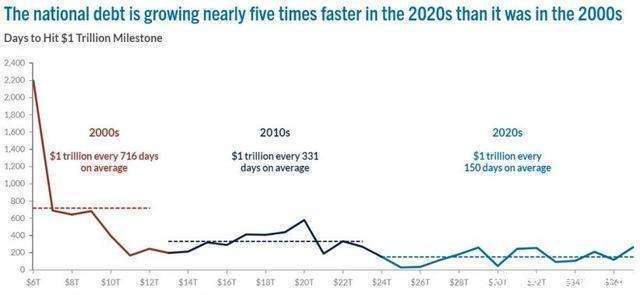
Group 1 - The U.S. national debt has surpassed $37 trillion, averaging $107,700 per person, indicating a normalization of high debt levels in the U.S. economy [1] - Since 2010, the speed of U.S. debt accumulation has accelerated significantly, with the national debt increasing by $1 trillion almost every six months since 2020 [3] - The "Big and Beautiful Act," signed by Trump, has paradoxically increased the debt burden rather than reducing it, with projections indicating a $3.4 trillion increase in the deficit over the next decade [6][8] Group 2 - Interest payments on the national debt have reached $879.9 billion for the fiscal year 2024, accounting for 13% of total federal spending, the highest proportion in 25 years [6] - The rising interest rates, resulting from aggressive Fed rate hikes, have significantly increased the burden of U.S. debt, with the average interest rate on federal debt doubling from 1.556% in January 2022 to 3.352% by July 2023 [10][11] - Trump is pressuring Fed Chair Powell to lower interest rates to alleviate the government's debt burden, highlighting the urgency of the fiscal situation [10][11] Group 3 - A fundamental solution to the debt crisis requires controlling the fiscal deficit and balancing the budget, rather than relying on short-term measures like interest rate adjustments [13] - The U.S. is facing a potential economic crisis if effective measures are not taken to manage the growing debt and deficit [8][14]

申银万国期货首席点评:“万亿用电+万亿成交”双破纪录背后的中国经济新韧性
Shen Yin Wan Guo Qi Huo· 2025-08-22 02:06
Report Summary 1. Report Industry Investment Rating No information provided in the report. 2. Core Viewpoints - The Chinese economy shows new resilience with the dual records of "trillion - kilowatt - hour electricity consumption and trillion - yuan trading volume". The policy combination is effective, and a positive cycle has been formed [1]. - The domestic stock market is in a resonance period of "policy bottom + fund bottom + valuation bottom", and the market trend is likely to continue, but investors need to adapt to accelerated sector rotation and structural differentiation [2]. - Various commodities have different trends affected by factors such as supply and demand, geopolitics, and policies [2][3]. 3. Summary by Relevant Catalogs a. Chief Comment - A - share market major indices are rising, with the Shanghai Composite Index, Shenzhen Component Index, and ChiNext Index up 12.51%, 14.45%, and 21.19% respectively this year. The trading volume of the Shanghai and Shenzhen stock markets frequently exceeds 2 trillion yuan, and the margin trading balance is at a historical high [1]. - In July, the total social electricity consumption reached 1.0226 trillion kilowatt - hours, a year - on - year increase of 8.6%, doubling compared to a decade ago [1]. - China's foreign trade maintains a steady - to - improving trend, with the cumulative import and export growth rate rising month by month, achieving a 3.5% increase in the first seven months [1]. b. Key Varieties - **Equity Index**: The equity index shows differentiation. The domestic liquidity is expected to remain loose in 2025, and more incremental policies may be introduced in the second half of the year. The external risks are gradually easing. The CSI 500 and CSI 1000 indices with more technology - growth components are more offensive, while the SSE 50 and CSI 300 indices with more dividend - blue - chip components are more defensive [2]. - **Precious Metals**: Gold and silver are in a volatile state. The market is waiting for signals from Powell's speech at the Jackson Hole meeting. The long - term drivers of gold still provide support, and the overall trend of gold and silver may be volatile with the increasing expectation of interest rate cuts [3]. - **Crude Oil**: International oil prices continue to rise due to the decline in US crude oil inventories, strong oil demand, and the uncertainty of efforts to end the Russia - Ukraine conflict. The hurricane season in 2025 is relatively calm so far [3]. c. Main News Concerns - **International News**: The EU and the US announced details of a new trade agreement. The US will impose a 15% tariff on most EU goods, while the EU will cancel tariffs on US industrial products and provide preferential market access for US seafood and agricultural products. The EU plans to purchase $750 billion of US liquefied natural gas, oil, and nuclear products and $40 billion of US AI chips by 2028 [5]. - **Domestic News**: The State Council agreed in principle to the "Development Plan for the Open and Innovative Development of the Whole Biopharmaceutical Industry Chain in the China (Jiangsu) Free Trade Pilot Zone" [6]. - **Industry News**: In July, the total social electricity consumption exceeded 1 trillion kilowatt - hours for the first time globally, with a significant increase in the proportion of new energy [7]. d. Morning Comments on Main Varieties - **Financial**: - **Equity Index**: The US three major indices fell. The domestic equity index shows differentiation, and the market trading volume is 2.46 trillion yuan. The market is in a favorable period, but investors need to pay attention to sector rotation [10]. - **Treasury Bonds**: Treasury bonds rebounded after reaching the bottom. The central bank's monetary policy is loose, which supports short - term treasury bond futures prices, but the stock - bond seesaw effect may suppress the bond market, and the cross - variety spread may widen [11]. - **Energy and Chemicals**: - **Crude Oil**: Oil prices continue to rise due to factors such as inventory decline and demand. The hurricane has not affected key oil and gas infrastructure. The number of initial jobless claims in the US increased, and the OPEC's production increase situation needs to be monitored [12]. - **Methanol**: Methanol prices fell at night. Coastal methanol inventories increased significantly, and the short - term trend is mainly bullish [13]. - **Rubber**: The price of rubber is mainly supported by the supply side. The demand side is weak, and the short - term trend is expected to continue to correct [15]. - **Polyolefins**: Polyolefin futures rebounded. The market is mainly driven by supply and demand. The inventory is slowly being digested, and the terminal demand may pick up in mid - to - late August [16]. - **Glass and Soda Ash**: Similar to polyolefins, the market is driven by supply and demand, and attention should be paid to the autumn stocking market and supply - cost changes [17]. - **Metals**: - **Precious Metals**: Gold and silver are volatile, waiting for signals from Powell's speech. The long - term drivers of gold still support the price, and the overall trend may be volatile [18]. - **Copper**: Copper prices may fluctuate within a range due to factors such as low concentrate processing fees and stable downstream demand [19]. - **Zinc**: Zinc prices may fluctuate widely. The supply of concentrates has improved, and the smelting supply may recover [20]. - **Lithium Carbonate**: The short - term trend is affected by sentiment. The supply is expected to increase slightly in August, and the demand is also expected to increase. The inventory situation is complex, and the price may have room to rise if the inventory is depleted [21]. - **Black Metals**: - **Iron Ore**: The demand for iron ore is supported by strong production. The global iron ore shipment has decreased recently, and the mid - term supply - demand imbalance pressure is large. The market is expected to be volatile and bullish [22]. - **Steel**: The supply pressure of steel is gradually emerging, but the supply - demand contradiction is not significant. The market is expected to be volatile and bullish [23]. - **Coking Coal and Coke**: The futures of coking coal and coke are in a wide - range volatile state, with intense long - short competition [24]. - **Agricultural Products**: - **Protein Meal**: Bean and rapeseed meal are weakly volatile at night. The US soybean production is expected to be good, but the reduction in planting area provides support. The domestic market is expected to be range - bound [25]. - **Oils and Fats**: Oils and fats rose at night. The production and export of Malaysian palm oil increased in August, but there are risks of a short - term decline due to factors such as US biodiesel news [26]. - **Sugar**: International sugar prices are expected to be volatile as the global sugar market is about to enter the inventory - accumulation stage. The domestic sugar market is supported by high sales - to - production ratios and low inventories, but import pressure may drag down prices [27]. - **Cotton**: US cotton prices fell. The domestic cotton market supply is relatively tight, but the demand is in the off - season. The short - term trend is expected to be volatile and bullish with limited upside space [28]. - **Shipping Index**: - **Container Shipping to Europe**: The EC index is weakly volatile. The freight rate has been decreasing, and the short - term decline may slow down. The high - volume capacity supply may increase the downward pressure on freight rates during the off - season [29].
韩上半年财政赤字居历史高位
Shang Wu Bu Wang Zhan· 2025-08-21 03:58
Group 1 - The South Korean Ministry of Economy and Finance reported a fiscal deficit of 94.3 trillion won for the first half of the year, marking a decrease from over 100 trillion won in the same period last year, but still the fourth highest in history [1] - Total revenue for the same period reached 320.6 trillion won, reflecting a year-on-year increase of 24.7 trillion won, driven by improvements in corporate performance and increases in interest and dividends [1] - Total expenditure amounted to 389.2 trillion won, which is an increase of 17.3 trillion won compared to the previous year [1] Group 2 - As of the end of June, the central government debt stood at 1218.4 trillion won, with a slight increase of 0.6 trillion won from the previous period [2] - Including the second supplementary budget, the total national debt for both central and local governments is projected to reach 1301.9 trillion won, accounting for approximately 49.1% of the GDP [2]
美元资产走弱,金价无惧议息会议放鹰,大幅反弹丨黄金早参
Sou Hu Cai Jing· 2025-08-21 01:32
申银万国期货分析指出,美联储7月利率会议继续按兵不动,但美联储内部观点呈现分裂,特朗普通过 人事任命影响市场对美联储的预期。贸易谈判呈现多方进展,但整体贸易环境仍在恶化。大而美法案落 地继续推升美国财政赤字预期,中国央行持续增持黄金,黄金方面长期驱动仍然提供支撑,当下价位较 高黄金上行迟疑, 金银整体或在降息预期升温下呈现震荡走势。 每日经济新闻 8月20日,受美股回落,美元走弱和美债收益率下滑支撑,市场避险需求上升,金价大幅反弹,截至收 盘,COMEX黄金期货涨1.00%报3392.20美元/盎司,截至亚市收盘,黄金ETF华夏(518850)跌0.3%, 黄金股ETF(159562)涨1.39%。 消息面上,今日凌晨,美联储公布的7月会议纪要显示,7月会上,几乎全体决策者支持暂不降息,只有 两人反对。纪要体现了,对通胀和就业的风险以及关税对通胀的影响,联储官员均存在分歧,不过多数 还是认为,通胀上升的风险比就业下行的风险高。多人认为,关税的影响需要一些时间才会全面显现。 ...
一国官宣:不降息!
中国基金报· 2025-08-20 14:30
Core Viewpoint - The Bank of Israel has decided to maintain the benchmark interest rate at 4.5%, aligning with market expectations, amidst ongoing geopolitical uncertainties and a slight decrease in inflation rates over the past year [2][3]. Group 1: Economic Indicators - The inflation rate in Israel for July was reported at 3.1%, which is slightly above the target upper limit, but forecasts suggest it will return to the target range in the coming months [3]. - The government has decided to raise the fiscal deficit ceiling to 5.2%, indicating potential challenges in managing economic stability [3]. Group 2: Geopolitical Risks - The central bank highlighted various risks that could accelerate inflation or deviate from targets, including geopolitical developments, demand growth coupled with supply constraints, and deteriorating global trade conditions [3]. - The ongoing geopolitical uncertainty is expected to impact economic activity, with potential scenarios leading to increased supply constraints and slower economic recovery [3]. Group 3: Future Monetary Policy - The Bank of Israel's Governor, Amir Yaron, expressed a desire to lower interest rates three times next year to reach 3.75%, although the timing for such reductions remains uncertain [4]. - A lower risk premium could lead to a rapid expansion in demand, and the appreciation of the shekel is anticipated to help reduce inflation [5]. Group 4: Investment Climate - The Israeli economy faces uncertainties due to market and technological investment conditions, exacerbated by U.S. tariffs, which pose risks to the economy [6]. - The reliance of Israel's technology sector on U.S. venture capital funding makes it particularly vulnerable to these uncertainties, affecting overall economic performance [6].

美预算机构预警:未来十年财政赤字将激增近万亿美元
智通财经网· 2025-08-20 06:48
Group 1 - The core viewpoint is that the future ten-year federal budget deficit in the U.S. is projected to be nearly $1 trillion higher than the previous estimate by the Congressional Budget Office (CBO) due to tax, spending legislation, and tariff policies [1] - The Committee for a Responsible Federal Budget (CRFB) forecasts a cumulative deficit of $22.7 trillion from fiscal years 2026 to 2035, compared to CBO's earlier prediction of $21.8 trillion [1] - The CRFB estimates that the deficit for fiscal year 2025 will be $1.7 trillion, accounting for 5.6% of GDP, slightly lower than the previous year's deficit of $1.83 trillion [1] Group 2 - The CRFB's new estimates include the budget impacts of the One Big Beautiful Bill Act and current tariff policies, but do not account for the dynamic effects of these policy changes on economic growth, which has faced criticism from the Trump administration [2] - The CRFB anticipates that tax cuts and spending measures will increase the deficit by $4.6 trillion by 2035, while the new tariff policies are expected to generate $3.4 trillion in additional import tariff revenue over the next decade [2] - The CRFB predicts that net interest payments on the national debt will total $14 trillion over the next ten years, rising from nearly $1 trillion in 2025 to $1.8 trillion by 2035 [2] Group 3 - The CRFB's alternative scenario suggests a significantly worsened budget outlook, with deficits projected to exceed CBO's baseline by nearly $7 trillion if certain tariff policies are overturned [3] - This alternative scenario assumes that temporary tax cuts from the One Big Beautiful Bill Act will be extended, leading to an additional $1.7 trillion in deficits over the decade [3] - The debt-to-GDP ratio is projected to rise from 118% under CBO's baseline to 120% under CRFB's baseline, and could reach 134% in the alternative scenario [3]
特朗普政府大幅扩大钢铝关税范围 标普预计其政策将带来“可观”财政收入
智通财经网· 2025-08-19 22:33
Group 1 - The Trump administration has significantly expanded the scope of tariffs on steel and aluminum products, imposing a 50% tariff on over 400 product categories, including firefighting equipment, machinery, construction materials, and specialty chemicals made from steel and aluminum [1] - The U.S. Department of Commerce stated that the new measures cover 407 new product categories, aiming to close loopholes and support the revival of the U.S. steel and aluminum industries [1] - Experts predict that the impact of these tariffs will be extensive, with the current steel and aluminum tariffs covering at least $320 billion in imported goods, which is expected to further increase inflationary pressures in the Producer Price Index (PPI) [1] Group 2 - S&P Global indicated that the substantial revenue generated from the broad tariff policy will largely offset the recent significant tax cuts and spending reductions, maintaining the U.S. long-term sovereign credit rating at AA+ [2] - The report warns that if the U.S. deficit continues to expand over the next two to three years without effective spending control or addressing the fiscal gap caused by tax cuts, there may be a downgrade in the rating [2] - Despite the increase in customs tariff revenue, the federal budget deficit still widened by approximately 20% during the same period [2]

美债收益率止跌回落 投资者押注美联储9月启动降息
智通财经网· 2025-08-19 22:32
Group 1 - US Treasury yields reversed a three-day decline, with rates falling across the board as investors bet on a potential Fed rate cut in September and awaited Fed Chair Powell's speech at the Jackson Hole conference [1] - The 10-year benchmark yield dropped to 4.30%, ending a sell-off that began after the July PPI recorded its largest increase in three years, raising market concerns [1] - The probability of a Fed rate cut in September has risen to approximately 80%, although strategists caution that the final decision will depend on upcoming economic data [1][2] Group 2 - S&P Global maintained the US long-term sovereign credit rating at AA+, noting that tariff revenues from the Trump administration will partially offset the fiscal impact of large tax cuts [1][2] - July saw US tariff revenues reach a record high of $28 billion, which is viewed positively by the White House as it emphasizes the benefits of tariff policies on US fiscal health [2] - S&P's outlook indicates that US net government debt is expected to exceed 100% of GDP over the next three years, but the average fiscal deficit from 2025 to 2028 is projected to be 6%, lower than last year's 7.5% [3]
标普确认美国“AA+/A-1+”主权评级 展望保持稳定
Xin Hua Cai Jing· 2025-08-19 05:43
Core Viewpoint - S&P Global Ratings has confirmed the United States sovereign credit rating at "AA+/A-1+" with a stable outlook, reflecting confidence in the country's economic resilience and fiscal management [1] Economic Factors - The approval of the Trump administration's signature tax and spending legislation after seven months in office demonstrates the core policy agenda [1] - The increase in effective tariff rates is expected to substantially offset potential weaknesses in fiscal conditions, which could have been triggered by recent fiscal legislation involving tax increases and spending adjustments [1] Fiscal Outlook - The stable outlook reflects expectations of continued economic resilience in the U.S. [1] - The credibility and effectiveness of monetary policy execution are acknowledged [1] - Although the fiscal deficit remains high, it has not continued to expand, supporting the growth of general government net debt [1] - The debt ceiling has been raised by $5 trillion, contributing to the overall fiscal stability [1]