AI泡沫

Search documents
CXO表现活跃,恒生医药率先翻红!微创医疗、微创机器人领涨
Mei Ri Jing Ji Xin Wen· 2025-12-18 02:21
Group 1 - The core viewpoint of the article highlights the impact of overseas AI bubble concerns on the Hong Kong stock market, leading to a collective decline in key indices, with the Hang Seng Technology Index dropping over 1% and the Hang Seng Biotechnology Index also experiencing a near 1% decline [1] - The medical and CXO sectors showed activity during the trading session, with companies like MicroPort Medical, MicroPort Robotics, WuXi AppTec, and WuXi Biologics leading the gains, which helped the Hang Seng Biotechnology Index turn positive [1] - Huatai Securities indicated that external disruptive factors for the CXO industry have marginally improved, and with the combination of overseas interest rate cuts, domestic recovery, and industrial upgrades, the industry has entered a new high prosperity cycle [1]


“大空头”伯里沉寂多年突然7周高频发声:做空英伟达、Palantir,押注AI泡沫两年爆裂!
Zhi Tong Cai Jing· 2025-12-18 01:36
泡沫观察 2023 年 4 月沉寂后,伯里于 10 月底重返 X,发言集中在对 AI 历史性泡沫的担忧。 (原标题:"大空头"伯里沉寂多年突然7周高频发声:做空英伟达、Palantir,押注AI泡沫两年爆裂!) 智通财经APP获悉,过去七周,一向神秘的迈克尔·伯里(Michael Burry)突然走到台前,就比特币、迷因 股、AI 热潮到美联储等话题接连发声。 这位因《大空头》出名的投资人,以往习惯在 X(原推特)上发一些简短难懂的警告,随后秒删,并销声 匿迹数月甚至数年。 如今,他彻底对外关闭自己的对冲基金,不再接受外部资金,把重心放在 Substack 上,写个人投资笔 记并分享财务分析。 这篇文章系统梳理了他在Substack平台发表的文章、X社交平台的动态内容以及近期与作家迈克尔·刘易 斯进行的那场播客访谈,从中提炼并归纳出其至今公开披露的核心观点与关键细节。 他称 OpenAI 是"我们时代的网景",但账上正血流不止,并披露已押注英伟达和Palantir(PLTR.US)下 跌,预计 AI 泡沫两年内破裂。他建议,在热门资产上大赚的投资者应及时落袋。 据其Substack平台内容显示,在与作家迈克尔 ...


华泰证券:海外市场对国内映射的四个路径
Xin Lang Cai Jing· 2025-12-18 01:08
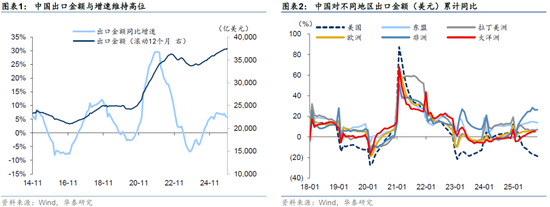
Core Viewpoints - The characteristics of trading driven by overseas macro events have become evident this year, with increased radiation and linkage to the domestic market. The focus has shifted from being primarily economy-driven to multiple channels including economy, geopolitics, AI industry trends, and global liquidity [1][5][36] - Four main paths of overseas influence on the domestic market need close attention in the coming year: external demand affecting profit expectations, AI chains contributing to market hotspots, reduced geopolitical risks, and positive impacts of overseas liquidity and RMB appreciation on domestic assets [1][20][59] Group 1: Overseas Influence on Domestic Market - Despite the impact of tariffs, China's export growth has remained robust, with a cumulative year-on-year increase of 5.4% in export value for the first 11 months, and a trade surplus increase of 21%. Net exports contributed 29% to GDP, surpassing the 17.5% contribution from investment [5][43] - The global economic outlook suggests a dual easing of fiscal and monetary policies, providing strong support for domestic growth through external demand. The structural shift in exports towards Africa and ASEAN has effectively countered declines in exports to the US [5][43][54] - Domestic enterprises are actively expanding into overseas markets, potentially creating a second growth curve, with leading companies likely to break through first. China's foreign direct investment is expected to reach nearly $200 billion in 2024, contrasting with a decline in global FDI [7][45] Group 2: Geopolitical Changes - Geopolitical changes are expected to influence market risk preferences in the short term and the restructuring of global order in the long term. China's response to trade tensions has demonstrated strategic resolve, and the market is becoming less sensitive to US tariff policies [10][49] - The trend towards regional integration and de-dollarization is accelerating, with a focus on self-sufficient supply chains. This context reduces tail risks and enhances the strategic value of scarce resources and capital goods [10][49] Group 3: AI Industry Trends - The AI wave has generated hotspots in the domestic market, primarily impacting hardware profitability and leading to valuation increases in applications. The market has experienced two rounds of AI-related trends this year, with a focus on hardware profitability and the need for actual earnings realization [12][51] - As overseas AI investments deepen, their influence is beginning to spill over into other asset classes, with a shift from "chip shortages" to "electricity shortages" becoming evident. This shift is expected to increase demand for power equipment and copper [13][52] Group 4: Monetary Policy and Currency Trends - The Federal Reserve's easing cycle, narrowing of the US-China interest rate differential, and gradual appreciation of the RMB are favorable for domestic asset performance. The trade surplus remains high, and the willingness of enterprises to convert currency has increased significantly [15][54] - The RMB is expected to continue appreciating, supported by a substantial potential for currency conversion funds and the anticipated further rate cuts by the Federal Reserve in the coming year [15][54] Group 5: Market Conditions and Recommendations - The domestic bond market is facing redemption pressures, with skepticism about the long-term interest rate support. The market is expected to experience volatility, with a focus on short- to medium-term credit bonds as relatively safe choices [39][60] - In the stock market, there is a consensus expectation for a spring rally, but the lack of earnings support may limit upward potential. Key sectors to watch include technology growth, commercial aerospace, and robotics, alongside cyclical and resource sectors [39][62]


马斯克预测某车企:必死;“天才少女”罗福莉首秀,称小米开源模型全球前二;好特卖回应新加盟叫停;玛莎拉蒂APP遭下架丨邦早报
创业邦· 2025-12-18 00:07
Group 1 - Elon Musk predicts Ford's electric strategy will lead to its demise, citing a $19.5 billion asset impairment and the halt of F-150 Lightning production as key factors [3] - Tesla's market value surpassed $1.6 trillion, with a single-day increase of $48.5 billion, reflecting investor confidence in electric vehicle technology [3] - Xiaomi's new model, MiMo-V2-Flash, has been released and is capable of deep thinking and real-time data retrieval, indicating advancements in AI capabilities [18] Group 2 - Luckin Coffee is reportedly considering acquiring Blue Bottle Coffee, although Blue Bottle has not confirmed this information [13] - OpenAI is in talks with Amazon for a potential investment of at least $10 billion, which could elevate OpenAI's valuation to over $500 billion [14] - Databricks has completed over $4 billion in Series L funding, raising its valuation to $134 billion, indicating strong investor interest in data and AI sectors [17] Group 3 - BYD has initiated comprehensive testing for L3 autonomous driving in Shenzhen, completing over 150,000 kilometers of real-world validation [18] - The Chinese music theater market is projected to generate over 1.8 billion yuan in ticket revenue by 2025, with a growing number of performances and audience engagement [22] - The foldable smartphone panel shipment is expected to grow by 46% in 2026, driven by Apple's first foldable device, with Samsung Display likely to capture over 50% market share [22]





美国AI泡沫风险可能与全球美元债务风险同步释放
2025-12-17 15:50
Summary of Conference Call Notes Industry Overview - The discussion revolves around the **U.S. economy**, particularly focusing on the **AI sector** and its implications on **debt risks** and **financial stability** [1][2]. Core Insights and Arguments - The U.S. has relied on **debt expansion** to stimulate total demand, especially during periods of global demand deficiency, primarily through **government bond issuance** [1]. - This model has facilitated **technological advancement** and economic growth, but it is heavily dependent on the ability to sustain ongoing debt expansion [1]. - The U.S. is currently facing challenges regarding its **debt expansion capacity**, particularly in emerging technology sectors like AI, which could disrupt the supply-demand cycle [1][5]. - The Biden administration's debt expansion rate has outpaced profit growth, leading to visible debt issues and challenges to the **creditworthiness of the dollar** [1][7]. - The development of AI is closely tied to the macroeconomic environment and the government's ability to expand debt; without this, the sustainability of AI applications could be severely impacted [6]. Additional Important Points - If the **AI bubble bursts**, it could expose U.S. debt risks, potentially leading to a **stock market crash** and a massive sell-off of U.S. bonds, exacerbating a financial crisis [2][9]. - The U.S. has utilized **globalization and technological monopolies** to alleviate domestic labor-capital conflicts, with large tech companies generating profits globally and using a portion for government transfers to reduce income inequality [4]. - The relationship between U.S. debt and global profit distribution is critical; the U.S. must secure sufficient global wealth to support its debt, which has become increasingly challenging [7]. - AI technology is seen as a crucial factor in addressing U.S. debt issues by lowering labor returns and increasing capital returns, thereby enhancing the U.S.'s ability to capture more global wealth [8]. - Future economic fluctuations are anticipated, with potential shifts in market styles in China and a significant appreciation of the **Renminbi** if the AI sector encounters difficulties [10][11]. This summary encapsulates the key points discussed in the conference call, highlighting the intricate relationship between AI development, U.S. debt, and broader economic implications.
海外策略-2026年港股&美股展望
2025-12-17 15:50
海外策略-2026 年港股&美股展望 20251217 摘要 发达市场在 2024-2025 年领涨,经济韧性强于新兴市场,预计 2026 年全球降息周期后半程,发达市场仍可能跑赢,美国、日本、韩国在半 导体周期中具吸引力。 美国经济虽消费边际走弱,但企业和地产投资有增量空间,小盘企业盈 利改善,预计美国经济可能从软着陆走向扩张,对美国经济持乐观态度。 中国经济物价是关键,预计明年中期 PPI 收窄,经济增长预期保持在 4.5%左右,政府政策指引将在明年下半年体现,对中国物价回升持中性 乐观态度。 中美科技发展形成共振,对全球科技产业产生深远影响。多数预测认为 美元将走弱,但因美国经济韧性较强且降息已被充分定价,美元不会大 幅走弱。 预计日本维持宽松货币政策,日元汇率大概率在 140-160 区间震荡。欧 洲经济预期不如美国,欧元未必一直走强,美元也不一定会大幅走弱。 港股 2025 年表现不错,但目前盘整,预计明年上半年美联储降息将提 升流动性,中美关系缓和及国内政策协同发力将支持港股上行。 美股 2026 年预计上涨 12%-13%,经济复苏和企业盈利增长是主要推 动因素,上半年关注科技板块,下半年看好顺 ...
2026年海外宏观经济及大类资产展望:风潮转轨:从宏观叙事到微观腹地
Guo Tai Jun An Qi Huo· 2025-12-17 14:28
1. Report Industry Investment Rating - Not provided in the content 2. Core Views of the Report - In 2026, the global macro - economy is expected to maintain resilience, supporting risk sentiment. The macro - economic mainline will shift from trade policies and geopolitical relations to economic fundamentals, and major economies will be in a period of relatively abundant macro - liquidity mainly driven by fiscal expansion [2][49]. - The global economy, led by the US, will maintain resilience in 2026, continuing to support the performance of risk assets. The structure may be more balanced than in 2025, with the technology sector, industry prosperity logic, and macro - cycle opportunities intertwined [3][50]. - The long - term US Treasury bond yield has limited trends in 2026, with an upward - risk bias. The US dollar index is expected to maintain a wide - range oscillation throughout the year, with an upward - risk bias [3][163][172]. 3. Summary According to the Directory 3.1 2025 Overseas Macroeconomic Mainline Logic and Performance Review of Major Asset Classes - **Economic fundamentals**: In 2025, the US economy maintained a relatively high growth rate, but the actual GDP growth rate declined marginally compared to 2024. Non - US economies were stronger in the first half of the year, and the US economy was stronger in the second half. The inventory and net exports of the US GDP fluctuated greatly in the first half due to trade policies, and personal consumption and private fixed investment showed certain resilience. The US industrial output increased, and there were signs of an early - cycle expansion. Monetary policy continued to cut interest rates, and the yield of US Treasury bonds declined, but the stock - market valuation remained basically unchanged. The fiscal deficit ratio decreased [7][8][16][17][26]. - **Adapting to the new reality of the tariff era**: In 2025, tariff policies were the most important macro - risks. The overall US tariff rate remained high, and the "severe decoupling" between China and the US turned into "slow decoupling." The "tariff - inflation" transmission was relatively mild, and the US inflation expectation became stable and desensitized to tariff uncertainties [30][37][39]. - **Performance review of major asset classes**: In 2025, the global market had a good year. Global equity markets rose significantly, with the Philadelphia Semiconductor Index and the STAR 50 Index leading the way. The bond market also had positive returns, and the commodity market was highly differentiated [47][48]. 3.2 2026 Overseas Macroeconomic Outlook 3.2.1 "From Politics to Economy", "From International to Domestic" - The mainline of the global macro - economy will shift from trade policies and geopolitical relations to economic fundamentals, and the focus of geopolitics will shift from international to domestic. The US mid - term elections, China's 14th Five - Year Plan, the eurozone's fiscal expansion, and Japan's new policies will all focus on domestic economic and political issues [55]. - **Tariff policy changes**: The "general tariff" under the IEEPA framework is facing challenges. If the government loses the lawsuit, the IEEPA tariff will be revoked. Relevant industry tariffs may become an important legal tool for rebuilding the high - tariff system, and attention should be paid to changes in key industries and commodity trade flows [56][58]. - **US National Security Strategy**: The US National Security Strategy focuses on economic and financial security, including trade balance, ensuring key supply chains, re - industrialization, energy dominance, revitalizing the US dollar, and tax cuts and deregulation. It shows a shift from maintaining global leadership to focusing on national interests [61]. 3.2.2 Macro - liquidity - **Monetary policy**: The Fed is expected to cut interest rates to 3.25% in 2026, with two 50bp cuts in total. There is a risk that the final interest - rate cut space is less than expected, and there is a probability of an early end to the interest - rate cut cycle or a start of an interest - rate hike cycle. The Fed is expected to restart balance - sheet expansion in the second half of 2026 [65][67][68]. - **Fiscal policy**: The US fiscal policy will expand marginally in 2026. The "Great Beauty Act" will have a positive impact on the economy, and the fiscal deficit ratio is expected to expand moderately. The risk of concerns about the sustainability of US Treasury bonds is relatively controllable [78][79][80]. - **Macro - liquidity**: The US financial conditions index is expected to continue to expand in 2026, mainly driven by factors such as the decline in the benchmark interest rate, credit expansion, and the resilience of the equity market. The expansion of the financial conditions index is expected to have a more significant impact on the real economy [86][94][96]. 3.2.3 Economic Structure - **Forward - looking and backward - looking indicators**: The US economy is currently in a situation where forward - looking indicators are improving while backward - looking indicators are still weak. It is expected that the backward - looking indicators will improve in 2026 [101]. - **Inflation**: Inflation is expected to remain above the Fed's target in 2026, with a CPI growth rate of 2.8%. The "pro - cyclical inflation" will have a relatively limited impact on macro - assets [103][104]. - **Employment**: The employment market is trending downward, supporting the Fed's interest - rate cut tendency. The unemployment rate is expected to rise to 4.5% in the first half of 2026 and then fall to 4.4% in the second half [114]. - **Consumption**: Personal consumption is expected to remain stable in 2026, showing a K - shaped differentiation. Consumption may be weak in the first half due to income factors and will be boosted by the employment market and fiscal policies in the second half [121][122]. - **Private fixed investment**: Private fixed investment is expected to be a highlight in 2026, with a significant improvement in the quarter - on - quarter growth rate. However, the structure is differentiated, and it is necessary to follow industry Alpha [128][129]. 3.2.4 Debate on the "AI Bubble" - The "AI bubble" reflects concerns about the sustainability of AI investment, debt, and return on investment. At the index level, there is no systematic risk for now, but the risk is concentrated in leading technology companies. It is recommended to track risks through indicators such as ROIC - WACC, credit market risk exposure, and the profit erosion of depreciation and amortization [135][137][147]. 3.3 US Treasury Bond Market - In 2026, the long - term US Treasury bond yield has limited trends, with an upward - risk bias. The 10 - year US Treasury bond interest - rate center may be around 4.20%, with support at 3.95 - 4.00 and the first target at 4.35% and the second target at 4.65%. The 2 - year US Treasury bond yield has support at around 3.20% and a target of 3.68%. The yield curve may show a "bull steepening" in the first half and a "bear steepening" in the second half [163][164]. 3.4 US Dollar Index - The US dollar index is expected to maintain a wide - range oscillation in 2026, with an annual oscillation range of 96 - 108 and an upward - risk bias. The oscillation range in the first quarter of 2026 is 97.7 - 102. Attention should be paid to the rhythm of economic relative strength, the marginal change of interest - rate differentials, and carry - trade themes [172][180].
每日投行/机构观点梳理(2025-12-17)
Jin Shi Shu Ju· 2025-12-17 14:27
Group 1 - If the AI hype continues to fade, the Chinese stock market may outperform the US stock market [1] - Concerns about US tech stocks have resurfaced, with the S&P 500 index down nearly 2% from its recent peak [1] Group 2 - Goldman Sachs predicts that the Federal Reserve may be more willing to cut interest rates next year than previously assumed [2] - The upcoming employment reports will be crucial in determining whether the Fed will resume easing policies, with a focus on the unemployment rate rather than overall non-farm payroll growth [2] - Goldman expects the easing cycle to extend into 2026, with the federal funds target rate potentially dropping to 3% or lower [2] Group 3 - Morgan Stanley forecasts that the price increase of gold will slow down by 2026 due to reduced purchases by central banks and ETFs [3] - By Q4 2026, gold prices are expected to reach $4,800 per ounce, driven by stronger retail demand in China and increased central bank buying [3] - Silver is anticipated to underperform gold, with a peak shortage expected in 2025 due to declining solar equipment installations [3] Group 4 - A Bank of America survey indicates that 53% of investors believe the dollar is overvalued, up from 45% in November [4] - Investors are currently underweight in the dollar compared to historical levels, with short positions in the dollar considered the third most crowded trade [4] Group 5 - Concerns about the AI bubble have eased slightly but remain high, with 38% of investors identifying it as the biggest tail risk [5] - Private credit has emerged as a new risk factor, with 14% of fund managers considering it the largest tail risk for the coming year [5] Group 6 - The likelihood of a rate hike by the Bank of Japan has increased due to strong export performance, but the governor is not expected to signal a hawkish stance [6] - November exports grew for the third consecutive month, indicating a recovery from previous economic contraction [6] Group 7 - The Canadian Imperial Bank of Commerce notes that softening US employment data may prompt the Fed to consider earlier rate cuts in 2026 [8] - The labor market's cooling is expected to weaken the Fed's resolve to maintain current rates, increasing the likelihood of policy easing [8] Group 8 - China International Capital Corporation remains optimistic about bank stocks' absolute and relative performance, highlighting their high dividend yields and quality development phase [9] - The focus is on dividend yield and certainty, which depend on valuation and profit growth [9] Group 9 - Tianfeng Securities anticipates a more pronounced credit front-loading trend in 2026, with a positive outlook for early-year loans [10] - The bank sector may face challenges from high-interest term deposits and stock market fluctuations impacting general deposits [10] Group 10 - Tianfeng Securities expects a non-symmetric principle for deposit rate cuts in 2026, with a higher probability of implementation in the second quarter [11] - The report suggests a potential need for a rate cut before the Spring Festival, with a range of 25-50 basis points [11] Group 11 - China Galaxy Securities indicates that leading real estate companies are demonstrating strong operational management capabilities, which may enhance their market share [12]
iPhone18Pro或改单打孔设计,罗永浩回应骂俞敏洪
3 6 Ke· 2025-12-17 13:38
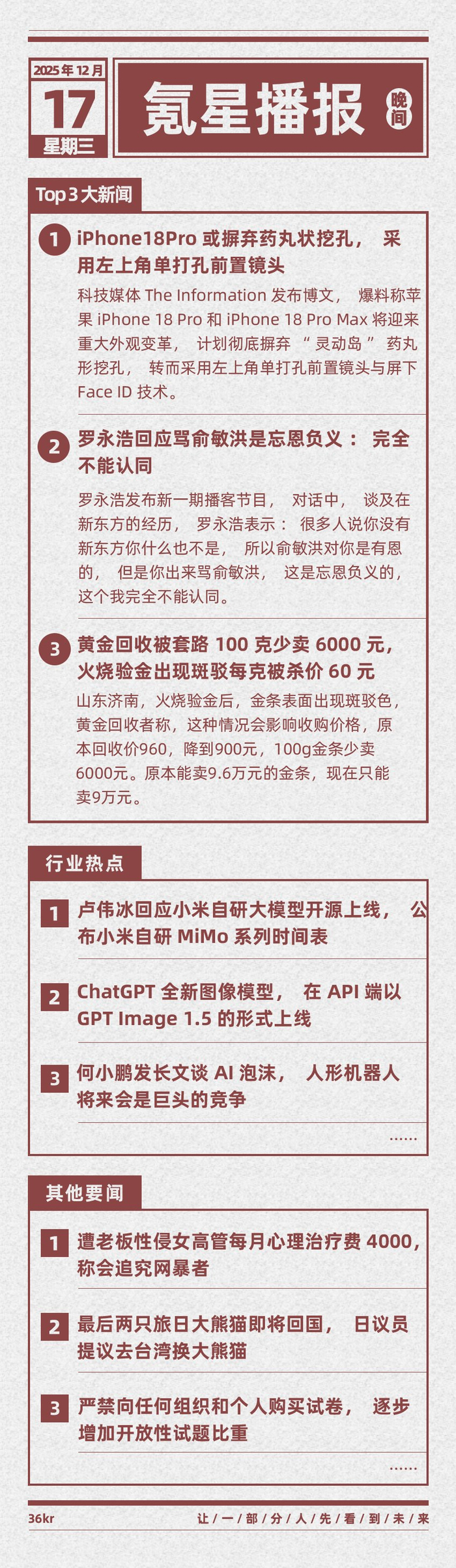
Group 1 - iPhone 18 Pro and iPhone 18 Pro Max are expected to undergo significant design changes, moving away from the "Dynamic Island" pill-shaped cutout to a single punch-hole front camera in the upper left corner, along with under-display Face ID technology [3] - Xiaomi's self-developed MiMo series has been announced to be open-sourced, with a timeline provided by Lu Weibing [4] - ChatGPT has launched a new image model, available on the API side as GPT Image 1.5 [5] Group 2 - He Xiaopeng discussed the AI bubble, suggesting that humanoid robots will become a competitive area for major companies in the future [5] - The market regulator has indicated that requiring merchants to offer the lowest prices online may constitute monopolistic behavior [5] - Recent fiscal data shows that fiscal revenue continues to exhibit low growth trends [5]

降息大消息,黄金等待突破!
Sou Hu Cai Jing· 2025-12-17 09:44
Group 1: Gold Market Analysis - Gold experienced high volatility, dropping to approximately $4,272 before rebounding to $4,335, ultimately closing at $4,302, remaining relatively stable [1] - Currently, gold is slightly up, hovering around $4,320 during European trading hours [1] Group 2: U.S. Labor Market Data - The U.S. unemployment rate rose to 4.6% in November, the highest level recorded since October 2021 [3] - The total number of unemployed individuals reached approximately 7.83 million, significantly higher than the 7.12 million reported in the same month last year [5] - In November, the non-farm sector added 64,000 jobs, while October saw a substantial decrease of 105,000 jobs [5] Group 3: Federal Reserve and Interest Rate Expectations - Following the labor data release, traders increased bets on the Federal Reserve potentially lowering interest rates twice in 2026, with the probability of a 25 basis point cut in January rising to 26.6% from 22% [6] - The labor data is described as "incomplete" due to a 43-day government shutdown, affecting the collection of household data [5] Group 4: U.S. Stock Market Performance - U.S. stock indices showed mixed results, with the Dow Jones and S&P 500 declining by 0.62% and 0.24% respectively, while the Nasdaq rose by 0.23% [2] - There are contrasting views on the stock market, with some analysts believing there is a significant bubble, while others argue that valuations are reasonable given the strong growth driven by AI [10] Group 5: Geopolitical Developments - The U.S. military conducted strikes against three vessels suspected of drug trafficking, resulting in eight fatalities, part of a broader operation that has reportedly killed at least 95 individuals [11] - President Trump announced a complete blockade of all sanctioned oil tankers entering or leaving Venezuela, labeling the current Venezuelan government as a "foreign terrorist organization" [11]