
债市

Search documents
投资和消费增速回落,风险偏好施压债市
Ge Lin Qi Huo· 2025-08-16 07:32
1. Report Industry Investment Rating - Not mentioned in the provided content 2. Core Viewpoints of the Report - Investment and consumption growth rates have declined, and risk appetite has put pressure on the bond market [2] - The performance of the bond market is affected by multiple factors such as macro - economic data, stock market trends, and monetary policy. If the stock market continues to be strong, it will suppress the bond market; if the stock market corrects, the bond market is likely to rebound [51] - The trading strategy for trading - type investments is to conduct band operations [52] 3. Summary by Relevant Catalogs 3.1 National Debt Futures Weekly Market Review - This week, the main contracts of national debt futures fell on Monday and Tuesday, rebounded on Wednesday, and continued to decline on Thursday and Friday with a slowing decline rate. The 30 - year national debt fell 1.48%, the 10 - year national debt fell 0.29%, the 5 - year national debt fell 0.15%, and the 2 - year national debt fell 0.02% [5] - As of August 15, compared with August 8, the national debt spot yield curve showed a bearish steepening, with an overall upward shift and a larger upward shift at the long - end. The 2 - year national debt yield remained flat at 1.40%, the 5 - year yield rose 4 BP to 1.59%, the 10 - year yield rose 6 BP to 1.75%, and the 30 - year yield rose 9 BP to 2.05% [8] 3.2 Investment Data - From January to July, the national fixed - asset investment increased by 1.6% year - on - year, lower than the market expectation of 2.7% and the 2.8% in January - June. General infrastructure investment (including electricity) increased by 7.3% year - on - year, down from 8.9% in January - June; narrow infrastructure investment (excluding electricity) increased by 3.2% year - on - year, down from 4.6% in January - June; manufacturing investment increased by 6.2% year - on - year, lower than the market expectation of 7.2% and down from 7.5% in January - June; real estate development investment decreased by 12.0% year - on - year, worse than the market expectation of a 11.5% decline and down from 11.2% in January - June [11] 3.3 Real Estate Market Data - From January to July, the sales area of newly built commercial housing was 51,560 million square meters, a year - on - year decrease of 4.0%, and the sales volume was 4,956.6 billion yuan, a decrease of 6.5%. The decline rates were both larger than those in January - June [13] - In July, the second - hand housing prices in first - tier cities decreased by 1.0% month - on - month, with the decline rate expanding by 0.3 percentage points. The prices in second - and third - tier cities decreased by 0.5% month - on - month, with the decline rate narrowing by 0.1 percentage points [17] - Since June, the decline rate of the national new housing sales area has accelerated. From August 1st to 14th, the average daily sales area of commercial housing in 30 large - and medium - sized cities was 180,000 square meters, a year - on - year decrease of 14% [20] 3.4 Consumption Data - In July, the total retail sales of consumer goods were 3,878 billion yuan, a year - on - year increase of 3.7%, lower than the market expectation of 4.9% and the 4.8% in June. The month - on - month decline was 0.14% [23] - In July, most of the year - on - year growth rates of categories related to the trade - in policy slowed down compared with June. The growth rates of essential consumer goods remained stable, while the retail sales of automobiles decreased year - on - year [25] - From January to July, the total service retail sales increased by 5.2% year - on - year, and the growth rate of commodity retail sales was 4.9% year - on - year [27] - In July, the national service production index increased by 5.8% year - on - year, lower than the 6.0% in June [29] 3.5 Industrial Data - In July, the added value of large - scale industries increased by 5.7% year - on - year, slightly lower than the market expectation of 5.8% and the 6.8% in June. From January to July, the cumulative year - on - year increase was 6.3% [31] 3.6 Unemployment Data - In July, the national urban survey unemployment rate was 5.2%, an increase of 0.2 percentage points from the previous month, the same as the same month last year [35] 3.7 Social Financing and Credit Data - In July, the social financing scale increased by 1.16 trillion yuan, less than the market expectation of 1.41 trillion yuan but 389.3 billion yuan more than the same period last year [38] - In July, RMB loans decreased by 50 billion yuan, more than the market expectation of a 15 - billion - yuan decrease and 310 billion yuan more than the same period last year [41] - At the end of July, the balance of M2 increased by 8.8% year - on - year, and the balance of M1 increased by 5.6% year - on - year [43] 3.8 Other Market Data - This week, the Nanhua Industrial Products Index rose slightly and then declined, and the short - term inflation pressure was limited [45] - This week, DR007 only increased on Friday. The average issuance rate of one - year AAA inter - bank certificates of deposit was slightly higher than last week [48]
债市日报:8月15日
Xin Hua Cai Jing· 2025-08-15 08:31
Market Overview - The bond market experienced fluctuations on August 15, with most government bond futures closing lower, particularly the 30-year main contract which fell by 0.29% to 117.480 [1][2] - The interbank bond yield initially decreased before rising by approximately 1 basis point in the afternoon, indicating a cautious sentiment among investors [1][2] Monetary Policy and Liquidity - The central bank conducted a net injection of 116 billion yuan through reverse repos, with a total of 238 billion yuan in 7-day reverse repos conducted at a rate of 1.40% [1][6] - The upcoming tax period is expected to lead to a tightening of liquidity, although there remains confidence in the central bank's ability to provide timely support [1][6] Economic Indicators - In July, the industrial output increased by 5.7% year-on-year, slightly below the expected 5.8%, while retail sales grew by 3.7%, also below expectations [8] - Fixed asset investment for the first seven months of the year rose by 1.6%, falling short of the anticipated 2.7% [8] Real Estate Market - The real estate sector showed signs of decline, with a 12% year-on-year drop in development investment and a 4% decrease in new housing sales area [8] - The real estate development climate index stood at 93.34 in July, indicating ongoing challenges in the sector [8] Institutional Insights - Huatai Securities recommends focusing on high-quality leading companies with long-term growth potential, particularly in sectors like new energy, semiconductors, and biomedicine [10] - Xingsheng Fixed Income suggests that the bond market may face downward pressure in the latter half of August, with potential buying opportunities as yields approach 1.75% for 10-year bonds and 2.0% for 30-year bonds [10]
下半年债市有哪些政策机会值得关注?
Mei Ri Jing Ji Xin Wen· 2025-08-15 01:36
Fiscal Policy - The government's net financing from bonds has reached 9.5 trillion, surpassing any year except 2023 and 2024, with an additional 4-5 trillion expected to be issued this year [1] - The issuance of government bonds is expected to accelerate, while special bonds will maintain a steady issuance pace similar to previous years [1] - There is a likelihood of additional government bond issuance in the second half of the year to support economic resilience, potentially through special treasury bonds or increased deficits [1] Monetary Policy - A prediction of stock liquidity easing in the second half of the year, but the overall impact may not be as significant as previously anticipated due to financial stability constraints [1] - The central bank is expected to restart bond purchases in the third quarter, primarily due to a lack of long-term liquidity tools [2] - The bank's net interest margin is a significant factor limiting the extent of interest rate reductions, with a focus on the sustainability of banks' profitability [2] Bond Market Outlook - The bond market is currently in a state of oscillation, with strategies suggested for gradually increasing long-term bond holdings at high yield points and reducing them at low yield points [3] - The yield curve is at a relatively high level compared to the year, indicating a neutral to low historical position, with financial stability being a key constraint on monetary policy [2][3]
高瑞东:低增的信贷和脆弱的债市
Sou Hu Cai Jing· 2025-08-14 14:18
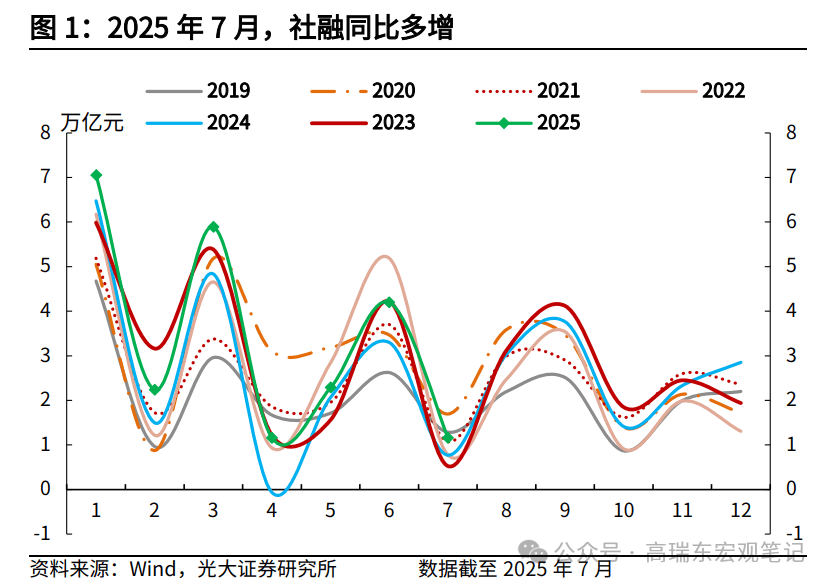
Core Insights - The financial data for July 2025 indicates a stable social financing (社融) environment but weak credit performance, suggesting a potential recovery in credit demand due to upcoming policy effects such as long-term special government bonds and consumer loan interest subsidies [2][10] Group 1: Social Financing and Credit Performance - In July, new social financing amounted to 1.16 trillion yuan, which is 389.3 billion yuan more than the same month last year, but below market expectations. The social financing stock's year-on-year growth rate was 9.0%, up 0.1 percentage points from the previous month [3][9] - The structure of social financing showed a decrease in RMB loans by 4.263 billion yuan, with foreign currency loans also declining by 8.6 billion yuan. Non-standard financing decreased by 166.7 billion yuan [3][4] - Direct financing saw significant contributions, with net financing from government bonds at 1.24 trillion yuan, an increase of 555.9 billion yuan year-on-year, and corporate bonds net financing at 279.1 billion yuan, reflecting a positive trend [3][9] Group 2: Loan Structure and Trends - RMB loans from financial institutions decreased by 500 billion yuan, with long-term loans to households down by 120 billion yuan and corporate long-term loans down by 390 billion yuan [4][10] - The short-term financing for enterprises remained stable, with a year-on-year increase in corporate bill financing by 312.5 billion yuan [4][10] Group 3: Monetary Indicators - The M1 money supply growth rate was 5.6%, up 1.0 percentage points from the previous month, while M2 growth improved to 8.8%, an increase of 0.5 percentage points [7][10] - In July, RMB deposits increased by 500 billion yuan, with a notable decrease in household deposits by 1.11 trillion yuan [7][10] Group 4: Future Outlook - The upcoming policies, including the issuance of long-term special government bonds and consumer loan interest subsidies, are expected to stimulate credit demand [10][13] - The bond market is sensitive to liquidity changes due to low bond yields, and the central bank is likely to maintain liquidity support, which could positively influence the bond market's performance [2][10][13]

基本功 | 什么环境对债市更有利?
中泰证券资管· 2025-08-14 11:33
Group 1 - The core idea emphasizes the importance of foundational knowledge in investment and fund selection, suggesting that solid fundamentals are crucial for successful investing [2] - The article discusses favorable conditions for the bond market, highlighting that weak economic fundamentals, such as low economic growth and low inflation, typically lead to declining market interest rates, which in turn increases bond prices [3] Group 2 - The content encourages readers to engage with a dedicated section on foundational knowledge, indicating a focus on educational resources for investors [6]

每日投行/机构观点梳理(2025-08-14)
Jin Shi Shu Ju· 2025-08-14 11:30
Group 1 - Deutsche Bank analysts indicate that Trump's attacks on U.S. institutions pose a threat to the dollar's outlook, particularly criticizing the Federal Reserve and the Bureau of Labor Statistics [1] - Bank of America suggests that dissenting opinions within the Federal Reserve will become more common, leading to uncertainty regarding interest rate decisions, with expectations for a 25 basis point cut supported by upcoming data [1][3] - Mizuho Securities notes that the debate within the Fed is intensifying, with no clear majority for either hawkish or dovish positions, focusing on whether rate cuts are justified to support a weak labor market [1][3] Group 2 - CICC predicts that the U.S. may enter a phase of fiscal dominance and monetary cooperation, leading to a long-term depreciation of the dollar and increased opportunities in non-U.S. markets [2] - CICC also highlights a sustained explosion in demand for AI inference computing power in the second half of the year, driven by the enhancement of large model capabilities and diverse application scenarios [2] - Galaxy Securities emphasizes that the market has already priced in expectations for a September rate cut, but confirms that more data is needed to determine the Fed's decision [3] Group 3 - CITIC Securities expresses strong confidence in the value of core assets in China's battery sector, anticipating improved performance due to supply-demand dynamics and cost reductions [5] - CITIC Jinshi reports that the competition and iteration of AI large models continue, suggesting sustained high levels of investment in computing power [6] - CITIC Jinshi also notes that the rare earth industry is entering a traditional consumption peak season, with rising demand and prices expected to benefit the sector [7]
固定收益点评:“搬家”的存款还是存款
GOLDEN SUN SECURITIES· 2025-08-14 06:36
1. Report Industry Investment Rating - Not provided in the content 2. Core Viewpoints of the Report - The "relocated" deposits remain as deposits and do not reduce the allocation power in the bond market. Even if residents' deposits move to the stock market, they still exist in the form of margin deposits, so the overall bank deposits do not decrease, and the asset - side allocation power will not decline [1]. - Credit showed negative growth and relied on bills, indicating weak financing demand. Both corporate and household credit demand was weak in July, with high - frequency data showing a weakening in real - estate sales [2][9]. - Government bonds are still the main support for social financing. However, if there is no new fiscal budget, government bond supply may decrease year - on - year in the future, and social financing may face pressure again [3][4][14]. - The base effect pushed up the M1 growth rate, and non - bank deposits drove the M2 growth rate to rebound. As the government bond issuance pace slows down, fiscal deposits may decrease year - on - year, increasing market liquidity [5][20]. - The bond market may experience short - term or periodic fluctuations and is waiting for a breakthrough. As the commodity and stock markets cool down, the bond market is expected to oscillate in the short term, and interest rates may break through downward as the fundamentals change and the asset shortage evolves, more likely around or in the fourth quarter [6][23]. 3. Summary by Relevant Contents Credit Situation - In July, new credit was - 500 billion yuan, a year - on - year decrease of 310 billion yuan. Corporate long - term loans decreased year - on - year, short - term loans were flat compared with the previous year, and bill financing increased year - on - year. Household new long - term and short - term loans both decreased year - on - year, and high - frequency data showed weak real - estate sales and household credit demand [2][9]. Social Financing Situation - In July, new social financing was 1.16 trillion yuan, a year - on - year increase of 389.3 billion yuan, with a year - on - year growth rate of 9.0%. Government bonds were the main support, with an increase of 555.9 billion yuan year - on - year to 1.244 trillion yuan. Non - government bond social financing growth was weak, and if there is no new budget, government bond supply may decrease year - on - year in the future, putting pressure on social financing growth [3][4][14]. Monetary Supply Situation - In July, the M1 growth rate rebounded from 4.6% to 5.6% mainly due to the base effect, and there was no trend - like increase in the two - year compound growth rate. The M2 growth rate was 8.8%, a 0.5 - percentage - point increase from the previous month, mainly driven by the year - on - year increase in non - bank deposits. As the government bond issuance pace slows down, fiscal deposits may decrease year - on - year, increasing market liquidity [5][17][20]. Bond Market Outlook - The bond market may experience short - term or periodic fluctuations. As the commodity and stock markets cool down, the 10 - year and 30 - year treasury bonds are expected to oscillate in the short term. As the fundamentals change and the asset shortage evolves, interest rates may break through downward, more likely around or in the fourth quarter [6][23].
2025年7月金融数据点评:低增的信贷和脆弱的债市
EBSCN· 2025-08-14 02:56
Group 1: Financial Data Overview - In July 2025, new social financing (社融) amounted to 1.16 trillion yuan, a decrease from 4.20 trillion yuan in the previous month, and 3,893 billion yuan higher year-on-year[1] - The year-on-year growth rate of social financing stock was 9.0%, up from 8.9% in the previous month[1] - RMB loans decreased by 50 billion yuan, compared to an increase of 224 billion yuan in the previous month[1] Group 2: Credit and Loan Analysis - Financial institutions reported a decrease of 50 billion yuan in RMB loans, which is 310 billion yuan lower year-on-year[4] - Long-term loans to households decreased by 120 billion yuan year-on-year, while short-term loans saw a reduction of 167.1 billion yuan[4] - Corporate long-term loans decreased by 390 billion yuan year-on-year, while short-term financing remained stable[4] Group 3: Market Trends and Outlook - The bond market is sensitive to changes in market liquidity due to low bond yields, with the 10-year government bond yield rising to 1.73%[14] - The government bond net financing in July was 1.24 trillion yuan, a year-on-year increase of 5,559 billion yuan, indicating a strong contribution to social financing[3] - Future credit demand is expected to improve with the release of policies such as long-term special government bonds and consumer loan interest subsidies[15]
债市日报:8月13日
Xin Hua Cai Jing· 2025-08-13 08:53
Core Viewpoint - The bond market showed slight recovery on August 13, with government bond futures rising across the board, while interbank bond yields fell by approximately 1 basis point. The market is supported by stable fundamentals, although short-term performance is influenced by risk appetite and stock market trends [1][2]. Market Performance - Government bond futures closed higher, with the 30-year main contract up 0.10% at 118.270, the 10-year main contract up 0.02% at 108.435, the 5-year main contract up 0.05% at 105.745, and the 2-year main contract up 0.03% at 102.368 [2]. - The yields on major interbank bonds mostly declined slightly, with the 30-year government bond yield down 1.25 basis points to 1.961%, the 10-year policy bank bond yield down 0.75 basis points to 1.829%, and the 10-year government bond yield down 0.9 basis points to 1.7185% [2]. International Market Trends - In North America, U.S. Treasury yields were mixed, with the 2-year yield down 2.93 basis points to 3.727% and the 10-year yield up 0.97 basis points to 4.291% [3]. - In Asia, Japanese bond yields rose, with the 10-year yield increasing by 1.2 basis points to 1.511% [4]. - In the Eurozone, yields on 10-year bonds increased, with French yields up 5.3 basis points to 3.407% and German yields up 4.7 basis points to 2.742% [4]. Primary Market Activity - Agricultural Development Bank's financial bonds had successful bids with yields of 1.3575% for 1.074 years, 1.7089% for 3 years, and 1.8490% for 10 years, with bid-to-cover ratios of 2.36, 3.48, and 2.57 respectively [5]. Funding Conditions - The central bank conducted a 7-day reverse repurchase operation of 118.5 billion yuan at a rate of 1.40%, resulting in a net withdrawal of 20 billion yuan for the day [6]. - Short-term Shibor rates mostly increased, with the overnight rate unchanged at 1.315% and the 7-day rate rising by 0.1 basis points to 1.434% [6]. Institutional Insights - Institutions noted that while the stock market's strength may pressure bond market sentiment, the domestic economy still faces downward pressure, and no significant turning point in fundamentals has been observed [7]. - The current economic data release window suggests that economic performance is likely to meet expectations, leading to narrow fluctuations in the bond market [7][8].
银行理财周度跟踪(2025.8.4-2025.8.10):多元资产配置新探索,银行理财收益延续回升-20250813
HWABAO SECURITIES· 2025-08-13 08:41
Investment Rating - The report does not explicitly provide an investment rating for the banking wealth management industry [3]. Core Insights - The banking wealth management market is facing challenges due to a "low interest rate, low growth, and low risk appetite" environment, which is impacting profitability and asset allocation [4][11]. - There is a significant potential for growth in the wealth management market, necessitating a focus on long-term investment philosophies, technological empowerment, and enhanced customer experiences [4][11]. - Recent trends indicate a recovery in bank wealth management product yields, driven by improved sentiment in the bond market [5][14]. Summary by Sections Regulatory and Industry Dynamics - On August 7, 2025, China Merchants Bank hosted a forum highlighting the wealth management market's potential and the structural challenges faced by institutions [4][11]. - The industry is urged to enhance long-term investment strategies, optimize asset allocation, and improve customer experiences [4][11]. Peer Innovation Dynamics - Huibin Wealth Management launched the "Star Huibin+" multi-asset strategy product system, integrating various investment strategies to enhance risk diversification and return optimization [4][12]. - Xingyin Wealth Management successfully completed the first equity subscription registration project in Fujian Province, marking a significant milestone in their service offerings [4][13]. Yield Performance - For the week of August 4-10, 2025, cash management products recorded a 7-day annualized yield of 1.34%, down 2 basis points from the previous week [5][14]. - The bond market exhibited a volatile pattern influenced by various factors, including central bank liquidity support and stock market performance [5][15]. Net Value Tracking - The net value ratio of bank wealth management products decreased to 0.91%, down 1.44 percentage points, indicating a positive trend in credit spreads [5][24]. - The current credit spread remains at a historical low, suggesting limited value for investors [5][24].