
人民币升值

Search documents
金融期货早评-20251226
Nan Hua Qi Huo· 2025-12-26 05:14
1. Report Industry Investment Ratings No industry investment ratings are provided in the report. 2. Core Views of the Report Financial Futures - **Macro**: Overseas, the US GDP in Q3 grew by 4.3% year - on - year, and the employment market recovered, weakening the rate - cut expectation. Domestically, the government will continue to implement proactive fiscal and moderately loose monetary policies, with expanding domestic demand as the primary task next year. However, the domestic demand in November was weak, still needing policy support [2]. - **Renminbi Exchange Rate**: Although there is an expectation that the RMB will "break 7 and enter 6" in 2026, there are three potential risks. The RMB's real purchasing power is underestimated, and the narrowing of the Sino - US interest rate spread is the core trigger for its appreciation. The attractiveness of the capital market has become a key variable for the exchange - rate trend [4]. - **Stock Index**: In the short term, it is expected to fluctuate strongly. Although the market sentiment has improved, there is still pressure on the index due to the approaching year - end and tightened capital [7]. - **Treasury Bond**: Maintain a non - pessimistic view on the medium - term bond market. Hold mid - term long positions [8]. - **Container Shipping to Europe**: The market is in a narrow - range consolidation, weighing between "weak reality" and "strong expectation", waiting for a clear pre - holiday driver [9]. Commodities Non - ferrous Metals - **Platinum & Palladium**: In the medium - to - long term, the bull market foundation of platinum remains. In the short term, beware of adjustment risks due to the large futures - spot price difference and light spot trading [16]. - **Gold & Silver**: In the short term, gold is in a relatively strong state after breaking through the previous high, while silver has high price risks. In the medium - to - long term, maintain a bullish view [17]. - **Copper**: The copper price has exceeded the expected range. After reaching a new high, the long - short game intensifies, and the price volatility is expected to increase in Q1 [19]. - **Aluminum Industry Chain**: For aluminum, it is expected to fluctuate strongly in the medium term. For alumina, it is in an oversupply situation and is expected to run weakly. For cast aluminum alloy, it is expected to fluctuate strongly [21][22]. - **Zinc**: It is expected to maintain a high - level shock in the short term [23]. - **Nickel - Stainless Steel**: It is expected to have a wide - range shock [24]. - **Tin**: It is expected to have a wide - range shock, and it is recommended to operate within the range [25]. - **Lithium Carbonate**: In the short term, beware of sharp fluctuations. In the medium - to - long term, there are opportunities to go long on dips [26]. - **Industrial Silicon & Polysilicon**: Industrial silicon is in a supply - demand double - weak pattern, with value for long - term bottom - fishing. Polysilicon has deviated from the fundamentals, and new registered warehouse receipts should be monitored [27][28]. - **Lead**: It is expected to fluctuate between 16700 - 17500 in the short term [29]. Black Metals - **Rebar & Hot - Rolled Coil**: The steel price is expected to fluctuate at a low level, with the rebar 2605 contract between 2900 - 3300 and the hot - rolled coil 2605 contract between 3000 - 3400 [30][31]. - **Iron Ore**: It is expected to run within a range, with limited upside space after valuation repair [33]. - **Coking Coal & Coke**: As the terminal winter - storage replenishment approaches, the coking - coal inventory structure is expected to improve. For coke, if steel mills resume production quickly, the supply - demand structure is expected to improve [35][36]. - **Ferrosilicon & Ferromanganese**: They are expected to fluctuate strongly in the short term, but the upside space is limited, and they may follow the steel - price trend [37][38]. Energy and Chemicals - **Pulp - Offset Paper**: The current market is neutral. The "breaking 7" of the RMB brings macro - level benefits, and the price has rebounded from a low level. For offset - paper futures, the market sentiment has improved, and it is recommended to wait and see or try short - term long positions [39][40][41]. - **Crude Oil**: The escalating geopolitical situation between the US and Venezuela will drive up the short - term oil price. Follow - up attention should be paid to the development of the situation [43]. - **LPG**: The fundamentals are stable. The near - term price has support, while the expected price is under pressure [44][45]. - **PTA - PX**: PX is in a good supply - demand pattern and is expected to be easy to rise and difficult to fall. PTA's processing - fee expectation center moves up, but the space is limited [47][48][49]. - **MEG - Bottle Chip**: The demand for ethylene glycol is weakening, and the supply has initially shown support signals. The over - supply expectation will continue to suppress the valuation [50][51]. - **Methanol**: The fundamentals are mixed, with a near - term weak and long - term strong expectation. Hold the 1 - 5 reverse spread [53]. - **Pure Benzene - Styrene**: Pure benzene is in an over - supply situation, with an internal - weak and external - strong pattern. Styrene has changed from strong reality to weak expectation, and the follow - up should focus on relevant news [56]. - **Soda Ash & Caustic Soda**: Soda ash is in an over - supply situation, and the price is expected to be under pressure. Glass needs to digest high inventory, and caustic soda is expected to fluctuate weakly [57][58][62]. - **Log**: It has low volatility, with limited upside and downside space. Consider interval operations [63][64]. - **Propylene**: It maintains a loose supply situation and is expected to fluctuate at a low level [65][66]. Agricultural Products - **Hogs**: In the long - term, it can be bullish, but in the short - to - medium term, focus on the fundamentals. The near - term出栏 pressure remains, while the far - term is affected by expectations and shows a strong trend [67]. - **Oilseeds**: The external - market soybeans are waiting for the January USDA report, and the internal - market soybean meal should focus on the supply increase from state reserves. Wait for a definite opportunity [68][69]. - **Oils and Fats**: In the short term, they will continue to fluctuate. Palm oil is relatively strong in the sector, and attention should be paid to the production and biodiesel market information [70]. - **Cotton**: In the short term, the hedging pressure on cotton prices is gradually digested. In the long - term, the supply - demand may be tight, and attention should be paid to pre - holiday downstream orders [71][72]. - **Sugar**: In the short term, it is difficult for the sugar price to rise further after the basis repair [73][74]. - **Eggs**: The long - term egg - laying hen capacity is still excessive, and the price is under pressure. In the short term, some farmers are culling hens. It is recommended to take a light - position long position if betting on a rebound [74][75]. - **Apples**: The near - term is strong, and the far - term is weak. Wait for the price to pull back to go long [76][77]. - **Jujubes**: In the short term, the jujube price is expected to fluctuate at a low level. In the long - term, the supply - demand is loose, and the price will be under pressure [78][79]. 3. Summaries According to Relevant Catalogs Financial Futures - **Market News**: The Chinese Ministry of Commerce responded to issues such as the relaxation of rare - earth magnet exports to the US, TikTok's joint - venture establishment in the US, and opposed the US's additional 301 tariffs on Chinese semiconductor products. Japan plans to launch a record - high budget of 122 trillion yen in the new fiscal year [1]. - **Renminbi Exchange Rate**: The on - shore RMB against the US dollar closed at 7.0066 on the previous trading day, and the mid - price rose. Japan raised its economic forecast for the 2025 fiscal year and is approaching the 2% inflation target [3]. - **Stock Index**: The stock index closed up on the previous trading day, and the market sentiment improved. However, there is pressure on the index due to the approaching year - end [5][7]. - **Treasury Bond**: The treasury bond closed down on Thursday, and the trading volume of medium - and long - term varieties continued to shrink. The market adheres to a non - pessimistic view on the medium - term [7][8]. - **Container Shipping to Europe**: The futures market fluctuates between "weak reality" and "strong expectation", with spot - price increase games and geopolitical disturbances [9][12]. Commodities Non - ferrous Metals - **Platinum & Palladium**: The overseas market was closed for Christmas, and the Guangzhou Futures Exchange continued to limit positions. The long - term prospects of platinum are good, but beware of short - term adjustment risks [14][16]. - **Gold & Silver**: The overseas market was closed for Christmas, while the domestic night - session was active. Silver rose sharply. Pay attention to the appointment of the new Fed chairman and economic data [17]. - **Copper**: The CSPT did not set a spot - purchase guidance price for Q1 2026. The copper price has reached a new high, and the price volatility is expected to increase in Q1 [18][19]. - **Aluminum Industry Chain**: The aluminum price is expected to fluctuate strongly in the medium term, alumina is in an over - supply situation, and cast aluminum alloy is expected to follow the aluminum - price trend [20][21][22]. - **Zinc**: The zinc price has strong support below. The supply is expected to be loose in the long - term, but the short - term raw - material supply is tight. It is expected to fluctuate at a high level [22][23]. - **Nickel - Stainless Steel**: They showed a slight correction and are expected to fluctuate widely. The nickel - ore market is expected to be stable and strong, and the stainless - steel market is relatively stable [23][24]. - **Tin**: It fluctuated widely at a high level. The supply from Myanmar and Indonesia is expected to recover in December, and the demand has no obvious increase in the short term [25][29]. - **Lithium Carbonate**: The futures price decreased, and the trading volume and open interest declined. The industry is in a state of production increase and inventory reduction [25][26]. - **Industrial Silicon & Polysilicon**: Industrial silicon is in a supply - demand double - weak pattern, and polysilicon has deviated from the fundamentals. Pay attention to new registered warehouse receipts [27][28]. - **Lead**: The lead price rebounded slightly. The supply is decreasing, and the demand is stable. It is expected to fluctuate between 16700 - 17500 [28][29]. Black Metals - **Rebar & Hot - Rolled Coil**: The steel price rebounded due to the rise of coking coal and iron ore prices and then fluctuated. The supply may increase, and the demand is in the off - season [30][31]. - **Iron Ore**: The port inventory is accumulating, but the steel - mill inventory is low. The iron - water production is expected to bottom out, and the price is expected to run within a range [32][33]. - **Coking Coal & Coke**: The coking - coal inventory structure is deteriorating, and the coke's third - round price cut has been fully implemented. As the terminal winter - storage replenishment approaches, the coking - coal inventory structure is expected to improve [34][35][36]. - **Ferrosilicon & Ferromanganese**: They rebounded from the bottom last week due to policy and cost factors. The supply may decrease, and the demand is expected to decline [37][38]. Energy and Chemicals - **Pulp - Offset Paper**: The pulp price rebounded from a low level, and the offset - paper market sentiment improved. The port pulp inventory is decreasing, and some pulp mills have reduced prices [39][40][41]. - **Crude Oil**: The overseas market was closed for Christmas. The escalating geopolitical situation between the US and Venezuela will drive up the short - term oil price [42][43]. - **LPG**: The LPG price fluctuated, and the fundamentals were stable. The near - term price has support, while the expected price is under pressure [44][45]. - **PTA - PX**: PX is in a good supply - demand pattern, and PTA's production has decreased significantly. The PTA processing - fee expectation center moves up, but the space is limited [47][48][49]. - **MEG - Bottle Chip**: The demand for ethylene glycol is weakening, and the supply has initially shown support signals. The over - supply expectation will continue to suppress the valuation [50][51]. - **Methanol**: The methanol price is mixed, with a near - term weak and long - term strong expectation. Hold the 1 - 5 reverse spread [52][53]. - **Pure Benzene - Styrene**: Pure benzene is in an over - supply situation, and styrene has changed from strong reality to weak expectation. Follow - up attention should be paid to relevant news [54][56]. - **Soda Ash & Caustic Soda**: Soda ash is in an over - supply situation, and the price is expected to be under pressure. Glass needs to digest high inventory, and caustic soda is expected to fluctuate weakly [57][58][62]. - **Log**: It has low volatility, with limited upside and downside space. Consider interval operations [63][64]. - **Propylene**: It maintains a loose supply situation and is expected to fluctuate at a low level [65][66]. Agricultural Products - **Hogs**: The futures price decreased slightly, and the spot price showed regional differences. The long - term can be bullish, but focus on the short - to - medium - term fundamentals [67]. - **Oilseeds**: The external - market was closed for Christmas. The soybean supply is expected to be stable, and the rapeseed supply is low. Wait for a definite opportunity [68][69]. - **Oils and Fats**: The external - market was closed for Christmas. Palm oil production is expected to decline, and the demand is expected to increase. The overall market will continue to fluctuate [70]. - **Cotton**: The external - market was closed for Christmas, and the domestic cotton price rose. The new - season cotton - planting area in Xinjiang is expected to decrease, and attention should be paid to pre - holiday downstream orders [71][72]. - **Sugar**: The external - market was closed for Christmas, and the domestic sugar price fell. In the short term, it is difficult for the sugar price to rise further after the basis repair [73][74]. - **Eggs**: The futures price was stable, and the spot price was mainly stable. The long - term egg - laying hen capacity is excessive, and some farmers are culling hens [74][75]. - **Apples**: The futures price fluctuated horizontally, and the spot price was stable. The consumption has slowed down, and wait for the price to pull back to go long [76][77]. - **Jujubes**: The new - jujube harvest is basically completed. The short - term price is expected to fluctuate at a low level, and the long - term supply - demand is loose [78][79].

品渥食品:人民币升值会降低产品采购单价,对公司有正面影响
Sou Hu Cai Jing· 2025-12-26 03:57
有投资者在互动平台向品渥食品提问:"你好,公司主营进口食品的运营,人民币升值是不是对公司有 比较大的利好影响?" 声明:市场有风险,投资需谨慎。本文为AI基于第三方数据生成,仅供参考,不构成个人投资建议。 来源:市场资讯 针对上述提问,品渥食品回应称:"投资者您好,公司主要产品为国外进口,人民币升值会降低产品采 购的单价,对公司有正面影响。公司的进口产品采购主要以欧元、新西兰元、美元计价。感谢您对本公 司的关注。" ...

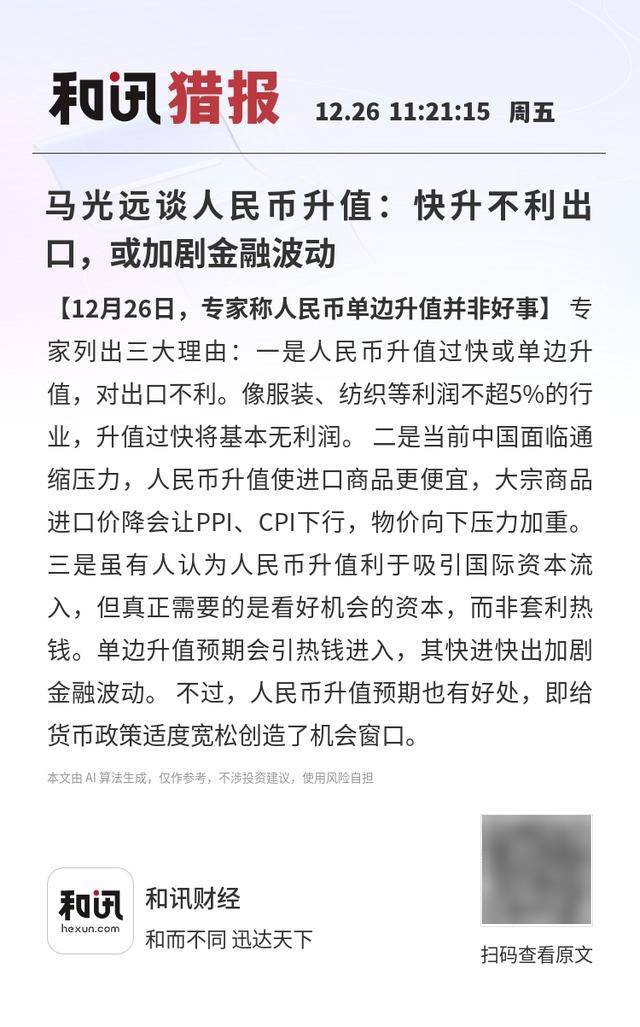
马光远谈人民币升值:快升不利出口,或加剧金融波动
Sou Hu Cai Jing· 2025-12-26 03:57
Core Viewpoint - The rapid appreciation of the Renminbi (RMB) is viewed negatively by experts, citing three main reasons that could adversely affect the economy and financial stability [1][2]. Group 1: Impact on Exports - Rapid or unilateral appreciation of the RMB is detrimental to exports, particularly in industries like clothing and textiles where profit margins do not exceed 5%, leading to minimal profitability [1][2]. Group 2: Inflation and Price Pressure - China is currently facing deflationary pressures, and the appreciation of the RMB makes imported goods cheaper. This decline in import prices for bulk commodities could lead to a decrease in Producer Price Index (PPI) and Consumer Price Index (CPI), exacerbating downward pressure on prices [1][2]. Group 3: Capital Inflows and Financial Volatility - While some believe that RMB appreciation could attract international capital, the focus should be on capital that sees genuine opportunities rather than speculative hot money. The expectation of unilateral appreciation may invite speculative capital, which can increase financial volatility due to rapid inflows and outflows [1][2]. Group 4: Monetary Policy Implications - Despite the concerns, the expectation of RMB appreciation may create an opportunity window for moderate easing of monetary policy [1][2].

品渥食品:公司的进口产品采购主要以欧元、新西兰元、美元计价
Mei Ri Jing Ji Xin Wen· 2025-12-26 03:51
Core Viewpoint - The appreciation of the Renminbi is expected to have a positive impact on the company, as it will lower the procurement costs of imported products [2]. Group 1: Company Impact - The company's main products are imported from abroad, and the appreciation of the Renminbi will reduce the unit price of product procurement [2]. - The company's imported product procurement is primarily denominated in euros, New Zealand dollars, and US dollars [2].
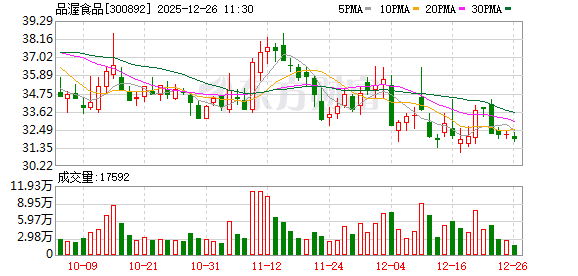
品渥食品:公司国外采购占比90%以上
Mei Ri Jing Ji Xin Wen· 2025-12-26 03:48
品渥食品(300892.SZ)12月26日在投资者互动平台表示,公司主要产品为国外进口,人民币升值会降 低产品采购的单价,对公司的业绩有正面影响,公司国外采购占比90%以上,具体数据已在定期报告中 披露。 (记者 王瀚黎) 每经AI快讯,有投资者在投资者互动平台提问:请问贵公司作为A股"进口食品第一股",目前公司进口 业务占比多少? ...
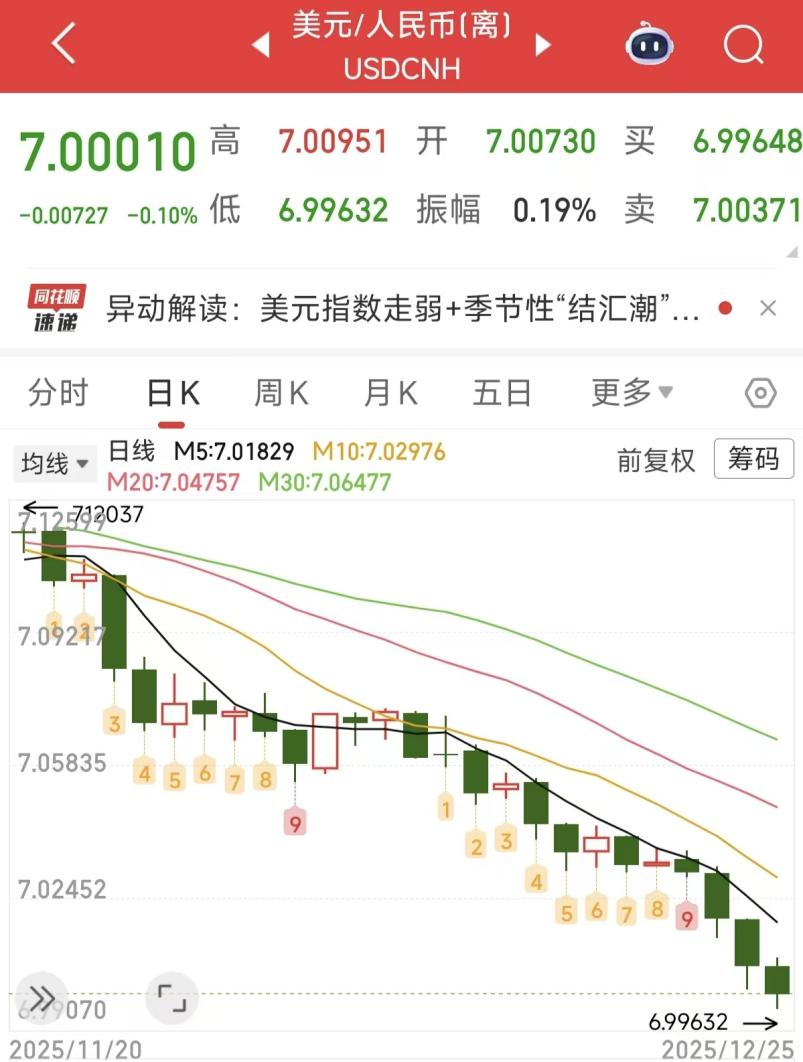
人民币破7!荣盛石化领衔大化工板块迎双重利好
Quan Jing Wang· 2025-12-26 03:16
Core Viewpoint - The offshore RMB has appreciated against the USD, surpassing the 7.0 mark for the first time since September 2024, with a year-to-date increase of 4.6%. This appreciation positively impacts the chemical industry, particularly oil-head refining enterprises, by reducing import costs and enhancing profit margins [1][2]. Company Analysis - Rongsheng Petrochemical, a major player in the oil-head refining sector, has a high sensitivity to exchange rate fluctuations due to its reliance on imported crude oil, which constitutes approximately 50%-90% of its total costs. The company benefits from a "more variety, less oil" strategy to increase the proportion of high-value-added products, leading to improved profit margins with RMB appreciation [1][2]. - The company operates the world's largest integrated refining project with a capacity of 40 million tons per year and has significant production capacities for PX and PTA, positioning it as a leader in the chemical sector [2]. - If the crude oil procurement price is estimated at $60 per barrel, a 3% appreciation in the RMB could save Rongsheng Petrochemical approximately 1 billion RMB in costs per quarter, potentially increasing annual profits by up to 4 billion RMB [2]. Industry Overview - The domestic demand for chemical raw materials is steadily recovering, with prices for downstream products like PX and PTA continuing to rise, creating a favorable environment characterized by "declining costs and product premiums" [2]. - Major refining enterprises are seen as having significant price elasticity, with RMB appreciation further amplifying their profit potential, making them attractive low-position assets for incremental capital [2]. - The recent increase in trading activity in the A-share market, coupled with RMB appreciation, has led to accelerated foreign investment in core assets, supporting the upward price trends of major oil-head refining companies like Rongsheng Petrochemical, Hengli Petrochemical, and Hengyi Petrochemical [2].

【中证1000ETF(159845)盘中成交额超7亿元,人民币适度升值对股市形成利好】
Sou Hu Cai Jing· 2025-12-26 03:06
东莞证券表示,人民币适度升值对中国股市总体形成积极利好。这一走势有助于提升人民币资产的整体 吸引力,进一步提振市场投资需求。。对于关注汇兑收益的境外机构投资者而言,他们既能赚取资产增 值收益,又能获得汇率升值带来的红利,从而实现双重收益。这种效应有望推动中国股市获得持续增量 资金流入,增强市场活力与稳定性,为资本市场长期发展提供支持。 中证1000ETF(159845)紧密跟踪中证1000指数。中证1000指数由全部A股中剔除中证800指数成份股 后,规模偏小且流动性好的1000只股票组成,综合反映中国A股市场中一批小市值公司的股票价格表 现。 行业表现来看,中证1000ETF前几大重仓行业中,电子下跌0.13%,电力设备上涨1.78%,医药生物下跌 0.05%,计算机上涨1.25%,机械设备上涨0.63%。 资金面来看,中证1000ETF(159845)近五个交易日资金净流入9.91亿元,近十个交易日净流入24.5亿 元。最新规模达490.01亿元,近一个月规模增长43.18亿。今日盘中成交额7.62亿元,近一周日均成交高 达14.12亿元,流动性较好。 近日,中国人民银行货币政策委员会第四季度会议认为,要 ...
人民币破7!大化工谁最受益?
Cai Fu Zai Xian· 2025-12-26 03:05
Group 1 - The offshore RMB has appreciated against the USD, breaking the 7.0 mark for the first time since September 2024, with a cumulative increase of 4.6% this year [1] - The onshore RMB has also approached the 7.0 mark, with a year-to-date appreciation of 4% [1] - The appreciation of the RMB is expected to accelerate the conversion of corporate earnings held overseas, further driving appreciation and hot money inflow [1] Group 2 - The chemical industry, particularly oil-head refining enterprises, will benefit significantly from the RMB appreciation due to their high reliance on imported raw materials [3] - Oil-head refining is the mainstream route in the chemical industry, with crude oil accounting for 50%-90% of total costs, making it highly sensitive to exchange rate fluctuations [4] - For example, Rongsheng Petrochemical, a leading private refining enterprise, could save 1 billion RMB in costs for every 3% appreciation of the RMB, potentially increasing annual profits by 4 billion RMB [4] Group 3 - Coal-head route enterprises like Baofeng Energy have lower sensitivity to exchange rate changes due to their high self-sufficiency in raw materials, primarily using domestic coal [5] - Baofeng Energy's cost structure is less affected by RMB appreciation, as it relies mainly on domestic coal, making the impact on profits negligible [5] Group 4 - Gas-head route enterprises, such as Satellite Chemical, have moderate sensitivity to exchange rate changes, depending on their import ratios of ethane and propane [6] - Satellite Chemical's core project relies on imported ethane, and a 3% appreciation of the RMB could save several million to over 100 million RMB in raw material costs [6] Group 5 - The current domestic chemical raw material demand is steadily recovering, with downstream products like PX and PTA experiencing price increases, creating a dual benefit of cost reduction and product premium for refining leaders [7] - The combination of an A-share bull market and RMB appreciation is attracting foreign investment into core assets, with leading companies like Rongsheng Petrochemical seeing significant stock price increases [7]
宏观金融数据日报-20251226
Guo Mao Qi Huo· 2025-12-26 02:30
投资咨询业务资格:证监证可【2012】31号 | | 国贸期货研究院 宏观金融研究中心 郑雨婷 | | 期货执业证号:F3074875; 投资咨询证号: Z0017779 | | | 2025/12/26 | | --- | --- | --- | --- | --- | --- | --- | | | 品种 | 收盘价 | 较前值变动(bp) | 品种 | 收盘价 | 较前值变动 (bp) | | | DRO01 | 1.26 | -0.24 | DR007 | 1.48 | 10.14 | | | GC001 | 1.35 | -41.50 | GC007 | 1.87 | -1.00 | | S | SHBOR 3M | 1.60 | 0.00 | LPR 5年 | 3.50 | 0.00 | | 1 | 1年期国债 | 1.28 | -0.70 | 5年期国债 | 1.58 | -0.20 | | 1 | 10年期国债 | 1.81 | -3.90 | 10年期美债 | 4.13 | 0.00 | | 2 | | | | | | | 回顾: 央行昨日开展了1771亿元7天期逆回购操作,操作利率1.40 ...
【申万宏源策略】讨论人民币升值、PPI回升和外资流入展望
申万宏源证券上海北京西路营业部· 2025-12-26 02:28
Core Viewpoint - The article discusses the outlook for RMB appreciation, PPI recovery, and foreign capital inflow, highlighting the potential positive impacts on the economy and investment landscape [2] Group 1: RMB Appreciation - The article indicates that the RMB is expected to appreciate due to various economic factors, which could enhance the purchasing power of consumers and businesses [2] - It notes that a stronger RMB may lead to increased imports and reduced export competitiveness, impacting trade balances [2] Group 2: PPI Recovery - The Producer Price Index (PPI) is projected to recover, suggesting a potential increase in manufacturing profitability and overall economic growth [2] - The recovery in PPI is seen as a positive signal for industrial sectors, indicating improved demand and pricing power [2] Group 3: Foreign Capital Inflow - The article highlights an anticipated increase in foreign capital inflow, driven by favorable economic conditions and investment opportunities in China [2] - It suggests that this inflow could support domestic markets and enhance liquidity, benefiting various sectors [2]
