
春季行情

Search documents
再刷十年新高!有色超级周期威力尽显,有色ETF华宝(159876)再涨1.7%创历史新高
Sou Hu Cai Jing· 2025-12-23 03:06
Group 1 - The core viewpoint of the articles highlights the ongoing bullish trend in the non-ferrous metals sector, with the Huabao Non-Ferrous ETF (159876) reaching a historical high since its listing, driven by favorable market conditions and expectations for a prolonged super cycle in non-ferrous metals until 2026 [1][2] - The continuation of the non-ferrous metals super cycle is contingent upon three factors: the recovery of US dollar credit, the progress of strategic reserves, and the effectiveness of "anti-involution" policies [1] - Major financial institutions, including Goldman Sachs, JPMorgan, and Bank of America, predict that gold prices may challenge the historical high of $5000 per ounce by 2026, with central bank purchases being a key support factor for gold prices [1] Group 2 - The Huabao Non-Ferrous ETF (159876) and its linked fund (017140) cover a wide range of sectors including copper, aluminum, gold, rare earths, and lithium, providing a diversified investment option compared to single metal investments [2] - As of December 22, the Huabao Non-Ferrous ETF (159876) has a total scale of 754 million yuan, making it the largest ETF tracking the same index among three similar products in the market [2]
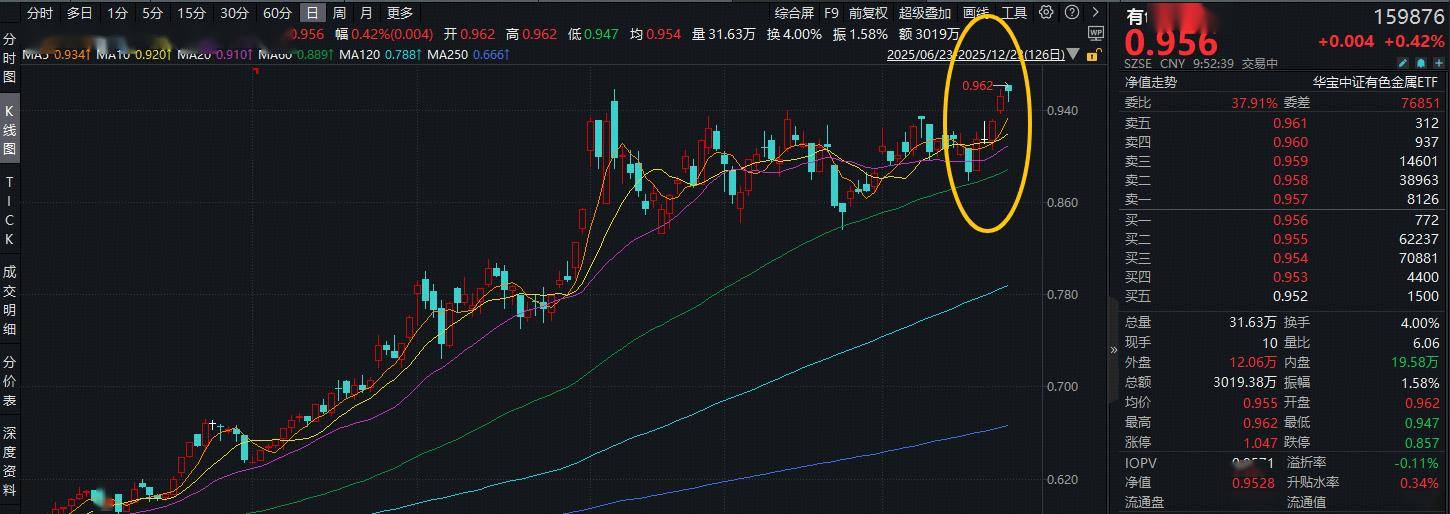
ETF盘中资讯 | 有色ETF华宝(159876)创上市新高!山东黄金领涨超4%!机构:有色金属正在经历爆发性的一年
Sou Hu Cai Jing· 2025-12-23 02:43
Core Viewpoint - The non-ferrous metal sector continues to surge, with the largest non-ferrous ETF, Huabao (159876), reaching a new high, up over 0.6% in intraday trading [1] Group 1: Market Performance - In the gold sector, Shandong Gold leads with a rise of over 4%, while Western Gold and Zhongjin Gold increase by more than 1% [3] - Among small metal leaders, Yunnan Zhenye and Zhongkuang Resources both rise over 2% [3] - Major stocks such as Zijin Mining and China Aluminum also show positive performance [3] Group 2: Price Trends and Influences - Recent surges in precious metals are attributed to geopolitical tensions, particularly the situation in Israel and Palestine, and escalating U.S.-Venezuela relations, which have heightened demand for safe-haven assets [4] - Gold prices have increased by over 60% year-to-date, reflecting a strong market for precious metals [4] Group 3: Economic Factors - Recent strong gold prices are linked to expectations of interest rate cuts in January due to higher unemployment and lower CPI, alongside the conclusion of the Bank of Japan's interest rate hike [5] - The long-term outlook for gold prices is positive, driven by low domestic gold reserves and ongoing central bank purchases [5] Group 4: Future Outlook for Industrial Metals - By 2025, metals such as copper, aluminum, cobalt, and lithium are expected to perform well, driven by energy transition needs, AI advancements, and strategic reserves amid global competition [6] - The duration of the super cycle for non-ferrous metals will depend on the recovery of U.S. dollar credit, progress in strategic reserves, and the effectiveness of "de-involution" policies [6] Group 5: Investment Strategy - For investors looking to capitalize on the non-ferrous metal sector, a diversified approach through the Huabao non-ferrous ETF (159876) and its associated funds is recommended, as it covers a wide range of metals [7]


长城基金:积极布局跨年行情
Xin Lang Cai Jing· 2025-12-23 02:34
Group 1: A-Share Market Performance - The A-share market showed an overall upward trend amidst fluctuations, with strong performance in sectors such as retail, beauty care, and non-bank financials, driven by the "reward economy" concept [1][6] - New retail, spandex, and dairy industries performed well, while previously popular themes like nuclear fusion and Hainan Free Trade Zone experienced corrections, and technology growth faced adjustments [1][6] Group 2: Domestic Economic Indicators - The latest November economic data indicates signs of recovery in external demand and a rebound in price levels, although internal demand momentum remains insufficient [1][6] - The overall policy stance is focused on stability, with a need for targeted and structural policies to be implemented more quickly [1][6] - Key areas to monitor include indications of next year's policy direction from local two sessions, the potential increase in physical workload from policy financial tools, and the timing of potential policies related to real estate and service consumption subsidies [1][6] Group 3: U.S. Inflation Data - U.S. November inflation data significantly underperformed expectations, with CPI and core CPI year-on-year growth rates at 2.74% and 2.63%, respectively, both well below market forecasts and previous values [2][7] - The super core CPI growth rate for October-November dropped to its lowest since April 2021, influenced by factors such as government shutdowns leading to fiscal tightening and reduced demand [2][7] - The decline in inflation is attributed to multiple factors, including temporary disturbances from the Thanksgiving sales season and unsustainable negative growth in housing inflation [2][7] Group 4: Future Economic Outlook - Looking ahead, the U.S. economy may experience a phase of overheating in Q1 next year due to a combination of loose fiscal and monetary policies and seasonal factors [2][7] - The recent slowdown in economic activity may lead to an upward adjustment in market policy expectations, with a potential cross-year market rally beginning to take shape [2][7] - In the context of stable RMB exchange rates, expectations for the People's Bank of China to implement easing policies in 2026 are likely to rise [2][7] Group 5: Spring Market Trends - Historical patterns indicate that spring market rallies typically occur between December of the previous year and April of the following year, often characterized by a "large-cap platform, small-cap performance" style [3][8] - Given the recent deep market adjustments and expectations for increased policy support, the current period may represent an important window for positioning ahead of the upcoming spring market [3][8] - Investment strategies should focus on sectors aligned with industrial trends, particularly large-cap growth and value styles benefiting from insurance capital allocation [3][8]
机构称A股有望迎来“增量资金潮”,上证180ETF指数基金(530280)多股飘红
Xin Lang Cai Jing· 2025-12-23 02:19
Group 1 - The core viewpoint of the articles indicates that the A-share and Hong Kong stock markets are expected to experience a "new capital influx" driven by both domestic and foreign investments in 2026, with potential incremental capital estimated between 6 trillion to 9.6 trillion yuan for the A-share market [1][2] - Major institutions, including Morgan Stanley, predict that the influx of capital from households, private equity funds, and ETFs will flow into the Chinese stock market, especially as the global economy may enter a rate-cutting cycle in 2026 [1][2] - The Shanghai 180 Index, which reflects the performance of 180 major stocks in the Shanghai market, has shown a slight increase of 0.13% as of December 23, 2025, with significant gains from stocks like Cambricon (up 4.27%) and Shandong Gold (up 4.25%) [1][2] Group 2 - The liquidity environment for the A-share market is expected to remain loose in the short term, with a trend of "deposit migration" likely to continue due to low interest rates and a scarcity of quality assets [2] - The top ten weighted stocks in the Shanghai 180 Index account for 26.13% of the index, with notable companies including Kweichow Moutai, Zijin Mining, and China Ping An [2]





【机构策略】积极把握即将到来的春季行情机会
Zheng Quan Shi Bao Wang· 2025-12-23 01:22
Group 1 - The A-share market opened high and trended upward on Monday, with strong performance in sectors such as communication equipment, electronic components, aerospace, and semiconductors, while sectors like pharmaceutical commerce, education, banking, and retail showed weaker performance [1] - The Shanghai Composite Index is expected to consolidate around the 4000-point mark due to factors such as funding disturbances, policy expectations, and fluctuations in overseas liquidity [1] - The market sentiment is likely to improve as external disturbances decrease, with a potential continuation of the rebound trend in the short term [2] Group 2 - The three major A-share indices strengthened collectively on Monday, with the Shanghai Composite Index recovering the 3900-point level but not yet effectively breaking through resistance [3] - The market liquidity environment is expected to remain loose until the first quarter of next year, with a trend of "deposit migration" likely to continue due to low interest rates and a scarcity of quality assets [3] - The recent market pullback has provided a favorable opportunity for investors to position themselves ahead of the upcoming spring market [3]
前瞻2026:春季行情或提前启动,三大主线布局“十五五”开局之年
Sou Hu Cai Jing· 2025-12-22 09:31
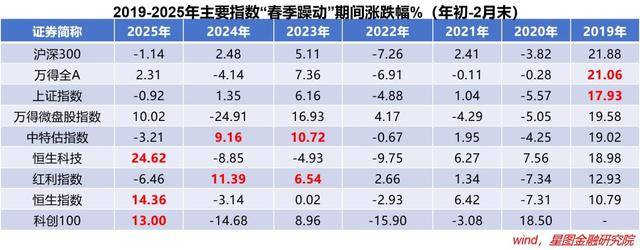
Core Viewpoint - The article discusses the "spring market" phenomenon in the capital market, highlighting its significance as a seasonal trend and a key opportunity for investors to position themselves for the upcoming year, particularly with the expectations for 2026 as the start of the "14th Five-Year Plan" [1] Group 1: Understanding the "Spring Market" - The "spring market" refers to a phase of upward movement in the market from year-end to the first quarter, driven by multiple factors such as policy expectations, liquidity environment, fundamental outlook, and market risk appetite [2] - Over the past seven years (2019-2025), the spring market has shown a high frequency of positive returns, occurring in four out of seven years, with notable variations in strength and structural characteristics [2][3] - The performance of major indices during the spring market varies significantly, with growth stocks generally outperforming, but specific leading sectors changing each year [2][4] Group 2: Drivers of the Spring Market - The spring market is supported by three seasonal positive factors: 1. Policy expectation window, where the December Central Economic Work Conference sets the tone for the following year's economic policies, creating a fertile ground for thematic investments [5] 2. A relatively friendly liquidity environment, as banks increase credit to achieve a "good start" for the year, providing potential incremental funds to the stock market [5] 3. A performance data vacuum in the first quarter, allowing the market to focus on medium to long-term trends without immediate earnings constraints [6] Group 3: Outlook for 2026 - The conditions for the spring market in 2026 appear more mature, with a higher probability of occurrence, and the initiation of the market may occur earlier than usual, potentially starting in late December 2025 [7] - High expectations for policy in 2026, as it marks the beginning of the "14th Five-Year Plan," with anticipated policies focusing on technological innovation and industrial upgrades [7][8] - The consensus on profit recovery is forming, with expectations for industrial enterprises to enter a recovery phase in 2026, particularly in the midstream manufacturing sector [8] Group 4: Key Investment Themes - If the spring market unfolds as expected, it is likely to exhibit more balanced and structured characteristics rather than a simple broad-based rally, with three main investment themes: 1. Technology innovation and self-sufficiency, focusing on AI technology and its applications [9] 2. Recovery of cyclical sectors and improvement in supply-demand dynamics, particularly in mid to downstream manufacturing and traditional cyclical industries [9] 3. Low valuation and stable performance assets, with a focus on defensive and steady income-generating sectors, including brokerage firms [10]
股票型基金站上“C位”,中国创新型科技公司热情依然高涨
Huan Qiu Wang· 2025-12-22 01:07
Group 1 - The core viewpoint of the articles highlights that the CSI A500 index has surpassed the CSI 300 index in terms of net inflow of funds, reaching over 46 billion yuan, indicating a shift in investor interest towards broader market indices [1] - The total scale of public funds has exceeded 300 billion yuan, with the number of newly established public funds reaching 1,468, marking a four-year high [1] - The market dynamics have shifted, with equity funds gaining prominence over bond funds, which were previously considered the market's stabilizing force [1] Group 2 - The A-share market is currently experiencing a high-level fluctuation, with concerns about weak economic growth potentially impacting corporate profits [1] - Some investors anticipate government intervention to support economic growth, which could bolster market sentiment and investment returns, particularly in innovative technology sectors [3] - The A-share market is viewed as entering a critical window for year-end positioning, with structural opportunities expected to align with policy guidance and industry prosperity [3]
十大券商看后市|A股风险偏好或企稳回升,春季行情启动在即
Sou Hu Cai Jing· 2025-12-22 00:53
Core Viewpoint - The A-share market is expected to stabilize and recover in risk appetite, with a spring rally anticipated in 2026 as the overseas environment becomes more stable and liquidity expectations are clarified [1][4][7]. Group 1: Market Outlook - Multiple brokerages indicate that a classic "cross-year-spring" rally is brewing, with significant institutional investors increasing their holdings in broad-based ETFs, providing stable incremental capital to the market [1][10][11]. - The spring market is characterized by a favorable liquidity environment, with historical patterns suggesting a high probability of a rebound before the Spring Festival [7][10]. - The market is currently experiencing a narrow range of fluctuations, influenced by external factors such as U.S. Federal Reserve policies and Japanese central bank actions, but is expected to resonate upward with global markets [8]. Group 2: Investment Strategies - Investors are advised to adopt a strategy of finding buying points and waiting for opportunities, rather than chasing prices, as the market adjustment appears to be sufficient [2][12]. - Focus areas for investment include sectors benefiting from domestic demand, such as AI applications, commercial aerospace, and tourism, as well as cyclical recovery sectors [4][11][13]. - The spring rally is seen as an opportunity to invest in high-growth sectors, with recommendations to pay attention to industries like industrial metals, non-bank financials, and tourism-related services [11][14]. Group 3: Currency and Asset Allocation - Investors are encouraged to adapt to a continuously appreciating RMB environment, with certain industries expected to benefit from improved profit margins due to currency appreciation [3]. - Approximately 19% of industries may see profit margin improvements due to the RMB's appreciation, which could attract investor attention [3].




越跌越买!资金,抄底ETF
Xin Lang Cai Jing· 2025-12-21 23:18
Core Insights - The satellite-related ETFs and tourism-related ETFs showed strong performance with gains exceeding 6% during the period from December 15 to 19, while cross-border ETFs faced declines [1][7] - The overall market experienced fluctuations, but there was a significant net inflow of over 87 billion yuan into ETFs, indicating a clear bottom-fishing sentiment among investors [8] - Broad-based ETFs attracted the most capital, with seven out of the top ten ETFs by net inflow being broad-based ETFs, including the A500 ETF and the ChiNext ETF [8] Performance Summary - The top-performing ETFs included: - Satellite ETF (E Fund) with a weekly gain of 7.04% and a turnover rate of 146.49% [9] - Tourism ETFs with gains of 6.77% and 6.71% respectively [9] - Other notable performers included the satellite industry ETF and the aerospace ETF, both showing gains above 5% [9] - Conversely, cross-border ETFs, particularly the Hong Kong Information Technology ETF and the S&P Oil & Gas ETF, experienced significant declines, with the Hong Kong Information Technology ETF down by 5.24% [10] Fund Flow Analysis - From December 15 to 19, several broad-based ETFs saw substantial net inflows, with the A500 ETF (E Fund) and the ChiNext ETF leading with net inflows of 27 billion yuan and 31 billion yuan respectively [11] - The inflow into cross-border ETFs and innovative bond ETFs was also notable, with several ETFs in these categories exceeding 10 billion yuan in net inflows [11] Trading Volume Insights - The trading volume for ETFs tracking the CSI A500 index was significantly high, with multiple ETFs achieving average daily trading volumes exceeding 70 billion yuan [12] - The top three ETFs by trading volume included the Hong Kong Securities ETF, A500 ETF (E Fund), and ChiNext ETF, with weekly trading volumes of 520 billion yuan, 290 billion yuan, and 191 billion yuan respectively [12] Market Outlook - Investment firms like Invesco Great Wall Fund maintain an optimistic outlook for the market, particularly in the equity sector, emphasizing technology as a key focus area for future growth [13] - Recommendations include a shift from defensive to aggressive positioning, with a focus on technology indices and sectors benefiting from domestic demand recovery [13]

东方财富:春季行情演化论与内需机会探讨
智通财经网· 2025-12-21 22:50
Core Viewpoint - The report from the Chen Guo team at Dongfang Caifu indicates that while there are signs of rising US Treasury yields and an imminent interest rate hike by the Bank of Japan, there is a strong willingness among investors to capitalize on the spring market rally, particularly in the domestic demand sector, especially non-durable consumer goods [1] Group 1: Market Dynamics - The spring market has evolved through three distinct phases: the calendar effect phase (before 2017), the preemptive speculation phase (2018-2023), and the reflexive phase expected in 2024-2025 [2] - The current market is characterized by a high level of financing and a tendency for institutional investors to engage in preemptive buying, indicating a strong market sentiment [3] Group 2: Investment Opportunities - Key sectors to focus on include insurance, brokerage, non-ferrous metals, AI computing/semiconductors, retail/personal care/social services/dairy products, aviation, new energy, and innovative pharmaceuticals, as these sectors show sufficient attractiveness and increasing win rates [1] - The domestic policies aimed at expanding domestic demand and reducing internal competition provide a favorable environment for these sectors, with expectations of a stronger RMB exchange rate [3][4] Group 3: Long-term Outlook - Historical data suggests that sectors with lower performance in the previous year may experience a rebound, driven by policy expectations and the end of annual performance assessments for institutions [4] - The gradual appreciation of the RMB and supportive policies from the Central Economic Work Conference are expected to play a significant role in restoring domestic demand and improving economic structure in the medium to long term [4]