
货币政策宽松

Search documents
国债期货维持震荡整理
Bao Cheng Qi Huo· 2025-06-10 10:53
投资咨询业务资格:证监许可【2011】1778 号 国债期货 | 日报 2025 年 6 月 10 日 国债期货 专业研究·创造价值 国债期货维持震荡整理 核心观点 今日国债期货均继续窄幅震荡整理。消息面上,中美经贸磋商机制首 次会议在英国伦敦开始举行。目前磋商结果仍具有较强不确定性,市场情绪 以等待观望居多。由于关税前景不确定性扰动加深,国内宏观经济指标边际 走弱,货币政策适度宽松的主基调不变,加上当前市场利率隐含的降息预期 基本归零,对未来宽松政策的预期将升温,国债期货底部支撑较强。不过短 期内,货币工具的效应或不及财政工具,因此短期通过连续降息来提振需求 的可能性不高。总的来说,短期内国债期货震荡整理为主,关注 6 月 18 日 陆家嘴论坛的金融政策指引。 (仅供参考,不构成任何投资建议) 姓名:龙奥明 宝城期货投资咨询部 从业资格证号:F3035632 投资咨询证号:Z0014648 电话:0571-87006873 邮箱:longaoming@bcqhgs.com 作者声明:本人具有中国期货 业协会授予的期货从业资格证 书,期货投资咨询资格证书, 本人承诺以勤勉的职业态度, 独立、客观地出具本报告。 ...
避险降温与美元压制下 黄金短期走势何去何从
Sou Hu Cai Jing· 2025-06-10 08:59
在全球地缘政治局势方面,紧张局势仍在持续发酵。乌克兰方面宣称,俄罗斯发动了大规模空袭,这一事件对市场风险情绪构成了潜在扰动。在地缘政治冲 突不断升级的背景下,黄金作为传统的避险资产,其吸引力本应显著增强。然而,当前市场风险偏好因贸易谈判的乐观预期而有所改善,使得黄金的避险需 求在短期内未得到充分释放。但一旦地缘政治冲突进一步恶化,突破当前市场预期的范围,黄金价格可能会迅速获得强劲的上涨动力。 一位长期关注大宗商品领域的分析师指出:"从近期黄金价格走势来看,其未能有效向上突破200小时均线,这一现象深刻反映出多头动能的不足。基于此, 短期内黄金价格倾向于进行整理,甚至存在进一步调整的可能性。"当前,黄金市场的走势受到多种复杂因素的综合影响,其中美联储未来的政策路径充满 不确定性,这在一定程度上限制了黄金价格的下跌空间。尽管此前公布的强劲就业数据在短期内对黄金价格构成利空,但CMEFedWatch工具所呈现的数据 显示,市场对于美联储在9月实施降息的概率预期仍然接近60%。这种对未来货币政策宽松的预期,使得投资者在一定程度上对黄金价格的下行持有谨慎态 度,为黄金价格提供了潜在支撑。 此外,美国长期存在的财政赤字问 ...


西南期货早间评论-20250609
Xi Nan Qi Huo· 2025-06-09 07:00
Report Industry Investment Ratings No relevant content provided. Core Views - The macro - economic recovery momentum needs strengthening, and the monetary policy is expected to remain loose. For various commodities, different trends and investment suggestions are presented based on their respective fundamentals and market conditions [6]. Summary by Commodity Treasury Bonds - Last trading day, treasury bond futures closed up across the board. The macro - economic recovery momentum is weak, and the yield is at a relatively low level. It is expected that there will be no trend - based market, and caution is advised [5][6][7]. Stock Index Futures - Last trading day, stock index futures showed mixed performance. The domestic economy is stable, but the recovery momentum is weak. However, due to low asset valuations and China's economic resilience, the long - term performance of Chinese equity assets is optimistic, and long positions in stock index futures are considered [8][9][10]. Precious Metals - Last trading day, gold and silver futures had different performances. Given the complex global trade and financial environment, the long - term bull market trend of precious metals is expected to continue, and long positions in gold futures are considered [11][12]. Rebar and Hot - Rolled Coils - Last trading day, rebar and hot - rolled coil futures rose and then fell. The real - estate downturn suppresses rebar demand, and it is in the off - season. The price is at a low level, and there may be short - term weak oscillations. Short positions on rebounds are recommended [13][14]. Iron Ore - Last trading day, iron ore futures rebounded slightly. The supply - demand pattern has weakened marginally, but it found support at the previous low. Long positions at low levels are recommended [16]. Coking Coal and Coke - Last trading day, coking coal and coke futures rebounded. The market is in a supply - surplus situation, and short positions on rebounds are recommended [18][19]. Ferroalloys - Last trading day, manganese silicon and silicon iron futures rose. The short - term demand may peak, and the supply is excessive. Long positions need caution, and low - value call options can be considered [21][22]. Crude Oil - Last trading day, INE crude oil opened high and closed low. With upcoming Sino - US trade negotiations and the expected weakening of OPEC's pressure on oil prices, the oil price is expected to strengthen, and long positions are considered [23][24][25]. Fuel Oil - Last trading day, fuel oil opened high and closed low. Rising crude oil prices may drive up fuel oil prices, and long positions are considered [26][27][28]. Synthetic Rubber - Last trading day, synthetic rubber futures rose. Supply pressure persists, and demand improvement is limited. Wait for stabilization and then participate in rebounds [29][30]. Natural Rubber - Last trading day, natural rubber futures rose. There are concerns about demand and high inventory. Wait for the market to stabilize and then consider long positions [31][32][33]. PVC - Last trading day, PVC futures rose. The short - term fundamentals change little, and it mainly follows the macro - sentiment. It is in a bottom - oscillating state [34][36]. Urea - Last trading day, urea futures fell. Short - term cost decline and delayed agricultural demand lead to adjustments, but exports and future agricultural demand may drive the price up. Long positions at low levels can be considered [37][38][39]. PX - Last trading day, PX futures rose. Short - term crude oil prices oscillate, and the supply - demand structure is tight. It should be treated with an oscillating mindset, and interval operations are recommended [40]. PTA - Last trading day, PTA futures rose. The supply - demand structure weakens, but inventory reduction and cost support exist. Interval operations at low levels are recommended [41][42]. Ethylene Glycol - Last trading day, ethylene glycol futures fell. The supply - demand situation weakens, but inventory reduction increases short - term games. It is expected to oscillate, and attention should be paid to inventory and policies [43]. Short - Fiber - Last trading day, short - fiber futures rose. Downstream demand weakens, but cost support exists. Follow the cost - end oscillations and consider long positions at low levels [44]. Bottle Chips - Last trading day, bottle - chip futures rose. Raw material prices decline, and the supply - demand fundamentals improve. Follow the cost - end oscillations and participate cautiously [45]. Soda Ash - Last trading day, soda ash futures rose. The long - term supply exceeds demand, and the short - term rebound may not be sustainable. Avoid excessive long positions [46]. Glass - Last trading day, glass futures rose. The actual supply - demand contradiction is not prominent, and the short - term rebound may not last. Control short - position risks [47][48]. Caustic Soda - Last trading day, caustic soda futures rose. The overall supply - demand is loose, with regional differences. Long - position holders should control risks [49][50]. Pulp - Last trading day, pulp futures fell. The market is in a supply - demand stalemate in the off - season, and a turnaround may occur in August [51]. Lithium Carbonate - Last trading day, lithium carbonate futures rose. The supply - demand surplus persists, and the price is difficult to reverse without large - scale capacity clearance [52][53]. Copper - Last trading day, Shanghai copper futures rose. Sino - US trade negotiations are beneficial, and the basis for price increase exists. Long positions are considered [54][55]. Tin - Similar to lithium carbonate, the supply - demand surplus exists, and the price is difficult to reverse without large - scale capacity clearance [56][57]. Nickel - Last trading day, Shanghai nickel futures rose. The cost support weakens, and the demand is weak. The price is expected to decline [58]. Soybean Oil and Soybean Meal - Last trading day, soybean oil and soybean meal futures rose. The supply of soybeans is expected to be loose, and the upward pressure on soybean meal is high. For soybean oil, consider low - value call options [59][60][61]. Palm Oil - Malaysian palm oil prices rose. The inventory is increasing, and opportunities to widen the spread between rapeseed oil and palm oil can be considered [62][63]. Rapeseed Meal and Rapeseed Oil - Canadian rapeseed prices rose. Consider long positions in rapeseed meal after corrections [64][65][66]. Cotton - Last trading day, domestic cotton futures rose. The industry is in the off - season, and attention should be paid to Sino - US trade negotiations and USDA reports. Adopt a wait - and - see approach [67][68][69]. Sugar - Last trading day, domestic sugar futures rose. Overseas production is expected to increase, while domestic inventory is low. Consider long positions in batches [70][72][73]. Apples - Last trading day, apple futures oscillated. The new - year production is uncertain. Consider long positions after corrections [74][75]. Live Pigs - Last trading day, live - pig futures fell. Group - farm sales are increasing, and consider long - spread opportunities in peak - season contracts [76][77]. Eggs - Last trading day, egg futures fell. The supply is increasing, and short positions at high levels are considered [78][79]. Corn and Corn Starch - Last trading day, corn futures rose, and corn - starch futures fell. The domestic corn supply - demand is approaching balance, and a wait - and - see approach is recommended [80][81][82]. Logs - Last trading day, log futures rose. The fundamentals have no obvious drivers, and beware of long - position sentiment disturbances [83][84][85].
汇丰:印度央行周五料降息25个基点,8月将再降一次
news flash· 2025-06-04 07:50
汇丰:印度央行周五料降息25个基点,8月将再降一次 金十数据6月4日讯,汇丰全球研究的经济学家表示,印度央行可能会在周五召开的会议上将利率下调25 个基点,8月份还会再下调一次,届时利率将降至5.5%。在此前两次降息和大量注入流动性之后,印度 央行有进一步放松政策的空间,但接下来的宽松将以利率工具为主,而非继续注入流动性。2026财年通 胀可能会低于目标水平,这将有助于提升实际居民收入和财政收入。然而,印度央行可能在10月暂停降 息,以评估货币政策对存贷款利率的传导效果。经济学家预测,今年12月可能会迎来最后一次降息,但 届时是否实施还将取决于当时的经济增长状况。 ...

股指期货策略早餐-20250528
Guang Jin Qi Huo· 2025-05-28 09:06
策略早餐 主要品种策略早餐 (2025.05.28) 金融期货和期权 股指期货 品种:IF、IH、IC、IM 日内观点:震荡稍强 中期观点:蓄力上涨 参考策略:持有 IF2506 多单、多 IF2506 空 IM2506 对冲组合 国债期货 品种:TS、TF、T、TL 日内观点:窄幅震荡,TS2509 运行区间[102.30,202.50] 中期观点:偏强 参考策略:T2509 或 TL2509 多单持有 1 请务必阅读文末免责条款 核心逻辑: 1.海外市场方面,美国总统特朗普表示,同意将对欧盟征收 50%关税的最后期 限延长至 7 月 9 日,欧美"关税战"缓和,美元指数止跌回升,欧美权益市场集体 反弹,有助风险情绪回归。 2.国内方面,稳定和活跃资本市场政策接连出台,进一步优化 A 股市场投资生 态。险资长期投资试点、公募基金管理费收取模式改革、上市公司并购重组新的安 排等,均有利于为 A 股注入增量资金和改善市场活跃度。 3.近期风格切换较为频繁,大盘与小盘轮番占优,市场行情轮动较快,缺乏持 续上涨的主线机会。同时,市场成交额尚未出现明显放量,投资者情绪相对谨慎。 短期内,市场或仍维持震荡格局,但在国内 ...
新西兰央行降息25基点,警告全球经济下滑风险
Hua Er Jie Jian Wen· 2025-05-28 03:39
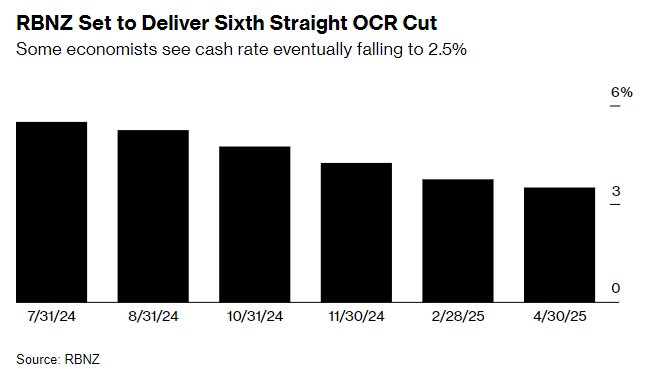
Group 1 - The Reserve Bank of New Zealand (RBNZ) has lowered the benchmark interest rate by 25 basis points to 3.25%, marking the sixth consecutive rate cut since August 2024, totaling a reduction of 225 basis points [1] - The RBNZ's decision reflects increasing concerns about the economic outlook, with predictions indicating that the cash rate will drop to 2.92% by Q4 2025 and further to 2.85% by Q1 2026, signaling a deeper easing cycle than previously forecasted [1][2] - The central bank has warned that international economic developments, particularly uncertainties surrounding U.S. tariff policies, are expected to suppress demand in New Zealand and slow global economic growth [1] Group 2 - Inflation in New Zealand has slowed, currently at 2.5%, within the target range of 1%-3%, but is expected to rise to 2.7% in Q3 [2] - The RBNZ is prepared to respond to both domestic and international developments to maintain medium-term price stability, with market expectations suggesting at least one more rate cut this year [2] - The RBNZ was a pioneer in tightening monetary policy during the pandemic, having raised rates by 525 basis points from October 2021 to September 2023, but high borrowing costs have significantly suppressed demand, leading to an economic recession last year [2]
公募基金4月规模增长9000亿至33.12万亿,货基规模单月飙升超6000亿
Ge Long Hui· 2025-05-28 02:59
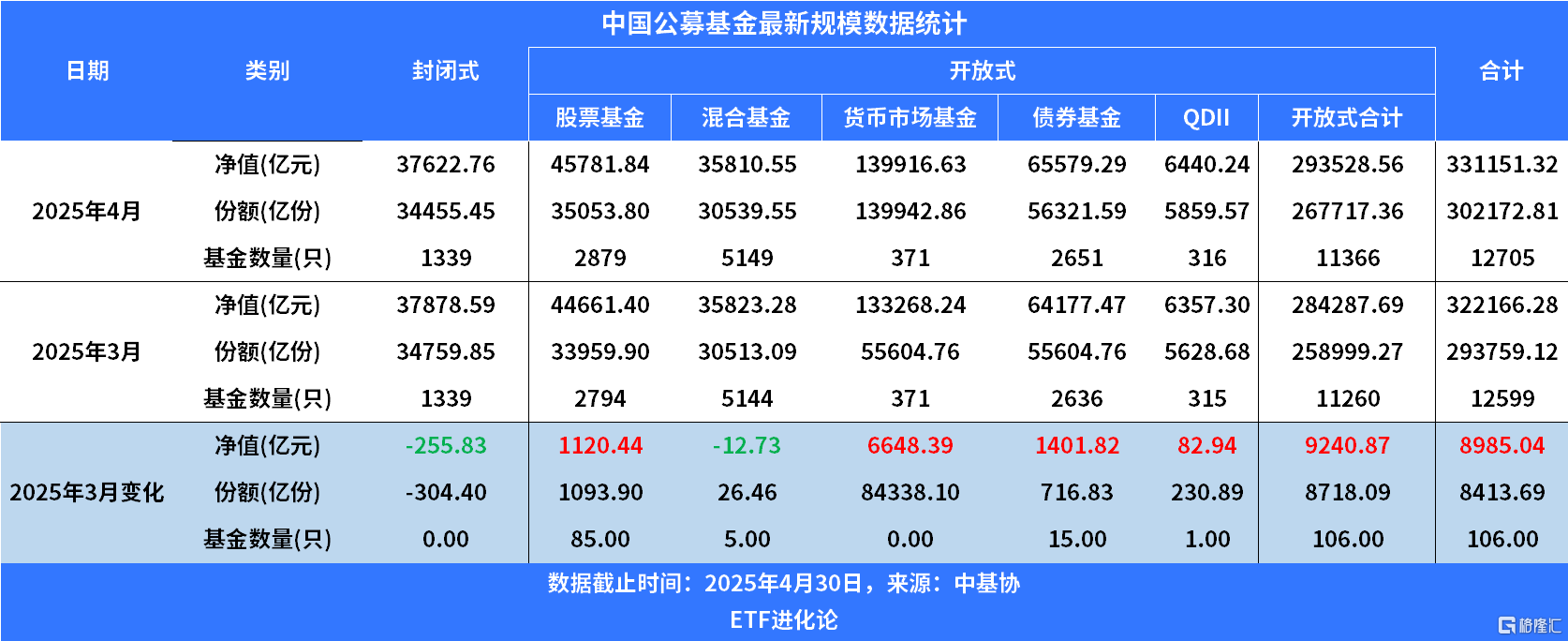
Core Insights - As of April 2025, the net asset value of China's public funds reached 33.12 trillion yuan, an increase of 898.5 billion yuan from March 2025, indicating a positive growth trend in the fund market [1][2] Fund Types Summary - **Equity Funds**: The scale reached 4.58 trillion yuan in April, up by 112.04 billion yuan, reflecting a month-on-month growth of 2.51% [1][2] - **Mixed Funds**: The scale slightly decreased to 3.58 trillion yuan, with a minor decline of 1.27 billion yuan, showing a negligible drop of 0.04% [1][2] - **Bond Funds**: The scale increased to 6.56 trillion yuan, with a growth of 140.18 billion yuan, representing a month-on-month increase of 2.18% [1][2] - **Money Market Funds**: The scale surged to 13.99 trillion yuan, with an increase of 664.84 billion yuan, marking a significant month-on-month growth of 5.00%, which was the main driver of overall growth [1][2] - **QDII Funds**: The scale rose to 644.02 billion yuan, with an increase of 8.29 billion yuan, reflecting a month-on-month growth of 1.31% [1][2] Market Trends - The increase in money market funds accounted for 74% of the total growth, indicating a preference for low-risk, high-liquidity assets among investors, likely influenced by monetary policy easing and a decline in market risk appetite [3] - The banking wealth management market saw a reduction of 0.81 trillion yuan in the first quarter, with a total scale of 29.14 trillion yuan at the end of the quarter, showing a year-on-year growth of 9.41% [3] - The Central Political Bureau's meeting emphasized the need for proactive macroeconomic policies, setting the tone for potential monetary easing measures [3] Financial Landscape Changes - The financial landscape in China is being reshaped by monetary easing, with wealth management scales reaching new highs, surpassing 31 trillion yuan by May 2025 [4] - Despite the recovery in wealth management scales, money market funds continue to attract significant inflows due to their higher liquidity and stability [4] - Bond funds also reversed a previous trend of net outflows, with a growth of 140.18 billion yuan in April, indicating renewed investor interest [4] Equity Market Dynamics - In the equity market, stock funds saw a net subscription of 109.3 billion units, leading to a significant increase of 112.04 billion yuan in scale, driven by substantial inflows into stock ETFs [5] - Mixed funds experienced a slight decline in scale despite an increase in units, as net asset value fell due to market fluctuations [5] - The growth in QDII funds was primarily due to the appreciation of existing products rather than new fund issuances [5] Interest Rate Environment - In a declining interest rate environment, mid-to-long-term pure bond and "fixed income +" products are still considered valuable for allocation [7] - The market is witnessing a shift towards "fixed income +" strategies that incorporate a small amount of equity assets, reflecting changing investor preferences [7]
研究所晨会观点精萃-20250527
Dong Hai Qi Huo· 2025-05-27 02:55
Report Industry Investment Rating - Not provided in the given content Core Viewpoints - Overseas, the EU plans to accelerate tariff negotiations with the US after the US threatens to impose tariffs on the EU, reducing global risk aversion. The US dollar index rebounds in the short - term, and global risk appetite rises. Domestically, although domestic demand in April slowed down and was lower than expected, industrial production and exports far exceeded expectations, and the economic growth remained stable. The central bank's interest - rate cut and the reduced risk of tariff escalation between the US and the EU help boost domestic risk appetite in the short term [2]. - Different asset classes have different trends: the stock index oscillates in the short term, and it is advisable to be cautiously long; treasury bonds oscillate at a high level in the short term, and it is advisable to wait and see; among commodity sectors, black metals oscillate at a low level in the short term, and it is advisable to wait and see; non - ferrous metals oscillate strongly in the short term, and it is advisable to be cautiously long; energy and chemicals oscillate in the short term, and it is advisable to wait and see; precious metals oscillate strongly at a high level in the short term, and it is advisable to be cautiously long [2]. Summary by Directory Macro - finance - **Stock Index**: Affected by sectors such as biomedicine, automobiles, and banks, the domestic stock market continued to decline slightly. The short - term risk appetite may be boosted, but there is no obvious macro - drive for trading currently. It is advisable to be cautiously long in the short term [2][3]. - **Precious Metals**: Geopolitical risks and trade policy disturbances increase, and the short - term support for gold is strengthened. In the long - term, the uncertainty of the US economy and the marginal weakening of US debt credit will support the upward movement of the valuation center of precious metals [3][4]. Black Metals - **Steel**: The steel market is in a dilemma, with weakening real demand and increasing supply. It is advisable to treat the short - term steel market with an interval - oscillation mindset [5]. - **Iron Ore**: The price decline of iron ore has widened. Although the iron - water output has decreased, there are differences in the market's view of its decline path. The supply may increase in the second quarter, and it is advisable to take a bearish view in the short term [5]. - **Silicon Manganese/Silicon Iron**: The spot prices of silicon manganese and silicon iron have decreased. The demand for ferroalloys is okay, but the downstream procurement sentiment is not good. The market will oscillate in the short term [6][7]. Energy and Chemicals - **Crude Oil**: Trump delays imposing a 50% tariff on the EU, boosting market sentiment. The short - term oil price may fluctuate significantly due to event - based factors and macro - impacts [8]. - **Asphalt**: The asphalt price oscillates weakly following crude oil. The demand is average, and the inventory de - stocking has stagnated. It will continue to fluctuate at a high level following crude oil in the short term [8]. - **PX**: The polyester sector has corrected, and PX has declined slightly. It maintains a strong oscillation in the short term but may decline slightly later [8]. - **PTA**: The downstream start - up rate has decreased, and PTA is affected by negative feedback from the downstream. The de - stocking rate will slow down, and the upward space is limited [9]. - **Ethylene Glycol**: The de - stocking is mainly due to the decrease in start - up, and the price will oscillate [10]. - **Short - fiber**: It maintains a high - level and weak - oscillation pattern and will continue to oscillate in the short term [11]. - **Methanol**: The price in the Taicang market has declined, and the basis has strengthened. The price will likely remain stagnant in the short term but may decline in the long - term [11]. - **PP**: The domestic PP market has declined. The downstream demand is expected to weaken, and the price is expected to decline under pressure [12]. - **LLDPE**: The polyethylene market price has decreased. The short - term demand has been slightly repaired, but the supply pressure is expected to increase in the future, and the price may decline in the long - term [12]. Non - ferrous Metals - **Copper**: The copper concentrate TC continues to decline, and the supply is increasing. The demand is about to enter the off - season, and the inventory is accumulating. The copper price will oscillate in the short term, and it is advisable to look for short - selling opportunities in the medium - term [14]. - **Aluminum**: The aluminum inventory is decreasing significantly, but the demand growth rate cannot be sustained. It is advisable to be cautious about short - selling in the short term and wait for a better short - selling point [14]. - **Tin**: The supply is gradually recovering, but there is still a raw - material gap in China. The demand is about to enter the off - season, and the market is under pressure [15]. Agricultural Products - **US Soybeans**: There is no weather premium for US soybeans currently. The market is in a range - bound situation without a continuous upward drive [16][17]. - **Soybean Meal**: The basis of soybean meal is weakening, and it lacks a stable upward support [17]. - **Soybean and Rapeseed Oil**: The soybean oil inventory is increasing, and the demand is weak. The rapeseed oil inventory is high, but the price is supported by the low - level inventory of rapeseeds and the strong price - support intention of oil mills [17]. - **Palm Oil**: The palm oil in Southeast Asia is in the production - increasing cycle, and the domestic market generally fluctuates with the BMD market but has stronger support when falling [18]. - **Pigs**: The supply of pigs has decreased slightly before the Dragon Boat Festival, but the price is still under pressure in the future. The futures may rise in June due to the high basis [19]. - **Corn**: With the harvest of new - season wheat, the corn price is under pressure, and there is no upward drive currently [19].
新西兰央行料连续第六次降息 暗示政策宽松不止步
智通财经网· 2025-05-26 23:24
Core Viewpoint - The Reserve Bank of New Zealand is expected to announce a rate cut for the sixth consecutive meeting, influenced by the economic outlook affected by U.S. trade barriers [1][4]. Group 1: Monetary Policy Expectations - A survey of 23 economists indicates that 22 predict the official cash rate (OCR) will be lowered by 25 basis points to 3.25%, with only one expecting a 50 basis point cut [1]. - The central bank may signal further rate cuts, with predictions that the OCR could drop below 3% this year [1]. - Economists forecast the OCR to be adjusted down to approximately 2.9% by the end of 2025 [4]. Group 2: Economic Conditions - The Reserve Bank has noted that U.S. tariff policies pose downward risks to economic activity and inflation, allowing for further rate cuts [4]. - Despite a recent easing of trade tensions, ongoing uncertainty is expected to hinder New Zealand's recovery from last year's recession [4]. - The unemployment rate remained stable at 5.1%, which is better than market expectations, while commodity prices have remained strong and inflation expectations have risen [4]. Group 3: Inflation and Real Estate Market - Inflation is projected to accelerate from the current rate of 2.2% towards the upper end of the central bank's target range of 1-3%, before slowing again next year [5]. - The real estate market continues to be sluggish, and declining business confidence is noted, with the government's recent budget tightening expected to create conditions for further rate cuts [5]. - Some economists predict the OCR could be lowered to 2.5% this year, while the market generally sees a higher likelihood of a drop to 2.75% [5]. Group 4: Strategic Policy Adjustments - The current environment provides ample strategic adjustment space for policymakers [6]. - The expectation is that the Reserve Bank will eventually lower the OCR to 2.5%, but it is not anticipated that a clear signal will be given at this stage [6].
4月固定收益月报:外部冲击超预期,利率有望下行-20250526
Shanxi Securities· 2025-05-26 03:23
Report Industry Investment Rating No relevant content provided. Core Viewpoints - In early April, Trump's tariff policy exceeded market expectations, causing bond yields to hit previous lows again. Despite signs of concessions, China still faces high external uncertainties, leading to low - level fluctuations in market interest rates [2][14]. - The Politburo meeting on April 25 emphasized implementing more proactive macro - policies, with potential future reserve requirement ratio and interest rate cuts to maintain liquidity and support the real economy. Monetary policy will remain loose [3][14]. - In April, the central bank significantly increased net MLF投放, indicating support for liquidity. Economic data shows that the economic recovery needs further observation, especially the price level has not improved significantly, suggesting limited demand recovery. External demand decline also adds pressure, requiring policy support [3][14]. - In early April, the 10 - year Treasury bond rate quickly dropped below 1.7% and then fluctuated around 1.65%. It is expected that long - term interest rates will continue to decline, and the 10 - year Treasury bond yield may fall below 1.6% [3][14]. - According to the model, the implied one - year interest rate cut in the interest rate swap curve in April increased by about 19.27bp compared to March. Market participants' expectations of interest rate cuts have risen significantly. The policy rate is expected to drop by 30 - 40bp this year, corresponding to a 10 - year Treasury bond yield around 1.6% [4][15]. Summary by Directory 1. Viewpoint Outlook - External uncertainty: Trump's tariff policy in early April shocked the market. Although there were signs of concessions later, external uncertainties remain high, resulting in low - level fluctuations in bond market interest rates [2][14]. - Policy orientation: The Politburo meeting emphasized proactive macro - policies, with potential future reserve requirement ratio and interest rate cuts to support the real economy. Monetary policy will remain loose [3][14]. - Capital situation: In April, the central bank's net MLF投放 reached the highest level since January 2024, indicating strong support for liquidity [3][14]. - Economic fundamentals: Economic data shows that the economic recovery needs further observation, especially the price level has not improved significantly, suggesting limited demand recovery. External demand decline also adds pressure, requiring policy support [3][14]. - Interest rate trend: The 10 - year Treasury bond rate dropped below 1.7% in early April and then fluctuated around 1.65%. It is expected to continue to decline and may fall below 1.6% [3][14]. - Interest rate cut expectation: The implied one - year interest rate cut in the interest rate swap curve in April increased by about 19.27bp compared to March. Market participants' expectations of interest rate cuts have risen significantly. The policy rate is expected to drop by 30 - 40bp this year, corresponding to a 10 - year Treasury bond yield around 1.6% [4][15]. 2. Capital Market - Open - market operations: In April, the central bank's open - market capital投放 was 392.27 billion yuan, with a net投放 of 32.08 billion yuan. There were no open - market Treasury bond purchases. The scale of repurchase agreements was 120 billion yuan (70 billion for 3 - month and 50 billion for 6 - month). Treasury cash deposits raised 10 billion yuan and 15 billion yuan matured. MLF投放 was 60 billion yuan, with 10 billion yuan maturing, resulting in a net MLF投放 of 50 billion yuan [5][16]. - Interest rates: As of April 30, DR007 was at 1.80%, down 39.02bp from the end of March; R007 was at 1.84%, down 46.34bp from the end of March [18]. - Inter - bank certificates of deposit: In April, 285.124 billion yuan of inter - bank certificates of deposit were issued, with 247.916 billion yuan maturing, resulting in a net financing of 37.208 billion yuan, a decrease of 71.993 billion yuan from the previous month [20]. 3. Interest Rate Market 3.1 Interest - Bearing Bond Primary Market - Overall situation: The overall issuance volume of interest - bearing bonds in the primary market decreased slightly compared to the previous month, and net financing decreased significantly. In April, Treasury bonds were issued at 146.83 billion yuan, with net financing of 26.575 billion yuan; local government bonds were issued at 69.3291 billion yuan, with net financing of 52.8089 billion yuan; policy bank bonds were issued at 60.825 billion yuan, with net financing of - 344 million yuan [24]. 3.2 Interest - Bearing Bond Secondary Market - Yield trend: In April, the yields of Treasury bonds and China Development Bank bonds generally declined [31]. 4. Credit Market 4.1 Credit Bond Primary Market - Overall situation: The issuance volume of new credit bonds increased significantly compared to the previous month, the repayment volume decreased, and the net financing scale increased significantly. The total issuance volume was 222.1512 billion yuan, the total repayment volume was 176.5422 billion yuan, and the net financing was 45.609 billion yuan [42]. - Urban investment bonds: Urban investment bonds were issued at 35.1555 billion yuan, with a net financing of - 9.1487 billion yuan. The average coupon rate was 2.53%, down 14bp from the previous month [43]. 4.2 Credit Bond Secondary Market - Overall situation: The secondary market of credit bonds fluctuated greatly, the broad - based market yield declined, and the yields of medium - and short - term notes of various credit ratings were at relatively low levels in the past two - year quantiles [47]. - Urban investment bonds: In April, the yields of urban investment bonds of various maturities generally declined. The yields of urban investment bonds of various credit ratings were still at historical lows in the past two - year quantiles. The term spreads showed differentiation, and the credit spreads widened except for the 1 - year maturity [51][52]. - Bank secondary bonds: In April, the yields of bank secondary bonds of various maturities declined synchronously, the term spreads widened, and the credit spreads showed differentiation. The yields of bank secondary bonds of various maturities were still at relatively low levels in the past two - year quantiles [55].