消费复苏

Search documents
海通国际:维持百威亚太“中性”评级 目标价7.9港元
Zhi Tong Cai Jing· 2026-02-24 02:09
Core Viewpoint - Budweiser APAC (01876) is undergoing a deep adjustment period in the Chinese market, facing short-term performance pressure due to reform pains and external shocks, but positive signals are emerging from channel transformation, with preliminary improvements in market share observed in Q4 [1] Group 1: Financial Performance - For the full year 2025, the company's revenue and EBITDA were $5.76 billion and $1.59 billion, respectively, representing a year-on-year decline of 6.1% and 9.8%; Q4 revenue and EBITDA were $1.07 billion and $170 million, down 4.2% and 24.7% year-on-year [2] - The Chinese market significantly dragged down performance, with Q4 revenue and EBITDA declining by 11.4% and 42.3% year-on-year, and full-year revenue and EBITDA down 11.3% and 15.7% [2] - The net profit attributable to shareholders for the full year was $489 million, a decrease of 32.1% year-on-year, while cash flow remained robust with a dividend payout ratio increased to 153% [2] Group 2: Market Dynamics and Strategy - The industry in China is experiencing stable volume but declining prices, with Budweiser APAC actively transforming its channels; the decline in sales volume in Q4 narrowed from 11% in Q3 to 3.9% [3] - The company is focusing on high-end product positioning and expanding into new channels like instant retail and O2O, with expectations for ASP improvement in 2026 supported by various factors including policy changes and increased consumer confidence [3] - Management's outlook for 2026 includes organic growth, inorganic expansion, and shareholder returns, with a focus on high-end channels in China and maintaining a strong position in the Korean market [3] Group 3: Valuation and Target Price - The estimated EPS for the company for 2026-2028 is projected at $0.04, $0.05, and $0.05, respectively, with the valuation multiple for 2026 adjusted from 20x PE to 25x PE, maintaining a target price of HKD 7.9 [1][2]

海通国际:维持百威亚太(01876)“中性”评级 目标价7.9港元
智通财经网· 2026-02-24 02:05
Core Viewpoint - Budweiser APAC is undergoing a deep adjustment period in the Chinese market, facing short-term performance pressure due to reform pains and external shocks, but positive signals are emerging from channel transformation, with preliminary improvements in Q4 market share [1] Group 1: Financial Performance - For the full year 2025, revenue and EBITDA were $5.76 billion and $1.59 billion, down 6.1% and 9.8% year-on-year; Q4 revenue and EBITDA were $1.07 billion and $170 million, down 4.2% and 24.7% year-on-year [2] - The Chinese market significantly dragged down performance, with Q4 revenue and EBITDA declining 11.4% and 42.3% year-on-year, and full-year revenue and EBITDA down 11.3% and 15.7% year-on-year [2] - The net profit attributable to shareholders for the full year was $489 million, a decrease of 32.1% year-on-year, while cash flow remained robust with a dividend payout ratio increasing to 153% [2] Group 2: Market Dynamics - The industry saw stable volume but declining prices in Q4 2025, with leading companies maintaining stable operations; however, the average selling price (ASP) has been under pressure, hindering premiumization [3] - Budweiser APAC, as a leader in high-end beer, is increasing investments in emerging channels like instant retail and O2O, with early signs of improvement as the decline in sales volume narrowed from 11% in Q3 to 3.9% in Q4 [3] - The company is expected to benefit from multiple factors supporting ASP improvement in 2026, including effective policies to boost consumer confidence and demand, alongside the release of benefits from high-end positioning and channel transformation [3] Group 3: Strategic Outlook - The management has outlined three core outlooks for 2026: organic growth, inorganic expansion, and shareholder returns, with a focus on high-end home channels and O2O expansion in China [4] - The company plans to explore M&A and collaboration opportunities in the Asia-Pacific region, supported by strong cash flow for external growth [4] - A high dividend policy continues, with a dividend yield of 5.6% providing a solid safety net for the stock price; the depreciation of the US dollar is also expected to positively impact financial statements [4]
食品饮料行业周报-春节跟踪:茅五和部分中低端价格带超预期增长,汾酒整体表现平稳
China Post Securities· 2026-02-24 01:25
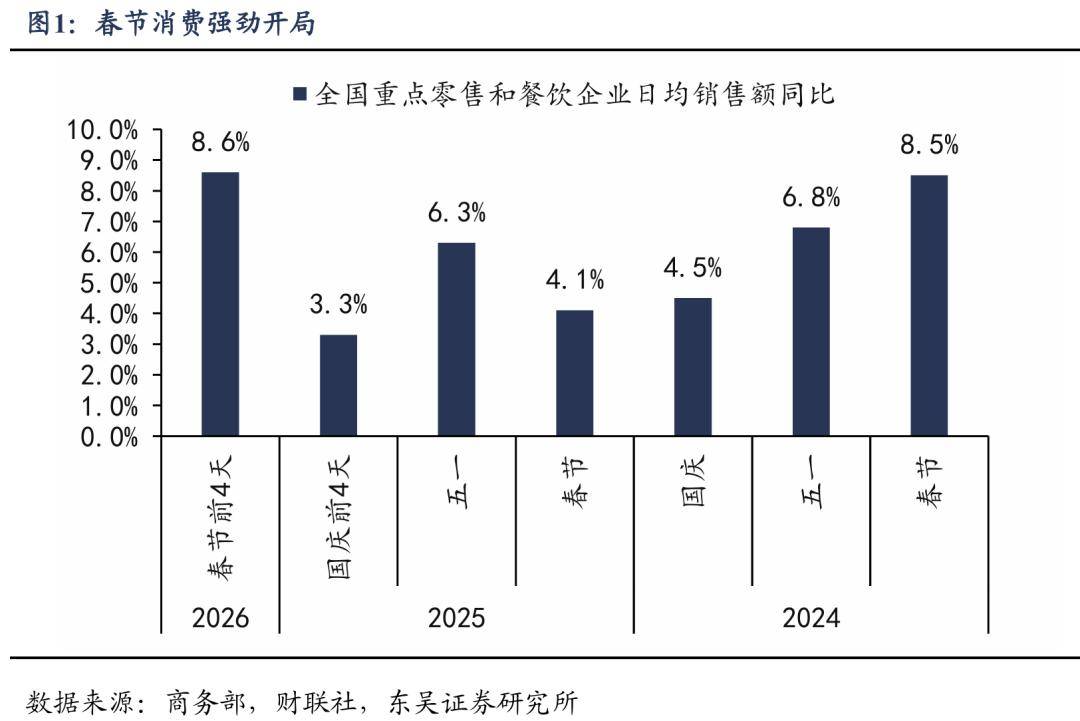
Industry Investment Rating - The industry investment rating is "Outperform the Market" and is maintained [2] Core Viewpoints - During the Spring Festival, national catering and retail consumption showed steady growth, with holiday consumption potential continuing to be released. According to the Ministry of Commerce, the average daily sales of key retail and catering enterprises during the first four days of the Spring Festival in 2026 increased by 8.6% compared to the same period in 2025 [5][19] - The performance of Moutai and Wuliangye, as well as some mid-to-low-end price segments, exceeded expectations, while the overall performance of Fenjiu remained stable [15][19] Summary by Relevant Sections 1. Weekly Viewpoints - Moutai and mid-to-low-end liquor sales during the Spring Festival showed growth, while sub-premium liquor continued to face pressure. Moutai's repayment progress slightly exceeded the same period last year, and Wuliangye's repayment progress remained stable [15][6] - The mid-to-low-end liquor segment is expected to achieve double-digit growth during the Spring Festival, while high-end liquor sales are under pressure [15][6] 2. Industry Performance - The food and beverage sector experienced a decline, with the Shenwan Food and Beverage Industry Index (801120.SL) dropping by 2.51% during the week of February 9 to February 14, ranking 29th among 30 Shenwan primary industries [20] - All sub-sectors within the food and beverage industry saw declines, with meat products, health products, and baked goods experiencing relatively smaller drops [20] 3. Key Company Announcements - Luzhou Laojiao announced that the number of restricted stock units eligible for release is 1,962,814 shares, accounting for 0.1333% of the company's total share capital [29] - Miaokelan Duo signed a memorandum with SADAFCO to explore the market for children's cheese snacks in Saudi Arabia [29] 4. Important Industry News - The Ministry of Commerce announced anti-subsidy measures for EU companies, with rates ranging from 7.4% to 11.7%, effective from February 13, 2026 [31] - Kangshifu launched a new product, Kangshifu Ice Red Tea Energy, entering the energy drink market [31] 5. Industry Chain Data Tracking - As of February 10, 2026, wheat prices were 2,510.8 RMB/ton, up 6.45% year-on-year, while pork prices were 18.08 RMB/kg, down 11.63% year-on-year [34][36]





宏观点评春节对全年消费有何指示意义?
Soochow Securities· 2026-02-24 00:35
证券分析师 芦哲 执业证书:S0600524110003 luzhe@dwzq.com.cn 证券分析师 占烁 执业证书:S0600524120005 zhansh@dwzq.com.cn 证券分析师 李昌萌 执业证书:S0600524120007 lichm@dwzq.com.cn 证券研究报告·宏观报告·宏观点评 宏观点评 20260223 春节对全年消费有何指示意义? 2026 年 02 月 23 日 相关研究 《春节海外市场回顾:IEEPA 违法后 特朗普的 Plan B 》 2026-02-22 《美国 1 月 CPI:没那么"弱"—— 2026 年 1 月美国 CPI 数据点评》 2026-02-14 东吴证券研究所 1 / 13 请务必阅读正文之后的免责声明部分 [Table_Tag] [Table_Summary] ◼ 核心观点:今年春节消费有三个特点,一是消费开局强劲,今年春节假 期前 4 天,全国重点零售和餐饮企业日均销售额同比增长 8.6%,高于 去年的 4.1%(去年整个春节假期)。二是春节服务消费内部分化,观影 回落、出行强劲。三是返乡消费增长强劲。春节对全年消费有何指示意 义?我们 ...
春节对全年消费有何指示意义?
Sou Hu Cai Jing· 2026-02-24 00:08
来源:宏观fans哲 芦哲 S0600524110003 占烁 S0600524120005 核心观点 核心观点:今年春节消费有三个特点,一是消费开局强劲,今年春节假期前4天,全国重点零售和餐饮企业日均销售额同比增长8.6%,高于去年的4.1% (去年整个春节假期)。二是春节服务消费内部分化,观影回落、出行强劲。三是返乡消费增长强劲。春节对全年消费有何指示意义?我们认为可能有以 下三方面信号:一是我们预计开年消费将温和复苏,1-2月社零同比增速可能介于去年上半年(5%)和下半年(2.5%)之间,相比去年底1%左右的增速 明显回升。二是从春节实践来看,全年消费可能有更多政策呵护,政策重心从"以旧换新"补贴转向其他方面,如消费贷贴息、有奖发票、支持服务消费、 鼓励优质供给等。三是2026年商品消费可能弱于去年,服务消费成为主要支撑。 春运:历史最多出行人次,节后出行强于节前。截至正月初五,今年春运前20天全国跨区域人员流动达到50.8亿次,创下历史最高水平,较去年同期增长 5.5%。从交通部口径的跨区域人员流动量来看,今年节前15天的日均流量为2.3亿人次,比去年同期高3.2%;而节后5天为3.2亿人次,比去年同 ...

消费温和复苏,悦己型春节消费崭露头角
Zhong Guo Yin He Zheng Quan· 2026-02-23 10:45
中国银河证券ICGS 行业点评报告·消费行业 消费温和复苏,悦已型春节消费斩露头角 2026年02月22日 核心观点 :guximin_vi@chinastock.com.cn 分析师登记编码:S0130522070002 免签政策的持续 张迪 www.chinastock.com.cn 证券研究报告 请务必阅读正文最后的中国银河证券股份有限公司免责声明 消费温和复苏,消费结构、消费格局变化更受瞩目:1)春节期间消费被寄 分析师 予厚望,政府发力组织 乐购新春" 春节特别活动, 发文 《积极推动物价合 理回升》, 针对互联网平台推动反垄断、反内卷。 2)消费呈现温和复苏的迹 何伟 象,包括客流的稳步增长, 以及核心商圈、 重点零售和餐饮企业相关消费的 :hewei_yj@chinastock.com.cn 增长。部分消费品、 服务消费价格的提升。3)但市场并不认同消费的全面复 分析师登记编码:S0130525010001 苏,春节期间香港市场 必选消费指数、 非必选消费指数分别下 陈柏儒 美团2月13日公布 :chenbairu_yj @chinastock.com.cn 跌1.31%、 下跌3.0% 消费相 ...
复苏,聚焦上游
Orient Securities· 2026-02-23 00:45
Investment Rating - The industry investment rating is "Positive" (maintained) [5] Core Viewpoints - The report emphasizes a recovery in the food and beverage industry, focusing on upstream opportunities. It suggests that the consumption power, which has been constrained by debt cycles, is expected to improve significantly by the second half of 2026, leading to a recovery in traditional consumption [8] - The report identifies three main investment lines: 1. Agricultural processing, including sugar processing, juice processing, and livestock 2. Food raw material suppliers, focusing on bio-extraction and sugar substitutes 3. Food packaging, which is expected to benefit from cost increases and improved competitive dynamics [3][8] Summary by Relevant Sections Investment Suggestions and Targets - Focus on upstream sectors with three main lines: 1. Agricultural processing: - Sugar processing: Recommend COFCO Sugar (600737, Buy), related stock Crown Agricultural (600251, Not Rated) - Juice processing: Related stocks Andeli (605198, Not Rated), Andeli Juice (02218, Not Rated) - Livestock: Recommend Youran Dairy (09858, Buy), related stock Modern Farming (01117, Not Rated) 2. Food raw material suppliers: - Bio-extraction: Recommend Angel Yeast (600298, Buy), Bairun (002568, Buy), related stocks Chenguang Biotech (300138, Not Rated), Huabao International (00336, Not Rated), and Fujian Sunner Development (00546, Not Rated) - Sugar substitutes: Related stocks Bolinbao (002286, Not Rated), Sanyuan Bio (301206, Not Rated), and Bailong Chuangyuan (605016, Not Rated) 3. Food packaging: Related stock Aorui Jin (002701, Not Rated) [3]


节后A股开盘必看!三大主线已明牌,这个变数不得不防
Sou Hu Cai Jing· 2026-02-22 04:30
各位朋友,春节假期即将过完了,A股马年首个交易周马上开锣!这七天国内外大事不断,政策、产 业、资金面都有新动向。别慌,今天一文给你捋清楚——节后行情怎么走?机会在哪儿?风险在哪儿? 看完这篇心里就有数了。 先说结论:节后A股大概率还是结构性行情,核心逻辑就八个字——政策托底、产业突围。科技成长、 政策受益、消费复苏这三条线最值得看,但国际上的关税变数和地缘风险也得留个心眼。 先看国内政策。内需消费被提到了前所未有的高度,《求是》杂志发重磅文章,明确要搞提振消费专项 行动,扩大优质商品供给,还要推城市更新和民间投资。这信号够直接吧?家电、文旅这些消费板块, 还有市政基建、新基建,都是直接受益的。另外2月17日起对加拿大、英国免签30天,入境游和免税店 短期要火,长期看服务贸易开放也是大趋势。 平台经济这边也有新动静。市场监管总局约谈了阿里、抖音等7家平台,核心就一句话——别搞内卷式 竞争,促销得守规矩。这对头部合规企业是长期利好,行业生态会慢慢变好。与此同时,字节跳动的豆 包大模型2.0 Pro发布了,直接对标GPT-5.2,推理成本降了一个数量级!国内AI大模型已经进入实用化 阶段,算力、算法、应用端的企业接 ...
AI风起搅动市场,数据看清真实脉络
Sou Hu Cai Jing· 2026-02-21 23:52
窗外的路灯透着暖黄的光,房间里只有电脑屏幕的光在闪。刚关掉手机,耳边还残留着白天市场的喧嚣——AI浪 潮要成全年主线、消费复苏有政策加持、人民币走强利好市场……各种消息轮番轰炸,看得人心里发慌。其实不 止我,身边有个朋友最近也在犯愁,一会儿被利好消息勾得蠢蠢欲动,一会儿又被利空传闻吓得不敢出手,到头 来什么机会都没抓住。2026年的市场确实充满变数,AI板块的热度、新旧产业的分化、人民币汇率的走势,每一 个都牵动着市场参与者的神经。但我越来越觉得,市场的核心从来不在消息里,而是藏在每一笔真实的交易行为 中。这时候,量化大数据的优势就显现出来了,它能帮我们跳出主观情绪的陷阱,看清那些被消息掩盖的真实脉 络。 很多时候,我们看到的价格变化,和背后真实的交易行为完全是两回事。就拿市场里的消息来说,明明是利好发 布,价格却没有如预期般延续走势,反而出现波动;有时候利空传来,价格却逆势企稳。这不是消息没用,而是 我们没看懂消息背后资金的真实意图。 一、价格走高背后的交易特征 看图1里的这只标的,价格还在稳步走高的阶段,量化大数据已经捕捉到「获利回吐」的交易行为——7个交易日 里有5天都被这种行为主导。「获利回吐」其实是 ...
重点留意!节后三大翻倍方向,重仓股民拿稳别慌!
Sou Hu Cai Jing· 2026-02-21 09:27
重点留意!节后三大翻倍方向,重仓股民拿稳别慌! 春节的瓜子还没嗑完、拜年的红包还没理清楚,重仓的股民朋友心早就飞回A股盘面了。有人攥着筹码 怕洗盘,有人盯着行情怕踏空,有人刷着研报找主线,整个人又期待又忐忑。 最近市场信号越来越清晰,节后行情正在悄悄蓄力,三大方向被政策、资金、业绩三重加持,多家正规 券商研报直接点名"具备翻倍级修复空间"。到底是画饼噱头,还是真金白银的机会?重仓的朋友该守还 是该跑? 2026年2月13日,上证指数收盘4082.07点,沪深两市成交19826.8亿元。 数据来源:上海证券交易所、深圳证券交易所官网行情中心。 市场不缺钱,央行直接送上"定心丸",官方公告可查。 2026年2月13日,央行开展10000亿元买断式逆回购操作,期限182天。 中长期活水直达市场,为节后行情筑牢资金底座。 经济基本面也在回暖,国家统计局数据实打实。 2026年1月CPI同比上涨0.2%,核心CPI同比上涨0.8%,消费稳步修复。 PPI同比降幅连续收窄,工业端持续回暖,企业盈利预期向上。 三重利好打底,节后不是瞎炒,是有支撑的结构性机会。 重仓的朋友先别慌,下面这三大方向,就是机构紧盯的翻倍主线。 第 ...