
美元资产

Search documents
黄金再度大涨!白银涨破40美元,成2011年来首次;分析师:明年金价或达4000美元/盎司
Mei Ri Jing Ji Xin Wen· 2025-09-01 07:55
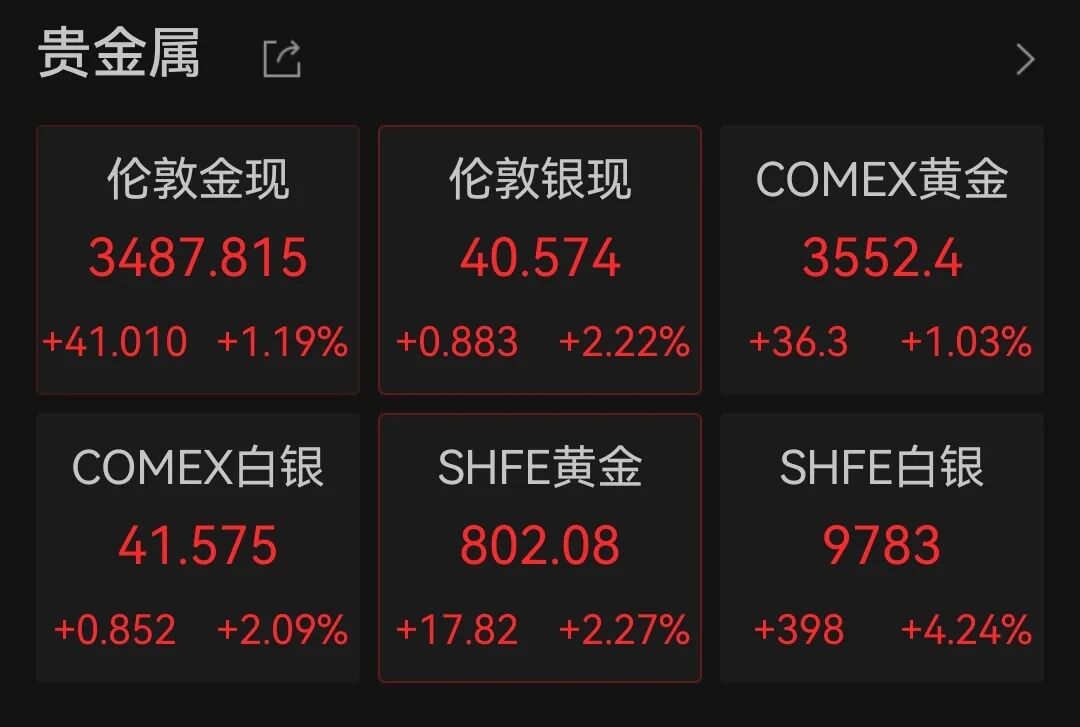
Group 1: Precious Metals Price Movement - International gold prices have risen for the fifth consecutive trading day, with COMEX gold futures reaching a record high of $3553.8 per ounce, and spot gold surpassing $3480 per ounce, nearing the historical high set in April. Year-to-date, spot gold has increased by over 32% [1] - Spot silver prices have also crossed the $40 per ounce mark for the first time since 2011, with a year-to-date increase exceeding 40%. As of the latest report, London silver is priced at $40.574 per ounce, reflecting a 2.22% increase [1] Group 2: Domestic Gold Stocks and Jewelry Prices - Domestic gold stocks have surged, with companies like Western Gold hitting the daily limit, Hunan Gold rising over 9%, and others like Zhongjin Gold and Shandong Gold increasing by over 6% [3] - Prices of certain gold jewelry brands have also seen an uptick. On September 1, Chow Tai Fook and Luk Fook Jewelry reported physical gold prices at 1027 yuan, marking a 1.18% increase [3][4] Group 3: Market Influences and Future Projections - Analysts from Bank of America identified two key factors driving up international gold prices: the Federal Reserve's open stance on potential interest rate cuts and market concerns regarding the independence of the Fed following the dismissal of a board member, which has led to increased gold purchases for hedging [5] - The market anticipates that the Federal Reserve may cut interest rates once or twice this year, providing overall support for commodity prices, including gold and silver. Swiss Bank has raised its gold price target for the first half of 2026 to $3700 per ounce, while Bank of America forecasts a peak of $4000 per ounce by the same period [5]

终于“投降”了?美联储年内连续降息三次,未来资金会流向中国?
Sou Hu Cai Jing· 2025-08-29 07:10
Group 1 - President Trump announced the dismissal of Federal Reserve Governor Lisa Cook, citing "mortgage fraud" as the reason [1][6] - This move is seen as an attempt by Trump to exert control over the Federal Reserve, especially following recent comments from Fed Chair Powell suggesting a need for policy adjustments due to employment risks [3][4] - Cook, the first Black woman on the Fed board, had previously warned that Trump's trade policies could hinder U.S. productivity and force the Fed to raise interest rates in a declining economic environment [6][10] Group 2 - Analysts suggest that if Trump successfully appoints two more members to the Fed's seven-member board, he could gain a majority and fundamentally reshape the Federal Reserve [8][10] - Trump's influence over the Fed could increase significantly, especially with the potential appointment of his ally Stephen Milan, who advocates for a weaker dollar to bring factories back to the U.S. [10][13] - The Fed's recent decision-making appears to be increasingly influenced by political factors, raising concerns about its independence and credibility [13][14] Group 3 - Recent economic data indicates that U.S. national debt interest payments reached $1.2 trillion over the past year, equating to $3,600 per American [16][17] - The expectation of interest rate cuts has led to a decline in the dollar's value, with the government facing increasing debt obligations, including $882 billion in interest payments for 2024 [17] - In contrast, Chinese assets have shown resilience, with the Shanghai Composite Index reaching a nearly ten-year high, indicating strong foreign investment in various sectors [16][19][21]
一场财富大转移,开始了!
大胡子说房· 2025-08-13 11:50
Core Viewpoint - The article suggests that a new wealth cycle in the capital market may have begun, driven by recent employment data in the U.S. that fell short of expectations, leading to a significant market reaction [2][3]. Market Reaction - The U.S. non-farm payroll data was released, showing employment figures that were significantly lower than market expectations, with previous data revised down by 90%, causing a collapse in confidence regarding the U.S. economy [3][6]. - Global stock markets experienced a collective plunge, with European markets dropping over 2%, and the U.S. markets seeing the Dow Jones down over 600 points, the Nasdaq down over 2%, and the S&P 500 down over 1.6% [4][6]. Employment Data Analysis - The article highlights that since 2023, the U.S. has been revising previously reported employment data downward each month, indicating that the actual employment situation has been poor, contrary to earlier reports [8][10]. - Notably, the revisions for June's job additions were adjusted from 147,000 to 14,000, and for May from 125,000 to 19,000, suggesting that only 10% of the reported data was accurate, with 90% being inflated [11][12]. Capital Market Dynamics - The article posits that the recent downward revisions in employment data will expose the underlying economic weakness in the U.S., prompting a swift market reaction characterized by panic [13][14]. - As a result, dollar-denominated assets and related currencies experienced significant declines, while safe-haven assets like gold saw a rapid increase in value [15][16]. Divergence in Markets - Despite the global panic triggered by the U.S. employment data, the Chinese A-shares and Hong Kong markets showed resilience, with the Shanghai Composite Index rising by 23 points and the Hang Seng Index increasing by 225 points [17][18]. - The article attributes this divergence to the Chinese capital market's positioning against dollar assets, suggesting that it is prepared to decouple from U.S. economic policies [19][20]. Future Outlook - The sustainability of the current market trend will depend on the Federal Reserve's decisions, particularly regarding interest rate cuts, with expectations for at least one cut by the end of the year [28][37]. - The probability of a rate cut in September has surged from 39% to 77%, indicating a significant shift in market expectations [38]. Investment Strategy - The article advises investors to consider reallocating their assets away from dollar-denominated investments, as a potential rate cut could trigger a major shift in capital flows towards non-dollar assets, including gold and markets that have decoupled from the dollar [46][47]. - It emphasizes the importance of acting quickly to capitalize on this potential wealth transfer opportunity before the Federal Reserve's decisions are made [46][47].

7月末中国外汇储备为32922亿美元
Zhong Guo Xin Wen Wang· 2025-08-08 02:32
Core Insights - As of July 2025, China's foreign exchange reserves stood at $32,922 billion, a decrease of $252 billion from the end of June, with gold reserves at 73.96 million ounces [1] - The increase in the US dollar index in July, influenced by macroeconomic data and monetary policy expectations, led to fluctuations in global financial asset prices, impacting the valuation of China's foreign exchange reserves [1] - The People's Bank of China has increased its gold holdings for the ninth consecutive month, maintaining a steady pace of gold accumulation [1] Economic Context - The National Foreign Exchange Administration believes that China's economic fundamentals remain strong, with advantages and resilience that support the stability of foreign exchange reserves [2] - The ongoing uncertainty in global trade and geopolitical factors is expected to drive central banks and investors to continue increasing their gold investments, providing ongoing support for gold prices [1]
人民币中间价收复7.15关口 外资增配中国资产仍有空间
2 1 Shi Ji Jing Ji Bao Dao· 2025-07-23 12:52
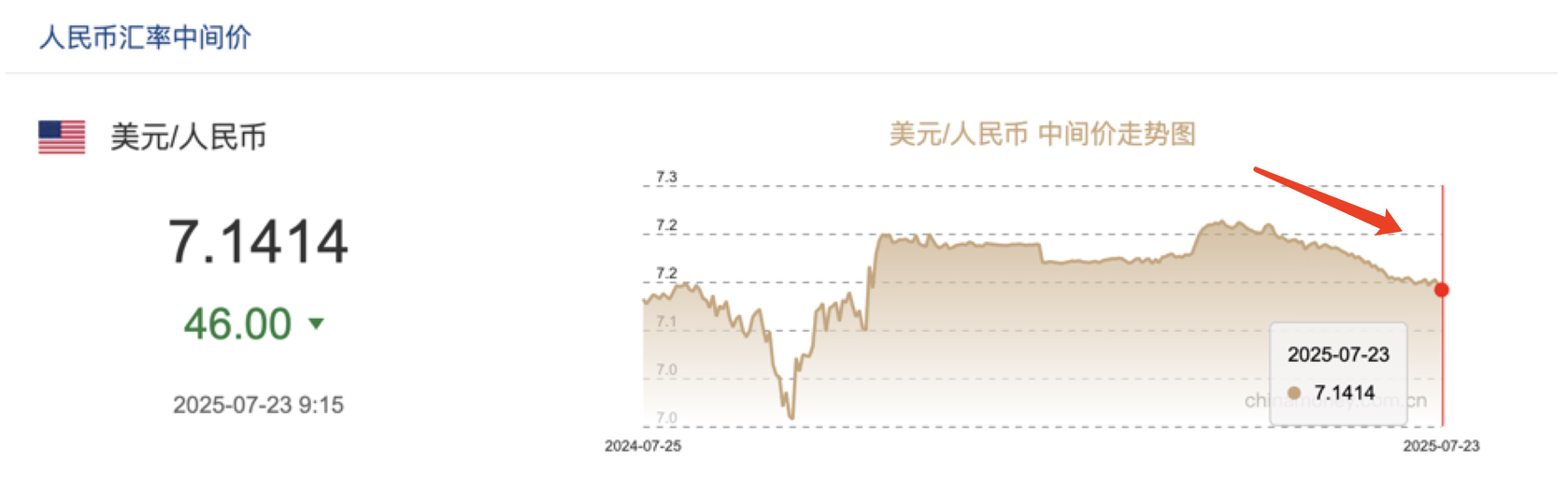
Core Viewpoint - The recent rebound of the Renminbi (RMB) against the US dollar indicates a positive trend in the currency's valuation, with the onshore and offshore RMB both recovering above the 7.2 mark, reflecting an appreciation since the beginning of the year [1][4]. Exchange Rate Performance - As of July 23, the central parity rate of RMB against USD was set at 7.1414, an increase of 46 basis points from the previous trading day, marking the highest level since November 5, 2024 [1]. - On the same day, the onshore RMB was reported at 7.1605, up 151 basis points, while the offshore RMB hovered around 7.15890, rising over 1100 basis points [1]. Market Stability and Expectations - In the first half of the year, the RMB appreciated by 1.9% against the USD, maintaining a stable range between 7.15 and 7.35, which has helped stabilize the macroeconomy and international balance of payments [4]. - The foreign exchange market has shown stable expectations, with no significant unilateral appreciation or depreciation anticipated for the RMB [4]. Economic Factors Influencing RMB - The RMB's stability is supported by several factors: domestic economic recovery, narrowing interest rate differentials between China and the US, balanced international payments, and improved resilience in the foreign exchange market [5]. - The People's Bank of China (PBOC) emphasizes that it does not seek to gain international competitive advantage through currency depreciation, maintaining a clear stance on the importance of market-driven exchange rate formation [5]. Capital Inflows and Foreign Investment - The capital market is witnessing a resurgence, with significant foreign capital inflows into the Chinese market, particularly through the Stock Connect program, which has seen transaction volumes exceed previous levels [7]. - Foreign investors are expected to continue increasing their allocation to RMB-denominated assets, supported by China's economic fundamentals and the demand for diversified global asset allocation [7]. Global Currency Trends - The US dollar's dominance is declining, with a significant drop in its share of global foreign exchange reserves, while the RMB is increasingly viewed as a desirable reserve asset by central banks [9]. - A report indicates that 30% of central banks plan to increase their RMB reserves over the next decade, suggesting a potential doubling of the RMB's share in global reserves to 6% [9]. Conclusion on RMB's International Position - The RMB has steadily risen in international status, becoming the second-largest trade financing currency and the third-largest payment currency globally [10]. - Despite the challenges faced by the RMB, including limited capacity for currency export due to China's trade surplus, the trend towards a multipolar currency system is evident, with the RMB gaining traction as a viable alternative to the US dollar [10].
美元资产“高息窗口”吸睛 如何平衡收益与风险?
Zhong Guo Jing Ying Bao· 2025-07-18 02:10
Core Viewpoint - The rapid achievement of yield targets for dollar-denominated financial products has led to early terminations, while institutions are aggressively expanding their presence in the dollar wealth management market despite declining yields [1][2][3]. Group 1: Market Trends - The number of newly issued dollar-denominated financial products reached 161 in June 2025, marking a year-on-year increase of 31.97% [1][2]. - The issuance of dollar wealth management products is expected to remain high in July 2025, with 68 products already launched by mid-month [2]. - The average annualized yield for dollar wealth management products has been declining, with June 2025 showing significant year-on-year decreases compared to June 2024 [3][4]. Group 2: Reasons for Institutional Interest - Institutions are seeking strategies to enhance yield, driven by expectations of potential interest rate cuts by the Federal Reserve and opportunities in U.S. Treasury investments [3][4]. - The demand for dollar-denominated assets is rising due to global economic uncertainties, including inflation and geopolitical tensions, making dollar assets attractive for their liquidity and safe-haven status [3][4]. Group 3: Yield Decline Factors - The decline in dollar wealth management yields is attributed to fluctuations in dollar asset prices, with the ICE U.S. Dollar Index experiencing a nearly 11% drop in the first half of 2025, the largest decline for that period since 1973 [4][5]. - Policies from the Trump administration, including tariffs and economic measures, have contributed to the rapid depreciation of the dollar, affecting market confidence [4][5]. Group 4: Investment Strategy Recommendations - Investors are advised to focus on fixed-income asset allocations to balance risks and returns, while also implementing measures to hedge against currency risks [6][8]. - Different types of dollar wealth management products are available, including those focused on dollar deposits, U.S. Treasury bonds, and overseas equities, each catering to varying risk appetites [7][8]. - Investors should consider product characteristics, such as stop-loss mechanisms, and be cautious of market noise when making investment decisions [8][9].
贵金属日报-20250717
Guo Tou Qi Huo· 2025-07-17 13:49
1. Report Industry Investment Rating - Gold: ★☆☆ (indicating a bullish bias, with a driving force for price increase, but limited operability in the market) [1] - Silver: ★☆☆ (indicating a bullish bias, with a driving force for price increase, but limited operability in the market) [1] 2. Core View of the Report - Overnight, the US PPI was lower than expected, and news that Trump intended to fire Fed Chairman Powell caused the US dollar assets to decline and international gold prices to rise. However, after Trump's denial, the market returned to stability. Driven by events, precious metals are sensitive. There is still room for negotiations before the deadline of the US tariff policy, and risk sentiment may fluctuate. Precious metals will mainly fluctuate. Attention should be paid to the US retail sales data tonight [1]. 3. Summary Based on Related Catalogs 3.1 US Economic Data - The US White House National Economic Council Director Hasset said that the Fed's actions are "very very slow" and inflation data has been performing well [2]. - The US June PPI annual rate was 2.3%, lower than the expected 2.5%, the lowest since September 2024, and the previous value was revised up from 2.6% to 2.7% [2]. - The Fed's Beige Book shows that the economic outlook is neutral to slightly pessimistic. Manufacturing activity decreased slightly, and corporate recruitment remained cautious [2]. 3.2 Tariff Policies - Canada will tighten steel quotas for some foreign countries [2]. - Trump will send general tariff rate notices to more than 150 small countries and may impose a 10% or 15% tariff on smaller countries [2].
美国纽约联储主席威廉姆斯:并未看到人们脱离美元资产。支撑美元走强的因素依然存在。有更多投资者对冲美元风险敞口。距离2%的通胀目标还有很长的路要走。
news flash· 2025-07-17 00:33
Core Viewpoint - The New York Federal Reserve President Williams stated that there is no evidence of a significant shift away from dollar assets by investors, indicating continued strength in the dollar [1] Group 1 - Factors supporting the strength of the dollar remain intact, suggesting a stable outlook for dollar-denominated investments [1] - An increasing number of investors are hedging against dollar risk exposure, reflecting a cautious approach in the current economic environment [1] - There is still a considerable distance to reach the 2% inflation target, indicating ongoing economic challenges that may affect investment strategies [1]
东稳西荡下的中国优势—策略周聚焦
2025-07-16 06:13
Summary of Conference Call Notes Industry or Company Involved - The notes primarily discuss the macroeconomic environment, focusing on the U.S. and China, including aspects of debt, currency, and market dynamics. Core Points and Arguments 1. The U.S. government is facing a $4 trillion debt ceiling, which may lead to increased public spending and dissatisfaction among stakeholders regarding tax cuts for businesses and individuals [1] 2. The U.S. dollar index is currently at 90.2, with predictions of further decline due to ongoing supply chain issues and potential adjustments to the debt ceiling [2] 3. China has strategically reduced its holdings of U.S. Treasury securities from a peak of approximately $1.2 trillion in 2018 to around $700 billion, indicating a shift in its financial strategy post-trade war [3] 4. China's economic policies have shifted since September 2022, focusing on fiscal expansion and stabilizing the economy, contrasting with previous periods of policy uncertainty [4] 5. The stability of the Chinese stock market is noted, with government bonds trading around 1.7% and stock indices fluctuating around 3.3%, reflecting a cautious but stable economic outlook [5] 6. The current low price levels in China may facilitate monetary easing, which could help stimulate economic recovery, while the U.S. faces challenges in this regard [6] 7. China's stock market is characterized by a relatively high debt-to-GDP ratio compared to other major economies, indicating a unique financial position [7] 8. The potential for a technological revolution is highlighted, with both the U.S. and China expected to leverage their respective strengths in R&D and market application over the next decade [8] 9. The outlook for the next 6 to 12 months suggests a continuation of the current bull market, with limited upward movement in indices due to strategic market stabilization efforts [9] 10. Companies are increasingly focused on cash management and financial stability, with a notable emphasis on sectors such as transportation and infrastructure [10] 11. The report concludes with a focus on the advantages of Chinese companies in terms of market timing and strategic positioning amid global risks [11] Other Important but Possibly Overlooked Content - The notes emphasize the importance of understanding the interplay between U.S. and Chinese economic policies and their implications for global markets, particularly in the context of ongoing geopolitical tensions and trade dynamics [2][3][4][5][6][8]
新闻解读20250604
2025-07-16 06:13
Summary of Conference Call Records Industry or Company Involved - The discussion primarily revolves around the U.S.-China trade negotiations, particularly focusing on strategic resources like rare earth elements and the implications for the financial markets. Core Points and Arguments - President Trump's recent comments on China's negotiation stance indicate significant difficulties in reaching a trade agreement, which has led to a slight pullback in U.S. stock index futures [1] - The U.S. may be hesitant to take strong actions against China due to potential negative impacts on its own dollar assets, suggesting that aggressive measures could backfire [2] - The U.S. Treasury's intervention in the market reflects underlying troubles, with short-term U.S. Treasury bonds receiving some support, while medium to long-term bonds face considerable pressure [3] - Internal divisions within the U.S. Congress regarding certain policies are highlighted, with notable opposition from influential figures like Elon Musk, indicating intense internal conflicts [4] - The discussion includes the "see-saw effect" of dollar assets, with gold and strategic resources like rare earths gaining attention amid market fluctuations [5] - The technology sector, particularly artificial intelligence, shows slight upward movement, while overall market activity remains subdued, as indicated by trading volumes in the Shanghai and Hong Kong markets [6] - There are expectations for potential central bank interventions to support market liquidity, although this optimism may be overly optimistic given the current pressures in the bond market [7] - The overall sentiment suggests a need to remain patient and vigilant for better investment opportunities in strategic resources and gold amidst rapid market changes [8] Other Important but Possibly Overlooked Content - The mention of rare earth elements as a key topic in U.S.-China tensions emphasizes their strategic importance in the current geopolitical landscape [5] - The potential for a liquidity crisis in the bond market is noted, which could have broader implications for financial stability [7] - The overall market environment is characterized by rapid shifts in focus and wealth effects, necessitating a strategic approach to investment opportunities [8]