
股债跷跷板效应

Search documents
公募基金泛固收指数跟踪周报(2025.07.21-2025.07.25):情绪冲击,债市调整-20250728
HWABAO SECURITIES· 2025-07-28 10:47
Report Industry Investment Rating No relevant content provided. Core View of the Report - Last week (July 21 - July 25, 2025), bond yields oscillated upwards. The ChinaBond Composite Wealth Index (CBA00201) fell 0.39%, and the ChinaBond Composite Full - Price Index (CBA00203) fell 0.44%. Interest - rate bonds and credit bonds across all tenors and ratings saw yield increases, and most credit spreads widened. The bond market adjusted due to the release of negative factors, the US Treasury yield curve flattened, and the secondary market for REITs declined while trading activity picked up [3][10]. - As of July 25, the total scale of 39 bond ETF products in the market exceeded 500 billion yuan, reaching 510.505 billion yuan, a nearly 200% increase from the beginning of the year, with science - innovation bond ETFs as the core growth driver [4]. Summary by Related Catalogs 1. Weekly Market Observation 1.1. Pan - Fixed - Income Market Review and Observation - **Bond Market Review**: Last week, bond yields oscillated upwards. Interest - rate bonds across all tenors declined, with medium - and long - term yields rising significantly more than short - term ones. Credit bond yields across all tenors and ratings increased, and most credit spreads widened. The 1 - year, 3 - year, 5 - year, and 10 - year Treasury yields rose 3.38bp, 6.64bp, 9.14bp, and 7.07bp respectively [3][10]. - **Bond Market Adjustment**: The bond market adjusted due to the release of negative factors. The central bank's net open - market injection was 10.95 billion yuan last week. The money market was tight at first and then loose, with DR007 and R007 rising 14.56bp and 18.65bp respectively. The bond market adjusted significantly due to factors such as improved fundamental expectations, a higher issuance rate of 30 - year special Treasury bonds, and the stock - bond seesaw effect. In the short term, the broad - money direction is unlikely to change, and the money market may be a disturbing factor. The central bank's support means limited liquidity risk, but the stock market may continue to affect the bond market [10][11]. - **US Treasury Yield Curve**: The US Treasury yield curve flattened. At the beginning of the week, yields declined due to risk - aversion, then rebounded as tensions eased. On Thursday, lower - than - expected initial jobless claims data pushed up short - term yields. In the future, the FOMC meeting may keep interest rates unchanged, and strong economic data may further dampen rate - cut expectations. Short - term yields can be traded on the dips, while caution is advised for long - term bonds [12]. - **REITs Market**: The secondary market for REITs declined, but trading activity picked up. The CSI REITs Total Return Index fell 1.56% last week. After the decline in July, the valuations of REITs projects adjusted, and the cash distribution rate increased. Individual bonds in sectors such as consumption and affordable housing have increased cost - effectiveness [13]. 1.2. Public Fund Market Dynamics - As of July 25, the total scale of 39 bond ETF products in the market reached 510.505 billion yuan, a nearly 200% increase from the beginning of the year. Science - innovation bond ETFs were the core growth driver, with the first batch of 10 products reaching over 100 billion yuan in scale in the first week after listing. The bond ETF market has diverse product types, and there is still room for development in terms of supply, product innovation, and investor structure [4][14][15]. 2. Pan - Fixed - Income Fund Index Performance Tracking | Index Classification | This Week | Last Month | YTD | Since Strategy Inception | | --- | --- | --- | --- | --- | | Short - Term Bond Fund Selection | - 0.08% | 0.07% | 0.59% | 4.00% | | Medium - and Long - Term Bond Fund Selection | - 0.30% | - 0.13% | 0.68% | 6.32% | | Low - Volatility Fixed - Income + Fund Selection | - 0.11% | 0.40% | 1.62% | 2.90% | | Medium - Volatility Fixed - Income + Fund Selection | 0.14% | 1.02% | 2.33% | 2.85% | | High - Volatility Fixed - Income + Fund Selection | 0.42% | 1.34% | 4.68% | 4.42% | | Convertible Bond Fund Selection | 2.24% | 4.77% | 11.60% | 15.09% | | QDII Bond Fund Selection | 0.33% | 0.42% | 3.17% | 8.16% | | REITs Fund Selection | - 1.61% | - 3.99% | 26.83% | 35.47% | 2.1. Pure Bond Index Tracking - **Short - Term Bond Fund Selection Index**: Aims at liquidity management, selects 5 funds with stable long - term returns, strict drawdown control, and significant absolute - return capabilities, and uses 50% Short - Term Pure Bond Fund Index + 50% General Money - Market Fund Index as the benchmark [17]. - **Medium - and Long - Term Bond Fund Selection Index**: Aims at stable returns by investing in medium - and long - term pure bond funds, selects 5 funds, adjusts duration and the ratio of credit and interest - rate bond funds according to market conditions [19]. 2.2. Fixed - Income + Index Tracking - **Low - Volatility Fixed - Income + Selection Index**: Has an equity central position of 10%, selects 10 funds with an equity central position of less than 15% in the past three years and recently, and uses 10% CSI 800 Index + 90% ChinaBond New Composite Full - Price Index as the benchmark [24]. - **Medium - Volatility Fixed - Income + Selection Index**: Has an equity central position of 20%, selects 5 funds with an equity central position between 15% - 25% in the past three years and recently [24]. - **High - Volatility Fixed - Income + Selection Index**: Has an equity central position of 30%, selects 5 funds with an equity central position between 25% - 35% in the past three years and recently, and focuses on funds with strong stock - picking ability in the equity segment [27]. 2.3. Convertible Bond Fund Selection Index - Selects bond - type funds with an average convertible - bond investment ratio of at least 60% in the latest period and at least 80% in the past four quarters as the sample space, and selects 5 funds based on an evaluation system [29][33]. 2.4. QDII Bond Fund Selection Index Tracking - Selects 6 QDII bond funds with stable returns and good risk control based on credit and duration [35]. 2.5. REITs Fund Selection Index Tracking - Selects 10 REITs funds with stable operations, reasonable valuations, and certain elasticity based on the underlying asset type [37].
【公募基金】情绪冲击,债市调整——公募基金泛固收指数跟踪周报(2025.07.21-2025.07.25)
华宝财富魔方· 2025-07-28 08:55
Market Review - The bond market experienced fluctuations with rising yields during the week of July 21-25, 2025. The China Bond Composite Wealth Index (CBA00201) fell by 0.39%, while the China Bond Composite Full Price Index (CBA00203) decreased by 0.44%. Yields on government bonds across various maturities rose, with the 1-year, 3-year, 5-year, and 10-year government bond yields increasing by 3.38bp, 6.64bp, 9.14bp, and 7.07bp respectively [12][13] - The central bank's net injection in the open market was 109.5 billion yuan, with a total of 21.563 trillion yuan injected and 20.468 trillion yuan withdrawn. The overall liquidity was balanced, with DR007 and R007 rising by 14.56bp and 18.65bp to 1.65% and 1.59% respectively [13] - The U.S. Treasury market showed limited volatility, with a flattening yield curve. Initial jobless claims data unexpectedly declined, reinforcing a strong labor market view and reducing recent rate cut expectations [14] Public Fund Market Dynamics - As of July 25, 2025, the total scale of bond ETF products in the market surpassed 500 billion yuan, reaching 510.505 billion yuan, a nearly 200% increase since the beginning of the year. The Sci-Tech Innovation Bond ETF has become a core growth driver, with the first batch of 10 products launched after the Lujiazui Forum in June, achieving over 100 billion yuan in the first week [16][17] - The bond ETF market features a diverse range of products, with significant growth in various categories. For instance, the Pengyang 30-Year Treasury ETF exceeded 20 billion yuan, and the Bosera CSI Convertible Bond ETF surpassed 40 billion yuan [17] - The bond ETF market's growth indicates a deep integration of finance and technology, with ongoing product innovation and an optimized investor structure expected to inject sustained momentum into the high-quality development of China's capital market [17] Performance Tracking of Fixed Income Funds - Short-term bond fund index fell by 0.08% last week, with a cumulative return of 4.00% since inception [19] - Medium to long-term bond fund index decreased by 0.30%, with a cumulative return of 6.32% since inception [19] - Convertible bond fund index rose by 2.24%, achieving a cumulative return of 15.09% since inception [19]


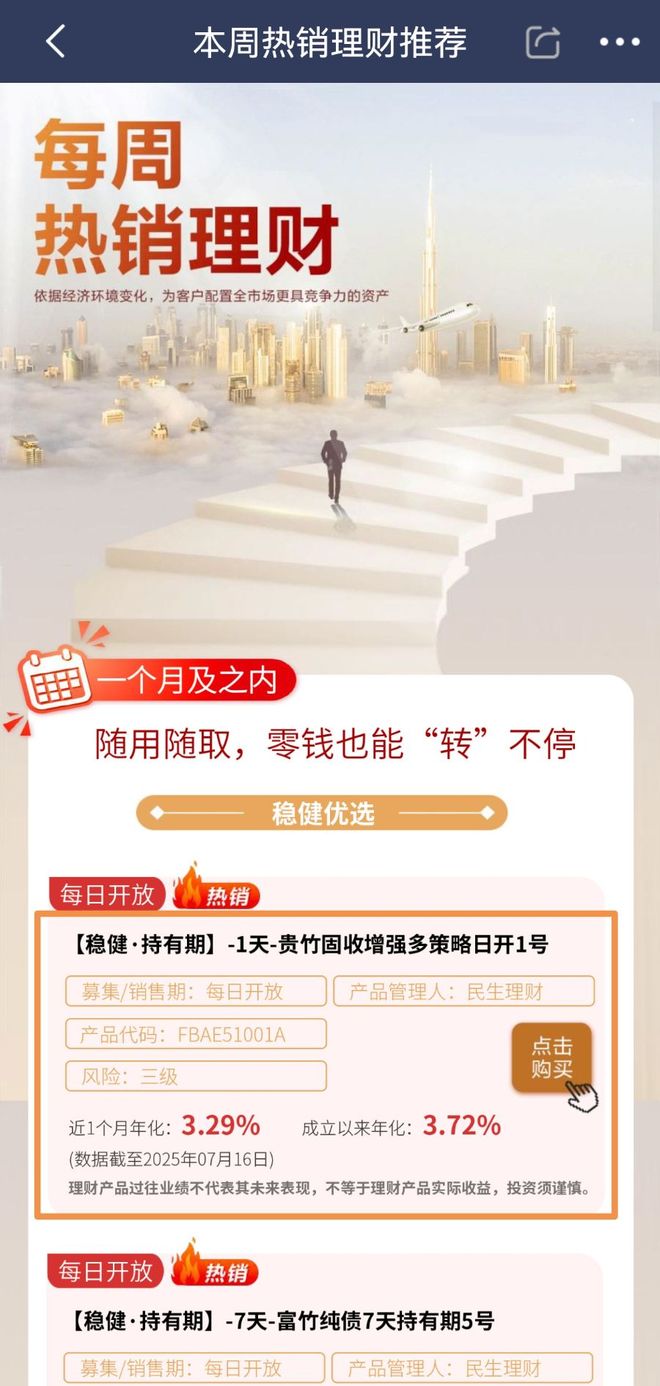
债市持续调整,民生银行APP热销多策略产品如何应对债市下跌?
2 1 Shi Ji Jing Ji Bao Dao· 2025-07-28 02:18
近期债市调整、股市一度突破3600点,"股债跷跷板"效应再现。随着投资难度加大,通过多元化资产配 置分散风险的多元配置策略越来越受欢迎。理财通评评"理"第44期继续测评银行热销产品,本期测评民 生银行APP"每周热销理财"中排第一的产品:贵竹固收增强多策略日开1号。该产品为一款多策略产 品,通过多元化配置分散风险以及增加多元化收入来源。 上周债市出现持续调整,而股市气势如虹一度突破3600点,"股债翘翘板效应"再现,部分资金从债市悄 悄"搬家,债券型基金赎回压力明显增大。据浙商银行FICC公众号发布的相关报告,经脱敏处理的机构 净申赎数据显示,上周三纯债型基金单日赎回规模已逼近5月末"商业银行季末浮盈兑现"传闻的单日水 平。从收益率曲线形态观察,近一个月在资金分流、风险偏好提升等多重因素压制下,收益率底部呈现 渐进式抬升形态,叠加微观结构尚未修复,债市或延续震荡筑底格局。 债市调整意味着固收类产品净值面临回撤压力,那么同时配置了权益类资产的"固收+"产品,权益投资 部分是否能起到对冲效果,缓冲债市带来的净值下跌压力呢? 从本期测评的"贵竹固收增强多策略日开1号"的净值走势来看,该产品对股市波动较为敏感,4月7 ...

机构称可阶段性全面看多债市,公司债ETF(511030)近10个交易日净流入1.08亿元
Sou Hu Cai Jing· 2025-07-28 02:04
Group 1 - The core viewpoint of the articles highlights a significant "seesaw effect" in the market, where the A-share market is recovering while the bond market is experiencing adjustments, leading to increased redemptions in bond funds [1] - As of July 25, over 400 bond funds have reported losses this year, with more than half of bond funds showing negative performance since July, particularly those heavily invested in long-term interest rate bonds [1][2] - The yield on major interbank bonds has generally declined, with the 30-year government bond yield dropping by 2 basis points to 1.9275% and the 10-year policy bank bond yield down by 1.75 basis points to 1.81% [1] Group 2 - The bond market is expected to experience fluctuations over the next year, with opportunities arising from adjustments; during July 21-25, bond funds rapidly reduced duration, resulting in a net sell of 236.1 billion yuan in long-term bonds [2] - As of July 25, the company bond ETF (511030) has seen a slight increase of 0.01%, with a one-year cumulative increase of 1.76% [2] - The company bond ETF has a current scale of 22.262 billion yuan, with recent inflows and outflows remaining balanced, and a total of 1.08 million yuan raised over the last ten trading days [3] Group 3 - The company bond ETF has a management fee rate of 0.15% and a custody fee rate of 0.05% [4] - The tracking error of the company bond ETF for the year is 0.013%, closely following the China Bond - Medium to High Grade Corporate Bond Spread Factor Index [5] - The company bond ETF has achieved a maximum drawdown of 0.50% this year, with a recovery time of 23 days after the drawdown [3]
ETF资金逆势抄底债基,国开债券ETF(159651)历史持有2年盈利概率为100.00%
Sou Hu Cai Jing· 2025-07-28 02:04
Group 1 - The bond market is experiencing significant adjustments, with pure bond funds showing negative average returns since July, leading to increased large redemptions [1] - Over 400 bond funds have reported losses this year, particularly those heavily invested in long-term interest rate bonds, with more than half of bond funds showing negative performance since July [1] - The yield on major interbank bonds has generally decreased, with the 30-year government bond yield down by 2 basis points to 1.9275% and the 10-year policy bank bond yield down by 1.75 basis points to 1.81% [1] Group 2 - The National Development Bank bond ETF (159651) is showing a mixed market, with a recent price of 106.18 yuan and a cumulative increase of 1.65% over the past year [2] - The trading volume for the National Development Bank bond ETF has been active, with a turnover rate of 4.63% and a total transaction value of 35.09 million yuan on the latest trading day [2] - The National Development Bank bond ETF has achieved a net value increase of 4.50% over the past two years, with a historical monthly profit probability of 88.12% [2] Group 3 - The management fee for the National Development Bank bond ETF is 0.15%, and the custody fee is 0.05%, making it one of the lowest in comparable funds [3] - The tracking error for the National Development Bank bond ETF over the past two months is 0.014%, indicating the highest tracking precision among comparable funds [3] - The ETF closely tracks the China Bond - 0-3 Year National Development Bank Bond Index, which includes policy bank bonds with a maturity of up to three years [3]
跷跷板效应显现部分债基遭遇大额赎回
Shang Hai Zheng Quan Bao· 2025-07-27 18:48
Group 1 - The core viewpoint of the articles highlights a significant "see-saw effect" between the stock and bond markets, with the A-share market recovering while the bond market faces continuous adjustments, leading to substantial redemptions in bond funds [1][2][3] - As of July 25, pure bond funds have shown an average loss of -0.11% since July began, with less than 35% of products achieving positive returns, indicating a challenging environment for bond fund performance [2][3] - A total of 36 bond funds have raised their net asset value precision due to large redemptions since July, with the redemption intensity on July 24 being notably stronger than in February of this year, suggesting a trend of increasing investor caution [2][3] Group 2 - The recent pressure on the bond market is attributed to rising risk appetite in the stock and commodity markets, which has led to increased bond yields and affected the net values of some fixed-income funds [3][4] - Despite concerns about a potential ongoing redemption wave in bond funds, analysts believe that the current situation is primarily driven by precautionary measures from asset management institutions, and there is no significant outflow of retail funds from bond investments [4][5] - The outlook for the bond market remains cautiously optimistic, with expectations that it will find a new equilibrium amid adjustments, while emphasizing the importance of liquidity management and defensive strategies in the short term [5]

国债期货周报:财政预期升温与股债分流共振,国债期货全线收跌-20250727
Hua Tai Qi Huo· 2025-07-27 14:25
Report Summary 1. Investment Rating No investment rating for the industry is provided in the report. 2. Core View This week, Treasury bond futures closed down across the board, influenced by multiple factors such as the increasing expectation of fiscal expansion, the continuous seesaw effect between stocks and bonds, and fluctuations in the capital market. Although the bond market faces short - term adjustment pressure, long - term fundamental support remains, and there may be opportunities for a rebound after the market correction [1][2][3]. 3. Section Summaries Market Analysis - **Macroeconomic Conditions**: On May 20, the central bank cut the LPR, and major state - owned and some joint - stock banks lowered deposit rates. In July, the LPR remained stable. Sino - US economic and trade talks are scheduled from July 27 - 30. In the first half of 2025, the national fiscal operation was generally stable, with increased expenditure and optimized revenue - expenditure structure. General public budget revenue was 11.56 trillion yuan, a slight 0.3% year - on - year decrease, while expenditure was 14.13 trillion yuan, a 3.4% year - on - year increase. Government - funded budget expenditure increased by 30% year - on - year. The CPI in June increased by 0.1% year - on - year [1]. - **Funding Conditions**: On July 25, 2025, the central bank conducted 789.3 billion yuan of 7 - day reverse repurchase operations at a fixed rate of 1.4%. The main term repurchase rates (1D, 7D, 14D) were 1.52%, 1.65%, and 1.67% respectively, and the repurchase rates have recently risen [2]. - **Market Conditions**: On July 25, 2025, the closing prices of TS, TF, T, and TL were 102.31 yuan, 105.57 yuan, 108.18 yuan, and 117.95 yuan respectively. Their weekly price changes were - 0.11%, - 0.36%, - 0.53%, and - 1.68% respectively. The average net basis spreads of TS, TF, T, and TL were 0.02 yuan, 0.11 yuan, 0.10 yuan, and 0.80 yuan respectively [2]. Strategy - **Single - side Trading**: With the rising repurchase rates and the fluctuating prices of Treasury bond futures, the 2509 contract is neutral. - **Arbitrage**: Pay attention to the widening of the basis spread. - **Hedging**: As there is medium - term adjustment pressure, short - position holders can use far - month contracts for appropriate hedging [3].
股指期货将偏强震荡,多晶硅、碳酸锂、焦煤、玻璃期货将震荡偏强,工业硅、纯碱期货将偏强宽幅震荡
Guo Tai Jun An Qi Huo· 2025-07-25 09:08
Report Industry Investment Rating No relevant information provided. Core View of the Report Based on macro - fundamental and technical analysis, the report predicts the trend of various futures on July 25, 2025, including whether they will be strong or weak, and gives corresponding resistance and support levels [2]. Summary According to Relevant Catalogs 1. Futures Market Outlook - **Strong - biased and Volatile**: IF2509, IH2509, IC2509, IM2509, AO2509, RB2510, HC2510, PS2509, LC2509, JM2509, FG509, TA509, V2509, MA509, RU2509 [2][3][4][6][7] - **Weak - biased and Volatile**: T2509, TL2509, AU2510, AG2510, CU2509, I2509, SC2509, P2509 [2][3][4][6][7] - **Strong - biased and Widely Volatile**: SI2509, SA509 [3][6] 2. Macro News and Trading Tips - **Sino - EU Relations**: President Xi Jinping put forward three proposals for the future development of China - EU relations. Premier Li Qiang hopes the EU can provide a fair business environment for Chinese enterprises [8]. - **AI Conference**: Premier Li Qiang will attend the opening ceremony of the 2025 World Artificial Intelligence Conference and deliver a speech [8]. - **Mineral Export**: The Ministry of Commerce will take measures to combat strategic mineral smuggling [8]. - **Rural Finance**: The central bank and the Ministry of Agriculture and Rural Affairs will increase financial support for rural revitalization [8]. - **Investment**: 735 billion yuan of central budget - internal investment in 2025 has been basically allocated [9]. - **Price Law**: The National Development and Reform Commission and the State Administration for Market Regulation are soliciting opinions on the draft amendment of the Price Law [9]. - **State - owned Assets**: The State - owned Assets Supervision and Administration Commission emphasizes optimizing the allocation of state - owned assets [9]. - **MLF Operation**: The central bank will conduct a 400 - billion - yuan MLF operation on July 25, with a net injection of 100 billion yuan [9]. - **Medical Insurance**: During the 14th Five - Year Plan period, the national basic medical insurance participation rate remained stable at about 95% [10]. - **US Politics and Economy**: Trump hopes the Fed to cut interest rates. An investment company sues the Fed for non - transparent meetings. The EU may impose counter - tariffs on US products. US PMI data shows a mixed trend [10][11][12] 3. Commodity Futures Information - **Risk Warning**: Zhengzhou Commodity Exchange warns about uncertainties in the glass and soda ash markets [12]. - **Gold Market**: In the first half of the year, China's gold production increased by 0.44% year - on - year, while consumption decreased by 3.54%. Gold ETFs increased their positions [12]. - **International Futures**: On July 24, international precious metals futures generally fell, international oil prices rose slightly, and London base metals closed down [13] 4. Futures Market Analysis and Outlook - **Stock Index Futures**: On July 24, major stock index futures contracts showed an upward trend. It is expected that on July 25, they will be strong - biased and volatile [14][15][16][20] - **Treasury Bond Futures**: On July 24, treasury bond futures closed down. It is expected that on July 25, T2509 and TL2509 will be weak - biased and volatile [36][38] - **Precious Metal Futures**: On July 24, gold and silver futures closed down. It is expected that on July 25, they will be weak - biased and volatile [41][50] - **Base Metal Futures**: On July 24, copper and alumina futures had different trends. It is expected that on July 25, copper will be weak - biased and alumina will be strong - biased [52][58] - **Industrial Metal Futures**: On July 24, industrial silicon, polycrystalline silicon, and lithium carbonate futures showed an upward trend. It is expected that on July 25, they will be strong - biased [61][64][67] - **Building Material Futures**: On July 24, rebar, hot - rolled coil, and iron ore futures had different trends. It is expected that on July 25, rebar and hot - rolled coil will be strong - biased, and iron ore will be weak - biased [69][75][77] - **Energy Futures**: On July 24, coking coal, glass, soda ash, and crude oil futures had different trends. It is expected that on July 25, coking coal and glass will be strong - biased, soda ash will be strong - biased and widely volatile, and crude oil will be weak - biased [84][87][89][90] - **Chemical Futures**: On July 24, PTA, PVC, and methanol futures showed an upward trend. It is expected that on July 25, they will be strong - biased [95][97][100] - **Agricultural Futures**: On July 24, palm oil and natural rubber futures showed an upward trend. It is expected that on July 25, palm oil will be weak - biased and natural rubber will be strong - biased [101][103]
分析人士:债券“牛市”难言反转
Qi Huo Ri Bao· 2025-07-25 03:08
Group 1 - The bond market has experienced a significant adjustment since July, with the 10-year government bond yield rising from 1.64% to over 1.7%, and the 30-year bond yield fluctuating above 1.9% [1] - Economic resilience in China is a key factor supporting the bond market adjustment, with indicators showing strong production, rising consumption, stable exports, and a gradual recovery in loans [1][2] - The "anti-involution" policy expectations have also influenced the bond market, with rising prices in commodities like polysilicon and coking coal, driven by government initiatives to stabilize growth [2] Group 2 - Short-term outlook for the bond market is bearish, with expectations of continued pressure due to economic resilience and rising risk appetite [3][4] - Long-term support factors for the bond market include strong monetary policy support and the potential for interest rate cuts in the second half of the year, which may lead to a slight decrease in government bond yields [3][4] - The "anti-involution" policy aims to address supply-demand imbalances, suggesting that monetary policy will remain accommodative to support economic adjustments, providing some support for the bond market [4]
冠通期货资讯早间报-20250725
Guan Tong Qi Huo· 2025-07-25 00:42
资讯早间报 制作日期: 2025/07/25 隔夜夜盘市场走势 1. 周四夜盘收盘,国内期货主力合约涨跌互现,玻璃涨超 6%,焦煤涨超 5%, 纯碱涨超 4%,氧化铝、20 号胶、乙二醇涨超 2%。跌幅方面,铁矿石跌超 1%。 地址:北京市朝阳区朝阳门外大街甲6号万通中心D座20层(100020) 总机:010-8535 6666 重要资讯 【宏观资讯】 2. 国际贵金属期货普遍收跌,COMEX 黄金期货跌 0.77%报 3371.3 美元/盎司, COMEX 白银期货跌 0.55%报 39.285 美元/盎司。 3. 国际油价小幅走强,美油主力合约收涨 1.39%,报 66.16 美元/桶;布伦特原 油主力合约涨 0.96%,报 68.48 美元/桶。 4. 伦敦基本金属收盘全线下跌,LME 期铜跌 0.77%报 9854.50 美元/吨,LME 期 锌跌 0.75%报 2840.50 美元/吨,LME 期镍跌 0.66%报 15470.00 美元/吨。 5. 国际农产品期货多数上涨,美大豆涨 0.15%,美玉米涨 0.82%,美豆油涨 0.93%,美豆粕跌 0.80%,美小麦涨 0.23%。 投资有风险, ...