
滞胀

Search documents
今夜!跳水!
中国基金报· 2025-08-05 16:12
Core Viewpoint - The article highlights a significant downturn in the U.S. stock market, driven by disappointing service sector data, raising concerns about the economic outlook and potential market corrections [2][5][10]. Group 1: Market Performance - U.S. stock indices experienced a decline, with the Dow Jones dropping approximately 100 points and both the Nasdaq and S&P 500 falling around 0.5% [2]. - Technology stocks collectively fell, with notable declines in companies such as ARM (-2.83%), TSMC (-2.78%), and Nvidia (-1.73%) [4]. Group 2: Service Sector Data - The ISM services index showed almost zero growth in July, indicating stagnation and raising concerns about stagflation, characterized by high inflation and low employment [5]. - The services sector, which constitutes about 70% of the U.S. economy, is showing signs of slowdown, with the services index dropping to 50.1, below economists' expectations [5]. - The employment index fell to 46.4, marking its fourth contraction in five months and reaching one of the lowest levels since the pandemic [5]. Group 3: Economic Concerns - Businesses are facing challenges from high tariffs, cautious consumer behavior, and uncertainties stemming from former President Trump's policies [6]. - The new orders index decreased to 50.3, nearing stagnation, while 11 service industries reported growth, and 7 experienced contraction, with the largest decline in accommodation and food services [7]. Group 4: Market Predictions - Major Wall Street firms, including Morgan Stanley and Deutsche Bank, are warning investors to prepare for potential market corrections, with predictions of a 10% to 15% decline in the S&P 500 in the coming weeks [10][11]. - The S&P 500's relative strength index (RSI) reached 76, indicating overbought conditions, and historical data suggests that August and September are typically weak months for the index [11].




贵金属日报-20250805
Guo Tou Qi Huo· 2025-08-05 10:03
Report Investment Rating - Gold: ★★★, indicating a more distinct long trend with relatively appropriate investment opportunities currently [1] - Silver: ★★★, indicating a more distinct long trend with relatively appropriate investment opportunities currently [1] Core View - The precious metals are in a volatile trend. With the geopolitical situation cooling down and tariff policies gradually implemented, the market focus has shifted to the US economy and the prospects of interest rate cuts. Amid continuous verification, market sentiment will face fluctuations. If the scenarios of stagflation or even recession become clearer, the upside potential for gold may be reopened. Maintain the idea of buying on dips during the precious metals' volatile trend [1] Other Key Points Economic Data and Market Reaction - Last week, the US released multiple economic data. The annualized quarterly GDP growth rate in Q2 rebounded by 3% more than expected, and the weekly initial jobless claims remained low. However, the key non - farm payrolls data changed unexpectedly. The non - farm payrolls in July increased by 73,000, far lower than the expected 110,000, and the previous two months' data was revised down by 258,000 jobs. Trump claimed that the non - farm employment data was manipulated and instructed his team to fire the Bureau of Labor Statistics director immediately. The market's concerns about the authenticity of economic data and the US economic outlook have intensified [1] Fed Policy and Market Expectations - The Fed kept interest rates unchanged as expected at its July FOMC meeting. Powell reiterated that future policies will be determined based on economic data. With the significant decline in non - farm payrolls, traders fully priced in two Fed rate cuts by the end of the year, and the probability of a rate cut in September rose to 90%. Fed's Daly said that the time for rate cuts is approaching, and it is more likely to cut rates more than twice this year [1][2] Tariff - related News - The EU will suspend trade counter - measures against the US for 6 months and is waiting for Trump to take action on auto tariffs and exemptions this week. Trump said he will significantly increase tariff rates on India because the country buys Russian oil, and India responded that the accusation is baseless. The Swiss government plans to continue talks with the US after August 7 and is determined to make a more attractive proposal to the US [2]
美债专题跟踪 | 美7月非农数据遭遇“滑铁卢”,10年期美债收益率大幅下行
Sou Hu Cai Jing· 2025-08-05 08:43
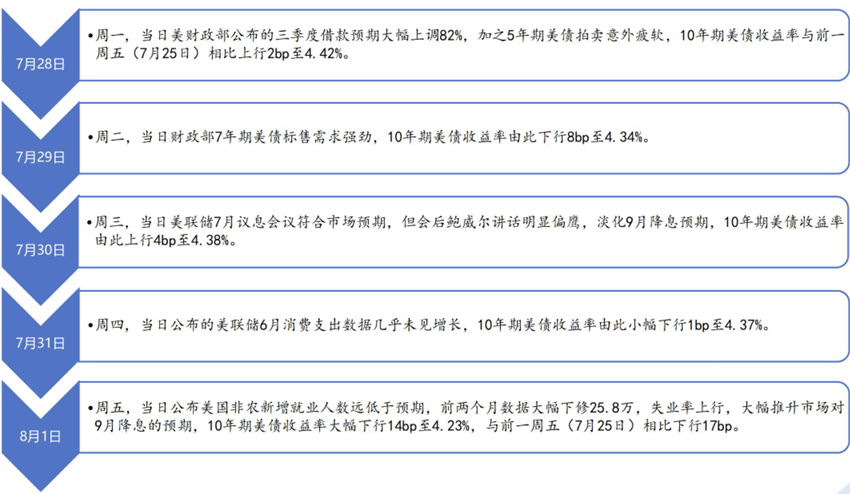
来源:东方金诚 上周美债收益率走势回顾 2025年7月28日当周,10年期美债收益率大幅下行。具体来看:周一,当日美财政部公布的三季度借款预期大幅上调 82%,加之5年期美债拍卖意外疲软,10年期美债收益率与前一周五(7月25日)相比上行2bp至4.42%;周二,当日财政 部7年期美债标售需求强劲,10年期美债收益率由此下行8bp至4.34%;周三,当日美联储7月议息会议符合市场预期,但 会后鲍威尔讲话明显偏鹰,淡化9月降息预期,10年期美债收益率由此上行4bp至4.38%;周四,当日公布的美联储6月消 费支出数据几乎未见增长,10年期美债收益率由此小幅下行1bp至4.37%;周五,当日公布的美国非农新增就业人数远低 于预期,前两个月数据大幅下修25.8万,失业率上行,大幅推升市场对9月降息的预期,10年期美债收益率大幅下行14bp 至4.23%,与前一周五(7月25日)相比下行17bp。 2.短期走势展望 在7月非农数据的推动下,目前市场对降息已重新定价(9月降息概率超过80%),除非8月7日公布的初请失业金人数大 幅低于预期,否则预计本周降息预期仍将继续发酵,从而推动10年期美债收益率继续探底。此外,特朗 ...
疲软非农令降息预期飙升,美银泼冷水:美联储今年或按兵不动
Feng Huang Wang· 2025-08-05 08:35
在短暂的恐慌过后,美股周一重新进入反弹模式,因投资者将注意力从上周五令人担忧的7月非农就业 报告转移到美联储可能很快采取行动降息的可能性上。 根据美国劳工统计局上周五发布的报告,美国7月新增就业岗位为7.3万个,远低于市场预期,失业率上 升至4.2%。更引人关注的是对5月和6月数据的大幅修正,两月合计被下修了25.8万个岗位。 数据公布后,美股上周五大幅下跌,三大指数均跌超1%。非农数据的大幅下修,被认为是引发华尔街 当天抛售的主要原因,因为这表明自4月2日美国总统特朗普宣布"对等关税"以来,经济弹性并不像看起 来那么强。 本周一,美股高开高收,三大指数集体上涨,均创下5月27日以来的最大单日百分比涨幅,投资者在上 一交易日的抛售之后低吸买盘,并且在弱于预期的就业数据公布后加大了对9月降息的押注。 根据芝加哥商品交易所集团(CME)的数据,目前美联储9月降息25个基点的概率已经攀升至94.4%, 而维持利率不变的概率仅为5.6%。 但至少就目前而言,美银团队坚持认为,美联储可能会维持利率不变直至2026年。 整体来看,尽管对劳动力的需求似乎有所下降,但劳动力市场的"闲置产能"并未显著增加。换句话说, 劳动力需 ...

贵金属日评:欧盟对美国贸易反制措施暂停6个月美联储下半年或降息三次-20250805
Hong Yuan Qi Huo· 2025-08-05 06:54
Report Industry Investment Rating No relevant content provided. Core Viewpoints - The weakening US job market has increased expectations of Fed rate cuts, and with global central banks continuing to buy gold, precious metal prices are likely to rise rather than fall. Investors are advised to buy on price dips. Specific support and resistance levels are provided for London gold, Shanghai gold, London silver, and Shanghai silver [1]. Summary by Relevant Catalogs Market Data - **Shanghai Gold**: The closing price was 775.55 yuan/g, with a change of 8.37 yuan compared to the previous day. The trading volume was 47,492, and the open interest was 206,958. The inventory was 35,889 (in ten - gram units) [1]. - **Shanghai Silver**: The closing price was 111 yuan/kg. The trading volume of the futures active contract was - 78,029, and the open interest was 371,051. The inventory was 1,174,273 (in ten - gram units) [1]. - **COMEX Gold Futures**: The closing price was 3,428.60 dollars/ounce, with a change of 12.60 dollars compared to the previous day. The trading volume was 132,941, and the open interest was 334,342. The inventory was 37,762,393.92 (in troy ounces) [1]. - **COMEX Silver Futures**: The closing price was 38.33 dollars/ounce, with a change of 0.34 dollars compared to the previous day. The trading volume was 44,731, and the open interest was 109,684. The inventory was 506,602,108.72 (in troy ounces) [1]. News and Information - **Gold**: The EU has suspended trade counter - measures against the US for six months. Switzerland is facing a negotiation "race" to reduce a 39% tariff, and Swiss gold trade has become the focus of Trump's tariff policy. Trump will choose a new Fed governor in the "next few days" and announce a new Bureau of Labor Statistics director in three to four days [1]. - **Macroeconomic Policies**: The Fed maintained the federal funds rate in July. The US economy shows "stagflation" characteristics, increasing the expectation of Fed rate cuts in September, October, and December. The European Central Bank may cut rates once by the end of 2025. The Bank of England may cut rates 2 - 3 times by the end of 2025, and the Bank of Japan may still raise rates by the end of 2025 [1].
“滞胀”2H25 vs “赢麻”2026,美股该涨还是该跌?
3 6 Ke· 2025-08-04 23:22
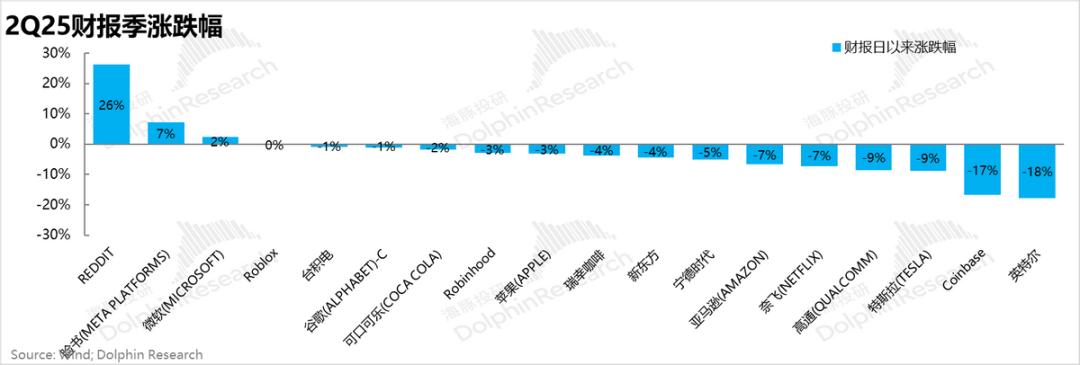
Group 1 - Major tech companies like Meta and Microsoft have shown solid performance, while Apple has also delivered stable results despite recent weaker performance [1] - Overall, most companies in this earnings season have seen their stock prices decline after reporting, except for those that significantly exceeded expectations [1] - The market appears to have priced in strong earnings already, leading to high valuations and increased sensitivity to negative news [3] Group 2 - Recent developments in three key areas: fiscal debt issuance, TGA (Treasury General Account) rebuilding, and interest rate expectations have been observed [4][6] - The U.S. Treasury plans to issue a net $1 trillion in debt in Q3, with an additional $590 billion in Q4, while maintaining a consistent issuance structure for medium to long-term bonds [4] - The Federal Reserve has maintained its interest rate levels, with no preset plans for a rate cut in September, emphasizing a data-driven approach to future decisions [10][12] Group 3 - Economic indicators suggest a state of "stagflation" characterized by rising prices, stagnant employment growth, and weakening domestic demand, despite a reported GDP growth of 3% [16][17] - The market seems to be ignoring the potential for sustained high interest rates in the second half of the year, focusing instead on narratives of fiscal and monetary easing [18] - The performance of individual companies, particularly in the advertising sector, indicates that the economic situation may not be as dire as suggested by macroeconomic data [18] Group 4 - The virtual investment portfolio "Alpha Dolphin" has not made any adjustments and has outperformed benchmark indices, with a 92.6% absolute return since inception [19][22] - The portfolio's performance is attributed to a defensive asset allocation, with significant holdings in gold, cash, and U.S. Treasuries [24] - Upcoming earnings reports from various companies, including AMD, Disney, and Uber, are expected to provide insights into the economic landscape and sector performance [25][26]
特朗普为何非要鲍威尔降息?
Sou Hu Cai Jing· 2025-08-04 16:13
Core Points - The Federal Reserve decided to maintain the federal funds rate target range at 4.25% to 4.50% during its recent meeting, marking a continuation of its current monetary policy stance [2][12] - President Trump has expressed strong dissatisfaction with Fed Chair Jerome Powell, criticizing him for not aligning with his political objectives and calling for interest rate cuts [4][5] - The independence of the Federal Reserve is highlighted, as Trump has attempted to exert pressure on Powell but has been advised against taking drastic actions that could undermine market confidence [4][9] Interest Rates - Interest rates are crucial in the financial and economic system, influencing asset valuations and investment decisions [9] - Trump argues that lowering interest rates could significantly reduce government debt interest payments, but this approach is likened to administering excessive medication that could destabilize the economy [9][12] - The Fed's decision to keep rates unchanged reflects a cautious approach to balancing employment and inflation, with recent economic indicators showing a slowdown in growth but stable employment levels [14][15] Federal Reserve's Independence - The legal framework allows the President to appoint the Fed Chair but does not grant the power to dismiss them, emphasizing the Fed's independence [4][12] - Trump's visit to the Fed headquarters and his public criticisms of Powell are seen as attempts to increase pressure on the Fed, which traditionally operates independently to maintain market confidence [7][12] - The Fed's dual mandate of promoting maximum employment and stable prices is often at odds, complicating its policy decisions [12][13] Decision-Making Dynamics - The recent FOMC meeting resulted in a 9-2 vote to maintain rates, indicating differing opinions among board members regarding the economic outlook and the need for rate cuts [14][15] - The dissenting votes reflect a division in the assessment of economic conditions, with some members advocating for immediate rate cuts to support employment [15] - The ongoing tension between presidential influence and the Fed's commitment to its long-term goals underscores the challenges faced by the central bank in navigating political pressures [13][15]

美国非农数据不及预期,金价回暖
Mei Ri Jing Ji Xin Wen· 2025-08-04 11:29
Market Overview - As of last Friday (August 1), London spot gold closed at $3362.64 per ounce, with a weekly increase of $26.42 per ounce, representing a 0.79% rise [1] - The highest gold price reached $3362.64 per ounce, while the lowest dipped to $3275.05 per ounce during the week [1] - The market is currently experiencing fluctuations in gold prices, with potential benefits if a rate cut is initiated [1] Economic Data - The U.S. non-farm payroll data for July was below expectations, with an increase of 73,000 jobs compared to the anticipated 104,000 [2] - Significant downward revisions were made to the May and June data, totaling a reduction of 258,000 jobs [2] - The labor force participation rate in July was 62.2%, lower than expected, while the unemployment rate was 4.2%, in line with expectations but higher than the previous value [2] Federal Reserve Actions - The Federal Reserve maintained the interest rate at 4.25%-4.5% during the July FOMC meeting, with a hawkish tone from Chairman Powell [4] - The Fed's statement acknowledged economic uncertainty and the need to monitor inflation risks, while not providing a clear response regarding a potential rate cut in September [4] Long-term Trends - The trend of "de-dollarization" globally is expected to support gold prices, as central banks continue to increase their gold reserves [7] - China's central bank reported an increase in gold reserves to 73.9 million ounces, marking the eighth consecutive month of gold accumulation [7] - The potential impact of the U.S. government's legalization of stablecoins may influence the demand for gold as a hedge against currency depreciation [6]
黄金周报|美国非农数据不及预期,金价回暖
Sou Hu Cai Jing· 2025-08-04 09:56
Group 1: Market Overview - As of last Friday (August 1), London spot gold closed at $3362.64 per ounce, with a weekly increase of $26.42 per ounce, representing a 0.79% rise [1] - The gold price fluctuated last week, reaching a high of $3362.64 per ounce and a low of $3275.05 per ounce [1] - The market is currently experiencing expectations of a rate cut in September due to disappointing non-farm payroll data, which has led to a decline in the dollar and U.S. stocks, subsequently boosting gold prices [1][5] Group 2: Economic Data - The U.S. non-farm payroll data for July showed an increase of 73,000 jobs, falling short of the expected 104,000, with significant downward revisions for May and June, totaling a reduction of 258,000 jobs [2] - The labor force participation rate in July was 62.2%, below expectations and previous values, while the unemployment rate was 4.2%, meeting expectations but higher than the previous figure [2] - The U.S. second-quarter GDP grew at an annualized rate of 3%, exceeding expectations of 2.6% and the previous value of 0.5% [3] Group 3: Federal Reserve Actions - The Federal Reserve maintained the benchmark interest rate at 4.25%-4.5% during the July FOMC meeting, with a hawkish tone from Chairman Powell emphasizing the need for more data before making decisions on rate cuts [4] - The Fed's statement acknowledged economic uncertainty and risks, particularly in the labor market, while maintaining a focus on price stability and maximum employment [4] Group 4: Long-term Trends - The trend of "de-dollarization" globally is expected to support gold prices, as central banks, including China's, continue to increase their gold reserves [7] - China's central bank reported a gold reserve of 73.9 million ounces as of the end of June, marking an increase of 70,000 ounces, continuing a trend of accumulation for eight consecutive months [7] - The potential impact of the U.S. government's legalization of stablecoins may influence the dollar's credibility and subsequently affect gold prices, depending on the development of credit risks associated with stablecoins [6][7]
特朗普和鲍威尔为何总是互掐?美联储为啥敢不听总统的话?
Sou Hu Cai Jing· 2025-08-04 09:44
一个是全世界最有权势的总统,一个是全球最具影响力的"央行行长"。为何特朗普与鲍威尔总是互掐? 美联储为何敢不听总统的话? 说起来,鲍威尔的美联储的主席是特朗普任命提名,咱们一起来分析分析。 美联储自诞生起就不是为总统服务。作为联邦制国家,美国人对太多的权力集中在少数人手里这件事, 骨子里很警惕。 美国制定国家根本大法《宪法》,也是来自各州的55名代表唇枪舌剑辩论127天才讨论出来的。所从自 1776年建国至今,一大半的时间都没有中央银行的概念,中央银行不存在。 没有中央银行,谁来印钱呢? 当时只要锚定黄金之类的硬通货,私人银行就可以发行货币。但这也带来了问题,美国人同样信不过小 银行,有一点风吹草动就把钱拿出来,一挤兑就很容易引发银行的危机。 美国人搞了无数次银行危机,折腾了很多次,大家筋疲力尽才考虑成立一个中央银行。中央银行的重要 任务是最后救济的一个大银行,当银行面临破产时,央行可提供救济。 这又把各个州的政府银行都聚在一起开会,讨论了三四年,直至1913年,美国已建国130多年才成立美 联储,全称叫"美国联邦储备系统"。 美联储性质复杂,更像是公私合营的组织,既有代表国家的联邦储备局,也有代表地方的联邦 ...