通胀数据

Search documents
宏观快评:6月通胀数据点评:从实际库存角度观察PPI
Huachuang Securities· 2025-07-10 05:43
Group 1: Inflation Data Overview - In June, the CPI increased by 0.1% year-on-year, while the core CPI rose by 0.7%, up from 0.6% in the previous month[2] - The PPI decreased by 3.6% year-on-year, worse than the expected decline of 3.2%[2] - The nominal GDP growth rate for Q2 is estimated at 4.4%, slightly down from 4.6% in Q1[3] Group 2: PPI Analysis - The PPI's decline is attributed to weak demand and delayed transmission of raw material prices to related industries[3] - The PPI's month-on-month decline was 0.4%, with domestic raw material prices contributing approximately 0.18 percentage points to this decline[5] - The increase in green electricity has led to a 0.9% month-on-month drop in electricity supply PPI[3] Group 3: CPI Insights - The CPI decreased by 0.1% month-on-month, with rental prices rising by 0.1%, lower than the 0.25% increase seen in the same period from 2015 to 2019[4] - Durable goods prices improved, with transportation prices down 0.4%, better than the average decline of 0.6% over the past three years[4] - Medical service prices have increased for three consecutive months by 0.3%, raising questions about the sustainability of this trend[4] Group 4: Inventory and PPI Relationship - Actual inventory growth has risen from 5.7% at the end of last year to 7.0% in May, indicating potential price pressures[6] - The mining and upstream manufacturing sectors have seen significant declines in actual inventory growth, impacting PPI positively when inventory levels drop[6] - In 39 comparable industries, 23 have higher inventory levels than last year, but only 8 exceed levels from the first half of 2015[7]
6月通胀数据点评:CPI边际改善,PPI持续低迷
Great Wall Securities· 2025-07-10 03:24
Group 1: CPI Analysis - In June 2025, the CPI showed a marginal improvement with a year-on-year increase of 0.1%, reversing four months of negative growth[2] - The month-on-month CPI decline narrowed from -0.2% in May to -0.1% in June, slightly above the average decline of -0.18% from 2020 to 2024[2] - Core CPI rose to 0.7%, marking a 0.1 percentage point increase from the previous month, the highest in nearly 14 months[2] Group 2: PPI Analysis - The PPI in June 2025 decreased by 3.6% year-on-year, with the decline widening by 0.3 percentage points compared to May, marking four consecutive months of increasing decline[2] - Month-on-month, the PPI remained at -0.4%, indicating persistent downward pressure on industrial prices[2] - Factors contributing to PPI decline include abundant supply in domestic raw material manufacturing, seasonal price decreases, and reduced demand for thermal coal due to increased green energy[2] Group 3: Economic Outlook - Despite a slight rebound in CPI, consumer demand remains weak, and PPI continues to face downward pressure due to supply-demand imbalances and intensified competition among enterprises[3] - The central government's recent emphasis on regulating low-price competition may help improve supply-demand structures and provide some support for future price stability[3] - Risks include potential underperformance of domestic macroeconomic policies, unexpected interest rate changes, and concentrated credit events that could impact CPI and PPI forecasts[4]
宝城期货股指期货早报-20250710
Bao Cheng Qi Huo· 2025-07-10 01:22
Report Summary 1. Report Industry Investment Rating No information provided. 2. Report's Core View - The short - term view of the stock index is oscillating strongly, and the medium - term view is rising. The continued upward trend of the stock index requires policy support, and the market risk preference is positive in the near term [1][4]. 3. Summary by Relevant Contents 3.1 Variety View Reference - Financial Futures Stock Index Sector - For IH2509, the short - term trend is oscillating, the medium - term trend is rising, the intraday trend is oscillating strongly, and the reference view is also oscillating strongly. The core logic is that the positive policy expectations provide strong support [1]. 3.2 Main Variety Price Market Driving Logic - Financial Futures Stock Index Sector - The varieties include IF, IH, IC, IM. The intraday view is oscillating strongly, the medium - term view is rising, and the reference view is oscillating strongly. The core logic is that the stock indexes oscillated and slightly corrected yesterday. The total stock market turnover was 1527.4 billion yuan, an increase of 52.8 billion yuan from the previous day, and more than 3300 stocks fell. The inflation data in June showed weak domestic demand. The rebound of the stock index since late June was driven by policy expectations. The domestic inflation is weak, and the endogenous growth momentum of domestic demand is insufficient, while external demand may be affected by tariffs. Policy support is needed, and the market is waiting for the policy implementation after the Politburo meeting in July. So the stock index will oscillate strongly in the short term [4].
宝城期货国债期货早报-20250710
Bao Cheng Qi Huo· 2025-07-10 01:15
1. Report Industry Investment Rating - No information provided about the industry investment rating 2. Core Viewpoints of the Report - The short - term view of TL2509 is to oscillate, the medium - term view is to oscillate, and the intraday view is to oscillate weakly. The overall view is to oscillate, as the monetary policy environment is biased towards looseness, but the possibility of short - term interest rate cuts is low [1] - For the main varieties of TL, T, TF, and TS, the intraday view is to oscillate weakly, the medium - term view is to oscillate, and the reference view is to oscillate. Although the long - term upward trend of Treasury bond futures exists due to the need for a loose monetary environment, the short - term upward and downward space is limited, and short - term Treasury bond futures will continue to oscillate and consolidate [5] 3. Summary by Related Catalogs 3.1 Variety Viewpoint Reference - Financial Futures Stock Index Sector - For TL2509, short - term: oscillate; medium - term: oscillate; intraday: oscillate weakly; overall view: oscillate. The core logic is that the monetary policy environment is loose, but short - term interest rate cuts are unlikely [1] 3.2 Main Variety Price Quotation Driving Logic - Financial Futures Stock Index Sector - Yesterday, most Treasury bond futures closed up, with the 30 - year main contract up 0.19%, the 10 - year main contract up 0.05%, the 5 - year main contract up 0.03%, and the 2 - year main contract flat [5] - In June, CPI rose 0.1% year - on - year, and PPI fell 3.6% year - on - year, showing weak overall performance, which is not conducive to the endogenous growth of domestic demand [5] - Considering the weak domestic inflation, insufficient endogenous growth momentum of domestic demand, and the impact of tariffs on external demand, a loose monetary environment is needed in the second half of the year. However, due to the capital diversion effect caused by the rising risk appetite of the stock market and the weak short - term interest rate cut expectation, the short - term upward and downward space of Treasury bond futures is limited [5]
6月通胀数据点评:PPI降幅扩大,“反内卷”势在必行
Changjiang Securities· 2025-07-09 23:30
Group 1: Inflation Data Overview - In June, the Consumer Price Index (CPI) increased by 0.1% year-on-year, marking a shift from a decline to an increase, which aligns with market expectations[2] - The core CPI rose by 0.7% year-on-year, the highest since May 2024, indicating a 0.1 percentage point increase from the previous month[2] - The Producer Price Index (PPI) saw a year-on-year decline of 3.6%, the largest drop since August 2023, reflecting weakened domestic demand and overcapacity in certain industries[6] Group 2: Price Movements and Influences - Industrial consumer goods prices rebounded, significantly contributing to the CPI increase, with fuel prices declining by 10.8% year-on-year, a reduction of 2.1 percentage points[6] - Gold and platinum jewelry prices surged by 39.2% and 15.9% respectively, contributing approximately 0.21 percentage points to the CPI increase[6] - The PPI's year-on-year decline was exacerbated by significant drops in coal, steel, and cement prices, with coal prices falling by 21.8%[6] Group 3: Future Outlook and Policy Recommendations - The outlook for pork prices suggests they will remain stable, while energy prices may face downward pressure due to geopolitical risks[2] - The Central Financial Committee's focus on addressing "involution" in competition may help stabilize prices in various sectors, emphasizing the importance of demand-side policies alongside supply-side optimization[2] - To promote a recovery in consumer prices, both supply and demand sides must work together, with a focus on enhancing employment and social security to boost household income[6]
6月通胀数据点评:核心CPI同比持续回升
Tai Ping Yang Zheng Quan· 2025-07-09 23:30
Group 1: CPI Analysis - China's June CPI increased by 0.1% year-on-year, reversing a four-month decline, exceeding market expectations[4] - The month-on-month CPI decreased by 0.1%, but the decline was narrower than the previous month by 0.1 percentage points[6] - Industrial consumer goods prices stabilized and contributed to the CPI increase, with a reduction in the downward impact on CPI by approximately 0.18 percentage points[6] Group 2: PPI Analysis - China's June PPI decreased by 3.6% year-on-year, with the decline widening by 0.3 percentage points compared to the previous month[4] - The PPI's further decline reflects accumulated supply-side pressures and weak demand[23] - Upstream industrial prices faced significant pressure, with mining industry prices dropping by 13.2% year-on-year[27] Group 3: Price Trends - Core CPI, excluding food and energy, rose by 0.7%, marking a 14-month high, supported by resilient service prices[20] - Energy prices increased by 0.1% month-on-month, reversing the previous downward trend, influenced by geopolitical factors[16] - Food prices decreased by 0.4% month-on-month, but the decline was smaller than seasonal expectations by 0.5 percentage points[14]
6月物价数据点评:CPI与PPI背离趋势为何加剧?
Huaan Securities· 2025-07-09 14:16
Group 1: Report Overview - The report is a fixed - income review report titled "Why is the Divergence Trend between CPI and PPI Intensifying? - Review of June Price Data" dated July 9, 2025 [1][2] - The chief analyst is Yan Ziqi, and the analyst is Hong Ziyan [2] Group 2: Data Observation CPI Data - In June, CPI was up 0.1% year - on - year, rising 0.2 pct from the previous month and moving from negative to positive. The month - on - month CPI decreased by 0.1%, with the decline narrowing by 0.1 pct from the previous month and the value being at a relatively high level in the same period over the years [2] - Core CPI continued to rise, indicating a possible demand recovery, but it was uneven. The year - on - year increase in CPI was stronger than that of core CPI mainly due to the reduced drag from the energy item. After removing the impact of food and energy, core inflation continued to rise year - on - year, reflecting a demand recovery. However, the recovery of consumer demand was mainly supported by sub - items such as transportation, communication, rent, water and electricity, and household appliances, while CPI in areas such as clothing, education, tourism, and household services decreased month - on - month [3] - Service CPI continued to grow, and consumer goods CPI continued to recover. The demand structure continued to shift from food to consumption and services. The decline in consumer CPI narrowed, and service CPI had been growing for 5 months, with the year - on - year value remaining at 0.5% as in the previous month. Food prices remained stable, and the increase in vegetable prices led to a narrowing of the decline in food CPI [3] PPI Data - The month - on - month PPI of consumer goods weakened. The reason was that during the subsidy gap period, the path for demand to spread from policy - driven areas to other consumer goods areas slowed down compared with the previous month. Durable consumer goods declined month - on - month in June [4] - External demand suppressed the prices of the processing industry, while the input factor of international crude oil drove the price recovery of upstream industries, and PPI entered a weak equilibrium state. In June, the decline in external demand orders in the PMI indicated a weakening of external demand, leading to a month - on - month decline in the PPI of the processing industry. High temperatures restricted infrastructure construction, resulting in demand lagging behind material supply. The decline in coal prices due to new energy substitution and over - capacity continued to reduce PPI prices, but the increase in international crude oil prices repaired the drag on domestic related industries, and deflation in upstream industries such as mining and raw material industries eased [4] Group 3: In - depth Perspective From the Perspective of Resident Income - Since March, the year - on - year decline in rent has narrowed to - 0.1% and remained unchanged for 4 consecutive months. The stable and flat trend of rent may indicate that the income improvement trend has stalled, and income recovery is the core driving force for the recovery of total demand and the return of price levels to positive [6] From the Perspective of Corporate Activity - In June, the year - on - year price of pork dropped to - 8.5%, and the month - on - month price dropped to - 1.2%. The decline in pork prices was mainly due to oversupply and also reflected a contraction in pork demand in June, suggesting a possible structural decline in factory labor demand. The continuous squeeze on corporate profits in previous months still had a lagging impact on the economy, and the significant decline in the PMI of small enterprises and employment in the manufacturing and service industries in June confirmed the contraction in pork demand. The month - on - month decline in liquor prices was 0.3%, the same as the average in the past 5 years, implying that the business activity of small enterprises remained weak [6] From the Perspective of Corporate Price Transmission - The increase in household appliance prices in June may be an illusion during the policy window period. The month - on - month increase in household appliance CPI was likely due to manufacturers adjusting prices during the subsidy gap period. The price model of leading brands was to "raise the marked price and offset with subsidies" to achieve a nominal price increase. In June, the subsidy amount in many places was exhausted, leading to a decrease in the subsidy part and an increase in the final product price. The price increase during the subsidy gap period may be a game behavior to transfer inventory pressure [7] High - frequency Data - International oil prices showed a downward trend, and PPI would face downward pressure in the next stage. The marginal price of Nanhua industrial products began to rise, but the price of rebar continued to decline. Although the third batch of 300 billion dual - purpose funds had been issued, high - temperature weather restricted demand release and limited physical construction. Glass prices continued to decline, indicating no improvement in the real estate market [7] Group 4: Future Outlook CPI Outlook - Currently, CPI has achieved an upward breakthrough with a marginal reduction in external interference items, but the demand recovery is uneven, and the recovery trend needs to be consolidated. High - frequency data shows that international oil prices have started to decline, and with the easing of local geopolitical conflicts, it is highly likely that the oil price center will shift downward in July, which may drive next month's CPI down. In July, the next batch of fiscal funds will start to be in place, and the household appliance sub - item of CPI may decline. Due to the slowdown in the transmission to other industries caused by the subsidy gap and the crowding - out of consumption in other areas this month, the price recovery in other areas next month still needs to be observed. From the perspective of corporate activities, the continuous profit compression pattern has led to a decline in the prosperity of small enterprises and employment, and the consumption demand contributed by the income side is still not optimistic [7] PPI Outlook - The supply - side dilemma of PPI has not changed. The "rush - to - export" effect of external demand is fading, and although the pull from domestic demand has slowed down, it may rebound in July, maintaining the current weak equilibrium. On the supply side, the over - capacity pattern is difficult to change in the short term, and the decline in international oil prices in July may lead to a decline in PPI prices. In terms of external demand, there are still challenges, and exports are likely to decline in the second half of the year, with trade cooling down, which is difficult to significantly drive up total demand. In terms of domestic demand, after the next batch of subsidy funds is in place in July, on the one hand, it will directly improve corporate profits, and on the other hand, the uneven pattern of CPI demand recovery may improve, and the chain of CPI pulling PPI will restart, and the PPI of consumer goods may continue to rise. However, overall, the upward repair amplitude may be relatively limited [8]
通胀数据快评CPI同比转正
Guoxin Securities· 2025-07-09 13:29
Inflation Data Summary - In June, China's CPI turned positive at +0.1% year-on-year, a recovery from -0.1% in May, marking the first positive reading since January 2025[3] - The month-on-month CPI decreased by -0.1%, an improvement from the previous month's decline of -0.2%[3] - Core CPI rose to +0.7% year-on-year in June, up from +0.6% in May, while month-on-month core CPI remained unchanged at 0%[3] PPI Analysis - June's PPI decreased by -3.6% year-on-year, a decline of 0.3 percentage points from the previous month, marking the lowest level since August 2023 and the 33rd consecutive month of negative growth[9] - Month-on-month PPI fell by -0.4%, continuing a trend of negative growth for seven consecutive months, which is weaker than the historical average of -0.1%[9] Key Drivers and Trends - The positive CPI was primarily driven by clothing, household goods, and services, with household goods benefiting from consumption incentives[4] - Food prices decreased by -0.4% month-on-month, with pork prices significantly dropping from +3.1% to -8.5% year-on-year[4] - The international oil price recovery, influenced by geopolitical tensions, supported domestic gasoline prices, which shifted from -3.7% to +0.3% month-on-month[4] Future Outlook - The current inflation rate is still far from the annual target of 2%, indicating a need for further policy support to stabilize domestic demand[12] - The core CPI is expected to remain a key support for prices under existing policies, while industrial product prices may require additional measures to improve[12]
通胀数据表现偏弱
Bao Cheng Qi Huo· 2025-07-09 13:08
Report Summary 1. Report Industry Investment Rating No information about the report industry investment rating is provided in the given content. 2. Core View of the Report - Today, most treasury bond futures closed higher, with the 30 - year main contract up 0.19%, the 10 - year main contract up 0.05%, the 5 - year main contract up 0.03%, and the 2 - year main contract flat. The inflation data in June showed that CPI rose 0.1% year - on - year and PPI fell 3.6% year - on - year, which is weak and not conducive to the endogenous growth of domestic demand. Considering the current macroeconomic indicators and monetary policy, domestic inflation is weak, the endogenous growth momentum of domestic demand is insufficient, and external demand is vulnerable to tariff factors. A moderately loose monetary environment is still needed in the second half of the year to support demand and stabilize expectations, so the medium - to - long - term upward trend of treasury bond futures remains. However, due to the recent increase in risk appetite in the stock market leading to capital diversion and the weak expectation of interest rate cuts in the short term, the upward and downward space of treasury bond futures is limited in the short term. Overall, treasury bond futures will continue to fluctuate and consolidate in the short term [2]. 3. Summary According to Relevant Catalogs Industry News and Related Charts - On July 9, the People's Bank of China conducted 75.5 billion yuan of reverse repurchase operations at a fixed interest rate of 1.4%. There were 98.5 billion yuan of reverse repurchase maturities in the open market today, resulting in a net withdrawal of 23 billion yuan. - In June 2025, the year - on - year increase in the consumer price index was 0.1%, and the year - on - year decrease in the producer price index for industrial products was 3.6% [4].
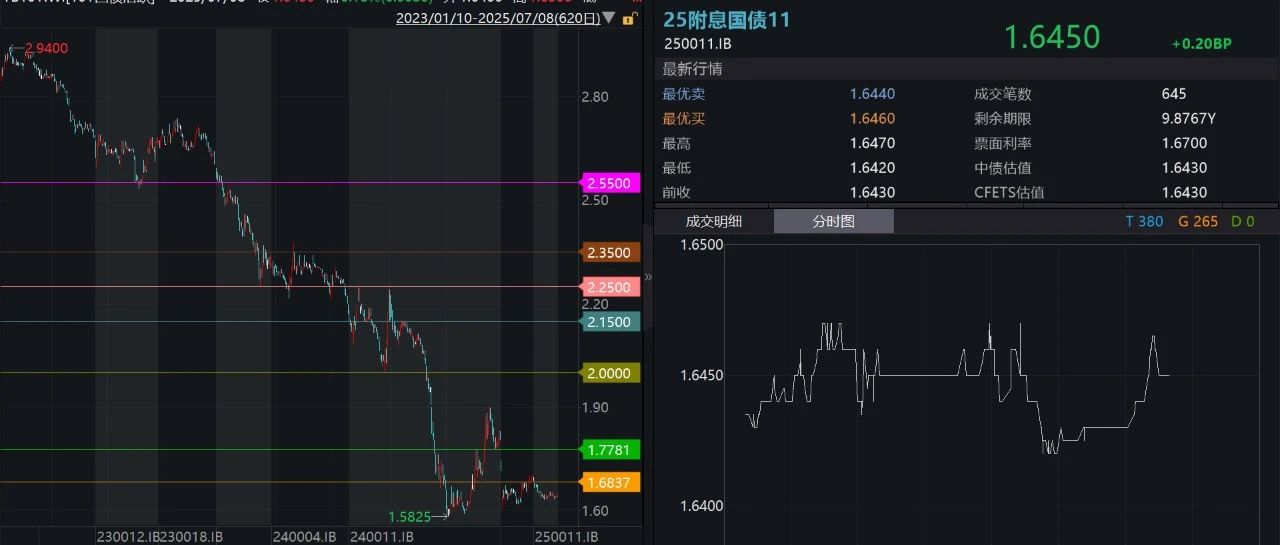
【笔记20250709— “某省压降债券规模”只值0.2bp】
债券笔记· 2025-07-09 12:31
Core Viewpoint - The article discusses the current state of the financial market, focusing on the balance of funds, interest rates, and the impact of recent economic data on market sentiment. Group 1: Market Conditions - The central bank conducted a 7-day reverse repurchase operation of 755 billion, with 985 billion maturing today, resulting in a net withdrawal of 230 billion [2] - The funding environment remains balanced and loose, with stable funding rates; DR001 is around 1.32% and DR007 is around 1.48% [2] - June inflation data was weak, leading to fluctuations in the stock market, which peaked and then retreated [3][4] Group 2: Interest Rates and Bond Market - The weighted average rates for various repos are as follows: RO01 at 1.38%, R007 at 1.50%, and R014 at 1.54%, with total transaction volume at approximately 82,256.73 billion [3] - The 10-year government bond yield opened at 1.6435% and fluctuated slightly, reflecting market reactions to economic data and external factors [4] - There were reports of a province reducing the investment scale in agricultural commercial banks' bonds, which contributed to a slight increase in interest rates [4][5] Group 3: Market Sentiment and Reactions - Market sentiment was stable in the bond market despite external pressures, with minor fluctuations in response to economic indicators [4] - The article mentions a "shame" felt by agricultural commercial banks regarding their lending capabilities and investment strategies, indicating a broader sentiment of distress within the sector [6][7]