以旧换新

Search documents
贸易外经统计司司长:提振消费政策持续显效,消费市场稳定增长
Guo Jia Tong Ji Ju· 2025-10-20 02:44
Core Insights - The consumption market is experiencing stable growth, driven by various policies and new consumption models, leading to enhanced market vitality and released consumption potential [1][6] Group 1: Consumption Market Overview - The total retail sales of consumer goods reached 365,877 billion yuan in the first three quarters, with a year-on-year growth of 4.5%, accelerating by 1.2 percentage points compared to the same period last year [2] - Service consumption is growing rapidly, with service retail sales increasing by 5.2% year-on-year, outpacing goods retail sales by 0.6 percentage points [2] - The film box office revenue increased by 20.7% year-on-year, indicating strong demand in the entertainment sector [2] Group 2: Urban and Rural Market Dynamics - Urban retail sales grew by 4.4% year-on-year, while rural retail sales increased by 4.6%, showing a balanced growth between urban and rural markets [3] - The county and township market is expanding, with the share of county and township retail sales in total retail sales reaching 38.8%, an increase of 0.1 percentage points from the previous months [3] Group 3: Product Categories Performance - Overall retail sales of goods increased by 4.6% year-on-year, with significant growth in basic living goods and upgraded products [4] - The retail sales of furniture increased by 21.3%, while home appliances and audio-visual equipment grew by 25.3% and 19.9%, respectively, indicating strong performance in the "trade-in" policy [4] Group 4: New Consumption Trends - Online retail sales grew by 9.8% year-on-year, with physical goods online retail sales increasing by 6.5%, reflecting a sustained upward trend [5] - New retail formats, such as warehouse membership stores and discount stores, are thriving, with double-digit growth in sales [5] Group 5: Future Outlook - The consumption market is expected to continue expanding and improving, with a focus on enhancing consumer willingness and stimulating consumption potential [6] - Future actions will include implementing consumption-boosting initiatives and promoting high-quality development in the consumption market [6]
家用电器:9月扫地机和洗地机景气延续,白电高基数承压
Huafu Securities· 2025-10-19 06:50
Investment Rating - The report maintains an "Outperform" rating for the industry [8] Core Views - The cleaning appliance sector, particularly floor cleaning robots and washing machines, continues to show strong growth in September, while the white goods sector faces pressure due to high base effects from last year [3][15] - The overall sales of major white goods categories experienced a decline in September, primarily due to the high base from last year's government subsidies [3][15] - The washing machine segment saw a year-on-year growth rate of 49.4% in September, with volume and price growth rates of +39% and +7% respectively. The floor cleaning robot segment achieved a year-on-year growth rate of 26.2%, with volume and price growth rates of +21% and +4.55% respectively [3][15] Summary by Sections Market Data - The home appliance sector experienced a decline of 2.1% this week, with white goods, black goods, small appliances, and kitchen appliances showing declines of -0.6%, -5.6%, -2.4%, and -2.0% respectively [4][31] - Raw material prices for copper and aluminum decreased by 1.46% and 1.04% respectively compared to the previous week [4][31] Investment Recommendations - The report suggests focusing on the following areas due to expected recovery in domestic demand supported by policy: 1. Major appliances benefiting from trade-in programs, recommending companies like Midea Group, Haier Smart Home, Gree Electric, Hisense Home Appliances, TCL Electronics, and Hisense Visual [5] 2. Pet-related companies as a resilient sector, recommending companies like Guibao Pet, Zhongchong Co., and Petty Holdings [5] 3. Small appliances and branded apparel expected to recover from weak consumer demand, recommending leading companies like Bear Electric, Feike Electric, Supor, and Newell [5] 4. Electric two-wheelers benefiting from new standards and trade-in programs, recommending companies like Ninebot, Yadea Holdings, and Aima Technology [5] Industry Trends - The report highlights that the global restructuring of manufacturing continues to favor Chinese manufacturing advantages, particularly in major appliances, vacuum cleaners, and tools, recommending companies like Midea Group, Haier Smart Home, and Hisense Home Appliances [6] - The report notes that the cleaning appliance sector remains strong globally, with leading brands benefiting from increased penetration rates, recommending companies like Roborock and Ecovacs [5][6] Sales Performance - In September, the sales performance of major brands in the floor cleaning robot segment showed significant growth, with Ecovacs and Roborock leading with year-on-year growth rates of +94% and +27% respectively [16][20] - The washing machine segment also showed strong performance, with brands like Tineco and Roborock achieving year-on-year growth rates of +38% and +115.8% respectively [20][21] Air Conditioning Market - The air conditioning market faced pressure in September, with domestic and foreign sales declining by 2.5% and 18.1% year-on-year respectively [22][26] - Major brands like Gree, Haier, and AUX showed positive growth in domestic sales, while foreign sales for brands like Midea and Gree experienced declines [26][28]
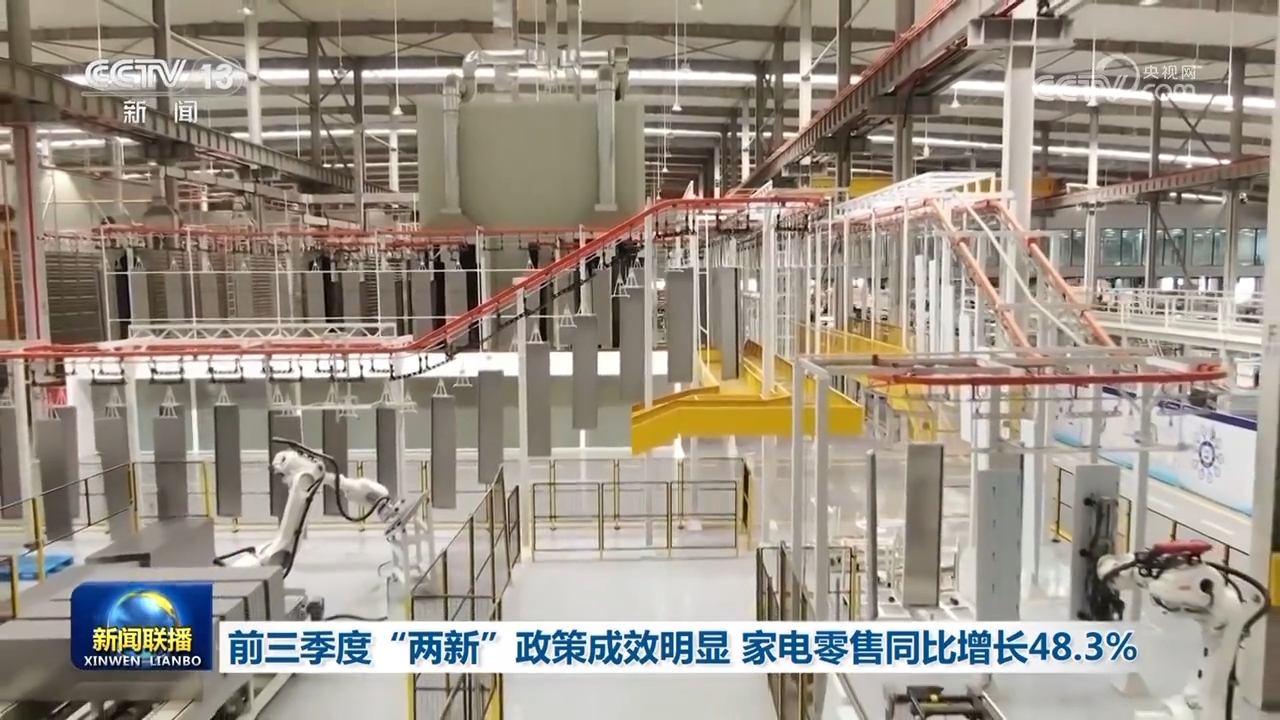
前三季度“两新”政策成效明显 家电零售同比增长48.3%
Yang Shi Wang· 2025-10-18 12:05
Group 1 - The core viewpoint is that the implementation of the consumption upgrade policy and significant equipment updates have accelerated the procurement of machinery and equipment across various industries in China, with notable growth in high-tech manufacturing and digital transformation sectors [1][3][5] Group 2 - Industrial enterprises have increased their machinery and equipment procurement by 9.4% year-on-year, with high-tech manufacturing showing a robust growth of 14% [1] - The information and technology sectors have seen substantial increases in equipment investment, with procurement amounts rising by 26.8% in information transmission and software services, and 32.5% in scientific research and technical services [3] - The procurement of digital equipment has grown by 18.6%, indicating a strong trend towards digital transformation among enterprises [3] Group 3 - The consumption upgrade policy has had a significant impact, with retail sales in the daily household appliances sector increasing by 48.3% and furniture retail sales by 33.2% year-on-year [5] - Newly included categories such as mobile phones have also experienced a retail sales increase of 19.9% [5] Group 4 - The sales of new energy vehicles have surged, with a year-on-year increase of 30.1% in the first three quarters, reflecting the effectiveness of the automobile consumption upgrade policy [7]

“省出10倍差价!”杭州女子晒图火了,还有这种操作?
Sou Hu Cai Jing· 2025-10-17 02:19
Core Insights - The price of spot gold has reached a new high of $4250 per ounce, reflecting a 1.04% increase in a single day, while domestic jewelry gold prices have surpassed 1200 yuan per gram [1] - The trend of "home goldsmithing" is gaining popularity among young people as they seek to create new gold jewelry from older pieces purchased at lower prices [1][4] Group 1: Market Trends - The rising gold prices have led to increased costs for consumers, with small gold earrings costing several thousand yuan [1] - Many consumers are opting for "home goldsmithing" as a cost-saving measure, with tools available online for as little as 50 to 60 yuan [4][7] - The sales of goldsmithing tools on e-commerce platforms have exceeded 10,000 sets, indicating a strong interest in this DIY trend [4] Group 2: Consumer Behavior - Consumers like Xiao Zhao have successfully created over 30 pieces of jewelry, saving significant amounts on processing fees compared to traditional goldsmithing shops [7] - Social media platforms show a vibrant community discussing "home goldsmithing," with thousands of posts and active engagement [7] Group 3: Challenges and Costs - Newcomers to "home goldsmithing" face challenges such as material loss due to mishaps like "gold explosions," which can negate the cost savings [8][11] - The process involves additional steps like trimming and polishing, which can lead to further material waste if not managed properly [10][11] Group 4: Professional Insights - Professional goldsmiths are experiencing increased business due to high gold prices, with many customers opting for custom designs that exceed the limitations of DIY methods [12] - Despite the rise in DIY goldsmithing, traditional gold shops continue to see stable demand, particularly during peak wedding seasons [13]

四川“十四五”时期扩大内需主要成就公布 消费投资两手抓 “双引擎”驱动稳增长
Si Chuan Ri Bao· 2025-10-17 00:26
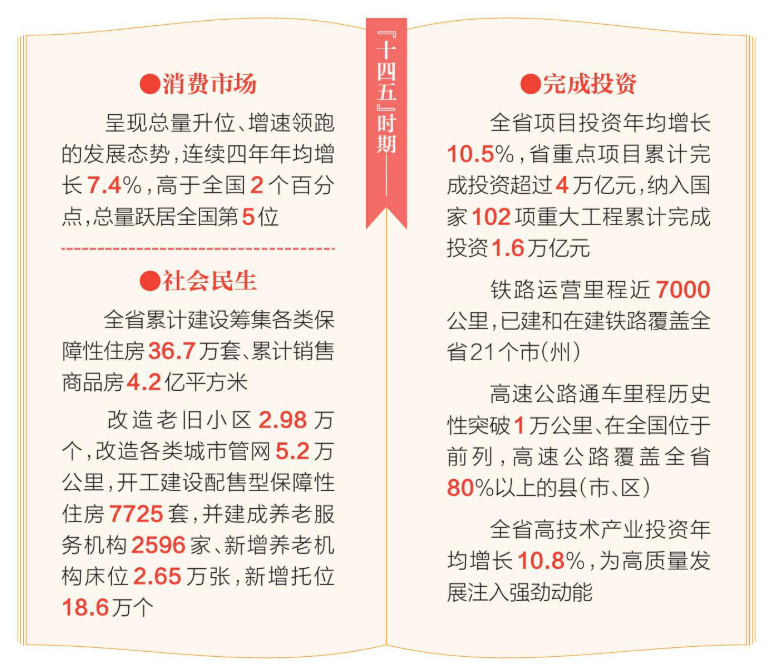
Core Insights - The article discusses the achievements of Sichuan province in expanding domestic demand during the "14th Five-Year Plan" period, emphasizing the dual engines of consumption and investment for economic growth [3][4]. Consumption - Sichuan's consumption market has experienced an average annual growth of 7.4% over the past four years, surpassing the national average by 2 percentage points, and ranking fifth in total consumption nationwide [4]. - The "trade-in" policy has significantly boosted large-scale consumption, with 13.19 million units of automobiles, home appliances, and other items being replaced this year, generating over 132.7 billion yuan in consumption [4]. - The province has seen a substantial increase in the ownership of new energy vehicles, rising from 170,000 at the end of 2020 to over 1.8 million currently, with their share in new car sales increasing from 4% to over 40% [4]. - Sichuan is a leading region for live performances, hosting 110 large-scale events this year, attracting over 2.1 million attendees and generating ticket revenue of 1.46 billion yuan, which in turn stimulated approximately 10 billion yuan in related consumption [5]. Investment - Sichuan has completed over 4 trillion yuan in investment for key projects during the "14th Five-Year Plan," with an average annual growth rate of 10.5% in project investment [6][8]. - Major infrastructure projects, including railways and highways, have been accelerated, with nearly 7,000 kilometers of railway and over 10,000 kilometers of highways constructed, enhancing connectivity across the province [7]. - High-tech industry investments have also seen an average annual growth of 10.8%, contributing to the province's high-quality development [8]. - Social welfare projects have been implemented, including the renovation of 29,800 old communities and the construction of 2,596 elderly care institutions, ensuring equitable distribution of development benefits [8].
数览三季度税收“成绩单” “税动力”助力高质量发展提质增效
Yang Shi Wang· 2025-10-16 08:06
Core Insights - The latest data from the National Taxation Administration indicates a significant acceleration in equipment updates among enterprises in the first three quarters of the year, driven by large-scale equipment upgrades and the expansion of the old-for-new consumption policy [1] Group 1: Equipment Procurement Trends - In the first three quarters, the amount spent by industrial enterprises on machinery and equipment increased by 9.4% year-on-year, with high-tech manufacturing seeing a 14% increase and the electricity, heat, gas, and water production and supply sector experiencing a 10.5% increase [1] - The information and technology sectors showed substantial investment in equipment updates, with the information transmission, software, and IT services industry increasing procurement by 26.8%, and scientific research and technical services by 32.5% [3] Group 2: Digital Equipment Investment - There was a notable increase in the procurement of digital equipment, with a year-on-year growth of 18.6% in the first three quarters, indicating that digital transformation is becoming a key development direction for enterprises [5] - High-end manufacturing sectors are accelerating their digital investments, with shipbuilding and computer industries seeing increases of 17.3% and 22.7% respectively in digital equipment procurement [5] Group 3: Private Sector Contributions - The role of private enterprises in equipment updates has become more prominent, with a 13% year-on-year increase in machinery and equipment procurement, surpassing state-owned and foreign enterprises [7] - Innovative sectors within the private economy are maintaining strong momentum, with procurement in the internet and intelligent unmanned aerial vehicle sectors increasing by 32.8% and 70.5% respectively [7] Group 4: Consumer Goods and New Energy Vehicles - The old-for-new consumption policy has shown significant results, with retail sales of home appliances and furniture rising sharply, including a 48.3% increase in daily household appliances and a 26.8% increase in audiovisual equipment [9] - Sales of new energy vehicles have also continued to grow, with a 30.1% year-on-year increase in the first three quarters, reflecting the ongoing vitality of China's new energy vehicle industry [11]
税收数据显示:前三季度全国企业设备更新加快推进 以旧换新持续释放消费潜力
Zhong Guo Jin Rong Xin Xi Wang· 2025-10-16 03:00
Core Insights - The implementation of large-scale equipment renewal and consumption upgrade policies since March 2024 has significantly boosted equipment investment and consumption growth in China [1][3]. Group 1: Industrial Equipment Investment - Industrial enterprises have shown a positive trend in equipment renewal, with machinery equipment purchases increasing by 9.4% year-on-year in the first three quarters of this year [1]. - High-tech manufacturing maintained strong growth, with machinery equipment purchases rising by 14% [1]. - The electricity, heat, gas, and water production and supply sectors saw a 10.5% increase in machinery equipment purchases, with thermal production and supply specifically growing by 16.4% [1]. Group 2: Information and Technology Sector - The information and technology sectors have increased their investment in equipment, with machinery equipment purchases in information transmission, software, and IT services rising by 26.8%, and scientific research and technical services by 32.5% [2]. Group 3: Digital Equipment Investment - National enterprises have shown strong motivation for digital equipment updates, with purchases increasing by 18.6% year-on-year in the first three quarters [2]. - High-end manufacturing sectors, such as shipbuilding and computing, have accelerated their digital investments, with increases of 17.3% and 22.7% respectively [2]. Group 4: Private Enterprises - Private enterprises have played a significant role in equipment renewal, with machinery equipment purchases increasing by 13% year-on-year, surpassing state-owned and foreign enterprises [2]. - Innovative sectors within the private economy, such as the internet and smart drone industries, have seen substantial growth, with equipment purchases rising by 32.8% and 70.5% respectively [2]. Group 5: Consumer Goods and Home Appliances - Sales of home appliances and furniture have surged, with retail sales of daily-use appliances like refrigerators increasing by 48.3% and home audio-visual equipment by 26.8% [2]. - The furniture and lighting retail sectors also experienced significant growth, with sales increasing by 33.2% and 17.2% respectively, particularly in smart home products like robotic vacuum cleaners, which saw a 75% increase in sales [2]. - The retail sales of mobile communication devices, following the expansion of the market, grew by 19.9% [2]. Group 6: New Energy Vehicles - Sales of new energy vehicles have continued to grow, with a year-on-year increase of 30.1% in the first three quarters, reflecting the vitality of China's new energy vehicle industry [3]. - The "old-for-new" vehicle policy has effectively stimulated automotive consumption potential [3].
京东集团-SW(09618.HK)2025Q3前瞻:电商业务表现亮眼 外卖新业务UE持续改善
Ge Long Hui· 2025-10-15 20:58
Core Viewpoint - JD Group is expected to report a strong Q3 2025 revenue growth of 13% year-on-year, driven by government subsidies boosting retail income, despite a decline in Non-GAAP net profit margin by 4 percentage points [1][2][3] Revenue Performance - Q3 revenue is projected to reach 293.9 billion yuan, reflecting a 13% year-on-year increase, primarily due to government subsidies enhancing JD's retail revenue growth [1][2] - JD's retail revenue growth is anticipated at 11%, with high single-digit growth in electronic categories and double-digit growth in daily necessities, although there is a slight sequential decline due to a high base effect from the previous year [1][2] - The growth rates for JD's retail, logistics, and new businesses in Q3 are expected to be 11%, 20%, and 230% respectively [1][2] Operational Insights - JD's GMV growth is estimated at around 15%, with market share continuing to recover, mainly driven by the replacement of old electronics [3] - Active purchasing users and purchase frequency in e-commerce are showing strong growth, benefiting from government subsidies and the new food delivery business [3] - Among the new food delivery users acquired in March-April, 40% have converted to main site users by July [3] Profitability Analysis - The Non-GAAP net profit margin for Q3 2025 is expected to be 1.4%, down 3.6 percentage points year-on-year [3] - JD's retail operating profit margin is projected to increase by 0.3 percentage points, attributed to improved supply chain efficiency and faster growth in commission and advertising revenue [3] - The new food delivery business continues to incur losses, but there is an improvement in user experience due to more precise subsidies and enhanced delivery efficiency [3] Investment Outlook - The company maintains an "outperform" rating, with revenue forecasts for 2025-2027 adjusted to 1.3348 trillion, 1.4197 trillion, and 1.4882 trillion yuan, with no change in growth rates [2][3] - Adjusted net profit forecasts for 2025-2027 are set at 29.8 billion, 40.8 billion, and 56.7 billion yuan, reflecting slight upward adjustments [2][3]

以旧换新加之反内卷,物价势头改善
Chengtong Securities· 2025-10-15 07:30
Group 1: CPI Analysis - In September, the CPI decreased by 0.3% year-on-year, a slight improvement from the previous month's decline of 0.4%[1] - Food prices fell by 4.4% year-on-year, contributing approximately 1 percentage point to the CPI decline[1] - Core CPI rose by 1% year-on-year, marking the fifth consecutive month of acceleration[1] Group 2: PPI Insights - The PPI decreased by 2.3% year-on-year in September, but the decline narrowed by 0.6 percentage points compared to the previous month[2] - The PPI showed no change month-on-month, indicating a halt in the downward trend for two consecutive months[2] - Prices in coal processing rose by 3.8% month-on-month, while black metal smelting and rolling industries saw a 0.2% increase[2] Group 3: Economic Outlook - Positive signals in price trends are attributed to central government measures since "9·24" aimed at stabilizing growth and boosting confidence[3] - Despite positive signals, there remains significant downward pressure on prices, particularly as investment and consumption data show signs of decline in the second half of the year[3] - The need for enhanced counter-cyclical adjustments and effective policy resource utilization is emphasized to maintain growth momentum[3]
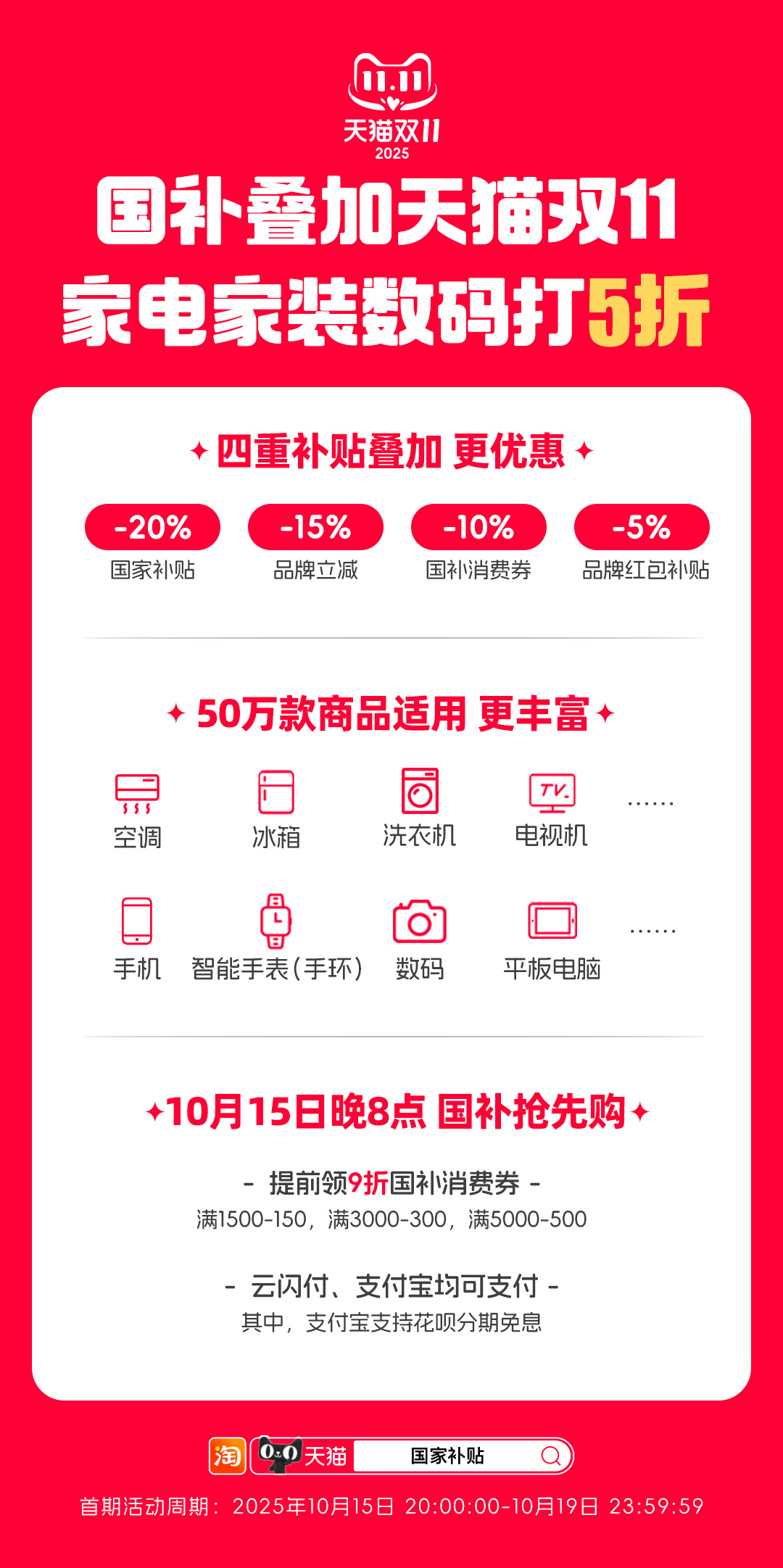
第四波国补资金来了 叠加天猫双11家电家装3C数码打5折 今晚8点开卖
Guan Cha Zhe Wang· 2025-10-15 04:05
2025年第四波国补资金重磅落地,今晚8点,天猫双11国补5折开卖! 记者获悉,今年天猫双11,超3700个品类,9000个品牌商家,50万款品牌商品参与国补,覆盖家电、家装、家居、3C数码等全品类,支持双11优惠与国补 叠加,补贴商品数量较618翻倍,是全年优惠力度最大、规模最大的一次国补换新消费! 据悉,多款苹果产品参与国补,最新款苹果iPhone17,直接补贴500元!华为Pura80Ultra多重补贴后直降2400元!海尔一级能效燃气热水器K70A,原价6999 元,双11叠国补仅2959.2元,打42折!小米巨省电1.5匹空调,原价2899元,双11叠国补到手价1379元,打48折! | | 商品名 | 日常参考价 国补叠加 | | | --- | --- | --- | --- | | NEW | 四天 iPhone17 | 5999 | 5499 | | | (256G) | | | | | 华为 Pura 80 Ultra | 9999 | 7599 | | NEW | ூ门子 极浄魔盒3.0 | 9999 | 4552 | | | 洗碗机 | | | | NEW | 海尔 云溪4.0pro ...