反内卷

Search documents
12月工业企业利润数据点评:新旧分化显著,工业企业利润年增速结束连续三年负增长转正
Zhong Cheng Xin Guo Ji· 2026-02-02 13:04
Group 1: Industrial Profit Trends - In 2025, industrial enterprises' revenue grew by 1.1% year-on-year, a decline of 1 percentage point compared to 2024[2] - Industrial profits turned positive with a year-on-year increase of 0.6%, ending three consecutive years of negative growth[3] - December 2025 saw a monthly profit increase of 5.3%, a rebound of 18.4 percentage points from November[3] Group 2: Cost and Revenue Dynamics - The cost per 100 yuan of revenue for industrial enterprises was 85.31 yuan, an increase of 0.15 yuan year-on-year[6] - The profit margin for industrial enterprises was 5.31%, a slight increase of 0.02 percentage points from the previous month but a decrease of 0.08 percentage points year-on-year[3] - Accounts receivable grew by 4.7% year-on-year, marking the lowest growth rate since 2020[6] Group 3: Sector Performance Disparities - State-owned enterprises experienced a profit decline of 3.9%, while private enterprises' profits remained flat at 0%[7] - Foreign and Hong Kong-Macau-Taiwan invested enterprises saw a profit increase of 4.2%, contributing significantly to overall industrial profit growth[7] - High-tech manufacturing profits grew by 13.3% year-on-year, significantly outpacing overall industrial growth[13] Group 4: Future Outlook - Industrial profits are expected to continue recovering in 2026, supported by stable export demand and ongoing policy measures[18] - Challenges remain, including weak domestic demand and structural imbalances in supply and demand[18] - Continued focus on expanding domestic consumption and addressing external risks is necessary for sustained recovery[18]
政策半月观:力争“开门红”,还有哪些政策可期?
GOLDEN SUN SECURITIES· 2026-02-02 11:46
Policy Focus - The recent policies emphasize expanding domestic demand, with a focus on six key areas including support for service consumption and cultural tourism[1] - The Chinese government aims to enhance the elderly care service sector through various measures, including tax incentives and subsidies for service consumption[1][6] Economic Targets - The weighted average GDP target for 22 regions is set at 5%, down from 5.3% in the previous year, reflecting a 0.3 percentage point decrease[8] - Among the major provinces, the highest GDP target is set at over 7% for Tibet, while the lowest is 4.5% for Tianjin[8] Investment and Financing - A new 500 billion yuan special guarantee plan for private investment has been established to guide banks in providing an additional 500 billion yuan in loans to small and micro enterprises[7] - The China Securities Regulatory Commission has modified regulations to expand the types of strategic investors, requiring a minimum shareholding of 5%[5][24] Cultural and Tourism Initiatives - The Ministry of Culture and Tourism has launched a nationwide cultural and tourism consumption month, planning approximately 30,000 events and distributing over 360 million yuan in consumption vouchers[5][25] Industry Development - The government is focusing on the development of zero-carbon factories, aiming to cultivate a number of such facilities in key industries by 2027[9][35] - Policies are being implemented to optimize public housing fund management and stimulate housing demand through various local initiatives[9][34]
玻璃日报:短期震荡-20260202
Guan Tong Qi Huo· 2026-02-02 09:50
1. Report Industry Investment Rating - The industry investment rating is short - term shock [1] 2. Core View of the Report - The core contradiction of glass lies in the game between "supply contraction expectation" (cold repair + policy) and "weak real - world demand" (real estate downturn + seasonal off - season). High inventory is the biggest pressure for the market to rebound. Although anti - involution and the withdrawal of the three - red - line policy for real - estate enterprises provide short - term emotional support, the supply - demand contradiction of glass has not been substantially improved. After entering February and approaching the Spring Festival holiday, downstream demand is expected to weaken further. The short - term price may fluctuate, but there is a possibility of weakening in the later stage. Attention should be paid to macro - policy changes and cold - repair of production lines [4] 3. Summary According to the Directory Market行情回顾 - **Futures market**: The main glass contract opened lower today and fluctuated during the day. The 120 - minute Bollinger Band tightened, indicating a short - term shock signal. The pressure during the session continued to focus on the 20 - and 60 - day moving averages on the daily line, and the support focused on the lower Bollinger Band. The trading volume increased by 77,681 lots compared with yesterday, and the open interest decreased by 72,809 lots. The intraday high was 1087, the low was 1046, and the closing price was 1056, down 15 yuan/ton or 1.4% from the previous settlement price [1] - **Spot market**: In North China, the shipment was okay, the price was stable, and the focus was on order closing and pre - holiday collection; in East China, the trading was weakening, and enterprises mainly kept prices stable; in Central China, the market was running stably, and the purchasing sentiment of downstream enterprises slowed down; in South China, some downstream enterprises stocked up appropriately according to orders and storage capacity, but most still focused on rigid demand [1] - **Basis**: The spot price in North China was 1020, and the basis was - 36 yuan/ton [1] Fundamental Data - **Supply**: As of January 29, the total output of float glass this week was 1.057 million tons, unchanged from the previous week and - 3.375% year - on - year. The industry average operating rate was 71.86%, up 0.24% from the previous week; the industry average capacity utilization rate was 75.7%, unchanged from the previous week (data has been revised since August 31, 2025). In January, 2 production lines were cold - repaired, but 1 production line was newly restarted and ignited, and the overall supply pressure was not significantly relieved [2] - **Inventory**: The total inventory of national float glass sample enterprises was 52.564 million heavy boxes, down 652,000 heavy boxes or 1.22% from the previous week and up 21.24% year - on - year. The inventory days were 22.8 days, 0.3 days less than the previous period. As the Spring Festival approached, the demand of most enterprises gradually entered the final stage from north to south [2] - **Import and Export**: In December 2025, the domestic float glass export was 87,000 tons, an increase of 2,200 tons or 2.59% from the previous month; the net export was 72,400 tons, a month - on - month increase of 4.51%. The cumulative export volume from January to December was 1.0292 million tons, an increase of 497,700 tons or 93.63% compared with the same period last year [2] - **Profit**: The weekly average profit of natural - gas float glass was - 155.12 yuan/ton, up 3.57 yuan/ton from the previous week; the weekly average profit of coal - gas float glass was - 68.5 yuan/ton, down 3.39 yuan/ton from the previous week; the weekly average profit of petroleum - coke float glass was 1.07 yuan/ton, up 2.85 yuan/ton from the previous week [3] Main Logic Summary - The core contradiction of glass is the game between "supply contraction expectation" and "weak real - world demand". High inventory is the biggest pressure for the market to rebound. The real - estate demand has not improved. Although there is short - term emotional support, the supply - demand contradiction has not been substantially improved. The short - term price may fluctuate, and attention should be paid to the possibility of weakening later and changes in macro - policies and cold - repair of production lines [4]
国泰君安期货:原油触及跌停!化工品的反弹结束了吗?
Xin Lang Cai Jing· 2026-02-02 07:45
Core Viewpoint - The commodity futures market is experiencing significant adjustments, with precious metals and oil prices facing substantial declines. The focus is on the geopolitical situation regarding Iran and ongoing supply pressures in the oil market [2][8]. Group 1: Recent Developments in Oil Market - Geopolitical tensions have eased as the U.S. has expressed willingness to engage in talks with Iran regarding a nuclear agreement, leading to a decrease in short-term geopolitical premiums [2][8]. - OPEC+ has decided to maintain its production cut policy, with no increase in oil output planned for March. They may consider a phased restoration of production up to 1.65 million barrels per day based on market conditions [2][8]. Group 2: Market Dynamics and Future Outlook - The key short-term factor in the oil market remains the geopolitical developments concerning Iran, while long-term supply surplus pressures are expected to continue influencing oil prices [3][9]. - The recent drop in oil prices has approached the risk premium levels seen during the June conflict between Israel and Iran, indicating potential downward pressure on prices [3][9]. - For other chemical products, previous price increases were driven by rising oil costs due to geopolitical tensions and weather-related energy price spikes. However, with oil prices falling, cost support may weaken, and demand validation around the Chinese New Year should be monitored [11].


政策仍在“等待期”——政策周观察第66期
一瑜中的· 2026-02-02 07:13
Group 1: Central Government Policies - The central government has focused on several key areas, including diplomacy, anti-corruption, industry regulation, and capital markets [2][3] - The Ministry of Industry and Information Technology emphasized the need to combat "involution" in the photovoltaic industry, advocating for capacity control and other measures to ensure healthy competition [2][3] - The National Development and Reform Commission announced improvements to the capacity pricing mechanism for coal, gas, and pumped storage power generation, including the establishment of a new pricing mechanism for independent energy storage [2][3] Group 2: Key Meetings and Events - The Politburo of the Communist Party held a meeting to discuss the strategic direction for future industrial development, emphasizing the importance of innovation and collaboration among industries [8] - The State Council held a meeting on anti-corruption, highlighting the ongoing challenges and the need for a strong stance against corruption to achieve the goals set for the 14th Five-Year Plan [8] - The China Securities Regulatory Commission convened a meeting to discuss the "14th Five-Year Plan" for the capital market, focusing on risk prevention and promoting high-quality development [13][14] Group 3: State-Owned Enterprises Reform - The State-owned Assets Supervision and Administration Commission outlined plans for the restructuring and strategic integration of central enterprises, aiming to enhance their role in national security and public service [11] - The focus will be on promoting high-quality mergers and acquisitions to secure core resources and technological advantages [11] - The government aims to reduce industry involution by supporting strong innovative enterprises in horizontal and vertical integration [11] Group 4: Industry-Specific Developments - The photovoltaic industry is facing challenges related to excessive competition, prompting the government to call for regulatory measures to restore rational development [12] - The Ministry of Commerce indicated a willingness to engage in new rounds of economic negotiations with the U.S. ahead of a potential leaders' meeting [13] - The National Development and Reform Commission's new pricing mechanism aims to enhance the participation of energy storage in the electricity market, promoting fair competition [15]
出口高频维持景气——每周经济观察第57期
一瑜中的· 2026-02-02 07:13
Group 1: Economic Indicators - The Huachuang Macro WEI index has rebounded to 10.75% as of January 25, 2026, up 2.60% from January 11, 2026 [9] - The land premium rate has increased to 3.6% as of January 25, 2026, with a four-week average of 1.7% [4][13] - Container throughput at ports has shown a year-on-year increase of 7.7% as of January 26, 2026, despite a week-on-week decrease of 4.4% [4][22] Group 2: Real Estate and Construction - The sales of commercial residential properties remain below last year's Lunar New Year levels, with a year-on-year decrease of 20% in the week ending January 31, 2026 [4][13] - The construction industry shows weak performance, with the operating rate lower than last year's Lunar New Year period [4][20] Group 3: Trade and Prices - Agricultural products and oil prices have risen, with egg prices increasing by 3.1% and crude oil prices reaching $65.2 per barrel, up 6.8% [4][36] - The Baltic Dry Index (BDI) has surged by 21.9%, indicating a significant increase in shipping costs [37] Group 4: Financial Markets - The stock-bond Sharpe ratio difference remains high at 3.91, indicating better relative value in stocks compared to bonds [11] - The DR007 rate has slightly increased to 1.5926% as of January 30, 2026, reflecting changes in liquidity conditions [45]

日度策略参考-20260202
Guo Mao Qi Huo· 2026-02-02 07:09
1. Report Industry Investment Ratings - Not provided in the given content 2. Core Views of the Report - In the short term, although external disturbances intensify, domestic capital drives the stock index to maintain strong resilience, with limited space for short - term shock adjustment. Long - term investors can gradually build long positions. - The asset shortage and weak economy are beneficial for bond futures, but the central bank warns of interest rate risks in the short term. Pay attention to the Bank of Japan's interest rate decision. - Market risk - aversion sentiment has significantly increased, leading to sharp fluctuations in prices of various commodities such as copper, aluminum, nickel, etc. Different commodities have different trends based on their own fundamentals and external factors [1]. 3. Summary by Related Categories Stock Index - Short - term: Despite increased external disturbances, domestic capital drives the stock index to remain resilient, with limited shock adjustment space. - Long - term: Long - term investors can take this opportunity to gradually build long positions [1]. Bond Futures - Asset shortage and weak economy are favorable, but the central bank warns of short - term interest rate risks. Pay attention to the Bank of Japan's interest rate decision [1]. Metals Copper - Market risk - aversion sentiment has increased, and after a sharp rise in copper prices, market sentiment amplifies the fluctuation range, causing intensified price fluctuations. Pay attention to Kevin Warsh's statement [1]. Aluminum - Limited industry drive and increased macro risk - aversion sentiment have caused a sharp decline in aluminum prices. Pay attention to the recovery of market sentiment [1]. Alumina - Supply exceeds demand in the domestic alumina industry, with a weak industrial outlook and price pressure. However, the current price is near the cost line, and prices are expected to fluctuate [1]. Zinc - The cost center of the zinc fundamentals is stabilizing. The North American cold wave has affected energy prices, which is unfavorable for overseas smelter restart. There are expectations of fundamental improvement. Under the current risk - aversion sentiment, zinc prices are expected to fluctuate at a high level. It is recommended to wait and see [1]. Nickel - In the short term, nickel prices fluctuate weakly, affected by the resonance of the non - ferrous metal sector. Pay attention to Indonesian policies and macro - sentiment. In the medium - to - long - term, high global nickel inventories may still have a suppressing effect. It is recommended to operate in the short term and wait for low - buying opportunities [1]. Stainless Steel - The raw material nickel - iron price continues to rise, but the spot trading of stainless steel is weak, and the social inventory has slightly increased. Steel mills' maintenance and production cuts in February have increased. Pay attention to the actual production of steel mills. With raw material support and cooling macro - sentiment, stainless - steel futures fluctuate weakly. It is recommended to operate in the short term and control risks [1]. Tin - Short - term market risk - aversion sentiment has increased, causing large fluctuations in tin prices. Considering the fragile tin supply fundamentals, after a full correction, it is recommended to pay attention to low - buying opportunities from a medium - to - long - term perspective [1]. Precious Metals - Trump's nomination of a hawkish candidate for the new Fed chairman has boosted the US dollar index, putting pressure on precious metals prices. Panic selling has led to a sharp decline. In the short term, the market may continue to release risks, but the space for further sharp declines is relatively limited. It is recommended to wait and see for now [1]. Platinum and Palladium - Short - term: Panic selling has caused sharp declines in platinum and palladium prices. The market may continue to release risks, with prices expected to open sharply lower and fluctuate strongly. It is recommended to wait and see. - Medium - to - long - term: There are differences in the supply - demand prospects of platinum and palladium. There is a supply - demand gap for platinum, while palladium tends to have a loose supply. The [long platinum, short palladium] arbitrage strategy can continue to be followed [1]. Industrial Silicon - Northwest production increases, while southwest production decreases. The production schedules of polysilicon and organic silicon in December have declined [1]. Polysilicon - In the new - energy vehicle off - season, energy - storage demand is strong, and there is battery export rush. After a large increase, there is a need for a correction [1]. Ferrous Metals Rebar - The expectation is strong, but the spot is weak. The sentiment transmission to the spot is not smooth, and the upward momentum is insufficient. Unilateral long positions should be closed and wait and see. Participate in cash - and - carry arbitrage positions [1]. Hot - Rolled Coil - High production and high inventory suppress price increases. The transmission of futures price increases to the spot is not smooth. Unilateral long positions should be closed and wait and see. Participate in cash - and - carry arbitrage positions [1]. Iron Ore - There is obvious upward pressure on iron ore. It is not recommended to chase long at this position [1]. Coke and Coking Coal - The market is pessimistic about the coking coal 05 contract. After the first round of coke price increase was shelved, short - sellers increased positions. The coking coal 05 contract has broken through important supports. The previous low - buying strategy may need to be changed. The logic for coke is the same as that for coking coal [1]. Agricultural Products Palm Oil - The purchasing rhythm of major consumer countries has started, and there is a possibility of production reduction and inventory reduction in the origin. Coupled with the potential fermentation of the biodiesel theme, it is expected to fluctuate strongly [1]. Soybean Oil - The domestic soybean oil fundamentals are strong, combined with the rebound of US soybeans and positive news about US biodiesel. It is recommended to go long [1]. Rapeseed Oil - Sino - Canadian relations are still variable under US influence, and the continuous import of Canadian rapeseed is blocked. The short - term supply contradiction is not significantly alleviated. Positive news about US biodiesel benefits the oil market [1]. Cotton - There is a strong expectation of a domestic new - crop harvest, and the cotton purchase price supports lint costs. The downstream operating rate is low, but the yarn mill inventory is not high, with rigid replenishment demand. The cotton market is currently in a situation of "having support but no driver". Pay attention to relevant factors such as the central government's No. 1 Document in the first quarter of next year [1]. Sugar - There is a global surplus of sugar, and the domestic new - crop supply has increased. The short - selling consensus is relatively consistent. If the futures price continues to fall, there is strong cost support below. However, the short - term fundamentals lack continuous drivers. Pay attention to changes in the capital situation [1]. Grains - Pre - festival stocking is nearly over, the regional price difference is low, and the domestic grain reserve inventory is sufficient. Pre - festival funds are taking profits, and the upward momentum of the futures price is insufficient. It is expected to fluctuate and correct before the festival [1]. Soybeans - There is an expectation of rainfall return in the Argentine production area in February, and the total supply of Brazilian soybeans is sufficient. Logistics congestion in Brazil may postpone the selling pressure of the basis. The domestic soybean - purchasing and crushing margin is at a high level. The short - term unilateral upward expectation is limited, and it is expected to fluctuate weakly later [1]. Pulp and Logs Pulp - There are disturbances on the supply side, but the demand side weakens after restocking. It is recommended to wait and see in the face of large fluctuations in commodity sentiment [1]. Logs - The spot price of logs has increased, the log arrival volume in February is expected to decline, and the overseas quotation is expected to rise. The futures price has upward driving force [1]. Energy and Chemicals Crude Oil - OPEC+ has suspended production increases until the end of 2026, the Middle East geopolitical situation has heated up, and the US cold wave has increased energy demand [1]. Fuel Oil - Follows crude oil, and the short - term supply - demand contradiction is not prominent [1]. Asphalt - The "14th Five - Year Plan" construction rush demand is likely to be falsified, the supply of raw material (Maya crude oil) is sufficient, and the asphalt profit is high [1]. BR Rubber - The cost of raw material (butadiene) has strong support, and there are expectations of increased exports in the long - term. Recently, private butadiene - rubber plant profits have been severely lost, and there are expectations of maintenance and production reduction. The short - term downstream negative feedback is gradually realized. Butadiene is in the process of inventory reduction, and high butadiene - rubber inventory is a potential negative factor. The short - term futures price is expected to fluctuate widely and correct, and there is an upward expectation in the long - term [1]. PTA and Short - Fiber - The PX market is strong, driving up chemical products. There has been a large inflow of funds into the chemical sector. The polyester sector has led the rise in the chemical industry. Domestic PTA production has continued to increase, with no new production capacity. PTA maintains a high operating rate, and domestic demand has declined. The short - fiber price continues to closely follow the cost [1]. Ethylene Glycol - After a long - term slump, the overseas ethylene - glycol price has rebounded. The reduction of ethylene - glycol exports from the Middle East has boosted market confidence. A 180 - million - ton ethylene - glycol plant in Jiangsu plans to switch a 90 - million - ton EG production line to ethylene production in mid - February. Market speculative demand has significantly increased [1]. Styrene - News of the shutdown of a styrene plant in the Middle East has spread. As the supply - demand fundamentals of styrene gradually improve, the styrene futures price has quickly rebounded. The Asian styrene market has stabilized, and the styrene - benzene price difference has widened. The inventory of styrene has decreased, alleviating the overall inventory pressure [1]. Methanol - Affected by the Iranian situation, the expected future import will decrease, but the downstream negative feedback is obvious. The downstream MTO leading device has stopped, and some enterprises have reduced production, but Fude will restart on January 25th. The Iranian situation has eased, but risks cannot be completely ruled out. Cold air has increased freight costs in the inland area, and northwest enterprises have large inventory - clearing pressure and are selling at reduced prices [1]. PE - The Zhong'an United full - density device has stopped, and the linear production ratio has decreased. There are risks of rising crude oil prices due to intensified geopolitical conflicts [1]. PVC - Global production capacity expansion in 2026 is limited, with an optimistic future expectation. The current fundamentals are poor. The export tax rebate has been cancelled, and there may be a rush to export. Differential electricity prices in the northwest region are expected to be implemented, forcing out inefficient PVC production capacity [1]. PG - The March CP is expected to decline compared with February. The Middle East geopolitical conflict has cooled down, and the short - term risk premium has decreased. The driving logic of the overseas cold wave is gradually weakening, and the futures price is expected to weaken, with the basis expected to widen. The domestic PDH operating rate has declined, and the profit is expected to seasonally recover. The global civilian combustion demand is stable, but the overseas olefin blending demand for MTBE has declined seasonally. The short - term demand side is bearish, suppressing the upward movement of the futures price. Be vigilant against the resurgence of the Middle East geopolitical situation [1]. Shipping Container Shipping on the European Route - Pre - festival freight rates have peaked and declined. Airlines are still cautious about trial resumption of flights. Airlines expect a strong willingness to stop the price decline and increase prices after the off - season in March [1].
“通往再平衡之路”系列之三:物价回升:这次不一样
Orient Securities· 2026-02-02 06:12
Group 1: Inflation Trends - The recovery of industrial product prices (PPI) is expected to be a major macroeconomic theme in 2026, driven by factors such as resource competition and increased demand from AI capital expenditures[7] - Historical data shows that PPI and consumer price index (CPI) do not always correlate, as seen in past instances where PPI recovery did not lead to CPI increases[10] - The current PPI recovery is not primarily driven by traditional sectors like chemicals or non-ferrous metals, but rather by clear demand measures and fiscal policies focusing on people's livelihoods[7] Group 2: Policy Impacts - Fiscal policies are shifting towards improving living standards, marking a potential transition from "investment in goods" to "investment in people"[7] - The "anti-involution" movement aims to enhance pricing through better institutional frameworks, impacting midstream industries more than upstream production[7] - Price increases in sectors like healthcare and electricity marketization are being observed, indicating a policy-driven approach to inflation[7] Group 3: Consumer Behavior and Demand - The improvement in CPI is more closely linked to independent factors such as the recovery of service prices and specific commodity prices like pork, rather than a direct transmission from PPI[7] - The correlation between PPI and CPI has weakened, with the current economic environment suggesting that price increases may not directly benefit consumer purchasing power[10] - Demand-side policies are expected to provide sustained support for CPI increases, despite the short transmission chain from PPI[7]
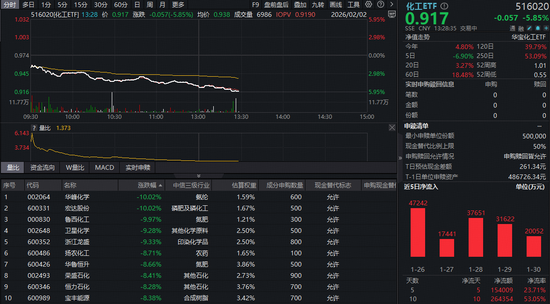
ETF盘中资讯|化工板块重挫,三股跌停!化工ETF(516020)跌近6%,后市如何看?
Sou Hu Cai Jing· 2026-02-02 05:51
Group 1 - The chemical sector experienced a significant pullback on February 2, with the Chemical ETF (516020) declining by 5.85% as of the report time [1] - Key stocks in the sector, including Huafeng Chemical, Hongda Co., and Luxi Chemical, hit the daily limit down, while others like Satellite Chemical and Zhejiang Longsheng fell over 9% [1] - Analysts suggest that the stock price adjustments are influenced by market volatility, including high fluctuations in global commodity prices and some companies' earnings forecasts falling short of expectations [3] Group 2 - A cold wave in the U.S. Gulf Coast has led to the shutdown of several chemical plants, with over 30% of chemical production capacity in Texas being affected [3] - This situation has tightened the supply of chemicals like ethylene and acetic acid, raising price expectations [3] - The cold wave has also increased natural gas prices, raising the cost of raw materials for ethylene and polyolefins, which may strengthen the short-term performance of chemical products [4] Group 3 - Looking ahead, the chemical industry is expected to be at a low point in 2025, but by 2026, the end of the current expansion cycle and measures to combat "involution" may catalyze a recovery in industry profits [4] - The rapid development of new materials driven by downstream demand is anticipated to initiate a new phase of high growth [4] - The current industry valuation is considered low, presenting potential opportunities for investment in the chemical sector [4] Group 4 - The Chemical ETF (516020) tracks the CSI segmented chemical industry theme index, covering popular themes such as AI computing power, anti-involution, robotics, and new energy [4] - Investors can also consider the Chemical ETF linked funds (Class A 012537/Class C 012538) for exposure to the chemical sector [4]
化工板块重挫,三股跌停!化工ETF(516020)跌近6%,后市如何看?
Xin Lang Cai Jing· 2026-02-02 05:42
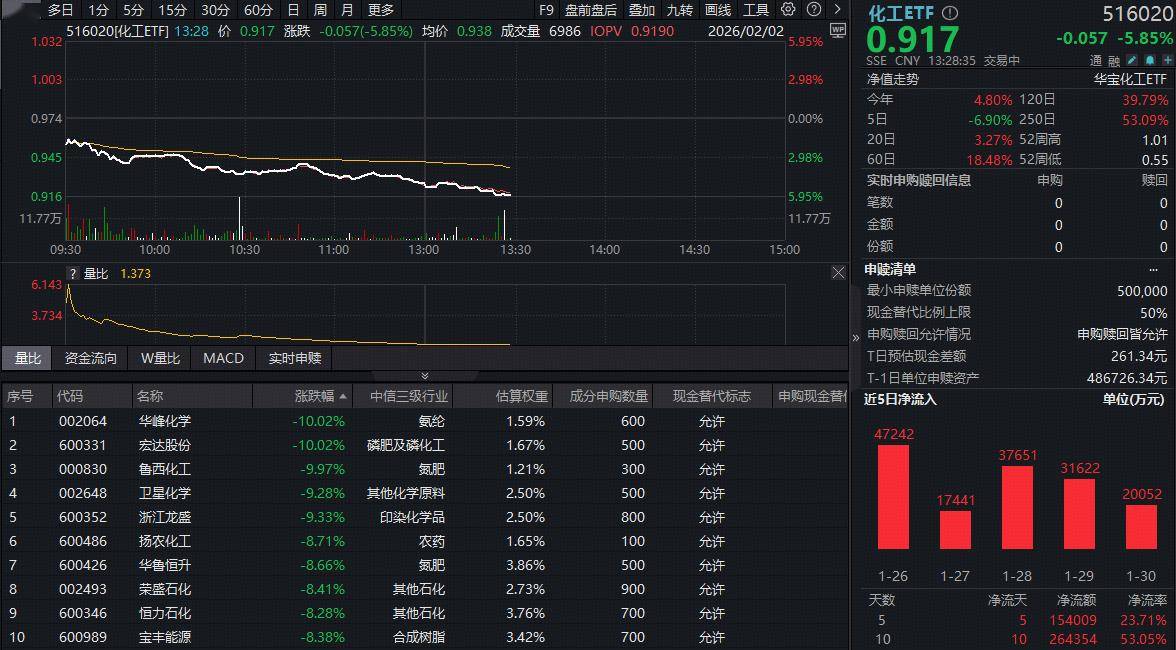
Core Viewpoint - The chemical sector experienced a significant pullback on February 2, with the chemical ETF (516020) declining by 5.85% during trading, reflecting a broader downturn in the industry [1][7]. Market Performance - The chemical ETF (516020) opened lower and saw a decline of 5.85%, with a trading price of 0.917 as of the latest update [2][7]. - Key stocks in the sector, including Huafeng Chemical, Hongda Co., and Luxi Chemical, hit the daily limit down, while others like Satellite Chemical and Zhejiang Longsheng fell over 9% [1][7]. Supply Chain and External Factors - A cold wave in the U.S. Gulf Coast has led to the shutdown of several chemical plants, affecting over 30% of the chemical production capacity in Texas, which accounts for about one-third of the U.S. chemical output [3][10]. - The cold weather has increased natural gas prices, raising the costs of ethylene and polyethylene, while supply constraints are expected to strengthen the pricing outlook for chemical products [10]. Future Outlook - Analysts predict that the chemical industry will face low demand in 2025, but measures to counteract "involution" may help restore profitability by 2026, alongside growth in new materials driven by rapid downstream demand [10]. - The current low valuation of the industry presents potential opportunities for investors, particularly through the chemical ETF (516020), which tracks a specialized index covering various themes including AI and new energy [10]. Investment Strategy - Investors are encouraged to consider the chemical ETF (516020) for efficient exposure to the sector, as it tracks the CSI segmented chemical industry index and includes stocks related to trending themes [10].