
量化紧缩

Search documents
美债收益率逼近5%!央行宽松失灵,全球债务失控,金银成最大赢家
Sou Hu Cai Jing· 2025-09-03 20:08
Group 1: Market Dynamics - The bond market is no longer responding to central bank narratives, with a significant rise in yields across major economies, including the US, UK, Germany, and France, reaching historical highs [1][6][18] - Investors are increasingly skeptical of central bank promises and are focusing on the expanding fiscal deficits of governments, as highlighted by the IMF's warnings regarding the US debt burden [1][2][6] Group 2: US Debt Situation - As of April 2025, the US national debt has surpassed $36.4 trillion, with $9.5 trillion maturing within the next 12 months, leading to a reliance on new debt issuance [2][4] - Interest payments for the US government are projected to approach $1 trillion in 2025, surpassing both healthcare and defense spending, indicating a significant financial burden [2][4] Group 3: Global Debt Trends - The UK and Japan are also facing severe debt challenges, with UK 30-year bond yields reaching 5.64%, the highest since 1998, and Japan's debt exceeding 250% of GDP [4][6] - France's fiscal deficit remains above 5% of GDP, raising concerns about its ability to manage debt effectively [4][6] Group 4: Market Sentiment and Investment Shifts - The bond market is punishing governments with poor fiscal discipline, leading to higher required yields as investors seek compensation for risk [6][10] - Traditional safe-haven behaviors are diminishing, with investors prioritizing inflation and debt concerns over the historical safety of bonds [6][10] Group 5: Precious Metals Performance - Gold and silver have emerged as preferred safe-haven assets, with gold prices rising over 33% in 2025, significantly outperforming the S&P 500 [10][12] - Silver prices have also surged, driven by industrial demand, particularly in solar energy and electric vehicles, with a projected supply gap of 149 million ounces in 2025 [10][12] Group 6: Central Bank Actions and Currency Dynamics - Central banks are increasing their gold reserves, with global demand reaching a record 4,974 tons in 2024, as they diversify away from dollar-denominated assets [11][16] - The weakening of the US dollar, with its share in global reserves dropping to 57.4%, is contributing to the attractiveness of gold and silver as alternative assets [14][16]

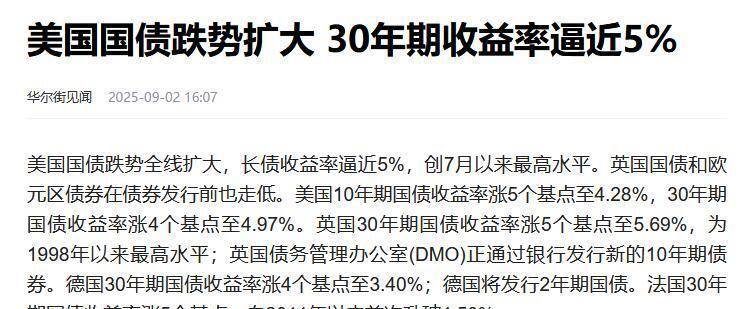
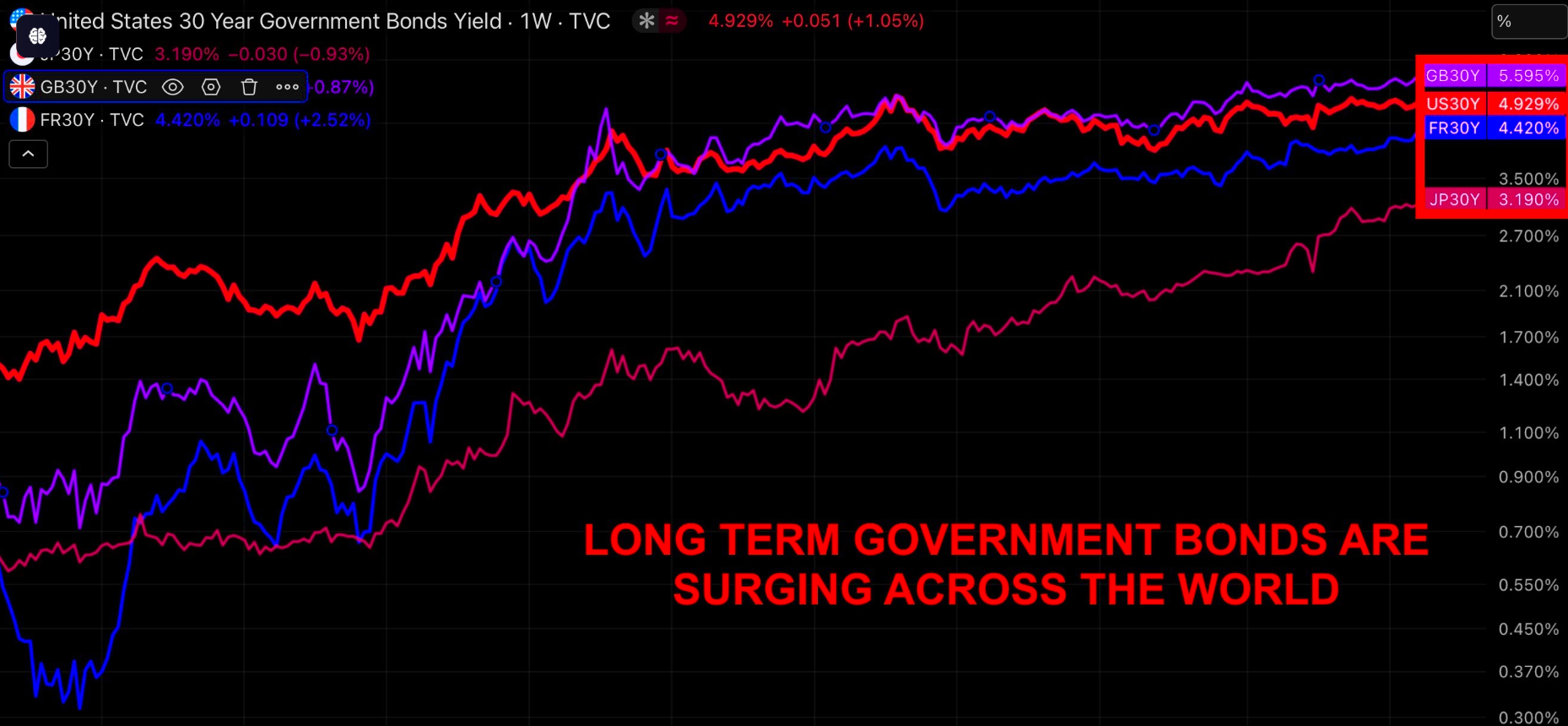
全球长债都在跌,市场在定价什么?
Hua Er Jie Jian Wen· 2025-09-02 09:26
Core Insights - The global bond market is undergoing a significant adjustment driven by rising fiscal deficits, increasing public debt, persistent inflation, and a shift in investor sentiment towards higher yields [2][3][12] Group 1: Fiscal Deficits and Rising Yields - Fiscal deficits in Europe and the U.S. are expanding, with the U.S. debt-to-GDP ratio expected to rise from under 80% pre-pandemic to nearly 120% by mid-2025 [3] - The U.S. fiscal deficit is projected to remain around 6-7% of GDP even during favorable economic conditions, exerting upward pressure on U.S. Treasury yields [3] - The UK's borrowing needs are anticipated to reach historical highs by early 2025, with long-term bond yields exceeding 5.6%, the highest since 1998 [3] Group 2: Japan's Debt Burden - Japan has the heaviest debt burden, exceeding 250% of GDP, and is adjusting its yield curve control policy due to global pressures, leading to a 30-year bond yield surpassing 3% for the first time [5] Group 3: Inflation and Central Bank Credibility - Persistent inflation is a global driving factor, eroding the real value of fixed-income bonds and prompting investors to demand higher returns to protect their capital [6][7] - Central banks have paused interest rate hikes after aggressive increases in 2022-23, yet bond yields continue to rise due to quantitative tightening [8][9] Group 4: Investor Sentiment and Market Dynamics - Investor psychology has shifted from assuming low yields would persist to a more cautious stance, with "bond vigilantes" re-emerging to enforce fiscal discipline through bond sell-offs [10][11] - The demand for safe-haven bonds has diminished, with investors focusing more on inflation and debt issues rather than seeking safety during global crises [11] Group 5: Structural Reset of the Global Bond Market - The global bond market is experiencing a structural reset, with long-term yields rising across various countries, marking the end of the ultra-low interest rate era [12][13] - Credit ratings reflect disparities among countries, with the U.S. losing its AAA rating and other nations facing similar pressures, leading to increased borrowing costs and fiscal strain [12]
日本央行副行长释放鹰派信号:持续加息仍是合适选项 国债政策迎重大调整
Xin Hua Cai Jing· 2025-09-02 06:45
Group 1 - The Deputy Governor of the Bank of Japan, Masayoshi Amamiya, signaled a continued tightening of monetary policy, stating that further interest rate hikes are an "appropriate policy choice" due to the current economic recovery and improving prices [1] - Despite three interest rate hikes this year, Japan's real interest rates remain significantly negative, indicating that the current tightening is insufficient to fully offset inflation, allowing room for further rate increases [1] - Amamiya emphasized a shift in policy tools, prioritizing adjustments to short-term policy rates over frequent changes in government bond purchase levels, marking a significant transition towards "price-based control" [1] Group 2 - Amamiya provided a clear roadmap for the reform of the government bond market, advocating for a gradual reduction in the central bank's bond purchases to allow long-term interest rates to be determined by market supply and demand [2] - He highlighted the importance of "risk management," noting multiple challenges facing the Japanese economy, including global economic slowdown, rising supply chain costs due to protectionism, and energy price volatility from geopolitical conflicts [2] - The Bank of Japan has established a rapid response mechanism to intervene promptly if economic indicators deviate from baseline expectations, reflecting a cautious approach to recent market optimism [2] Group 3 - The Bank of Japan is developing a monthly bond purchase standard aligned with an "appropriate reserve level," indicating that future purchase volumes will be dynamically adjusted based on economic needs, marking the official start of quantitative tightening (QT) [3]
【央行圆桌汇】8月非农数据来袭(2025年9月1日)
Xin Hua Cai Jing· 2025-09-01 05:54
Global Central Bank Dynamics - Federal Reserve Governor Cook has filed a federal lawsuit challenging the legality of Trump's dismissal, focusing on the interpretation of the "just cause" clause in the Federal Reserve Act, with the case potentially reaching the Supreme Court [1] - Trump’s administration is considering increasing its influence over the 12 regional Federal Reserve banks, including reviewing the selection process for bank presidents [1] - The Federal Reserve responded to Cook's lawsuit, stating that governors have term and dismissal protections [1] Federal Reserve Officials' Perspectives - Governor Waller supports a 25 basis point rate cut in September, expecting further cuts in the next 3 to 6 months unless there is a significant deterioration in August employment data [2] - New York Fed President Williams believes it is appropriate to lower rates at the right time, indicating that current policy remains moderately restrictive [2] - San Francisco Fed President Daly suggests it is time to adjust policy due to conflicting inflation and employment targets [2] - Dallas Fed President Logan emphasizes the need for improved communication regarding interest rate paths and economic outlook [2] European Central Bank Insights - ECB's Rehn states that inflation risks are "tilted to the downside," indicating potential for future rate cuts [2] - The U.S. imposing a 15% tariff on European exports could slow Eurozone growth by "several percentage points" [2] Other Central Bank Actions - The Bank of Hungary has set its benchmark interest rate at 6.5%, indicating that the fight against inflation is not over [3] - The Bank of the Philippines has cut rates by 25 basis points, with the possibility of further cuts [4] - The Bank of Brazil's survey shows economists expect GDP growth of 1.86% in 2026 and an inflation rate of 4.86% for 2025 [5] - The Bank of Indonesia will continue to participate in the foreign exchange market to maintain the Rupiah's alignment with fundamentals [6] Market Observations - Concerns over the independence of the Federal Reserve have increased following Trump's dismissal of Cook, leading to a decline in the dollar [7] - Analysts predict the Bank of England may slow its quantitative tightening pace to £70 billion over the next 12 months due to rising yield concerns [8] - Swiss bank analysts suggest that the Reserve Bank of Australia may delay its rate cut path due to unexpectedly high CPI readings [8] - The Philippine central bank appears to be nearing the end of its easing cycle, with expectations for one more rate cut this year [9]
每日机构分析:8月28日
Xin Hua Cai Jing· 2025-08-28 16:19
Group 1: Federal Reserve and Currency Concerns - Concerns over the independence of the Federal Reserve continue to impact the dollar, leading to its decline following Trump's dismissal of Fed Governor Lisa Cook [1] - Deutsche Bank analysts noted that these concerns have prompted investors to factor in faster rate cuts and higher inflation [1] Group 2: Commodity Currencies and Economic Policies - Goldman Sachs indicated that while the dollar may weaken, caution is advised when pursuing commodity currencies like the Australian, New Zealand, and Canadian dollars, which have shown relative weakness [2] - The underperformance of these currencies is attributed to domestic policy shifts and declining terminal rate pricing in Australia, New Zealand, and Canada [2] Group 3: UK Monetary Policy - Pantheon Macroeconomics analysts expect the Bank of England to slow its quantitative tightening to £700 billion from the current £1 trillion within the next 12 months [2] - This adjustment reflects growing concerns over the impact of quantitative tightening on the UK government bond market [2] Group 4: France's Fiscal Situation - Despite France's poor public finance situation, it is unlikely to seek assistance from the International Monetary Fund, with potential reliance on the European Stability Mechanism or European Central Bank instead [3] - The yield spread between French and German bonds has widened, reaching 82 basis points, indicating increased risk due to political tensions [3] Group 5: South Korea's Inflation Outlook - South Korea's inflation may have eased in August, allowing the central bank to consider further policy easing to support economic growth [4] - Analysts predict the Consumer Price Index (CPI) will rise by 1.9% year-on-year, down from 2.1% in July, with a slight month-on-month increase of 0.2% [4]
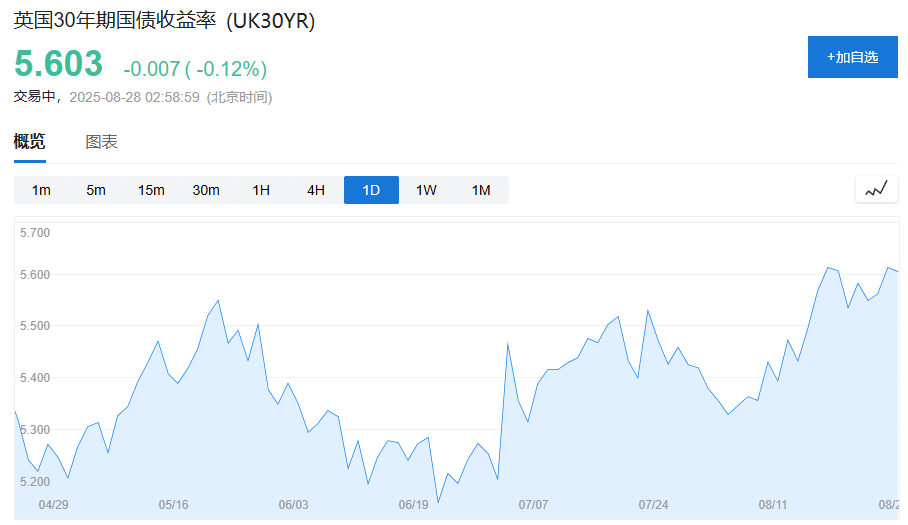
欧债阴霾从未远离!英国长债收益率逼近1998年高点,面临“滞胀”风险
Hua Er Jie Jian Wen· 2025-08-28 03:29
Core Viewpoint - The UK is facing significant economic challenges, with rising bond yields leading to increased borrowing costs and heightened concerns over "stagflation" risks [1][4][5]. Group 1: Bond Market Dynamics - The yield on the UK 30-year government bond surged to 5.64%, the highest in four months, approaching historical highs set in 1998 [1]. - Since early August, the UK 30-year bond yield has increased by 0.23 percentage points, significantly outpacing increases in Germany (0.13 percentage points) and the US (0.06 percentage points) [4]. - The divergence in central bank policy expectations is a key factor, with the market anticipating only one rate cut from the Bank of England in the next 12 months, compared to four from the Federal Reserve [4]. Group 2: Economic Outlook and Fiscal Pressure - The UK is experiencing a "stagflation" risk, characterized by high inflation and stagnant economic growth, complicating the Bank of England's ability to lower interest rates [5][6]. - Current inflation in the UK is near 4%, limiting the government's ability to stimulate the economy through rate cuts [5]. - If current yield levels persist, the fiscal space for the Chancellor of the Exchequer, Rachel Reeves, could shrink from £9.9 billion to £5.3 billion, necessitating the raising of up to £27 billion in the upcoming budget [5]. Group 3: Central Bank Challenges - The surge in bond yields is increasing pressure on the Bank of England, with calls to slow or halt its quantitative tightening (QT) program [6]. - The Bank of England is reducing its balance sheet by £100 billion annually, which is believed to be further depressing bond prices and increasing yields [7]. - Concerns over inflation and the credibility of UK policy are rising, with warnings that without government spending cuts and a halt to QT, the fiscal gap may widen, potentially leading to market turmoil [7].
刚刚!猛烈抛售,发生了什么?
Zheng Quan Shi Bao Wang· 2025-08-26 12:47
Group 1 - The Japanese government bond market is experiencing a significant sell-off, with the 10-year bond yield reaching 1.627%, the highest since October 2008, and futures hitting the lowest level since 2009 [1][2] - Concerns over Japan's fiscal discipline have arisen following the ruling coalition's losses in the upper house elections, leading to expectations of new fiscal stimulus measures that could increase bond issuance [2][3] - Continuous inflation in Japan is diminishing the appeal of fixed-income assets and reinforcing market expectations for the Bank of Japan to tighten monetary policy further [2][5] Group 2 - Overseas demand for Japanese government bonds is declining, with net purchases of 10-year and longer bonds dropping to 480 billion yen (approximately 3.3 billion USD) in July, only one-third of June's purchases [3][4] - The Bank of Japan's reduction in bond purchases has created a demand gap in the market, exacerbated by new capital regulations affecting domestic financial institutions and overseas investors [4] - The Japanese Ministry of Finance plans to include 32.3865 trillion yen (approximately 1.57 trillion RMB) in its 2026 budget for debt servicing, marking an increase of about 4 trillion yen compared to the previous year's record budget [4] Group 3 - The ongoing inflationary pressures in Japan are increasing the likelihood of interest rate hikes by the Bank of Japan, which is pushing bond yields higher [5][6] - The Bank of Japan's Governor has expressed optimism about the potential for wage increases to accelerate, which could lead to a tightening of monetary policy later this year [6] - Despite signs of cooling inflation, the core CPI in July remained above the central bank's target at 3.1%, leading to heightened expectations for a rate increase of at least 25 basis points later this year [6]
每日投行/机构观点梳理(2025-08-22)
Jin Shi Shu Ju· 2025-08-22 12:47
Group 1 - Morgan Stanley is optimistic about the Chinese stock market's performance through the summer, citing improved liquidity and investor confidence in policy easing as key drivers [1] - The bank recommends an overweight position in A-shares compared to offshore Chinese stocks [1] - Onshore bond yields indicate a more positive long-term macro outlook among domestic investors [1] Group 2 - Deutsche Bank suggests that Fed Chair Powell is unlikely to signal a policy shift at the Jackson Hole symposium but may pave the way for a 25 basis point rate cut in September [2] - The bank expects Powell's statements to remain cautious, with no significant changes in guidance [2] Group 3 - CBA economists believe Powell's speech at Jackson Hole will influence the dollar's trajectory, but no clear signals are expected [3] - The probability of a rate cut in September is currently around 70%, setting a high bar for Powell to deviate from market expectations [3] Group 4 - CITIC Securities forecasts that 4.5 to 9 trillion yuan may flow into "fixed income plus" products as deposits mature, indicating a trend towards indirect market entry [4] - The firm anticipates over 90 trillion yuan in deposits maturing by 2025, with 5-10% potentially seeking higher returns [4] Group 5 - CITIC JianTou reports signs of a strong consumption season, with rising demand in energy and metals, leading to price increases in rare earths and lithium [5] - The firm notes that the upcoming consumption peak is expected to support prices in these sectors [5] Group 6 - Huatai Securities highlights increased trading activity and new account openings, indicating a recovery opportunity for brokers focused on wealth management transformation [6] - The A-share broker index is currently at a PBLF of 1.67x, suggesting potential for value re-evaluation [6] Group 7 - CITIC JianTou indicates an improvement in fiscal revenue for July, with a 0.1% year-on-year increase in general public budget revenue from January to July [7] - The report notes a positive trend in tax revenue, particularly from personal income and stamp taxes, reflecting marginal economic improvement [7] Group 8 - CITIC Securities anticipates over 5 trillion yuan may flow from deposits into "fixed income plus" products, driven by declining deposit yields and capital market performance [8] - The report suggests that insurance and wealth management products are increasingly prioritizing equity assets [8] Group 9 -招商策略 maintains an optimistic outlook on the Hong Kong stock market, suggesting a focus on innovative pharmaceuticals, followed by internet and new consumption sectors for investment [9] - The report notes that Hong Kong's earnings are improving, with a high earnings forecast rate, indicating a potential lead over A-shares [9]



长期日债收益率创1999年来新高,日企避雷长债埋隐患
Di Yi Cai Jing· 2025-08-22 07:38
Group 1 - Concerns over fiscal expansion and weakening investor demand, combined with rising US Treasury yields, have led to a surge in long-term Japanese government bond yields to multi-decade highs [1][4] - The 20-year Japanese government bond yield reached 2.655%, the highest since 1999, while the 30-year yield climbed to 3.185%, nearly matching its peak from May [4] - Japan's public debt exceeds 260% of GDP, with core inflation consistently above the Bank of Japan's 2% target for seven months, prompting expectations of a shift in monetary policy [4][5] Group 2 - Domestic investors, including life insurance companies, have reduced their holdings of Japanese government bonds by 1.35 trillion yen since October 2024, indicating a retreat from the market [5] - Foreign investment in long-term Japanese bonds has also decreased significantly, with net purchases dropping to 480 billion yen in July, one-third of the previous month’s level [5] - The rising yields have led Japanese companies to avoid issuing long-term bonds, with approximately 75% of bond issuances this fiscal year concentrated in maturities of five years or less [7] Group 3 - The trend of issuing short-term bonds may limit immediate interest costs but increases refinancing risks and management expenses for companies [7] - Analysts suggest that the rising bond yields could suppress corporate investment and household spending, impacting Japan's economic growth [9] - The increase in long-term bond yields may also affect global equity markets, as higher borrowing costs could lead to a shift in investor sentiment [9]

财政主导时代来临,各国央行只能被动配合,而市场严阵以待
Hua Er Jie Jian Wen· 2025-08-21 01:31
Core Viewpoint - Prominent investors like Ray Dalio are warning that major global economies are entering a "fiscal dominance" era, where rising government debt and borrowing costs exert significant political pressure on central banks, potentially compromising their primary mission of controlling inflation [1][2]. Group 1: Fiscal Pressure on Monetary Policy - The OECD projects that sovereign borrowing in high-income countries will reach a record $17 trillion in 2023, followed by $16 trillion in 2024, and $14 trillion in 2025, creating a dilemma for central banks trying to normalize their balance sheets [2]. - Central banks, after years of quantitative easing, are attempting to shrink their balance sheets through bond sales, but this raises bond yields and increases government debt servicing costs, leading to policy conflicts [2]. Group 2: Rising Borrowing Costs - In the UK, the yield on 30-year government bonds has reached 5.6%, close to a 25-year high, while in Germany, yields have surpassed 3% due to increased borrowing for infrastructure and defense spending [3]. Group 3: Market Concerns Over Political Interference - In the U.S., the yield spread between 2-year and 30-year Treasury bonds has widened to its highest level since early 2022, indicating market concerns over potential political interference in monetary policy [4]. - Analysts suggest that recent unusual market reactions to inflation data reflect fears of increased control over monetary policy by the White House, with expectations of multiple rate cuts by the end of next year [4]. Group 4: Extreme Risks of Fiscal Dominance - Ray Dalio warns that fiscal dominance could lead to extreme risks, such as a "debt death spiral," where governments are forced to borrow more to pay rising interest, potentially leading to currency devaluation [5]. - The volatility in the market may hinder governments from issuing long-term bonds, pushing them towards riskier short-term debt, which could make fiscal conditions more sensitive to interest rate fluctuations [5].