
慢牛

Search documents
再论当前“春季行情”下的三条投资主线
HUAXI Securities· 2026-01-18 12:29
Market Review - The A-share market experienced a significant increase followed by a period of volatility, with a notable rise in trading volume driven by a strong profit-making effect, particularly in small-cap and growth styles. On January 14, the total trading volume reached a historical high of 3.99 trillion yuan, with margin financing balances hitting new records. However, following regulatory adjustments to margin requirements, market activity showed signs of cooling, and the previously strong technology index began to stabilize [1][2]. Market Outlook - Regulatory measures aimed at "counter-cyclical adjustment" are expected to support a "slow bull" market for A-shares. The recent surge in trading activity has prompted regulators to signal a need for cooling, leading to a shift from a one-sided increase to high-level fluctuations in the Shanghai Composite Index. Despite this, the overall valuation of A-shares remains reasonable, supported by macro policies, medium to long-term capital inflows, and a mild recovery in corporate earnings. The upcoming earnings announcements in late January are likely to refocus investor attention on performance-driven sectors, particularly in technology and industries benefiting from price increases [2][3]. Counter-Cyclical Adjustment Policies - The recent increase in the minimum margin requirement for financing from 80% to 100% is part of a broader strategy to prevent systemic risks in the market. The regulatory emphasis on maintaining market stability and preventing extreme fluctuations is evident, as seen in the significant net outflow of 142.3 billion yuan from equity ETFs in January, marking the largest monthly outflow since 2021. This counter-cyclical adjustment is viewed as a necessary measure to sustain the bull market trend while mitigating overheating risks [3][4]. Risk Premium and Sector Focus - As of January 16, the equity risk premium (ERP) for the CSI 300 index stands at 5.2%, which is near the median level for the past decade. Compared to previous peaks in January 2018 and February 2021, the current risk premium indicates that A-share valuations are relatively reasonable, although some sectors may experience capital withdrawal due to overheating. Key sectors attracting financing include electronics, power equipment, computers, military, and communications, with a need to monitor the impact of reduced financing on high-volatility stocks in these areas [4][5]. Investment Strategy - The slow bull trend in A-shares is expected to continue, with a focus on sectors showing high growth or improving conditions as companies prepare to announce their 2025 earnings. Key factors supporting this outlook include proactive macro policies, the influx of medium to long-term capital, and a narrowing decline in the Producer Price Index (PPI), which suggests a mild recovery in corporate earnings. Investors should pay attention to sectors such as technology (AI applications, robotics), commodities benefiting from price increases, and industries with anticipated high earnings growth [5].
万亿存款搬家进行时:2026年的A股,慢牛正在成形
Xin Lang Cai Jing· 2026-01-18 12:18
Core Viewpoint - A significant shift in bank deposits is occurring, which may influence the A-share market in 2026, as investors seek new avenues for their funds due to declining deposit rates and changing market dynamics [2][3]. Group 1: Changes in Deposit Behavior - The scale of household deposits in China has exceeded 140 trillion yuan, reflecting a defensive posture amid uncertainty [2]. - From the second half of 2025 to 2026, deposit rates are expected to decline, leading to a reassessment of the long-term return advantages of equity assets [2][3]. Group 2: Market Dynamics and Investment Strategies - The movement of funds from bank deposits does not equate to a rush into stock trading; rather, it indicates a gradual, layered, and long-term capital flow [3]. - The consensus for the A-share market in 2026 is shifting towards a "slow bull" or "long bull" market, driven by changes in the funding structure, policy objectives, and declining risk-free rates [3][4]. - The new main sources of incremental capital are expected to be pension funds, insurance funds, and index funds, which will lead to a more stable market environment [3]. Group 3: Investment Opportunities - Three categories of investment opportunities are identified: 1. High dividend and stable cash flow assets such as banks, insurance, and utilities, which may attract low-risk preference funds [3]. 2. Core sectors aligned with long-term trends, including high-end manufacturing, AI infrastructure, semiconductors, and renewable energy, which present structural opportunities despite short-term volatility [4]. 3. Indexation and concentration in leading companies, with an emphasis on selecting the right industries and companies over speculative trading [5]. Group 4: Market Outlook - The transition of trillions in deposits is viewed as a long-term trend rather than a short-term market catalyst, suggesting a more gradual upward trajectory for the A-share market [5][6]. - The market is expected to avoid extreme volatility and instead follow a steady growth path, emphasizing asset allocation and long-term holding strategies [5][6].


非银金融行业周报:逆周期调节呵护“慢牛”,券商和保险业务开门红-20260118
KAIYUAN SECURITIES· 2026-01-18 10:10
非银金融 2026 年 01 月 18 日 投资评级:看好(维持) 行业走势图 数据来源:聚源 -19% -10% 0% 10% 19% 29% 2025-01 2025-05 2025-09 非银金融 沪深300 相关研究报告 《衍生品监管透明化,规模限制有望 放松利好头部券商—衍生品监管政策 点评》-2026.1.18 《海南全岛封关运作,跨境资管空间 广阔—行业深度报告》-2026.1.15 《两融杠杆上限调降对券商影响有 限,看好板块行情—行业点评报告》 -2026.1.14 逆周期调节呵护"慢牛",券商和保险业务开门红 ——行业周报 | 高超(分析师) | 卢崑(分析师) | 张恩琦(联系人) | | --- | --- | --- | | gaochao1@kysec.cn | lukun@kysec.cn | zhangenqi@kysec.cn | | 证书编号:S0790520050001 | 证书编号:S0790524040002 | 证书编号:S0790125080012 | | | 周观点:逆周期调节呵护"慢牛",券商和保险业务开门红 | | 1 月 15 日证监会召开系统工作会议 ...
兴证策略张启尧团队:春季行情仍会有新高
Xin Lang Cai Jing· 2026-01-18 09:58
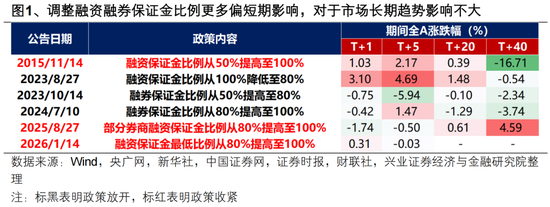
炒股就看金麒麟分析师研报,权威,专业,及时,全面,助您挖掘潜力主题机会! 来源:尧望后势 一、春季行情仍会有新高 本轮"开门红"在流动性和风险偏好驱动下,热点集中、主题驱动的特征比较明显,也造成了部分板块的 结构性过热。本周政策上调融资保证金比例,防范系统性风险、引导市场回归理性,同时宽基ETF遭遇 较多净流出、部分高位标的出现回调,市场进入震荡休整阶段。 本次市场降温,再次印证了本轮慢牛、长牛的底层逻辑。我们此前强调,本轮活跃资本市场肩负着伟大 的历史使命,要实现国家的高质量发展、承载居民的财富效应,通过自身活跃,与实体经济、科技创新 形成正反馈,当前更需要一轮"慢牛"、"长牛",这便决定了本轮市场一定是底部缓慢抬升的稳步市场。 因此,前期市场上涨斜率过快后,需要短期震荡休整回归本色。 但我们强调,此次降温的影响更偏短期,支撑春季行情向上的基本面和政策等核心逻辑并未发生任何变 化。并且由于前期市场过热更多体现在结构层面,本轮情绪降温也会更偏结构性,而非系统性。历史对 比来看,本轮春季行情无论是时间还是空间均仍在半途,短期休整过后,春季行情仍会有新高。 并且,回顾历轮春季行情的结束信号,大多为基本面验证不及预 ...
降温组合拳火速出手 解码四万亿天量
Hua Xia Shi Bao· 2026-01-17 01:13
Core Viewpoint - The recent regulatory measures in the A-share market aim to cool down speculative trading and maintain market stability, guiding the market towards a "slow bull" trend in the medium to long term [1][3][4]. Market Performance - On January 16, the three major A-share indices experienced collective declines, with the Shanghai Composite Index down 0.26%, Shenzhen Component Index down 0.18%, and ChiNext Index down 0.2% [1]. - The trading volume in the market decreased from nearly 4 trillion yuan to over 2 trillion yuan, indicating a significant reduction in trading activity [1]. Regulatory Actions - The financing margin ratio was raised from 80% to 100% for new financing contracts, a move aimed at controlling the heat of financing funds and preventing the accumulation of leverage trading risks [3][4]. - Major stocks, including招商银行 (China Merchants Bank) and 贵州茅台 (Kweichow Moutai), saw significant sell orders, interpreted as a clear intention to cool the market [3]. Investor Sentiment - The market has seen a resurgence of interest from external funds, with the margin financing balance reaching a historical high of 2.7 trillion yuan [3]. - Analysts believe that the current market environment, characterized by a combination of domestic economic recovery and international fund inflows, supports a positive outlook for A-shares [5][6]. Sector Performance - Sectors such as advanced packaging, semiconductors, and electric grid equipment showed strong performance, while sectors like AI materials and cultural media faced declines [1]. - The market is expected to continue its upward trajectory, driven by structural opportunities in sectors like AI computing, semiconductors, and new energy [9].
大和:“春季行情”提前到来,料A股市况迈向“慢牛”
Xin Lang Cai Jing· 2026-01-16 05:44
Group 1 - The core viewpoint of the report is that the "spring market" has arrived early, leading investors to potentially take profits before the Lunar New Year holiday or the National People's Congress, while liquidity support and stimulus policy expectations may boost the A-share market, although the pace of growth is expected to slow, transitioning towards a "slow bull" market [1] - The report notes that the regulatory authority raised the minimum margin ratio on January 14 to cool market sentiment, but it is believed that the A-share market has not yet entered a bubble phase [1] - Financing transactions as a percentage of total trading volume increased from 9.9% to 11.2% over the past month, still below the historical "warning level" of 12% that has previously triggered regulatory tightening [1] Group 2 - The report emphasizes that investor crowding in the top three popular sectors is still far below the peaks observed in February or October 2025 [1] - The company maintains a positive outlook for the first half of 2026, recommending investors to diversify their exposure in both A-share and Hong Kong markets for balanced sector risk [1] - Preferred stocks in the Hong Kong market include Tencent Holdings, Shenzhou International, Weichai Power, China Resources Land, and Alibaba, while preferred stocks in the A-share market include Midea Group, Northern Huachuang, CATL, Heng Rui Medicine, and Lanke Technology, all rated as "buy" [1]




市场“减速”,是福不是祸!帮主郑重:如何拥抱“慢牛”时代
Sou Hu Cai Jing· 2026-01-16 03:16
Core Viewpoint - The current market slowdown is seen as a necessary and healthy "stress test" and "style switch," shifting focus from emotional and capital-driven trading to fundamental analysis and real company value [4] Group 1: Market Dynamics - The market has transitioned from a rapid, emotional trading environment to a more stable and thoughtful pace, which is beneficial for long-term investors [1][4] - The previous "fast bull" market created a divide between hot and non-hot sectors, leading to impulsive trading behaviors that lacked deep logical support [3] Group 2: Investment Strategy - Investors are encouraged to adjust their mindset from "hunters" seeking quick profits to "cultivators" focusing on sustainable returns and long-term goals [4][5] - Emphasis is placed on deep research within familiar sectors rather than chasing fleeting market trends, highlighting the importance of understanding a company's business model and competitive advantages [4][5] - The current market period is an opportunity to optimize portfolio structures by eliminating speculative investments and concentrating on high-quality core assets that can withstand the test of time [5]

制度优化与资金格局有望共筑慢牛基石,关注中证A500ETF(159338)一键打包行业龙头
Mei Ri Jing Ji Xin Wen· 2026-01-15 02:58
Core Viewpoint - The China Securities Regulatory Commission has approved an adjustment to the financing margin ratio for investors, increasing the minimum margin ratio from 80% to 100% for new financing contracts, effective January 19. Existing contracts will not be affected [1]. Group 1: Policy Changes - The adjustment to the financing margin ratio is a regulatory measure aimed at stabilizing the market, reflecting the flexible use of such measures by the authorities [1]. - In August 2023, the financing margin ratio was reduced from 100% to 80%, which led to a steady increase in market financing scale and trading volume [1]. - Historical adjustments show that increasing the margin ratio can lead to market rebounds, as seen in November 2015 when the ratio was raised from 50% to 100%, resulting in a market uptrend [1]. Group 2: Market Outlook - The current policy change is expected to contribute to a slow bull market, with the long-term positive outlook for the market remaining unchanged [1]. - Ongoing capital market reforms aim to enhance market stability and attract long-term funds, promoting a dynamic balance in investment and financing [1]. - The trend of "deposit migration" continues to provide potential incremental funds to the market, indicating a favorable environment for investment [1]. Group 3: Investment Strategies - Investors are encouraged to consider the CSI A500 ETF (159338) as a diversified product that includes leading companies across various sectors [1]. - A "dumbbell" strategy focusing on technology and dividends is suggested as a satellite strategy to capture market growth while mitigating volatility [1].
A股“点刹”引爆震荡!三大交易所突提融资保证金,慢牛信号拉满
Sou Hu Cai Jing· 2026-01-15 02:47
Group 1 - The core message of the news is that the Chinese stock market is experiencing a significant regulatory intervention aimed at cooling down an overheated market, with a specific focus on reducing leverage in margin trading [1][3] - The margin financing ratio was raised from 80% to 100%, which directly reduces the leverage available to investors, indicating a clear shift in policy from a "crazy bull" market to a "slow bull" market [1] - The regulatory measures are designed to prevent a repeat of the 2015 market crash, with a focus on ensuring that market growth is driven by company performance rather than excessive speculation [3] Group 2 - High valuation and high leverage stocks, such as Cambrian and robotics, faced significant sell-offs, while established tech manufacturers and high-dividend sectors like banks and utilities became safe havens [3] - Approximately 70% of new retail investors who bought at high prices were trapped, highlighting the vulnerability of retail behavior in the current market environment [3] - The policy aims to transition the market from being driven by capital inflows to being driven by earnings, as evidenced by the recent performance of quality companies [3]
官宣“降杠杆”,拐点来了?
Hu Xiu· 2026-01-14 14:54
Group 1 - The adjustment of the financing leverage ratio from 80% to 100% indicates a tightening of financing conditions, reducing the leverage multiple from 1.25 times to 1 time, which may impact market dynamics [3] - This regulatory move is interpreted as a signal to control market risks and aims to promote a "slow bull" market rather than a "crazy bull" market, which could lead to systemic risks [3] Group 2 - The announcement from major exchanges reflects a proactive approach to manage market leverage under regulatory guidance, suggesting a focus on sustainable growth in emerging industries and high-quality domestic industry upgrades [3]