
资源民族主义

Search documents
印尼资源民族主义升级,存量博弈重塑定价锚点
East Money Securities· 2026-02-05 08:02
Investment Rating - The report maintains a "Strong Buy" rating for the industry, indicating a positive outlook for investment opportunities in the sector [2]. Core Insights - Indonesia's resource nationalism is intensifying, with the government tightening mining policies to increase fiscal revenue amid significant budget deficits. This includes controlling RKAB supply, adjusting HPM pricing formulas, and conducting antitrust investigations to establish a global pricing system based on Indonesian mineral costs [4][10]. - The depletion of high-grade nickel resources is prompting a policy shift towards protecting reserves. The government has stopped approving new RKEF projects and is expected to favor low-grade nickel resources, aligning with the needs of the new energy industry [4][10]. - A significant reduction in RKAB quotas is anticipated for 2026, with estimates suggesting a drop to 250-260 million tons from 379 million tons in 2025, potentially leading to a supply gap of 40-50 million wet tons [4][10]. - The HPM pricing formula may be revised, which could increase costs for wet processing projects significantly, thereby raising the global marginal cost line for nickel products [4][10]. - The report suggests monitoring the implementation of Indonesian policies and recommends focusing on companies such as Huayou Cobalt, Liqin Resources, and Zhongwei New Materials [4]. Summary by Sections 1. Progression of Resource Nationalism - The Indonesian government is tightening RKAB quotas, signaling a reduction to 250-260 million tons for 2026, a 34% decrease from 2025 [10]. - The government is enhancing scrutiny of monopolistic risks in the Morowali Industrial Park (IMIP) and may adjust the HPM pricing formula to include by-products like cobalt [10][10]. 2. Supply-Side Changes - The report highlights the shift in focus from high-grade nickel to low-grade nickel due to the depletion of high-grade resources, with a projected supply gap in 2026 [4][10]. - The anticipated changes in RKAB quotas and HPM pricing are expected to create a structural shift in the industry, impacting supply and pricing dynamics [4][10]. 3. Investment Recommendations - The report advises investors to keep an eye on the specific implementation of Indonesian policies and suggests companies that may benefit from these changes [4].
印尼资源民族主义之路-对煤炭-金属和农业的影响
2026-02-05 02:21
Summary of Key Points from the Conference Call Industry Overview - **Industry Focus**: The conference call discusses the impact of Indonesia's resource nationalism on coal, metals, and agriculture sectors, particularly focusing on aluminum, nickel, coal, and palm oil [1][2][4]. Core Insights and Arguments - **Resource Nationalism in Indonesia**: Indonesia is strengthening control over its resources through measures such as reducing export quotas and combating illegal mining to address economic pressures and enhance resource prices [1][2][4]. - **Coal Supply Impact**: Indonesia's reduction of coal export quotas is expected to significantly affect global coal supply, especially for China, potentially leading to tighter domestic supply and price fluctuations between 800 to 1,000 RMB [1][8][6]. - **Palm Oil Market Dynamics**: The acceleration of state control over the palm oil industry, combined with environmental sanctions and U.S. biofuel policies, is anticipated to drive a bull market in palm oil, with prices gradually increasing [1][10][11]. - **Nickel Price and Supply Adjustments**: A decline in nickel prices has led to losses in nickel smelting capacity, prompting the government to reduce nickel ore quotas by approximately 40% in 2026, which may reverse supply-demand dynamics and support price increases [1][13][14]. - **Tin Market Conditions**: The tin market is experiencing a supply-demand tightness, with significant contributions from China and Indonesia, and instability in regions like Myanmar and the Democratic Republic of Congo affecting prices [1][18][20]. Additional Important Content - **Government Policies**: Indonesia's government has implemented policies to combat illegal mining and reduce resource quotas, transitioning from multi-year to annual quota agreements, indicating a strong shift towards resource nationalism [4][5]. - **Investor Recommendations**: Investors are advised to focus on companies with high spot ratios that can benefit from price increases, such as Liu'an Huanneng and Jin Kong Coal, which are seen as having significant upside potential [9][17]. - **Long-term Nickel Supply Concerns**: The long-term outlook for high-grade nickel resources is challenging, with expectations of depletion by 2035, necessitating solutions to address the shortage [16]. - **Tin Demand Resilience**: Despite potential price increases, the demand for tin, primarily in the electronics sector, is expected to remain stable, indicating a positive outlook for price growth [21][22]. Company-Specific Insights - **Zanyu Technology**: The company has a competitive advantage due to its refinery in Indonesia, allowing it to produce refined products without export taxes, thus benefiting from rising palm oil prices [12]. - **Tin Industry Leaders**: Recommended stocks include Tin Industry Co. and Huaxi Nonferrous, both of which are positioned well in the current market environment and are expected to provide significant investment value [22][24].
2300万吨资源全送美国,南美小国为20亿弃中投美,现在追悔莫及了
Sou Hu Cai Jing· 2026-02-02 22:52
Core Viewpoint - Bolivia, holding a quarter of the world's lithium reserves, terminated a $1 billion lithium mining agreement with Chinese companies in 2025, opting for a $2 billion infrastructure loan from the U.S., leading to severe economic downturns and project failures [1][4][12]. Group 1: Economic Impact - The abrupt termination of the lithium project resulted in over 2,000 workers losing their jobs, halted community development projects, and left the economy in a deeper crisis with a 23% inflation rate and a fiscal deficit nearing 20% of GDP [4][11]. - Bolivia's decision was driven by the need to fill a significant fiscal gap, with over 30,000 businesses closing that year [4][12]. Group 2: Technological Challenges - The lithium extraction from Bolivia's Uyuni salt flat, containing 23 million tons of lithium, has been historically challenging due to technical limitations, which were addressed by Chinese companies through innovative extraction methods [3][13]. - The U.S. lacks the necessary technology to efficiently extract lithium, focusing instead on financial support without addressing the core technical challenges [5][12]. Group 3: Future Cooperation - Bolivia's attempt to renegotiate with China may face significant hurdles due to the loss of trust and the need for legally binding agreements that ensure protection for investors [6][15]. - Any future cooperation will require Bolivia to demonstrate genuine commitment through stricter contractual terms and assurances of policy stability to avoid repeating past mistakes [10][19]. Group 4: Geopolitical Context - The geopolitical dynamics indicate that Bolivia's resource nationalism may lead to it becoming a pawn in larger strategic games, particularly with the U.S. offering loans that may come with political strings attached [12][17]. - The global lithium supply chain is undergoing a transformation, with Bolivia's actions potentially diminishing its influence in the market, allowing countries like Australia and the U.S. to dominate pricing [18][19]. Group 5: Long-term Viability - The long-term development of Bolivia's lithium resources hinges on establishing a stable partnership that integrates technology, capital, and market access, rather than relying solely on short-term financial aid [17][19]. - Bolivia's failure to recognize the importance of developing a comprehensive industrial capability may result in its resources remaining untapped, as the country lacks the necessary infrastructure and expertise [11][18].


申万宏源:看好旺季煤价反弹 长期投资价值值得重点关注
智通财经网· 2026-01-30 02:15
Core Viewpoint - The market generally holds a pessimistic long-term outlook on traditional fossil energy, but the energy structure transformation is a lengthy and complex systemic project. Coal, as a "strategic ballast" for supply security, cannot be replaced in the short term, and rigid demand will continue to solidify the industry's fundamentals. In this context, the coal sector's "cash cow" attributes are becoming increasingly stable, and the reasonable high-level operation of coal prices is expected to further drive industry profitability and dividend capacity beyond expectations, making long-term investment value worthy of attention [1]. Supply Side - The coal industry supply side is undergoing a profound restructuring. The six national departments issued guidelines in December 2025 to control coal consumption in coal-fired power generation and coal-to-natural gas, alongside stricter ongoing supervision in safety and environmental protection. This will lead to a rational and high-quality transformation of supply order. The release of industry capacity is expected to continue in a stable yet tight manner, with the voice of high-quality compliant capacity continuing to rise. The trend of resource nationalism driven by de-globalization is highlighting coal's core value in ensuring national energy security. Since December 2025, Indonesia has lowered its coal production targets for 2026 and reintroduced a 1%-5% coal export tax while tightening foreign exchange management to consolidate resource control [1]. Demand Side - The rigid growth of electricity demand remains unchanged as of December 2025, with resilience in coal power demand. The coal chemical sector is also experiencing new growth momentum, with projects like coal-to-oil and coal-to-olefins accelerating. In December, chemical coal consumption increased by 7% year-on-year, continuing a high growth trend and becoming the core driving force for demand growth. Overall, coal demand is expected to remain stable and achieve slight growth in 2026 [2]. Investment Analysis - The company is optimistic about the continued rebound in thermal coal prices and suggests focusing on growth-oriented stocks such as Tebian Electric Apparatus, Jinko Coal Industry, Huayang Co., New Hope Energy, Huaihe Energy, and Yanzhou Coal Mining. It recommends stable operating high-dividend stocks like China Shenhua, Shaanxi Coal and Chemical Industry, and China Coal Energy, while also suggesting attention to Ordos. Additionally, it recommends flexible coking coal stocks such as Shanxi Coking Coal, Huaibei Mining, and Lu'an Environmental Energy [3].
招商证券:电子涨价潮有望延续至今年年末甚至明年年初 推荐关注量价共振、盈利改善的半导体、元件等
智通财经网· 2026-01-29 12:48
Core Viewpoint - The recent surge in electronic prices is driven by a structural transformation due to explosive growth in the AI industry and rising upstream raw material costs, rather than simple cyclical fluctuations. The demand for AI is expected to continue growing rapidly, and under the backdrop of a weak dollar and resource nationalism, metal prices are likely to rise further, extending the electronic price surge into the end of this year and possibly early next year [1] Information Technology - By Q2 2025, memory prices are expected to reach a cyclical turning point due to production cuts by manufacturers and improved end-user demand. As major manufacturers shift capacity towards high-margin products like HBM, the supply of consumer-grade memory chips will continue to shrink, leading to an expanding supply-demand gap and rising prices. By the end of 2025, the rising costs of industrial metals and other raw materials will cause price increases to spread from memory chips to passive components, testing, packaging, and other segments of the entire industry chain, thereby increasing cost pressures on consumer electronics [2] - The Philadelphia Semiconductor Index, Taiwan Semiconductor Industry Index, and DXI Index have all risen this week, along with increases in DRAM and NAND memory prices. The three-month rolling year-on-year growth rate of semiconductor manufacturing equipment shipments from Japan has narrowed, while the three-month rolling year-on-year decline in optical cable production has also narrowed. Panel prices have increased, and the three-month rolling year-on-year growth rate of NB LCD shipments has expanded [2] Midstream Manufacturing - This week, prices for some positive electrode materials, lithium raw materials, and cobalt products have increased, while the prices of lithium hexafluorophosphate and DMC have decreased. The photovoltaic price index has risen, with prices for silicon materials increasing, while prices for silicon wafers and components have remained stable. The three-month rolling year-on-year decline in the production of packaging equipment has narrowed, and the three-month rolling year-on-year growth rate of metal forming machine tool production has also narrowed. The four-week rolling average of port cargo throughput and container throughput has increased year-on-year [3] Consumer Demand - Prices for fresh milk have risen, while the comprehensive price of sugar has decreased. Pork prices have increased, with the wholesale price of piglets remaining stable compared to last week, and the average price of live pigs has decreased. In terms of pig farming profits, both self-bred and purchased pig farming profits have increased. In the broiler farming sector, the price of broiler chicks has decreased. The vegetable price index has decreased, while the futures settlement price of corn has increased, and the futures settlement price of cotton has decreased. The ten-day average of box office revenue has increased, while the ten-day average of movie ticket prices has decreased [3] Resource Products - The ten-day average transaction volume of construction steel has decreased, while the prices of steel billets have remained stable and rebar prices have decreased. In terms of coal prices, the price of Qinhuangdao mixed power coal has decreased, while the price of Shanxi coking coal at Jingtang Port has increased. The futures settlement prices of coke and coking coal have both decreased. In terms of inventory, coal inventory at Qinhuangdao Port has increased, while coking coal inventory at Jingtang Port has decreased, and coke inventory at Tianjin Port has increased. The national cement price index has decreased. Brent crude oil prices have increased, and the national chemical product price index has risen week-on-week, with chemical prices generally increasing, particularly for fuel oil and asphalt. This week, industrial metal prices have generally risen, with prices for copper, aluminum, zinc, tin, cobalt, and nickel increasing, while lead prices have decreased, and most inventories have risen. The prices of gold and silver in the spot and futures markets have increased [4] Financial Real Estate - The net injection in the money market has occurred. The turnover rate and daily transaction volume of A-shares have decreased. The land transaction premium rate has increased, while the transaction area of commercial housing has decreased. The number of second-hand houses listed for sale nationwide has decreased, while the listing price index has increased [4] Public Utilities - The ex-factory price of natural gas has increased. The year-on-year decline in the average daily power generation of key national power plants over a 12-week rolling period has narrowed [4]

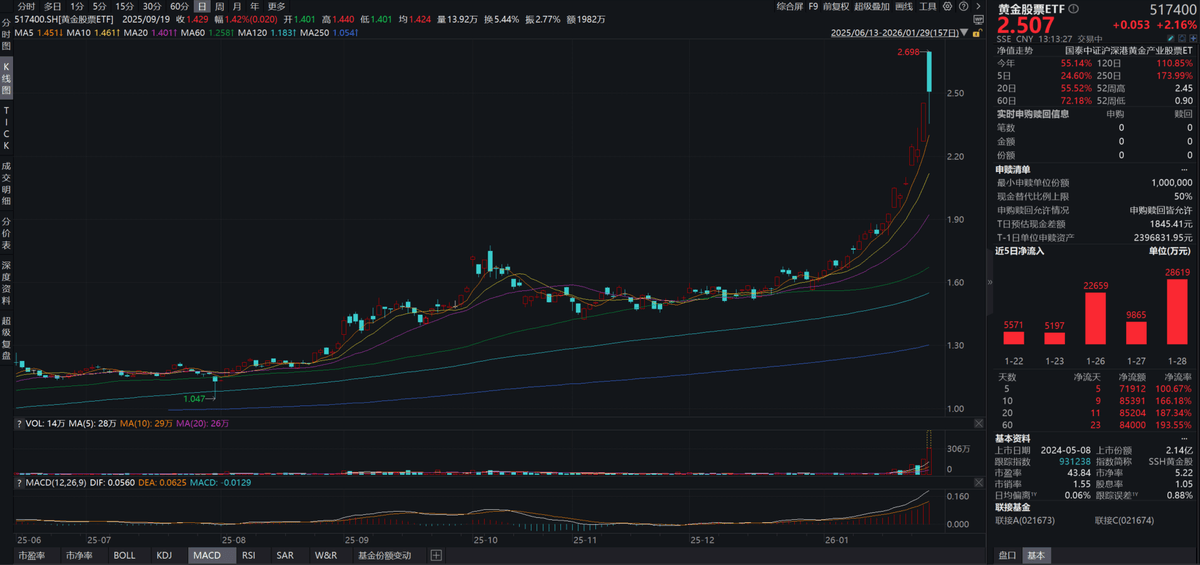
现货黄金加速冲上5500,黄金强周期来袭!
Sou Hu Cai Jing· 2026-01-29 05:25
Core Viewpoint - The recent surge in gold prices, surpassing $5,500 per ounce, signifies a profound shift in the global macroeconomic landscape, reflecting a transition in industrial demand paradigms and a reassessment of resource strategic value [3][4]. Group 1: Market Dynamics - Gold prices have recently broken the $5,500 mark, driven by a shift from traditional inflation hedging to a focus on hedging against changes in the global monetary credit system [4][5]. - The recent increase in gold ETF inflows, with over 5% gains and net inflows exceeding 5.8 billion yuan in the last 20 trading days, indicates strong market interest [1][4]. - The total open interest in gold futures has accelerated, reflecting a robust buying force from central banks and institutional asset reallocations [4][5]. Group 2: Macro Environment - The current macro environment is characterized by "de-globalization" and "resource nationalism," leading to strategic control over key mineral resources and creating supply constraints that elevate the strategic premium of all resources [6][7]. - Political factors are increasingly influencing the supply side of mineral resources, with countries implementing policies to strengthen control over domestic resources [7][8]. Group 3: Investment Strategies - The financial environment, marked by the Federal Reserve entering a rate-cutting cycle, reduces the opportunity cost of holding non-yielding assets like gold, providing a favorable liquidity backdrop for gold price increases [5][6]. - The demand for gold is being driven by geopolitical uncertainties and the traditional role of gold as a safe-haven asset, with increasing interest from central banks as long-term buyers [5][9]. - Investment banks, including Goldman Sachs, have raised gold price forecasts, predicting a potential rise to $6,000 per ounce in the spring of 2026, driven by structural changes in central bank gold purchasing behavior [8][9].
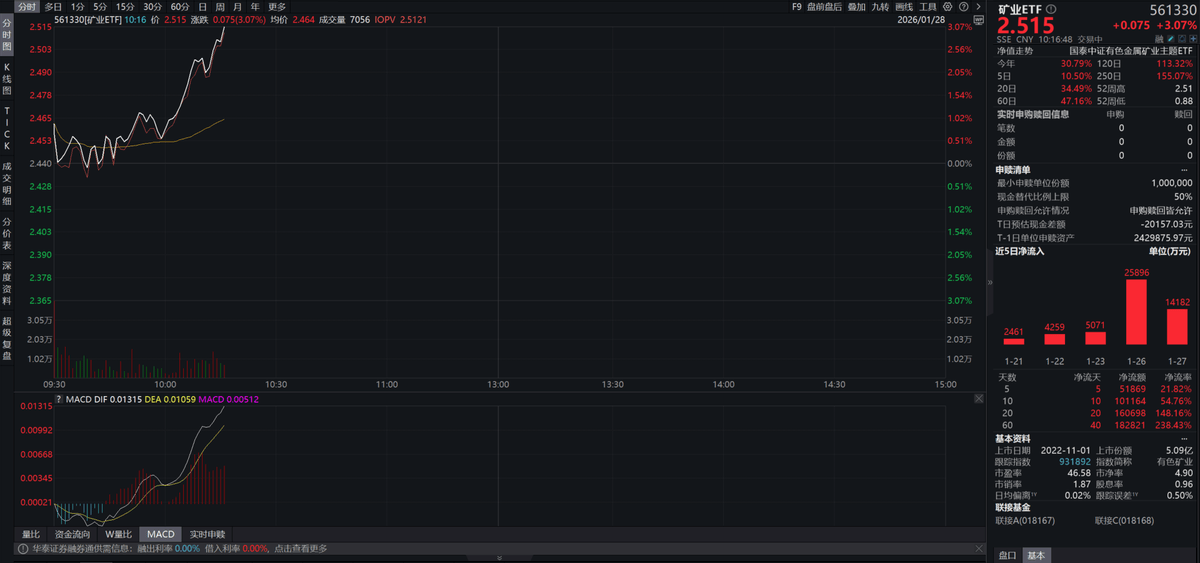
国际金价突破5200美元/盎司大关,有色金属牛市持续,矿业ETF(561330)大涨超3%
Sou Hu Cai Jing· 2026-01-28 02:41
Core Viewpoint - Recent surge in international gold prices surpassing $5200 per ounce has initiated a structural bull market in the non-ferrous metals sector, with significant inflows into the mining ETF (561330) exceeding 1.6 billion yuan over 20 consecutive days [1][3] Group 1: Market Performance - The mining ETF (561330) has seen a broad increase in its constituent stocks, with most of the top ten stocks experiencing gains [3] - The top ten constituent stocks of the mining ETF include Zijin Mining, Luoyang Aluminum, and Northern Rare Earth, with Zijin Mining showing a 3.67% increase and Luoyang Aluminum a 3.68% increase [4] Group 2: Macro Drivers - The current bull market in non-ferrous metals is driven by multiple factors, including de-globalization, de-dollarization, and macroeconomic cycles [5] - De-globalization has led to resource nationalism, with major resource countries implementing export controls and taxes to secure strategic resources, increasing the geopolitical value of these resources [5] - The acceleration of de-dollarization is evidenced by countries like Denmark and Sweden reducing their U.S. Treasury holdings, while nations like India are repatriating gold reserves, indicating a shift away from dollar-denominated assets [6] - The synchronization of macro policy cycles between China and the U.S. is expected to provide support for global industrial metal prices, particularly in 2026 [7] Group 3: Gold Market Insights - Gold's rise above $5200 per ounce reflects a reassessment of its monetary attributes amid the de-dollarization trend, with central banks continuing to accumulate gold [8][9] - The demand for gold is being driven by geopolitical tensions and the increasing appeal of gold as a safe-haven asset [10] - Institutional investors are beginning to allocate gold as an alternative to U.S. Treasury bonds, marking a significant shift in asset allocation strategies [11] Group 4: Industrial and Energy Metals - Industrial metals like copper and aluminum are experiencing a shift in demand from traditional infrastructure to AI and energy revolution, while supply constraints persist due to resource nationalism and insufficient capital expenditure [12] - Copper is facing structural shortages due to increased demand from sectors like AI data centers and electric vehicles, while supply is hindered by declining ore grades and geopolitical disruptions [13] - Aluminum supply is constrained by domestic carbon goals and high energy costs abroad, with demand expanding into high-growth areas like lightweighting for electric vehicles [13] - Lithium demand is surging due to the growth of energy storage markets, leading to a tightening supply-demand balance [13] Group 5: Investment Strategy - The non-ferrous metals market is transitioning from futures prices to equity markets, with a focus on the mining ETF (561330) as a more stable investment option [15] - The mining ETF (561330) has outperformed other non-ferrous ETFs, with a cumulative increase of 296.64% since its inception in 2013, indicating strong historical performance [16] - The mining ETF focuses on upstream resource leaders, providing higher profit elasticity and valuation opportunities during price increases [21]
MONGOL MINING(00975.HK):黑金稳基 黄金启航 积极转型多元化矿企
Ge Long Hui· 2026-01-27 05:49
Group 1: Core Business and Performance - The coal business serves as the company's cornerstone, with a stable position and focus on quality improvement and efficiency [1] - The company is the largest producer and exporter of washed coal in Mongolia, with a peak raw coal production of 16.34 million tons expected in 2024 [1] - The company has increased the proportion of sales through MSE auctions to 55%, effectively capturing sales premiums [1] - Historical performance has been heavily reliant on a single coal product, leading to significant cyclicality and past losses during downturns [1] Group 2: Diversification and Growth Opportunities - The company is actively diversifying into gold and copper to mitigate risks associated with coal price fluctuations [1][2] - The BKH gold mine is expected to start commercial production in September 2025, with a projected full production of 85,000 ounces by 2027 and an anticipated net profit contribution of over $100 million in 2026 [2] - The acquisition of a 50.5% stake in UCC provides access to the White Hill copper-gold project, with resources totaling approximately 185,000 tons of copper and 5,200 ounces of gold [2] Group 3: Political and Economic Environment - Mongolia's "resource nationalism" poses a core political risk for the mining industry, with the government increasingly focused on controlling mineral resources [3] - The mining sector significantly contributes to Mongolia's GDP growth, with mining and transportation expected to contribute 2.7% to GDP growth in 2024 [3] - Recent legislative changes allow the government to acquire up to 50% of strategic mineral deposits without compensation, which could impact foreign investments [3] Group 4: Investment Outlook - The company is positioned as a leading player in Mongolia's coking coal sector, with high-quality resources and geographical advantages near the Chinese market [3] - The diversification strategy, including the operationalization of the BKH gold mine, is expected to transform the company into a comprehensive mining entity in Mongolia [3] - Projected net profits for the company are estimated at $93 million, $263 million, and $377 million for the years 2025 to 2027, respectively, with a PE ratio of less than 7 for 2026 [3]
MONGOLMINING:深度研究黑金稳基,黄金启航,积极转型多元化矿企-20260126
东方财富· 2026-01-26 07:40
Investment Rating - The report assigns a "Buy" rating for the company, marking its first coverage [2][5]. Core Insights - The company is the largest coal producer and exporter in Mongolia, with a strong focus on diversification into gold and copper mining to mitigate risks associated with its coal business [4][5]. - The coal business remains the company's cornerstone, with a peak production of 16.34 million tons expected in 2024, while the newly developed gold business is anticipated to contribute over $100 million in net profit in 2026 [4][5]. - The company has a robust geographical advantage due to its proximity to the Chinese market, which supports its coal sales [5][24]. Summary by Relevant Sections Company Overview - The company is the first Mongolian enterprise listed on international capital markets and operates in the Tavan Tolgoi coalfield, managing two open-pit coal mines, UHG and BN [13][15]. - The company aims to enhance shareholder value while contributing to Mongolia's development through modern technology and responsible mining practices [14][13]. Coal Business - The company operates in a world-class coalfield, producing high-quality hard coking coal, with significant reserves of 340 million tons at UHG and 272 million tons at BN [24][25]. - In 2024, the company expects to achieve a peak coal production of 16.34 million tons, with a significant increase in sales through the Mongolian Stock Exchange (MSE) [39][44]. - The average production cost of coal has increased from $31.4 per ton in 2017 to $41.1 per ton in 2024, reflecting a compound annual growth rate of 4% [50][51]. Gold Business - The BKH gold mine commenced commercial production in September 2025, with expectations to reach full production of 85,000 ounces by 2027, contributing significantly to the company's revenue [4][5]. - The gold business is viewed as a second growth curve for the company, with low all-in sustaining costs (AISC) enhancing profitability [5][41]. Copper Business - The acquisition of a 50.5% stake in UCC provides access to the White Hill copper-gold project, which is expected to further diversify the company's revenue streams [4][5]. Political and Economic Context - The company operates in a politically sensitive environment characterized by "resource nationalism," which poses risks but is manageable due to the company's established position and diversification strategy [4][5]. - The mining sector significantly contributes to Mongolia's GDP, with mining and transportation expected to account for a 2.7% increase in GDP in 2024 [4][5]. Financial Projections - The company forecasts net profits of $0.93 million, $2.63 million, and $3.77 million for the years 2025, 2026, and 2027, respectively, with a PE ratio of less than 7 for 2026 [5][6].
MONGOL MINING(00975):深度研究:黑金稳基,黄金启航,积极转型多元化矿企
East Money Securities· 2026-01-26 05:07
Investment Rating - The report assigns a "Buy" rating for the company, marking its first coverage [5]. Core Views - The company is positioned as the leading coal producer in Mongolia, with a strong geographical advantage near the Chinese market. It is diversifying beyond coal into gold and copper, which are expected to contribute significantly to future profits [5][13]. - The gold business, initiated with the BKH gold mine, is projected to generate over $100 million in net profit by 2026, marking a substantial second growth curve for the company [5][6]. - The copper business, through the acquisition of UCC, is seen as a long-term growth opportunity, with plans for feasibility studies on the White Hill copper deposit [5][6]. Summary by Sections Company Overview - The company is the largest private mining enterprise in Mongolia, primarily engaged in coal production and export, with ongoing diversification into gold and copper [13]. - It was the first Mongolian company to list on the international capital market, with significant assets located in the Tavan Tolgoi coalfield [13][15]. Coal Business - The company operates two major coal mines, UHG and BN, with substantial coal reserves of 340 million tons and 272 million tons respectively, primarily producing high-quality hard coking coal [24][25]. - In 2024, the company achieved a peak raw coal production of 16.34 million tons, with a significant increase in sales through competitive bidding [39][41]. - The average selling price of coal is influenced by domestic market trends, with recent prices at $106 and $121 per ton for 2023 and 2024 respectively [44]. Gold Business - The BKH gold mine commenced commercial production in September 2025, with expectations to reach full production of 85,000 ounces by 2027 [5][6]. - The low All-In Sustaining Cost (AISC) of the gold business positions it as a high-margin contributor to the company's overall profitability [5]. Copper Business - The acquisition of a 50.5% stake in UCC provides access to the White Hill copper-gold project, which contains approximately 185,000 tons of copper and 52,000 ounces of gold [5][6]. - The company plans to conduct feasibility studies on the copper deposit to further reduce reliance on coal [5]. Financial Projections - The company forecasts net profits of $0.93 million, $2.63 million, and $3.77 million for the years 2025, 2026, and 2027 respectively, with a PE ratio of less than 7 for 2026 [5][6].