服务消费

Search documents
详解10月经济数据:工业增速高位放缓,服务消费成为重要增长点
Di Yi Cai Jing Zi Xun· 2025-11-14 09:15
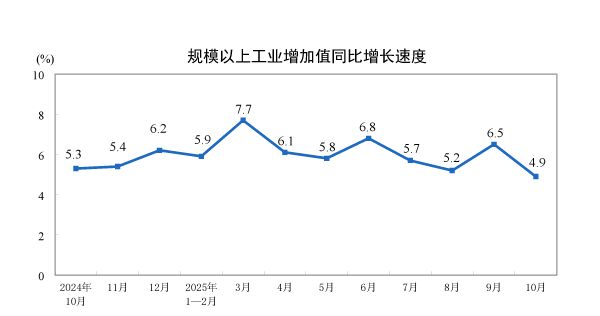
Economic Overview - In October, the industrial added value above designated size grew by 4.9% year-on-year, a slowdown of 1.6 percentage points compared to September [1][3] - The total retail sales of consumer goods increased by 2.9% year-on-year, slightly down by 0.1 percentage points from September [1] - From January to October, fixed asset investment (excluding rural households) reached 4089.14 billion yuan, a year-on-year decline of 1.7% [1][9] Industrial Performance - Despite a complex international environment and increased domestic market competition, industrial production maintained steady growth, with a year-on-year increase of 6.1% from January to October [3] - Among 41 major industries, 29 reported growth in added value, accounting for 70.7% [3] - The production of 50.2% of 623 major products showed growth [3] Consumer Trends - From January to October, the total retail sales of consumer goods increased by 4.3%, with service retail sales growing by 5.3% [6] - The "old-for-new" consumption policy has positively impacted sales, particularly in communication equipment and cultural office supplies, which saw year-on-year increases of 23.2% and 13.5%, respectively [6] - Online retail sales rose by 9.6% year-on-year, with physical goods retail growing by 6.3%, indicating a shift towards digital and green consumption [6] Investment Dynamics - Fixed asset investment saw a decline of 1.62% month-on-month in October, with private fixed asset investment down by 4.5% year-on-year [9] - Real estate investment dropped by 14.7% year-on-year, significantly impacting overall investment growth [9][10] - Manufacturing investment grew by 2.7% year-on-year, accounting for 25.6% of total investment, indicating a shift towards optimizing investment structure [9][10] High-Tech and Green Investment - Investment in high-tech sectors such as aerospace and information services grew by 19.7% and 32.7% year-on-year, respectively [10] - Clean energy investments, including solar, wind, nuclear, and hydropower, increased by 10.4% year-on-year, reflecting a strong trend towards green transformation [10]

国家统计局贸经司首席统计师袁彦解读10月份消费市场数据
Guo Jia Tong Ji Ju· 2025-11-14 07:03
Core Insights - The consumer market in October showed stable growth, with a notable increase in service consumption and a positive trend in sales of essential and some upgraded goods [1] Group 1: Service Retail Growth - Service retail sales accelerated, with a year-on-year growth of 5.3% from January to October, outpacing the growth of goods retail sales by 0.9 percentage points [2] - The National Day and Mid-Autumn Festival holidays led to increased spending in dining, accommodation, and transportation, with dining revenue growing by 3.8% in October [2] Group 2: Consumer Goods Market Performance - The total retail sales of consumer goods exceeded 40 trillion yuan, with a year-on-year growth of 4.3% from January to October, which is 0.8 percentage points higher than the previous year [3] - Sales in rural areas outpaced urban markets, with rural retail sales growing by 4.6% compared to urban areas [3] Group 3: Sales of Essential and Upgraded Goods - Over 70% of retail categories in large-scale units saw growth in October, with essential goods sales showing strong performance [4] - Notable growth in upgraded goods, such as communication devices and cultural office supplies, with year-on-year increases of 23.2% and 13.5% respectively [4] Group 4: E-commerce and New Retail Formats - Online retail sales grew by 9.6% from January to October, with physical goods online sales increasing by 6.3% [5] - New retail formats, including membership warehouses and unmanned stores, continued to thrive, with traditional retail adapting through supply chain optimization [5] Group 5: Future Outlook - The overall operation of the consumer market remains stable, with plans to implement policies to boost consumption and innovate new consumption scenarios [6]
国家统计局:服务消费增长日益成为居民消费的重要增长点
Zheng Quan Shi Bao Wang· 2025-11-14 03:04
从结构看,一是文旅服务增势较好,二是信息服务较快增长,数字影音、网络娱乐等服务需求持续扩 大。此外,假期期间居民外出就餐增加。从新兴消费看,数字消费和绿色消费在持续壮大。 付凌晖表示,我国正处在消费结构升级的关键阶段,文化旅游、医疗健康等消费发展空间广阔,银发经 济、首发经济等快速发展也为消费扩大注入新动能。 人民财讯11月14日电,11月14日,国家统计局新闻发言人、总经济师、国民经济综合统计司司长付凌晖 在国新办新闻发布会上表示,我国居民消费正在加快转型,服务消费增长日益成为居民消费的重要增长 点。在国庆中秋假日的因素带动下,10月份的服务消费持续较快增长,1—10月份服务零售额比1—9月 份是加快0.1个百分点,高于同期商品零售额的增速是0.9个百分点。 ...
风物长宜放眼量:迎接服务、文娱消费的蓝海!多家私募集聚“金长江”私募服务系列沙龙
券商中国· 2025-11-13 09:03
Core Viewpoint - The Chinese private equity industry is transitioning from quantitative expansion to qualitative transformation, supported by the "Golden Yangtze" private equity empowerment plan launched by Changjiang Securities, Industrial Bank, and Securities Times, focusing on research, funding, trading, and branding [1][4]. Group 1: Market Overview - As of late October, the Shanghai Composite Index returned to 4000 points after ten years, indicating a significant recovery in market sentiment, with private equity performance and issuance showing remarkable improvement, leading to a rapid increase in the number of billion-yuan private equity firms to 113 [3]. - The current capital market is experiencing a strategic opportunity period, with the A-share market steadily rising and private equity management scale reaching a historical high [4]. Group 2: Economic and Industry Trends - The "14th Five-Year Plan" emphasizes increasing consumer rates and enhancing consumption capacity, with consumption expected to contribute approximately 63% to economic growth during this period [5]. - The next five years are anticipated to see a boom in service and entertainment consumption, driven by a growing middle-income group in China [5]. Group 3: Private Equity Insights - Many private equity institutions remain optimistic about the current market, believing that overall valuations are within a reasonable range, despite recent market fluctuations [6]. - The market has seen a shift in style from value and micro-cap stocks to large-cap growth stocks, influenced by macroeconomic trends and industry dynamics [6]. Group 4: Investment Strategies - Investment strategies are becoming more complex due to increasing market divergence and geopolitical risks, necessitating higher demands for strategy selection and risk management [7]. - Quantitative strategies are gaining traction as tools for both relative and absolute return products, allowing investors to better navigate market volatility [7]. Group 5: Sector Focus - The technology growth sectors, particularly AI and robotics, are expected to remain key market themes, although careful selection and timing will be crucial due to increased competition within these sectors [8]. - Traditional manufacturing sectors are anticipated to gradually see price and profit recovery, presenting new investment opportunities [8]. Group 6: Market Dynamics - The current A-share market exhibits characteristics of strong indices alongside individual stock divergence, with a notable rotation among sectors [10]. - The market is entering a consolidation phase, with historical patterns suggesting that even in bull markets, periods of adjustment are common [12].

电商渗透率见顶 消费结构迎来深刻转型
Xin Lang Cai Jing· 2025-11-11 21:14
Core Insights - The e-commerce penetration rate in China has peaked at 27.6% in 2023 and is projected to decline to 26.8% in 2024, with the current rate around 25% [1][2] - This stagnation in e-commerce penetration does not indicate a decline in consumption but rather reflects a significant shift in consumer spending from goods to services, particularly in education, culture, and entertainment [1][2] E-commerce Trends - The growth of e-commerce is now facing limitations as consumers increasingly prefer experiential and personalized services over standardized goods, leading to a transformation in consumption patterns [2] - Major e-commerce platforms are adapting by integrating online and offline experiences through "instant retail" models, aiming to cover all aspects of consumer needs [2] Consumer Spending Insights - In the first nine months of this year, per capita spending on education, culture, and entertainment increased by 10.3%, significantly outpacing growth in traditional goods categories [1] - Online service consumption grew by 20.2%, and instant e-commerce sales surged by 24.3%, indicating a shift towards digital and service-oriented spending [2] Strategic Adaptations - Both e-commerce platforms and offline commercial facilities are seeking to enhance consumer experiences by linking immersive and interactive service consumption with physical goods [2][3] - The focus on understanding consumer experience and trust is crucial for the growth and competitiveness of both e-commerce and physical retail environments [3]

人气爆棚!中信证券:权益资产红利时代刚刚开始
中国基金报· 2025-11-11 10:23
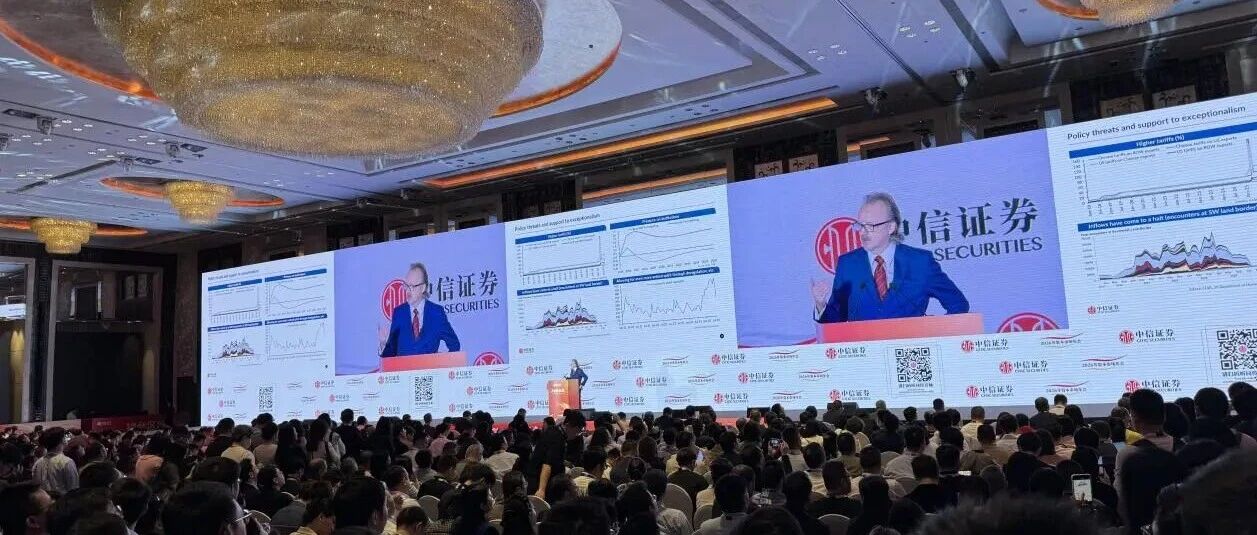
Core Viewpoint - The 2026 Capital Market Conference hosted by CITIC Securities emphasizes the positive momentum in China's capital market, driven by enhanced international influence, improved positioning in the global value chain, and a mature market ecosystem [2][11]. Group 1: Conference Overview - The conference took place from November 11 to 13, 2026, in Shenzhen, with the theme "Striving for a New Journey" [2]. - Over 4,000 attendees participated in person, while 33,000 viewers joined online via CITIC Securities' live streaming platform [5]. - The event featured more than 100 speakers and over 20 sub-forums covering various topics, including global economic outlook and AI applications [6]. Group 2: Economic Insights - CITIC Securities' Chief Economist predicts a GDP growth rate of approximately 4.9% for 2026, with a more proactive fiscal policy expected [11][12]. - The macroeconomic policy is anticipated to support economic recovery, with a focus on demand-side balance and service consumption as a key highlight [13][14]. Group 3: Market Trends - The equity market is seen as entering a new era of dividends, with a shift from real estate to equity assets in wealth allocation [5][15]. - The A-share market is transitioning from local exposure to global exposure, enhancing its position in the global value chain, which is fundamental for a stable market environment [15][16]. Group 4: Strategic Focus - The conference highlighted three key areas for industry focus: upgrading traditional manufacturing, expanding global presence, and leveraging AI for commercial applications [16]. - The emphasis on long-term participation and a stable investment approach is crucial in navigating the evolving market landscape [16].

社会服务行业2025Q3基金持仓分析报告:重仓比例环比减配,酒店餐饮底部布局
Wanlian Securities· 2025-11-11 10:02
Investment Rating - The industry is rated as "Outperforming the Market" with an expected increase of over 10% relative to the market index in the next six months [5][40]. Core Insights - The social service industry has seen a significant reduction in heavy positions, with a total market value of 4.595 billion yuan, down by 1.630 billion yuan from the previous quarter [2][10]. - The heavy position ratio for the social service industry is currently at 0.05%, which is significantly lower than the five-year average of 0.44%, indicating potential for rebound [2][10]. - The report highlights a general decline in the overweight ratios across various sub-sectors, with the hotel and catering sector maintaining a low position ratio of 0.02% [3][19]. - The report suggests that service consumption is accelerating towards becoming the mainstay of household consumption, driven by policies aimed at expanding service consumption [4][39]. Summary by Sections Heavy Position Analysis - The number of funds holding heavy positions in the social service industry decreased from 177 to 10, with a total market value of 4.595 billion yuan [2][10]. - The heavy position ratio ranks 30th among 31 first-level industries, indicating a low allocation compared to historical levels [2][10]. Sub-sector Performance - The hotel and catering sector's heavy position ratio has remained stable at 0.02%, while the tourism and scenic area sector has seen a slight decline to 0.01% [3][19]. - The professional services sector experienced a minor decrease, with a heavy position ratio of 0.02% [3][19]. Individual Stock Performance - The top ten stocks in the social service sector saw a combined heavy position ratio of 0.045%, down from the previous quarter [3][28]. - Notable stocks include Shoulu Hotel, which maintains the highest heavy position ratio, and Tongqing Tower, which has entered the top ten for the first time this year [3][28]. Investment Recommendations - The report recommends focusing on sectors benefiting from policy support, including cultural tourism, sports, and education, as these areas are expected to see growth due to favorable policies [4][39].


“双十一”的消费进化论
Xin Lang Zheng Quan· 2025-11-11 08:25
Group 1 - The "Double Eleven" shopping festival has started earlier this year, with major platforms like Tmall reporting significant sales figures, including 80 brands exceeding 100 million yuan in sales within the first hour [1] - New entrants like Xiaohongshu have also shown strong performance, with a 77% year-on-year increase in purchasing users and a 73% increase in transaction orders on the first day [1] Group 2 - The early start of promotions has led to a decrease in discussion around "Double Eleven" on November 11, with the consumer market showing mixed performance [2] - The food and beverage sector saw a notable increase of 3.22% on November 10, while traditional consumer sectors have been relatively quiet [2] Group 3 - The consumer sector has adjusted valuations, providing a safety margin for investors, with the food and beverage index currently at a price-to-earnings ratio of 21.29, which is low compared to the past decade [3] - The domestic consumer market shows resilience, supported by a large population and ongoing improvements in living standards, leading to a diverse demand landscape [3] Group 4 - Structural opportunities within the consumer sector are emerging, with new trends like emotional consumption and the silver economy driving growth [4] - The integration of technology in the consumer space is transforming the market, with companies like Tmall and JD.com emphasizing the role of AI in enhancing consumer experiences [4] Group 5 - After recent adjustments, valuations in traditional sectors have compressed, but leading companies maintain strong positions with robust cash flows and attractive dividend yields [5] - In the new consumption sector, despite high overall sentiment, there is significant valuation differentiation, necessitating careful selection of companies with strong brand and channel advantages [6]

贵州:四大举措扩消费,促进经济稳定向好
Sou Hu Cai Jing· 2025-11-10 08:45
Core Insights - The Guizhou provincial government is implementing measures to stimulate consumer spending and promote economic recovery, as highlighted in a recent press conference [1][4]. Consumer Market Performance - In the first three quarters, Guizhou's total retail sales of consumer goods increased by 3.8%, with retail sales of above-designated size growing by 5.1%, surpassing the national average by 0.2% [4]. - The value added in wholesale and retail, as well as accommodation and catering industries, grew by 5.7% and 5.3%, respectively, also exceeding national averages [4]. Characteristics of Consumption - Strong support for commodity consumption is evident, with significant participation in trade-in programs for automobiles and home appliances, resulting in a total consumption of 49.762 billion yuan [4]. - The province has seen a notable increase in the replacement of automobiles (20.7%) and communication equipment (42.6%) [4]. Service Consumption Potential - A new initiative launched in October aims to enhance service consumption across various sectors, including dining, accommodation, and entertainment, with a focus on quality improvement [5]. - New business formats such as specialty coffee and craft beer have seen rapid growth, with a 52.8% increase in coffee and tea consumption in Guiyang [5]. New Consumption Drivers - The implementation of the "Ten Hundred Thousand" e-commerce development project has led to the establishment of multiple e-commerce demonstration parks and bases, contributing to a 12.6% increase in online retail sales, totaling 104.93 billion yuan [6]. - The launch of the "One Code Guizhou" online exhibition for local liquor aims to boost digital consumption [6]. Consumption Scene Activation - Guizhou has developed 140 commercial districts and 116 pedestrian streets, enhancing the shopping experience and attracting tourists [7]. - Various promotional activities have been organized around key consumption periods, generating over 2 billion yuan in retail and dining consumption [7]. Policy Measures for Consumption Expansion - The provincial government is continuing to promote trade-in programs for consumer goods, with new policies aimed at facilitating automobile replacement and upgrades [8]. - A new subsidy program for purchasing new cars has been introduced, offering financial incentives based on the price of the vehicle [8]. Support for Key Industries - Recent measures have been introduced to support the development of the catering and retail sectors, with specific initiatives aimed at assisting businesses facing challenges [9]. - The government is actively working to implement consumption promotion policies and provide targeted support to the wholesale, retail, accommodation, and catering industries [9].

贵州“以旧换新”见成效 带动消费近500亿元
Sou Hu Cai Jing· 2025-11-10 06:22
Group 1 - The core viewpoint of the articles highlights the steady growth of the consumer market in Guizhou Province, with a 3.8% year-on-year increase in total retail sales of consumer goods in the first three quarters of the year [1] - Retail sales of limited consumer goods increased by 5.1%, surpassing the national average by 0.2 percentage points, indicating a robust performance in the wholesale and retail sectors [1] - The province has implemented national subsidy policies to promote the replacement of old vehicles and appliances, resulting in significant consumer engagement and a total consumption boost of 497.62 billion yuan [1] Group 2 - New service consumption potentials are being released, with new business formats like boutique coffee and new tea drinks growing by 52.8% in the first three quarters [2] - The government has issued implementation opinions to enhance the quality of service consumption in areas such as dining, tourism, and elderly care [2] - E-commerce is thriving, with online retail sales reaching 1,049.3 billion yuan, marking a 12.6% increase, supported by initiatives like the "Ten Hundred Thousand" project [2] Group 3 - The province has accelerated innovation in consumption scenarios, creating 140 commercial circles and 116 pedestrian streets, enhancing the shopping experience for consumers [3] - Specific measures to boost consumption include extending the old-for-new policy, optimizing vehicle replacement subsidies, and implementing support policies for various industries [3] - The introduction of a tax refund policy for outbound travelers has improved shopping convenience for international visitors, further stimulating local consumption [3]