
贸易战

Search documents
外汇商品 | 人民币汇率:不一样的升值周期
Sou Hu Cai Jing· 2025-10-12 00:31
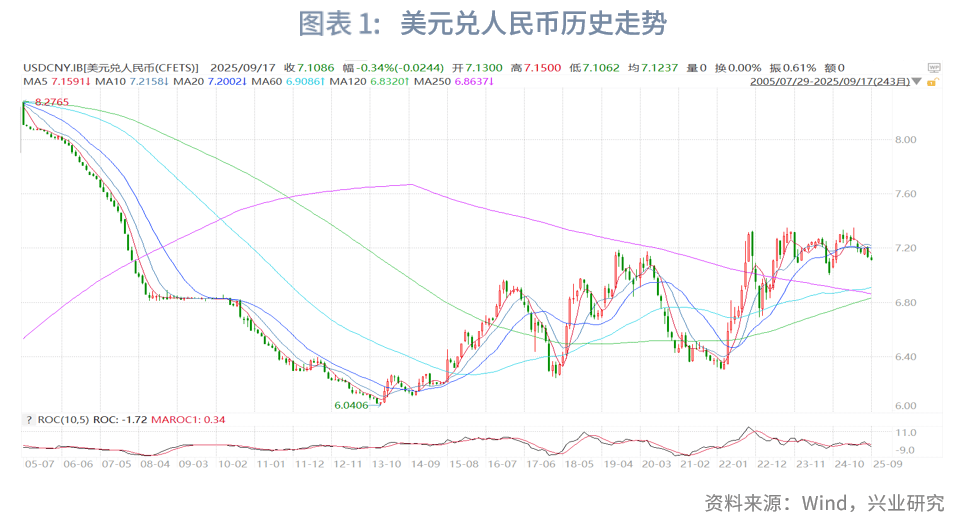
Core Viewpoint - The current appreciation cycle of the RMB is characterized by a smaller magnitude compared to previous cycles, primarily driven by the Federal Reserve's monetary policy and domestic factors such as the transition of the RMB into a financing currency and trade war hedging needs [1][4][11]. External Drivers - The external factors influencing the RMB exchange rate include the US dollar index and US dollar interest rates, with a focus on domestic dollar liquidity due to China's incomplete capital account convertibility [4][5]. - The current weakening of the dollar index is attributed to the divergence in monetary policies among major economies and increased hedging against dollar depreciation risks by market institutions [4][11]. Internal Drivers - The domestic environment is characterized by a "loose monetary + loose credit" cycle, contrasting with previous appreciation cycles that featured "tight monetary + loose credit" conditions, contributing to the smaller magnitude of the current appreciation [7][11]. - The RMB has shifted from being an investment currency to a financing currency, which, combined with low exchange rate elasticity, leads to a market preference for holding long positions in USD against RMB, thus suppressing the appreciation potential [11][13]. Market Outlook - The RMB is expected to remain in the current appreciation cycle until at least mid-next year, driven by the Federal Reserve's continued easing and the anticipated release of pending settlement orders [13][15]. - The fourth quarter may see a slight rebound in the dollar index, influenced by external factors, but the overall trend for the RMB remains upward, with caution advised for locking in exchange rates before the Spring Festival [18].

特朗普威胁对华加征100%关税,美股应声暴跌背后是什么
Sou Hu Cai Jing· 2025-10-11 15:01
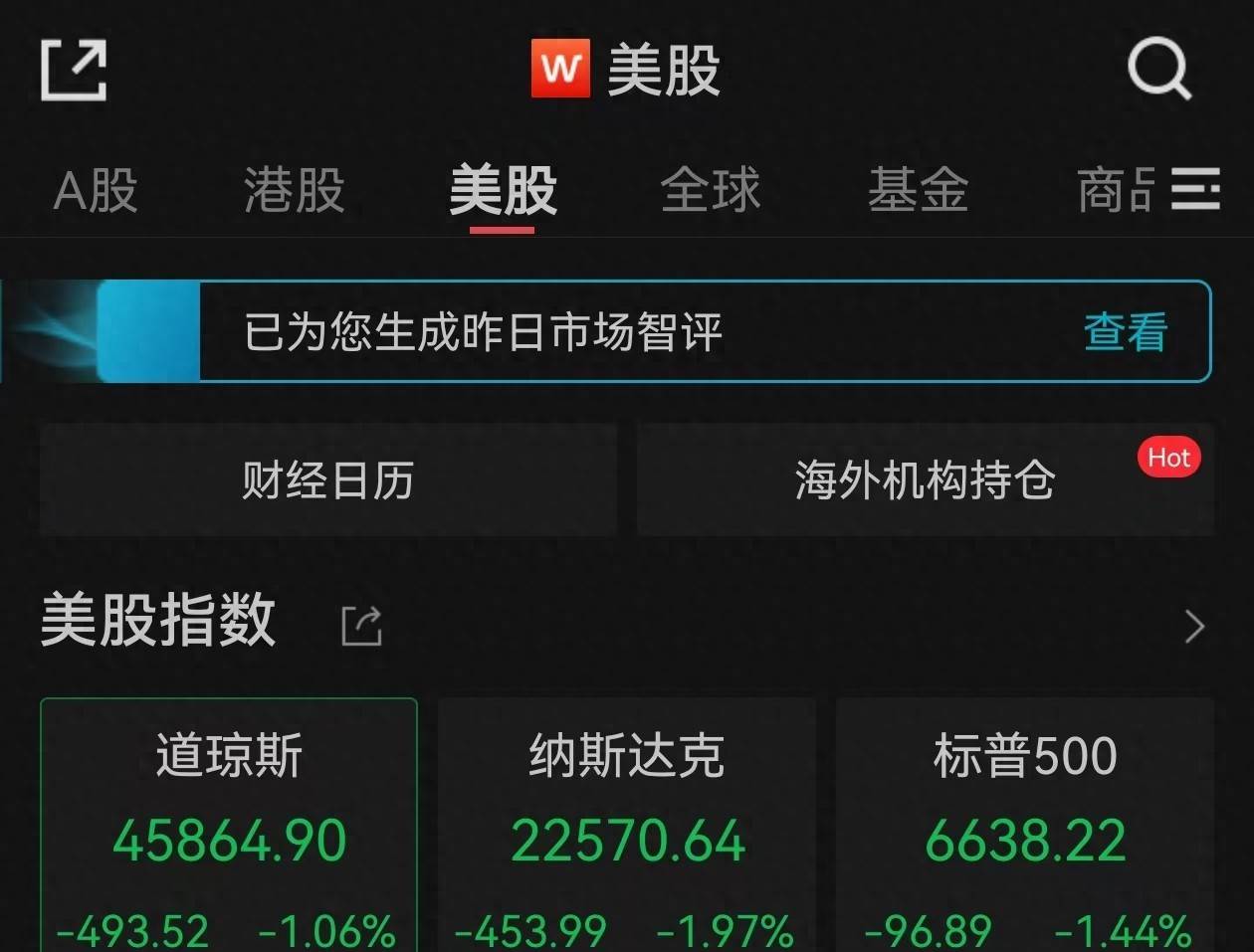
Core Viewpoint - The sudden announcement by Trump regarding additional tariffs on China has triggered a significant sell-off in the U.S. stock market, leading to fears of an escalating trade war and impacting major technology stocks [1][3][8]. Market Reaction - On October 10, U.S. stock indices experienced a sharp decline, with the Dow Jones dropping by 1.9%, the S&P 500 by 2.71%, and the Nasdaq by 3.56%, marking the largest single-day drop since April [1][3]. - Major technology stocks were heavily affected, with TSMC ADR falling over 6%, Broadcom and Tesla down over 5%, and Nvidia, Amazon, Apple, and Meta all experiencing declines of more than 3% [3][9]. - The Philadelphia Semiconductor Index plummeted by 4.7%, reflecting the severe impact on the semiconductor sector [9]. Trade War Context - Trump's tariff threat is a direct response to China's stringent export controls on rare earth materials, which are crucial for high-tech and military applications [4][11]. - China has implemented new regulations requiring foreign companies to obtain approval for transporting materials containing trace amounts of Chinese rare earth elements, particularly targeting the semiconductor industry [4][6]. Strategic Importance of Rare Earths - Rare earth elements are vital for modern technology and military applications, with each F-35 fighter jet requiring approximately 417 kilograms of rare earth materials [5]. - The U.S. Department of Defense relies on China for over 90% of its rare earth materials, highlighting the strategic dependency [6][12]. Supply Chain Concerns - U.S. chip companies are urgently assessing which products contain Chinese rare earths, fearing that China's licensing requirements could disrupt their supply chains [7]. - Analysts estimate that establishing a complete rare earth supply chain in the U.S. could take at least eight years, while Trump's proposed tariffs could be implemented as early as November 1 [14][15]. Broader Implications - The conflict over rare earths signifies a broader struggle for technological dominance, with potential ramifications for global supply chains and technology competition [11][15]. - The situation reflects a shift from resource-based disputes to technology-based blockades, indicating an intensifying trade confrontation between the U.S. and China [15].



美股突然暴跌,特朗普又来关税威胁,这回会出啥事?
Sou Hu Cai Jing· 2025-10-11 07:52
北京时间10月10号夜里,美股突然大跌。纳指盘中狂跌450多点,道指标普也跟着掉下来。到11号凌晨,三大指数全线下滑,市场慌得要命,不少钱都跑去 了债券和黄金。 特朗普10号在美国社交网站上说要对中国商品加征巨额关税。这话一出,华尔街立马慌了,一堆人开始抛股票。之前还在涨的美股全抹了回去,美元也跌 了。 这事发生当天刚好是周五,消息传得特别快。交易员们接到消息后马上卖股票,生怕损失更多。彭博社报道说市场直接从涨变跌,连带着避险资产价格都涨 了。 没人知道特朗普到底要加多少税,具体针对哪些商品。但他说得挺狠,市场立刻反应了。不少科技股跌得厉害,毕竟这些公司跟中国生意多,怕受影响大。 第二天亚洲股市开盘时,东京和香港股市也跟着跌了。大宗商品价格波动变大,全世界市场好像都受牵连了。这种连锁反应以前也见过,但这次跌幅格外明 显。 专家们议论纷纷,有人觉得特朗普是为了选票才这么闹,有人说是想给中美谈判施压。反正关税一高美国自家物价也会涨,美联储加息政策会不会受影响还 不清楚。 现在钱都往安全的地方躲,黄金和国债买的人多了。不少机构开始调整投资,不再赌风险而是专注保本。这种防御策略可能会持续一阵子。 科技公司已经在东南亚 ...
美高层绕过法令,再发长文加征100%关税,美媒:挑起了一场美国必败的博弈
Sou Hu Cai Jing· 2025-10-11 07:49
在此之前,该经济体已打出精准组合拳:从稀土出口管制到对美企反垄断调查,再到对美籍船舶加征费用,环环相扣,既打击美关键产业,又在规则层面占 据道义高地。如今,该经济体手握稀土、市场、制造三大王牌,反制措施合法合规,博弈策略从被动防御转为主动设局。这场博弈让我们看到,该经济体国 力日益强盛,在面对无理挑衅时,既有能力也有底气进行有力反制。我们坚信,该经济体将在这场博弈中坚定前行,维护国家利益,书写新的辉煌篇章。 此次美高层暴怒源于战略误判。其仍认为对方依赖美市场,却忽视该经济体半导体产业链自主加速、外贸结构深度重构等根本转变。反观美方,财政赤字高 企、债务飙升、制造业回流成效有限,此时加征关税无异于火上浇油。 美东部时间10月10日上午,美高层在社交平台发千字长文,威胁对某经济体商品"大规模加征关税",以回应对方稀土出口管制措施。消息发布仅3分钟,标 普500指数市值瞬间蒸发7000亿美元,当日美股遭遇4月以来最惨烈暴跌:道指重挫878点,纳指暴跌3.56%,科技股全线崩盘,全日蒸发1.65万亿美元。市场 用剧烈波动宣告,对"美高层式贸易战"的恐慌已达顶点。 当日美股闭市后,美高层再度发文,抛出更激进威胁:自20 ...
视频|杨德龙:隔夜美股暴跌冲击全球资本市场
Xin Lang Cai Jing· 2025-10-11 03:36
Core Viewpoint - The overnight plunge in US stocks, with major indices falling sharply, was triggered by Trump's threats of increased tariffs on rare earth exports and ongoing government shutdown concerns, raising fears of economic recession and renewed trade tensions [1] Market Impact - The Nasdaq dropped nearly 4%, leading to a sell-off in technology stocks, which had accumulated significant profit margins [1] - Safe-haven assets like gold surged, while risk assets such as Bitcoin experienced significant declines and frequent liquidations [1] Short-term Outlook - The impact of the US stock market decline is expected to transmit to A-shares and Hong Kong stocks, particularly affecting technology stocks [1] - Despite short-term pressures, the medium-term outlook remains positive due to supportive domestic policies, including the "14th Five-Year Plan" for technology, potential interest rate cuts, and a shift in household savings [1] Valuation and Strategy - A-shares and Hong Kong stocks are still undervalued compared to historical averages, with traditional blue-chip stocks not showing signs of bubble formation [1] - The Federal Reserve has raised the probability of an interest rate cut in October to 100%, with another potential cut in December, maintaining a global liquidity easing environment [1] Investment Strategy - In the short term, it is advisable to reduce positions in technology stocks that have seen significant gains and have uncertain earnings outlooks, while maintaining core holdings [1] - In the medium term, focus on investing in technology and new consumer leaders that demonstrate technical breakthroughs and solid order placements [1] - Key monitoring areas include the progress of US-China trade negotiations and the resolution of the US government shutdown [1]
【特别关注】突发!特朗普宣布11月1日起对华进口商品加征100%关税,铜价暴跌!
Sou Hu Cai Jing· 2025-10-11 03:35
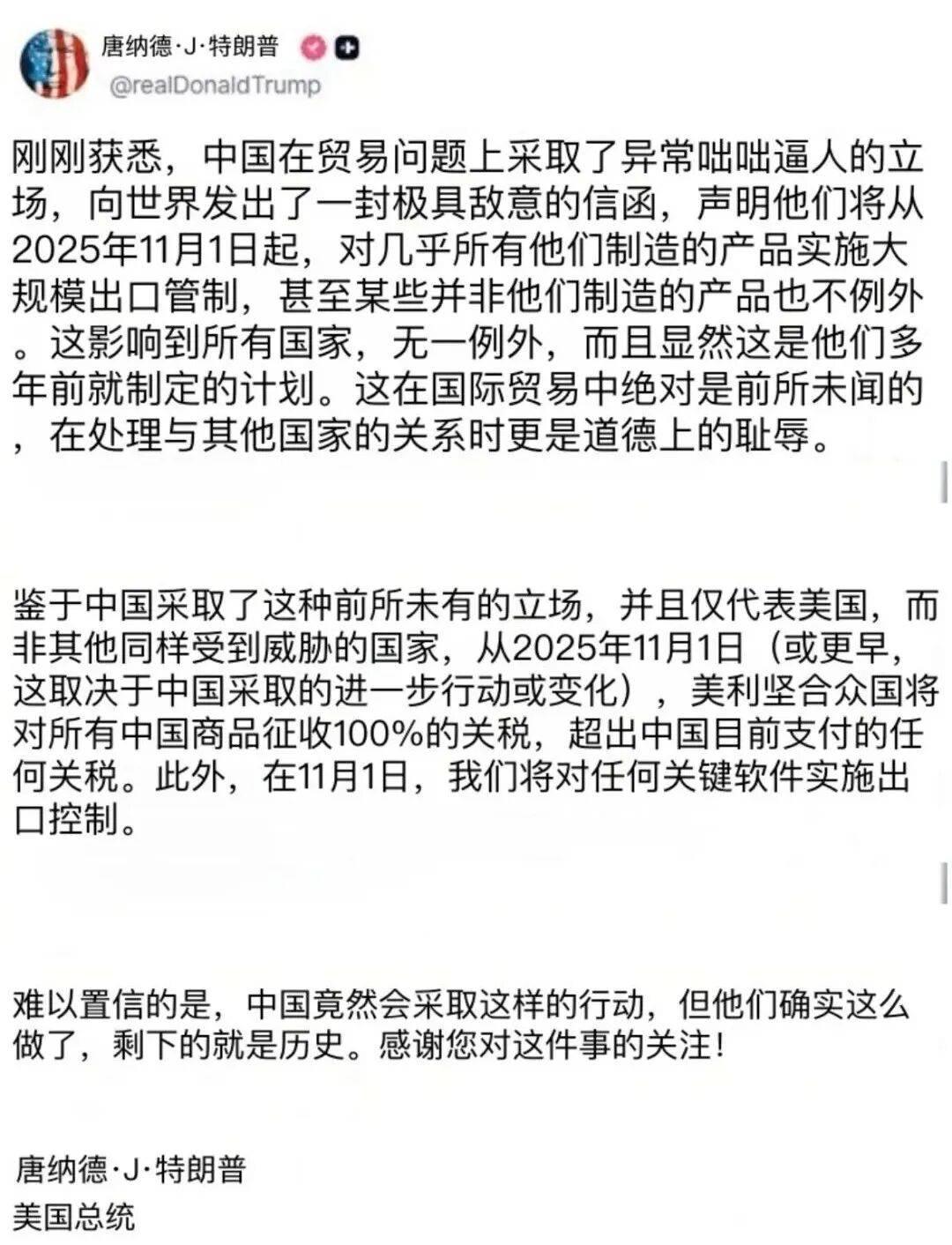
10月10日,美国总统特朗普在社交平台Truth Social发文称,美国计划于11月1日起实施两项政策:一是对中国进口商品加征100%新关税,此关税为当前已 缴关税之外的额外税率;二是对 "所有关键软件"实施出口管制,两项措施将同步于11月1日生效。 外界分析认为,这是美国对中国近期对稀土矿物出口实施新管制措施的报复行为。受此消息影响,美国股市大幅下挫,而债券和黄金价格则有所上涨。鉴 于铜在制造业中的广泛应用以及在全球电气化进程中所起的关键作用,铜价对贸易和全球经济的担忧尤为敏感。 此次铜价暴跌扭转了此前的涨势,此前的涨势是由智利、刚果民主共和国和印度尼西亚的大型铜矿遭遇重大挫折所推动的。由于其他项目也难以达到生产 目标,投资者近几周纷纷涌入铜市场,押注该市场可能面临严重短缺。 贸易战没有赢家,金融市场最诚实的反应已经印证了这一点。当两个巨人碰撞,全球经济的每一个环节都可能感受到震动。这场由一封"敌对信函"引发的 全球资产暴跌,究竟是短期恐慌,还是长期贸易冷战的开端?答案,或许就藏在接下来的每一步棋中。 来 源 | 中国线缆网综合整理 ...
贸易战升级,双方的出发点和可能的结果
Hu Xiu· 2025-10-11 01:01
Core Viewpoint - The article emphasizes the increasing importance of geopolitical discussions over economic discussions in the current market environment, highlighting that understanding geopolitical dynamics is crucial for investment decisions [1][3]. Geopolitical Dynamics - The current market situation presents a simple choice regarding asset evaluation, which is heavily influenced by geopolitical factors rather than traditional economic indicators [2][3]. - The article suggests that the ongoing U.S.-China trade tensions could either be tactical or strategic, impacting investment strategies accordingly [7][20]. Negotiation Framework - A framework for understanding negotiations is presented, indicating that differing interests between parties are normal and that intense negotiations can lead to stable outcomes [5][6]. - The article discusses the importance of recognizing the difference between a party's stated goals and their actual means during negotiations [6]. Trade and Export Controls - China's recent export controls on rare earth elements are analyzed, with implications for military applications and the potential impact on U.S. production capabilities [9][10]. - The article notes that this is a significant move by China, marking a departure from previous diplomatic strategies and indicating a more assertive stance [10][11]. Strategic vs. Tactical Considerations - The author concludes that the recent export restrictions are likely a tactical maneuver rather than a strategic shift, suggesting that both sides may still find common ground in future negotiations [13][21]. - The historical context of China's use of rare earths as a diplomatic tool is referenced, indicating that while such measures can yield short-term results, they may not be sustainable long-term [14][18]. Future Negotiations - The article anticipates that upcoming negotiations in South Korea may yield positive results, as both parties appear to understand the stakes involved [20][21]. - It is suggested that the dynamics of the negotiations may shift, with China taking a more proactive role compared to previous interactions [20][21].
纳指、标普500指数创4月初来最大单日跌幅 比特币一度跌超13%
Zhi Tong Cai Jing· 2025-10-10 23:36
Market Overview - Major U.S. indices experienced significant declines, with the Dow Jones falling by 878.82 points (1.90%) to 45479.60, the Nasdaq dropping 820.20 points (3.56%) to 22204.43, and the S&P 500 decreasing by 182.59 points (2.71%) to 6552.52, marking the largest single-day drop since April 10 [1] - European markets also faced losses, with Germany's DAX30 down 427.04 points (1.73%) to 24225.10, the UK FTSE 100 down 82.55 points (0.87%) to 9426.85, and France's CAC40 down 123.36 points (1.53%) to 7918.00 [2] Cryptocurrency Market - The cryptocurrency market saw a sharp decline, with Bitcoin dropping 13.5% to a low of $105,930 and Ethereum falling over 17% to a low of $3,344. Over $7.4 billion in crypto assets were liquidated in the past 24 hours, primarily during a four-hour window on Friday afternoon [3] Commodities - Gold prices rose above $4,000, increasing by 0.91%, while silver rose by 1.86% to $50.172. The CEO of Wheaton Precious Metals Corp expressed confidence that gold prices could exceed $5,000 next year, potentially reaching $10,000 by the end of 2030 due to geopolitical risks and supply shortages [4] - In the metals market, LME copper fell by $350 to $10,518 per ton, while LME aluminum decreased by $50 to $2,748 per ton. Goldman Sachs projected that copper prices would remain between $10,000 and $11,000 per ton in 2026/2027 [5] Economic Indicators - The U.S. consumer confidence index remained stable at 55 points in October, with concerns over high prices and weak job prospects persisting among consumers. Inflation expectations for the next year slightly decreased from 4.7% to 4.6%, while long-term expectations remained stable at 3.7% [10] Company News - Morgan Stanley announced the removal of restrictions on wealth clients holding crypto funds, allowing all clients to invest in cryptocurrencies across various account types starting October 15. This move reflects the firm's commitment to expanding access to crypto investments [11]


人民币明明被低估,为啥汇率不“疯”?
Hu Xiu· 2025-10-10 23:29
Core Viewpoint - The article discusses the undervaluation of the RMB in terms of real purchasing power and highlights the dominance of the RMB in international physical trade, despite its limited role in global settlement [1][2]. Group 1: RMB and International Trade - The RMB has become the primary currency in international physical trade, but this trade only accounts for 5% of international settlements, indicating that financial transactions are more significant [2]. - The article suggests that the U.S. has faced challenges due to its financial practices, which have led to a decline in its industrial capabilities and a reliance on foreign manufacturing [3][4]. Group 2: U.S. Financial Practices - The U.S. has historically used financial strategies, such as aggressive interest rate hikes, to maintain its economic dominance, which has adversely affected its manufacturing sector [8]. - The article argues that the U.S. financial system is unsustainable, as it relies on continuous global financial crises to sustain high growth rates [12][14]. Group 3: RMB Internationalization - The offshore RMB market has remained stable, fluctuating between 1.5 to 2 trillion, while foreign reserves have consistently been around 3 trillion, raising questions about the management of RMB internationalization [19]. - The article posits that if desired, foreign reserves could exceed 6 trillion, and increasing the offshore RMB scale to around 10 trillion is a conservative estimate [20]. Group 4: Manufacturing Focus - The article emphasizes that the primary goal should be to dominate global manufacturing, suggesting that the current dollar dominance is beneficial for this strategy [24]. - It highlights that the approach is not about immediate victories but rather about strategically undermining foreign manufacturing at the right moment [23].
隔夜美股 | 纳指、标普500指数创4月初来最大单日跌幅 比特币一度跌超13%
智通财经网· 2025-10-10 23:29
智通财经APP获悉,周五,三大指数暴跌,比特币、以太坊跳水。美国总统当地时间周五在社交媒体上 发表强硬言论,并威胁要对中国商品征收"大规模增加的关税"。消息传出后,华尔街交易员迅速按下抛 售键,对贸易战升级的担忧瞬间压倒了市场此前的乐观情绪。 【美股】截至收盘,道指跌878.82点,跌幅为1.90%,报45479.60点;纳指跌820.20点,跌幅为3.56%, 报22204.43点;标普500指数跌182.59点,跌幅为2.71%,报6552.52点。纳指、标普500指数创4月10日以 来最大单日跌幅。大型科技股普跌,亚马逊(AMZN.US)、特斯拉(TSLA.US)、英伟达(NVDA.US)跌约 5%,苹果(AAPL.US)跌3.45%。纳斯达克中国金龙指数收跌超6%,阿里巴巴(BABA.US)和百度 (BIDU.US)均跌超8%,哔哩哔哩(BILI.US)跌9%。 【欧股】德国DAX30指数跌427.04点,跌幅1.73%,报24225.10点;英国富时100指数跌82.55点,跌幅 0.87%,报9426.85点;法国CAC40指数跌123.36点,跌幅1.53%,报7918.00点;欧洲斯托克50指 ...