半导体周期

Search documents
华虹25Q2跟踪报告:产能利用率满载叠加涨价,25Q3收入指引积极
CMS· 2025-08-08 14:56
Investment Rating - The report maintains a "Recommended" rating for the industry, indicating a positive outlook for the sector's fundamentals and expected performance relative to the benchmark index [5]. Core Insights - The company reported a revenue of $566.1 million for Q2 2025, reflecting an 18.3% year-over-year increase and a 4.6% quarter-over-quarter increase, aligning with guidance [30][31]. - Gross margin for Q2 2025 was 10.9%, exceeding previous guidance of 7-9%, driven by improved capacity utilization and average selling price (ASP) increases [30][31]. - The company anticipates Q3 2025 revenue guidance of $620-640 million, representing a year-over-year increase of 19.7% and a quarter-over-quarter increase of 11.3%, primarily supported by growth in emerging sectors such as AI and automotive [3][38]. Summary by Sections Revenue and Profitability - Q2 2025 revenue reached $566.1 million, with a gross margin of 10.9%, and a net profit attributable to shareholders of $8 million, marking a 19.2% year-over-year increase [30][31][32]. - The company achieved an overall capacity utilization rate of 108.3%, up 5.6 percentage points from the previous quarter [30]. Product Performance - Revenue from embedded non-volatile memory platforms was $140 million, up 3% year-over-year and 8.5% quarter-over-quarter [2]. - Power device revenue was $166.7 million, reflecting a 9.4% year-over-year increase, driven by demand for super junction MOSFETs [2][36]. - Significant growth was observed in analog and power management ICs, with revenue of $161.2 million, up 59.3% year-over-year [2][36]. Capacity and Future Outlook - The new production line in Wuxi is expected to reach full capacity by mid-2026, focusing on high-value-added products [4][50]. - The company plans to maintain a focus on high-margin products such as PMICs and super junction MOSFETs in future capacity expansions [4][50]. Market Dynamics - The company reported that the Chinese market contributed $469.7 million, accounting for 83% of total revenue, with a year-over-year growth of 21.8% [33]. - North American revenue was $53 million, up 13.2% year-over-year, driven by demand for integrated circuit products [33]. Strategic Initiatives - The company is focusing on enhancing its core competencies in product technology, process, and supply chain management to improve operational efficiency [30]. - The strategy includes collaboration with domestic and international strategic customers to expand its global customer base [30].
广发证券:沪指在三季度依然有望冲破3674前高,目前的震荡实则在孕育新动能
天天基金网· 2025-08-08 12:28
Group 1 - The Shanghai Composite Index is expected to break through the previous high of 3674 in the third quarter, with current fluctuations nurturing new momentum [2][3] - External disturbances have limited impact on A-shares, and any short-term sharp declines may provide opportunities for rate-sensitive investments [3] - The semiconductor industry is in an upward cycle, with AI being the primary growth driver, supported by strong cloud AI demand and accelerating terminal AI applications [4] Group 2 - The current A-share market is driven by capital, with a clear policy bottom, and leveraged funds are boosting trading volume [5] - The transition between old and new growth drivers remains the main theme, with some industries showing signs of profit improvement [5] - The disturbances in August are not the end but rather a buildup for the policy window in September, with expectations of emotional stabilization and recovery [7]




多重因素推动7月进出口回升
Sou Hu Cai Jing· 2025-08-08 05:37
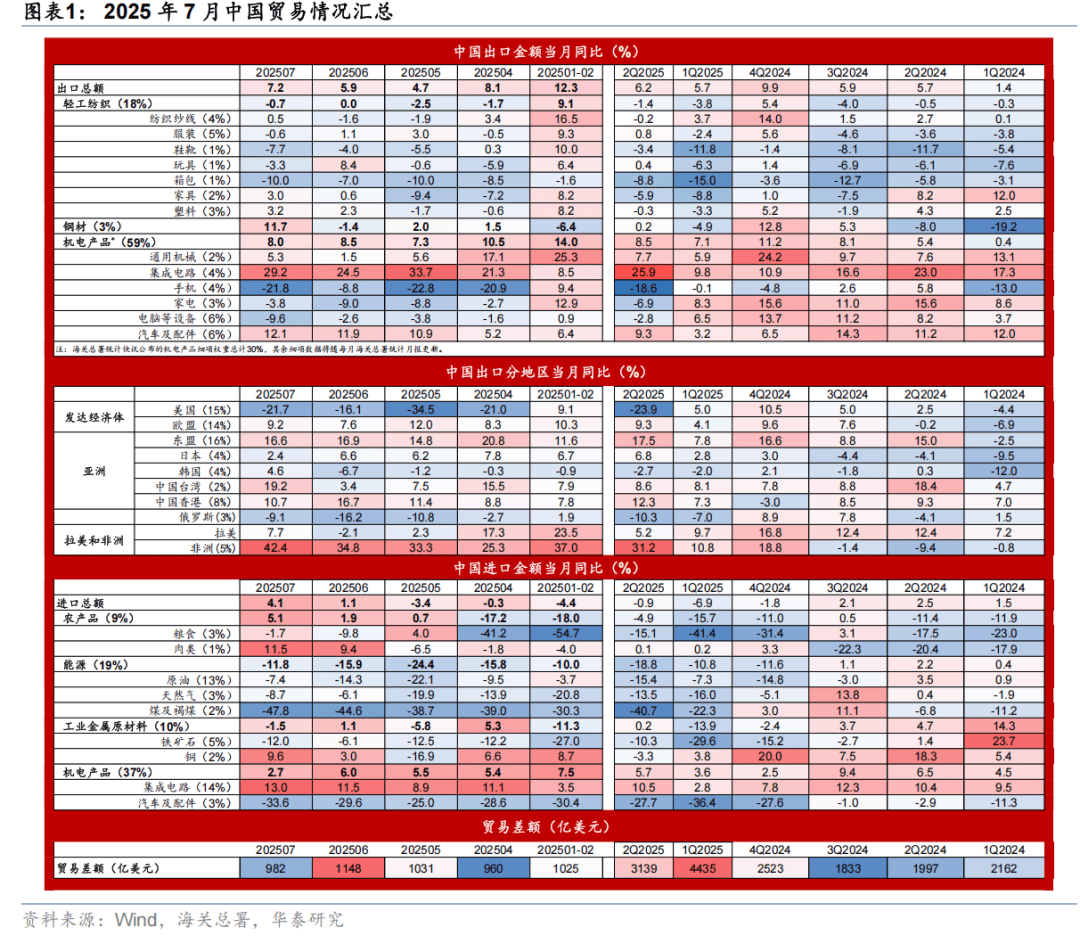
Core Insights - In July 2025, China's export growth rate in USD terms rebounded to 7.2% from 5.9% in June, exceeding Bloomberg's consensus forecast of 5.6% [1][5] - Import growth also improved, rising to 4.1% from 1.1% in June, surpassing the expected decline of -1% [1][5] - The trade surplus slightly decreased to $98.2 billion, an increase of $12.8 billion year-on-year, continuing to support overall demand [1][5] Export Analysis - The rebound in export growth is attributed to several factors, including the "export rush" effect and a recovery in global trade activity [2][5] - The semiconductor cycle's strength has positively impacted related industries, with July exports to South Korea and Taiwan showing significant improvement [2][5] - Exports to the EU and ASEAN have notably strengthened, contributing approximately 4 percentage points to July's export growth [2][6] Import Analysis - July's import growth rate increased by 3 percentage points to 4.1%, driven by improvements in agricultural products and upstream energy imports [3][9] - Energy imports improved from -15.9% to -11.8%, while agricultural imports rose from 1.9% to 5.1% [3][9] - Imports from the US continued to decline, with a year-on-year drop from -15.5% to -18.9%, negatively impacting overall import performance [3][9] Future Outlook - The implementation of new "reciprocal tariffs" and the "232" industry tariffs in August may further elevate global tariff levels, with potential impacts on trade activities still to be observed [4][10] - Despite uncertainties, the overall global demand is expected to remain stable due to fiscal and monetary policy expansions in major economies [4][10] - China's relative advantage in the US import market may increase, although risks from declining global trade volumes persist [4][10] Sector-Specific Insights - The export of mechanical and electrical products showed resilience, with integrated circuit exports growing significantly [6][7] - Automotive exports continued to rise, with a growth rate of 12.1% in July, while steel and fertilizer exports also saw substantial increases [7][8] - Exports to Africa and ASEAN remained strong, reflecting the diversification of China's export destinations [8][9]
华泰证券:多重因素推动7月进出口回升
Sou Hu Cai Jing· 2025-08-08 01:30
【大河财立方消息】8月8日,华泰证券研报认为,以美元计价,7月出口同比增速较6月的5.9%再度反 弹至7.2%,进口增速亦明显改善,显示全球贸易活动的景气度回升。 海关总署公布的数据显示,2025年7月美元计价的中国出口金额同比增速从6月的5.9%回升至7.2%,高 于彭博一致预期的 5.6%;进口金额同比增速则从6月的1.1%回升至4.1%,高于彭博一致预期的-1%;贸 易顺差略回落至982亿美元,同比多增128亿美元,仍对总需求形成支撑。 首先,8月关税232等法案亦可能对部分行业加征全球关税,仍有部分"抢出口"效应支撑。同时,4月中 美关税大幅上升以后,中国企业出海及供应链延伸进程亦有加速,二季度以来中国对东南亚、欧盟等地 区出口显著回升,上述地区或承担更多贸易分流作用。此外,全球的半导体周期走强或持续推升相关行 业出口回升,比如7月对韩国及中国台湾的出口均大幅改善。 8月前"抢出口"效应仍有提振,叠加全球制造业回升,带动全球贸易景气度提升。7月31日美国总统特朗 普签署行政令,调整了对69个国家和地区征收最新的"对等关税"、税率在10%至41%不等,新的"对等关 税"将以8月7日凌晨为界。其中,针对中 ...

46岁博士在深圳龙岗创业,为阿里、快手供应半导体,冲击IPO
3 6 Ke· 2025-07-30 12:18
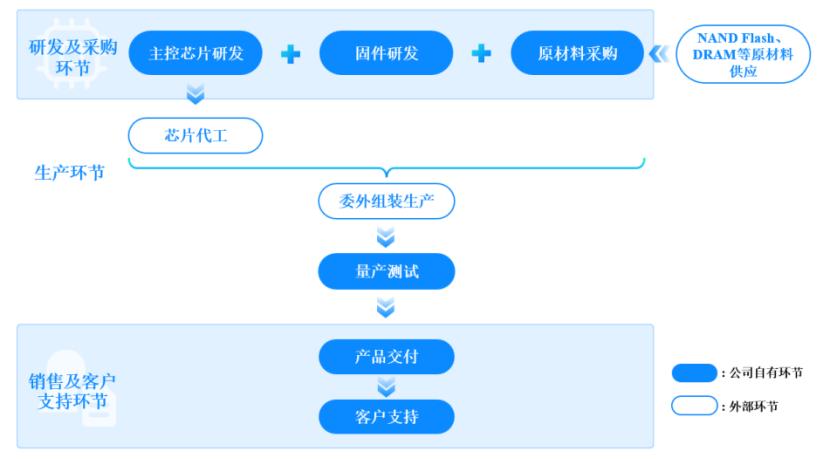
Core Viewpoint - Shenzhen-based Dapu Microelectronics is seeking an IPO on the ChiNext board, focusing on enterprise-level SSDs for data centers, and is the first unprofitable company to be accepted for listing on the board [1][2]. Company Overview - Dapu Microelectronics, founded in April 2016, specializes in semiconductor storage products, particularly enterprise-level SSDs [3][4]. - The company has a full-stack self-research capability in "controller chip + firmware algorithm + module" for enterprise-level SSDs and outsources assembly production to EMS factories [4][6]. - The founder, Yang Yafei, controls 66.74% of the voting rights and has a background in Qualcomm [3]. Financial Performance - Dapu Microelectronics has experienced significant revenue fluctuations, with revenues of 5.57 billion yuan in 2022, 5.19 billion yuan in 2023, and projected 9.62 billion yuan in 2024 [8]. - The company reported net losses of 5.34 billion yuan in 2022, 6.17 billion yuan in 2023, and a projected loss of 1.91 billion yuan in 2024, totaling over 13 billion yuan in losses over three years [8]. - The company's gross profit margins have been unstable, with rates of 0.46%, -26.36%, and 27.26% over the past three years [13]. Market Position - Dapu Microelectronics ranks fourth in the domestic enterprise-level SSD market with a market share of 6.4% as of 2023 [6][28]. - The global enterprise-level SSD market was valued at $20.454 billion in 2022 and is expected to reach $51.418 billion by 2027, with a CAGR of 20.25% [24]. Industry Dynamics - The semiconductor storage industry is heavily influenced by the semiconductor cycle, with significant price fluctuations observed [28]. - Major global players like Samsung, SK Hynix, Western Digital, Micron, and Kioxia dominate over 90% of the market, impacting pricing and production decisions [28]. - Dapu Microelectronics plans to raise 1.878 billion yuan for R&D and production projects, indicating a focus on innovation and market competitiveness [28].

大普微电子冲击IPO,3年亏13亿,为创业板受理的首家未盈利企业
Ge Long Hui· 2025-07-30 10:02
Core Viewpoint - Shenzhen is witnessing a surge of companies, particularly in the semiconductor sector, seeking IPOs, including Dapu Microelectronics, which has recently submitted its prospectus for listing on the ChiNext board [1][2]. Company Overview - Dapu Microelectronics, established in April 2016, focuses on enterprise-level SSDs for data centers and has recently transitioned to a joint-stock company [6][3]. - The company is led by founder Yang Yafei, who holds a 66.74% voting power through his entities [7]. - Dapu Microelectronics has developed a full-stack self-research capability in SSDs, including controller chips, firmware algorithms, and module design [8]. Financial Performance - The company has not yet achieved profitability, making it the first unprofitable company accepted for listing on the ChiNext board [4]. - Revenue has fluctuated due to the semiconductor cycle, with reported revenues of 5.57 billion yuan in 2022, 5.19 billion yuan in 2023, and projected 9.62 billion yuan in 2024 [14]. - Cumulative losses over the past three years exceed 1.3 billion yuan, with net profits of -534 million yuan in 2022, -617 million yuan in 2023, and a projected -191 million yuan in 2024 [14]. Market Position - Dapu Microelectronics ranks fourth in the domestic enterprise SSD market with a market share of 6.4% as of 2023 [9][26]. - The company has shipped over 3,500 PB of enterprise SSDs in the past three years, with 70% of shipments utilizing self-developed controller chips [9]. Industry Context - The global enterprise SSD market is projected to grow from $20.45 billion in 2022 to $51.42 billion by 2027, with a compound annual growth rate of 20.25% [31]. - The industry is dominated by major players like Samsung, SK Hynix, and Western Digital, which collectively hold over 90% of the market share [36]. - Dapu Microelectronics is positioned in a highly competitive and cyclical industry, with its performance closely tied to the semiconductor market dynamics [34][36]. Research and Development - The company has invested heavily in R&D, with cumulative expenses of 737 million yuan over the past three years, accounting for 36.15% of total revenue [22]. - Dapu Microelectronics' R&D focus includes complex technologies related to controller chips and firmware, which are critical for product performance [20]. Supply Chain and Inventory - The company relies on a limited number of suppliers for key components, with the top five suppliers accounting for over 98% of total procurement [24]. - As of the end of 2024, Dapu Microelectronics reported a significant increase in inventory value to 1.062 billion yuan, raising concerns about potential inventory write-downs amid market fluctuations [25].

锡牛或将启,布局迎时机 锡行业深度报告
2025-07-21 00:32
Summary of Key Points from the Conference Call Industry Overview - The global tin resource is limited and concentrated, with China holding the largest share of reserves. However, insufficient exploration investment has led to a decrease in the static extraction ratio, indicating a reduction in the lifespan of existing reserves, necessitating increased exploration efforts [1][3][4] - Supply-side disruptions significantly impact tin prices, with events such as Myanmar's suspension of mining and delays in Indonesia's export license approvals driving prices higher. Future tin prices are expected to rise due to increasing global mining costs and a scarcity of large, high-quality new mines [1][4] Demand Dynamics - The downstream demand for tin is primarily concentrated in the semiconductor sector, which fluctuates in tandem with infrastructure changes. The development of AI technology is anticipated to boost the semiconductor cycle, positively affecting tin prices [1][5] - The macroeconomic environment, particularly the onset of interest rate cuts by the Federal Reserve, is expected to improve global liquidity, supporting industrial metals, including tin [5][6] Supply Chain Challenges - Myanmar's recovery progress is slow, impacted by physical tax tightening, earthquakes, material shortages, and seasonal rains, making it difficult to restore previous production levels. The expected impact of Myanmar's recovery on global tin supply is limited [1][7][8] - Indonesia has shifted from exporting raw tin to refined tin, but the approval of mining quotas is delayed due to political changes and corruption investigations, leading to supply constraints. Future offshore mining efforts face increased costs and operational challenges [1][9] Inventory and Price Support - Global tin inventory levels are low, providing support for future tin prices. Current global supply is expected to have a shortfall, but this may be alleviated by Myanmar's recovery and new overseas production capacities coming online by 2026-2027 [1][12][13] Company-Specific Insights - Tin Industry Co., as the largest tin producer in China, has significant potential for internal expansion, with expected annual copper production reaching 940,000 tons and tungsten production at 560,000 tons, alongside a capacity of 1.5 million tons [2][14] - The company has established strategic partnerships to create an integrated new industrial base in northern China, focusing on resource and smelting integration [2][15] Future Outlook - The overall market is expected to maintain a stable upward price trend, with a projected global supply shortfall of 8,000 tons this year and a domestic shortfall of 16,000 tons. The anticipated recovery of Myanmar and new production capacities may help alleviate these shortages in the coming years [13] - The market's understanding of Tin Industry Co.'s growth potential is not fully recognized, but the company has substantial room for volume growth, particularly in its main mining operations [14] Conclusion - The tin industry is navigating a complex landscape of supply constraints, evolving demand dynamics, and macroeconomic influences. The strategic initiatives of key players like Tin Industry Co. position them well for future growth amidst these challenges [19]
阿斯麦Q2订单额55.4亿欧元超预期,环比增长41%,管理层警告2026年增长或无法实现
硬AI· 2025-07-16 07:01
Core Viewpoint - The strong performance of ASML in Q2 is driven by AI investments, with total revenue reaching €7.7 billion and net profit at €2.3 billion, both at the upper end of guidance. However, management warns of increasing uncertainties due to macroeconomic and geopolitical developments, which may hinder growth in 2026 [1][2][7]. Financial Performance - Q2 net sales amounted to €7.69 billion, exceeding market expectations of €7.51 billion [3]. - Q2 net profit was €2.29 billion, surpassing the market forecast of €2.05 billion [4]. - The order intake for Q2 was €5.54 billion, a 41% increase quarter-over-quarter, with EUV equipment orders at €2.3 billion [5]. - Gross margin reached 53.7%, exceeding expectations, primarily due to high-margin upgrade business and one-time cost reductions [6]. Future Outlook - Despite strong order performance, ASML's management remains cautious about future growth prospects. The CEO indicated that while the fundamentals for AI customers will remain strong in 2026, uncertainties from macroeconomic and geopolitical factors are increasing [7]. - The company expects Q3 net sales to be between €7.4 billion and €7.9 billion, with a gross margin between 50% and 52% [11]. - For the full year 2025, ASML anticipates a revenue growth of approximately 15% and a gross margin of around 52% [12]. Shareholder Returns - ASML announced an interim dividend of €1.60 per share and executed a share buyback of approximately €1.4 billion in Q2 [13].


【国信电子胡剑团队】神工股份:一季度业绩同比高增,半导体硅电极持续放量
剑道电子· 2025-07-11 01:15
Core Viewpoint - The company, ShenGong Co., Ltd. (688233.SH), reported significant growth in Q1 2025, with revenue increasing by 81.49% year-on-year and net profit rising by 1850.70%, driven by the demand for large-diameter silicon materials and the expansion of silicon component product shipments [2][3]. Financial Performance - In Q1 2025, the company achieved revenue of 106 million yuan, a year-on-year increase of 81.49% and a quarter-on-quarter increase of 19.44%. The net profit attributable to shareholders was 28 million yuan, reflecting a year-on-year increase of 1850.70% and a quarter-on-quarter increase of 108.64%. The overall gross margin reached 39.68% [2]. - For the year 2024, the company reported revenue of 303 million yuan, marking a year-on-year growth of 124.19%. The net profit turned positive at 41.15 million yuan, compared to a loss of 69.11 million yuan in the same period of 2023. The large-diameter silicon materials business generated revenue of 174 million yuan, up 108.32%, with a gross margin of 63.85% [3]. Business Segments - The large-diameter silicon materials segment remains the company's traditional core business, showing strong profitability. The demand is recovering due to an upward trend in the semiconductor cycle. The sales structure has been optimized with increasing domestic customer demand [4]. - The silicon component business achieved revenue of 118 million yuan, a year-on-year increase of 214.82%, accounting for nearly 40% of total revenue, becoming a key driver of the company's growth [3]. - The silicon wafer business reported revenue of 7.02 million yuan, a year-on-year decline of 14.98%, primarily due to the lengthy customer certification process [3]. Market Trends and Opportunities - The demand for large-diameter silicon materials is rebounding, and the company is well-positioned in the industry due to its technological expertise and cost control capabilities. The domestic market has limited suppliers capable of stable mass production of large-size single crystal silicon [4]. - The company is actively involved in the domestic semiconductor equipment localization process and is expanding its silicon component products for 12-inch plasma etching machines, collaborating with major wafer manufacturers [4]. - The company is also exploring new materials related to SiC, including SiC coatings and bulk materials, which can be used in various semiconductor applications [4].


半导体周期已被打破
半导体行业观察· 2025-07-03 01:13
Core Viewpoint - The semiconductor industry is experiencing a broken cycle, shifting from a traditional four-year cycle to a fragmented, profit-driven upward trend that only a few companies are feeling [1][2]. Group 1: Market Dynamics - The historical four-year cycle in the semiconductor market has been disrupted, leading to a new trend that is not driven by demand but by profitability [1][2]. - Despite companies like Nvidia achieving record profits, many others in the supply chain, such as wafer manufacturers, are experiencing flat or negative growth, with TSMC's capacity utilization at only 73% [2]. - The current cycle is characterized by rising profitability without a corresponding increase in production, which is unusual compared to previous cycles [2]. Group 2: Geopolitical Factors - There is an increasing geopolitical and strategic divide among regions, with Taiwan having a coherent semiconductor strategy, ensuring advanced nodes remain domestically produced [2][3]. - Taiwan's "T-1" policy keeps the most advanced technology at home, while the U.S. is producing older technologies [3]. - In contrast, Europe lacks a clear semiconductor development plan, which hampers its competitiveness in the industry [3][4]. Group 3: Industry Signals and Future Outlook - The industry is overly reliant on traditional indicators and investor optimism, which may obscure underlying data trends [4]. - The rise of artificial intelligence is reshaping the semiconductor industry, with AI being the primary driver of current economic recovery [5]. - Capital expenditures from cloud computing companies are expected to increase by 48% this year, which may exacerbate supply constraints in other sectors [5].