大金融

Search documents
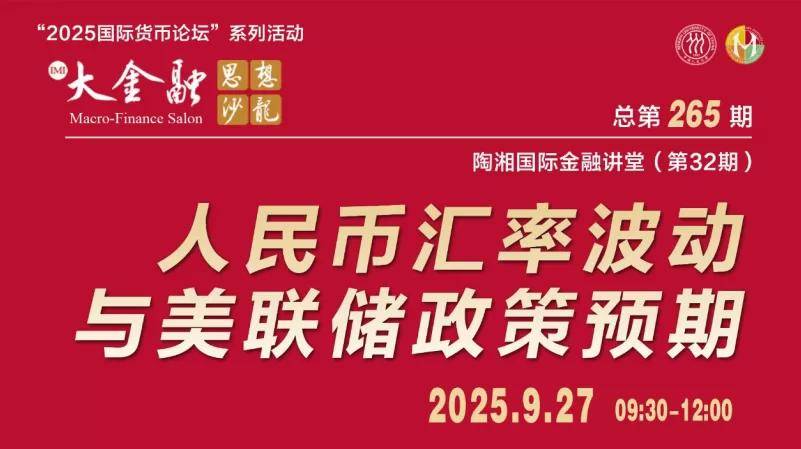
大金融思想沙龙总第265期:人民币汇率波动与美联储政策预期
Sou Hu Cai Jing· 2025-09-29 01:03
Core Insights - The conference focused on the theme "Fluctuations of the RMB Exchange Rate and Expectations of Federal Reserve Policies" [1] - Key speakers included Guan Tao, Chief Economist at Zhongyin Securities, and other experts discussing the implications of U.S. monetary policy on the RMB [1][3] Group 1: RMB Exchange Rate Outlook - The RMB is expected to appreciate against the USD by 2025 due to various factors, including a decline in the USD index by 9.5% in the first nine months of 2023 and improvements in the Chinese economy [3][4] - Factors supporting the RMB include the Federal Reserve's interest rate cuts, a weakened USD credibility, and positive economic indicators from China [3][4] - The current RMB exchange rate is not significantly deviating from its equilibrium, with no substantial appreciation pressure observed [4] Group 2: Federal Reserve Policy Impact - The Federal Reserve began a rate-cutting cycle in September 2023, which is expected to influence global liquidity and capital flows, benefiting emerging markets including China [6] - The Fed's monetary policy is primarily driven by domestic inflation and employment levels, which may lead to further weakening of the USD [6] - The anticipated slowdown in U.S. capital inflows in Q4 2023 could impact international capital confidence in USD assets, affecting the RMB exchange rate [6] Group 3: International Monetary System Challenges - The international monetary system faces challenges from geopolitical tensions, the rise of credit currencies, and the need for reform in response to technological advancements [8] - Future reforms may include promoting a more stable monetary system, enhancing cross-border payment efficiency, and exploring the role of sovereign currencies [8] - The U.S. Federal Reserve's policies are ultimately aimed at maximizing U.S. interests, balancing domestic and global economic considerations [8]



交易型指数基金资金流向周报-20250922
Great Wall Securities· 2025-09-22 09:21
Group 1: Core Insights - The report analyzes the fund flow of exchange-traded index funds from September 15 to September 19, 2025, highlighting significant trends in various categories [1][2]. - The overall fund flow indicates a mixed performance across different index categories, with notable outflows in major indices like the Shanghai Composite and CSI 300 [6][7]. Group 2: Fund Flow by Category - The Shanghai 50 index had a fund size of 159.46 billion yuan, with a weekly decline of 1.71% and a net outflow of 5.98 billion yuan [6]. - The CSI 300 index, with a fund size of 983.45 billion yuan, experienced a slight decline of 0.39% and a significant net outflow of 33.92 billion yuan [6]. - The ChiNext index showed a positive trend with a weekly increase of 2.17% and a net inflow of 5.76 billion yuan, indicating investor interest in growth sectors [6]. - In the technology sector, the large technology category saw a fund size of 216.69 billion yuan, with a weekly increase of 2.20% and a substantial net inflow of 58.01 billion yuan [7]. - The large financial category faced a decline of 3.20% with a net inflow of 140.61 billion yuan, suggesting a shift in investor sentiment [7]. Group 3: Sector Performance - The healthcare sector had a fund size of 100.16 billion yuan, with a weekly decline of 2.11% and a modest net inflow of 5.94 billion yuan, reflecting cautious investor behavior [7]. - The manufacturing sector reported a fund size of 72.82 billion yuan, with a weekly increase of 2.19% and a net inflow of 64.79 billion yuan, indicating resilience in this area [7]. - The consumer sector showed a slight decline of 0.24% with a net inflow of 32.55 billion yuan, suggesting mixed investor confidence [7]. Group 4: International Indices - The Nasdaq 100 index had a fund size of 78.42 billion yuan, with a weekly increase of 1.84% and a net outflow of 0.67 billion yuan, indicating fluctuating investor interest [11]. - The S&P 500 index reported a fund size of 20.84 billion yuan, with a slight increase of 0.50% and a net inflow of 0.77 billion yuan, reflecting stable performance [11]. - The Hang Seng index had a fund size of 19.17 billion yuan, with a weekly increase of 0.40% and a net outflow of 3.72 billion yuan, suggesting challenges in the Hong Kong market [11].
交易型指数基金资金流向周报-20250917
Great Wall Securities· 2025-09-17 03:40
1. Report Information - Report Title: Weekly Report on Capital Flows of Exchange-Traded Index Funds - Data Date: September 8 - 12, 2025 - Research Institution: Great Wall Securities Industrial Finance Research Institute - Analyst: Jin Ling - Report Date: September 17, 2025 [1] 2. Core View - The report presents the capital flow, fund scale, and weekly price change data of various exchange-traded index funds from September 8 - 12, 2025, covering comprehensive, industry theme, style strategy, enterprise nature, regional, QDII, bond, commodity, and index-enhanced funds. 3. Summary by Category Comprehensive Index Funds - **Fund Performance**: The Shanghai Composite 50 had a fund scale of 15.9456 billion yuan, a weekly increase of 0.99%, and a net weekly capital outflow of 394 million yuan; the CSI 300 had a scale of 98.3449 billion yuan, a rise of 1.51%, and an outflow of 4.095 billion yuan; the CSI 500 had a scale of 14.012 billion yuan, a 3.41% increase, and an inflow of 1.174 billion yuan [6]. Industry Theme Index Funds - **Sector Performance**: The large technology sector had a fund scale of 21.6688 billion yuan, a 5.13% increase, and an outflow of 6.616 billion yuan; the large finance sector had a scale of 12.8483 billion yuan, a 0.92% rise, and an inflow of 11.468 billion yuan; the large health sector had a scale of 10.0161 billion yuan, a 0.50% decline, and an inflow of 6.432 billion yuan [7]. Style Strategy Index Funds - **Style Performance**: The dividend style had a fund scale of 5.9877 billion yuan, a 1.01% increase, and an inflow of 633 million yuan; the growth style had a scale of 730.6 million yuan, a 3.02% increase, and an outflow of 252 million yuan; the value style had a scale of 330.8 million yuan, a 1.11% increase, and an outflow of 102 million yuan [9]. QDII Index Funds - **Overseas Market Performance**: The Nasdaq 100 had a fund scale of 7.8421 billion yuan, a 0.73% increase, and an outflow of 197 million yuan; the S&P 500 had a scale of 2.0837 billion yuan, a 0.69% increase, and an outflow of 38 million yuan; the German DAX had a scale of 975 million yuan, a 0.43% decline, and an inflow of 101 million yuan [11]. Bond Index Funds - **Bond Type Performance**: The 30-year bond had a fund scale of 896.9 million yuan, a 1.18% decline, and an inflow of 149 million yuan; the 10-year bond had a scale of 409 million yuan, a 0.20% decline, and no net inflow; the 5 - 10-year bond had a scale of 3.8952 billion yuan, a 0.26% decline, and an outflow of 302 million yuan [12]. Commodity Index Funds - **Commodity Performance**: Gold had a fund scale of 7.0887 billion yuan, a 2.33% increase, and an inflow of 2.095 billion yuan; soybean meal had a scale of 419.3 million yuan, a 0.75% increase, and an inflow of 12 million yuan; non-ferrous metals had a scale of 74.5 million yuan, a 1.40% increase, and an inflow of 7.7 million yuan [12]. Index-Enhanced Funds - **Index Enhancement Performance**: The Shanghai Composite 50 index-enhanced fund had a scale of 76 million yuan, a 0.99% increase, and no net inflow; the CSI 300 had a scale of 320.9 million yuan, a 1.30% increase, and an outflow of 108 million yuan; the CSI 500 had a scale of 197.8 million yuan, a 2.72% increase, and an inflow of 21.6 million yuan [12].
他来了,他来了,一天一只的IPO来了 | 谈股论金
水皮More· 2025-09-16 09:21
Market Overview - The three major indices in A-shares closed in the red today, with the Shanghai Composite Index rising by 0.04% to 3861.87 points, the Shenzhen Component Index increasing by 0.45% to 13063.97 points, and the ChiNext Index up by 0.68% to 3087.04 points [3][4] - The total trading volume in the Shanghai and Shenzhen markets reached 23.414 trillion, an increase of 640 billion compared to the previous day [4] Market Dynamics - Despite the overall increase in indices, there was a net outflow of 44.9 billion in main funds, with northbound funds also showing a net outflow of 43 billion [4][6] - The outflow of funds was primarily concentrated in the morning, while the afternoon saw a more balanced state [4] Sector Performance - The performance of small-cap stocks led the market today, contrasting with the decline in major weight stocks such as banks and oil companies [5][6] - The banking sector saw an overall decline of 0.93%, with significant outflows of 56.7 billion [7] - The securities sector showed a mixed performance, with 14 out of 49 brokerages experiencing declines, leading to a total outflow of 36.3 billion [7] Individual Stock Movements - Notable individual stock movements included a significant rise in "Huanwu" (寒武纪) by 6% during the morning, but it closed flat by the end of the day [8] - "Ningde Times" (宁德时代) exhibited a "V" shape in its trading pattern, ultimately closing down by 0.36% [8] Investment Themes - The current market focus remains on technology stocks and large financials, with no significant signs of sector rotation [9] - A noteworthy observation is the large-scale net outflow of southbound funds from Hong Kong, amounting to 32.8 billion, which historically has been a bearish signal [9] IPO Activity - There are five IPOs available for subscription this week, indicating a return to a frequency of one IPO per day, a situation not seen for a long time [9]

大金融思想沙龙总第262期 金价震荡:大类资产市场波动与下半年展望
Zhong Guo Fa Zhan Wang· 2025-09-15 08:33
Core Insights - The online seminar "Gold Price Fluctuations: Market Volatility and Outlook for the Second Half of the Year" was successfully held, featuring discussions from various experts on the current state and future trends of the financial market [1] Group 1: Gold and Silver Market Analysis - Gold has seen a rapid increase since the beginning of 2024, with silver showing a similar upward trend, indicating potential for further gains [2] - Central banks, particularly in China and India, are increasing their gold reserves to hedge against currency risks, reflecting a shift in global liquidity dynamics [2] - Despite a significant rise in gold prices over the past two years, the overall trend remains upward, with expectations of increased volatility in the future [2] Group 2: Market Volatility and Asset Allocation - The current global market is characterized by high uncertainty and volatility, driven by factors such as U.S. Federal Reserve policy uncertainty, geopolitical risks, and doubts about global economic growth [3] - Investors are advised to maintain diversified portfolios, focusing on high-quality assets while being cautious of risks in U.S. equities and exploring opportunities in A-shares and Hong Kong stocks [3] - The bond market is expected to remain uncertain until monetary policy becomes clearer [3] Group 3: Structural Economic Challenges - The global economy is entering a phase of "high volatility, low growth," with structural challenges such as aging populations and high national debts limiting growth potential [4] - There is a notable "K-shaped" divergence in asset performance, with U.S. stock indices being driven by a few tech stocks while many others lag behind [4] - Long-term investment in gold is recommended for its hedging properties, alongside opportunities in bonds and sectors like technology and pharmaceuticals [4] Group 4: Global Economic Dynamics and Financial Innovation - The restructuring of international order is enhancing the strategic value of gold, as central banks increase their gold purchases to mitigate dollar risks [5] - The advent of artificial intelligence is expected to revolutionize traditional economic analysis, necessitating new growth theories [5] - Developments in Web3 and Real World Assets (RWA) are anticipated to reshape financial infrastructure, with potential implications for gold and digital currencies [5] Group 5: U.S. Policy Impacts and Market Reactions - The economic impact of the Trump administration's policies has led to structural changes in the market, with concerns about long-term social inequality and growth potential [6] - The simultaneous decline of U.S. stocks, bonds, and the dollar reflects investor apprehension regarding U.S. policy uncertainties [6] - Investors are advised to monitor central bank asset diversification trends to prepare for potential risks associated with escalating trade tensions [6]
三大指数冲高回落,半导体陷入调整,贵金属逆势大涨
Ge Long Hui· 2025-09-10 18:57
Market Performance - The three major indices collectively declined, with the Shanghai Composite Index down 0.29%, the Shenzhen Component down 0.89%, and the ChiNext down 1.77% [1] - Over 4,000 stocks in the two markets fell, with a total trading volume of 1.32 trillion yuan [1] Sector Performance - Gold concept stocks experienced a strong surge, with multiple stocks, including Sichuan Gold and Xiaocheng Technology, hitting the daily limit [3] - Battery concept stocks were active, highlighted by Tianji Co. achieving four consecutive limit-ups [3] - The financial sector showed resilience, with Xi'an Bank rising nearly 5% [3] - The sapphire concept faced a downturn, dropping 3.65%, with Jing Sheng Co. down 9.38% and Lens Technology down 9% [3] - The semiconductor sector showed weakness, with SMIC experiencing a significant decline [3] - Other sectors such as CRO, AIPC, recombinant proteins, consumer electronics, and photovoltaics also saw notable declines [3] News Highlights - London spot gold reached a new historical high, surpassing $3,600 per ounce and peaking at $3,635 per ounce, marking a year-to-date increase of $1,000 per ounce and a 38% rise [3] - Henan province is encouraging financial institutions to support the construction of charging infrastructure through various financial channels [3] - Variable Robotics announced the completion of nearly 1 billion yuan in Series A+ financing and the open-sourcing of its embodied large model WALL-OSS [3]



港股开盘 | 恒生指数高开0.09% 地产股多数上涨
Zhi Tong Cai Jing· 2025-09-08 01:48
Group 1 - The Hang Seng Index opened up 0.09%, and the Hang Seng Tech Index rose by 0.11%, with real estate stocks mostly increasing, particularly Country Garden which surged over 14% [1] - The recent underperformance of the Hong Kong stock market is viewed as a phase of consolidation following a rapid rise, rather than a trend reversal, with the foundation of the current bull market still intact [1] - Market structure shows significant differentiation, with only 35% of stocks outperforming the benchmark index since the beginning of the year, indicating a lack of market breadth [1] Group 2 - Short-term factors affecting the Hong Kong market include fluctuations in Hong Kong dollar liquidity and adjustments in profit expectations for the internet sector; however, mid-term prospects may improve with potential interest rate cuts by the Federal Reserve [2] - The current valuation of Hong Kong stocks remains relatively low compared to other major global markets, with expectations of increased foreign capital inflow and a more attractive investment environment due to improved listing regulations [2] - Structural opportunities in the Hong Kong market are emerging, particularly in sectors like new consumption and innovative pharmaceuticals, as well as traditional industries such as "AI+", overseas expansion, and smart manufacturing [2]
【十大券商一周策略】短期调整接近尾声,上行逻辑仍未改变,资金聚焦高低切
Zheng Quan Shi Bao Wang· 2025-09-07 14:57
Group 1: Market Liquidity Characteristics - Recent market liquidity characteristics indicate a clear divergence in ETF fund flows, with broad-based funds decreasing while industry/theme funds are increasing, and A-shares decreasing while Hong Kong stocks are increasing, reflecting a high-cut low characteristic of institutional allocation funds [1] - The market may be entering the last round of intensive subscription and redemption phase for actively managed public funds since 2021, as core assets held by institutions rise, which may help alleviate redemption pressure and shift focus towards the next industrial trend and economic recovery [1] - The coexistence of high debt funding rates and passive interest rate cuts from central banks abroad is easing competitive pressure on Chinese manufacturing, suggesting a long-term recovery in profit margins as the industry shifts from market share advantages to pricing power [1] Group 2: Investment Strategies - It is recommended to adjust portfolio structures by focusing on structural opportunities in sectors such as consumer electronics, resources, innovative pharmaceuticals, chemicals, and gaming [2] - The current high risk appetite in the market supports equity asset performance, with a suggestion to overweight AH shares and US stocks while maintaining a standard allocation to bonds and gold [3] - The A-share market is expected to experience a low-slope upward trend after recent adjustments, with a focus on sectors like AI computing power, solid-state batteries, humanoid robots, and commercial aerospace [5] Group 3: Sector Focus and Trends - The A-share market is currently in a phase of resonance inflow from both institutions and individuals, with a focus on TMT sectors as a long-term main line, while short-term strategies may involve low-crowding sectors [4] - The market is likely to continue a trend of oscillation and upward movement, with attention on sectors such as machinery and electrical equipment that have potential for rebound [7] - The focus on sectors benefiting from domestic high-tech industry development and the "anti-involution" concept is emphasized, particularly in low-valuation assets in the service consumption field [7] Group 4: Market Sentiment and Volatility - The A-share market is experiencing increased volatility, with a cautious sentiment prevailing compared to previous phases, but is expected to maintain a trend of oscillation and upward movement [9] - The market is likely to enter a phase of consolidation, with a focus on sectors that have lagged behind but still have strong economic logic [6] - The current high volatility in the market suggests that a new trend of significant upward movement will require new catalysts, with attention on sectors like electrical equipment and non-ferrous metals [8]



交易型指数基金资金流向周报-20250904
Great Wall Securities· 2025-09-04 07:27
Group 1: Core Insights - The report highlights the capital flow trends in exchange-traded funds (ETFs) during the specified period, indicating a mixed performance across different categories of funds [2][4]. - The total fund sizes and weekly net inflows show significant variations, with the CSI 300 experiencing a net inflow of 9.34 billion yuan, while the STAR 50 saw a net outflow of 135.45 billion yuan [6][7]. Group 2: Fund Performance by Category - The report categorizes funds into major themes, with large technology funds showing a fund size of 216.69 billion yuan and a weekly net inflow of 261.95 million yuan, while large financial funds had a size of 128.48 billion yuan with a slight decline of 1% [7]. - In the health sector, large health funds reported a fund size of 100.16 billion yuan with negligible weekly change, while large consumer funds had a net inflow of 55.83 million yuan [7]. Group 3: Sector and Style Analysis - The report provides insights into style strategies, indicating that growth funds had a size of 73.06 billion yuan with a weekly increase of 6.34%, while value funds reported a size of 33.08 billion yuan with a slight increase of 0.26% [9]. - The report also notes that the dividend strategy funds had a size of 598.77 billion yuan but experienced a weekly decline of 0.78% [9]. Group 4: International Fund Performance - Internationally, the Nasdaq 100 had a fund size of 784.21 billion yuan with a weekly increase of 1.44%, while the S&P 500 reported a size of 208.37 billion yuan with a modest increase of 0.72% [11]. - The report indicates that the Hang Seng Index had a fund size of 191.74 billion yuan with a slight decline of 0.29% [11].
金银涨势持续-20250902
申银万国期货研究· 2025-09-02 00:46
Core Viewpoint - The article discusses the recent trends in various sectors, including transportation, precious metals, stock indices, lithium carbonate, and overall market sentiment, highlighting the impact of economic policies and geopolitical events on market dynamics [1][2][3][4]. Transportation - The national summer transportation period saw a total of 11.697 billion trips, a year-on-year increase of 7%, with road trips accounting for 87 billion, representing 70% of total trips [1]. Precious Metals - Precious metals, particularly gold and silver, are experiencing strong performance due to market uncertainties stemming from Trump's actions against the Federal Reserve and the potential for interest rate cuts [2][17]. - The USGS's proposal to include silver in the critical minerals list raises concerns about import tariffs, while the Fed's dovish stance enhances expectations for a rate cut in September [2][17]. Stock Indices - The A-share market showed strong performance with the Shanghai Composite Index closing up 0.46% at 3875.53 points, driven by a market turnover of 2.78 trillion yuan [1][3]. - The market is currently in a phase of "policy bottom + liquidity bottom + valuation bottom," suggesting a high probability of continued upward momentum, although sector rotation and structural differentiation are expected [3][10]. Lithium Carbonate - Short-term price movements for lithium carbonate are influenced by market sentiment, with production increasing by 424 tons to 19,980 tons, and demand expected to rise by 8% in August [4][20]. - Inventory levels are fluctuating, with total inventory decreasing by 162 tons to 142,256 tons, indicating potential for price increases if inventory continues to deplete [4][20]. Economic Policies and Market Sentiment - The article notes that the domestic liquidity is expected to remain loose, with potential incremental policies to boost the real economy in the second half of the year [3][10]. - The geopolitical landscape, including US-China trade negotiations and the Fed's interest rate decisions, is influencing market dynamics and investor sentiment [2][3][10].