
市场预期

Search documents
A股市场策略分析框架探讨
2025-09-07 16:19
Summary of Key Points from Conference Call Records Industry or Company Involved - The discussion primarily revolves around the A-share market strategy and the Volcker Model, which evaluates market performance through various dimensions including valuation, earnings, cycles, macro policies, overseas environment, and liquidity [1][3][5]. Core Insights and Arguments - **Volcker Model Components**: The model consists of six dimensions: Valuation (W), Earnings (E), Cycles (L), Macro Policies (C), Overseas Environment (O), and Liquidity (M). These factors collectively influence market performance, with macro policies and overseas environment primarily affecting valuation and fundamentals [3][5]. - **Asset Allocation Trends**: As per the report, when per capita income in China reaches $10,000, the proportion of non-financial assets will likely decline while financial assets will increase, particularly in fixed income and savings [1][8]. - **Corporate Lifecycle Stages**: Companies are categorized into five lifecycle stages: embryonic, expansion, high growth, maturity, and decline, each requiring different valuation methods such as PS, PEG, PE, and PB [1][10][11]. - **Macroeconomic Indicators**: Key indicators like GDP growth and CPI recovery are crucial for market and industry allocation. Adjustments in consumer sector allocations may be necessary if inflation expectations change in the latter half of the year [1][12]. - **Market Earnings Expectations**: The market earnings forecast for 2025 has been revised from 1% to 3.5%, based on macroeconomic indicators and industrial production data [1][15][16]. Other Important but Possibly Overlooked Content - **Impact of Population Cycle**: The slowing population growth in recent years has exerted pressure on income, indirectly affecting the performance of the A-share market [7]. - **Technological Cycles**: Different technological cycles impact various sectors, and market expectations play a significant role in assessing the prospects of technology sectors within the A-share market [9]. - **Monetary and Fiscal Policies**: The prolonged period of loose monetary policy has diminished its marginal impact on the market, while fiscal policy is gaining more attention, especially in light of external and internal economic conditions [14]. - **Liquidity Analysis**: Macro liquidity is assessed through both quantity (M1, M2, credit) and price (risk-free interest rates), which significantly influence stock market performance [19][20]. - **Market Bottom Indicators**: The assessment of the A-share market bottom in September 2024 was based on extreme turnover rates and low trading volumes, indicating potential recovery opportunities despite weak fundamentals [22]. - **Small vs. Large Cap Stocks**: Research indicates that small-cap stocks have outperformed large-cap stocks in recent years, influenced by macroeconomic expectations [26]. - **Industry Allocation Framework**: The GICS four-level industry classification system has been effectively used since 2013 to provide allocation recommendations, with outperforming sectors significantly beating the benchmark [27]. This summary encapsulates the essential insights and data from the conference call records, providing a comprehensive overview of the A-share market strategy and its influencing factors.
美股一路上涨,很多人会问:既然大家都赚钱了,那输家到底是谁?
3 6 Ke· 2025-09-01 03:18
Core Insights - The stock market is not a strict zero-sum game; it is fundamentally linked to economic growth and corporate profitability, allowing for potential mutual benefits among investors over the long term [3][23] - Stock price increases can be attributed to two main categories: genuine corporate value growth and speculative market behavior [3][6] Group 1: Genuine Corporate Value Growth - Companies with strong profitability and consistent performance, such as Apple, see their stock prices rise due to real value creation, benefiting long-term shareholders [4][23] - Apple's stock has increased hundreds of times over the past two decades, driven by substantial cash flow from its product ecosystem [4] - The rise in stock prices reflects the wealth generated by the company being distributed among its investors [3] Group 2: Speculative Market Behavior - Companies lacking strong competitive advantages may experience stock price increases driven by market speculation, leading to a cycle of rapid price increases followed by significant declines [6][9] - The GameStop case illustrates how speculative trading can lead to massive price swings, benefiting early investors while later entrants may incur substantial losses [7][9] Group 3: Industry Trends and Structural Opportunities - Stock price increases can also result from favorable industry trends, where companies capitalize on rapid market expansion [10][11] - Netflix's stock growth from 2007 to 2020 was fueled by the explosive growth of the streaming industry, reflecting market share gains rather than just company performance [11] Group 4: Policy and Macro Environment - Stock price increases can be driven by favorable policies or macroeconomic trends, as seen with Tesla, where government incentives for electric vehicles significantly boosted demand and stock prices [12][13] Group 5: Market Expectations and Future Growth Potential - Companies with average short-term performance may see stock price increases based on market expectations of future growth, as demonstrated by Amazon's early stock performance despite initial losses [16][17] Group 6: Structural Changes and Innovation - Stock price increases can also stem from strategic changes, product innovations, or technological advancements, as evidenced by Nvidia's stock growth driven by AI and data center demand [18][19] Group 7: Mergers, Restructuring, and Asset Value Release - Companies can unlock potential value through mergers, asset sales, or strategic restructuring, leading to stock price increases, as seen with Disney's acquisition of 21st Century Fox [21]



【新华解读】三大指数均有回升 经济景气水平总体保持扩张——透视8月份PMI数据
Xin Hua She· 2025-08-31 09:54
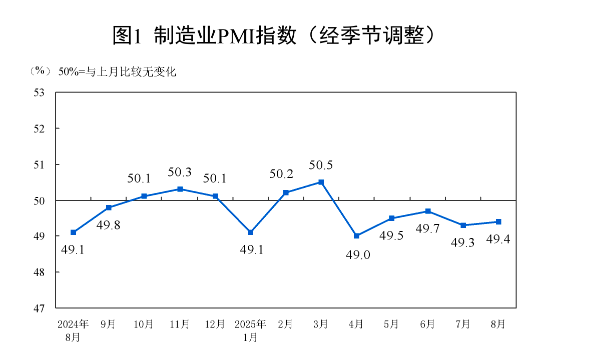
Group 1 - In August, the manufacturing PMI, non-manufacturing business activity index, and comprehensive PMI output index were 49.4%, 50.3%, and 50.5%, respectively, indicating a slight recovery in economic sentiment [1] - The production index for manufacturing was 50.8%, up 0.3 percentage points from the previous month, marking an acceleration in manufacturing production expansion [2] - The new orders index for manufacturing was 49.5%, showing a 0.1 percentage point increase from last month, with certain sectors like pharmaceuticals and electronics performing significantly better than the overall manufacturing sector [2] Group 2 - The high-tech manufacturing PMI and equipment manufacturing PMI were 51.9% and 50.5%, respectively, both showing increases from the previous month, indicating sustained support and leadership in these sectors [3] - The production and business activity expectation index was 53.7%, up 1.1 percentage points from last month, reflecting increased confidence among manufacturing enterprises regarding future market conditions [3] Group 3 - The non-manufacturing business activity index was 50.3%, with the new orders index rising to 46.6%, indicating a stabilization in supply and demand [4] - The service sector's business activity index reached 50.5%, the highest point of the year, with sectors like capital market services showing particularly strong growth [5] - The construction sector's business activity index fell to 49.1% due to adverse weather conditions, but the business activity expectation index remained slightly above 50 at 51.7% [5]
制造业PMI回升至49.4%,“反内卷”政策效果显现
Di Yi Cai Jing· 2025-08-31 04:07
Core Viewpoint - The manufacturing PMI remains below the growth line for five consecutive months, indicating ongoing economic pressure, although there are signs of improvement due to policy measures and reduced extreme weather impacts [1][4]. Manufacturing Sector - The manufacturing PMI for August is reported at 49.4%, a slight increase of 0.1 percentage points from the previous month, indicating a modest recovery in manufacturing sentiment [1]. - The new orders index within the manufacturing PMI is at 49.5%, up 0.1 percentage points, while the production index is at 50.8%, reflecting a stable expansion in production activities [4]. - The purchasing price index for raw materials is at 53.3%, up 1.8 percentage points, indicating a continued rise in raw material prices, while the factory price index is at 49.1%, up 0.8 percentage points, marking the highest level this year [4][5]. - Large enterprises show stable expansion with a PMI of 50.8%, while small enterprises have a PMI of 46.6%, indicating a recovery trend [5]. Economic Outlook - The production and business activity expectation index for August is at 53.7%, up 1.1 percentage points, suggesting improved market confidence and expectations for future economic performance [6]. - Positive factors are accumulating, leading to expectations of continued economic recovery in September and the fourth quarter, with stable demand and production activities in the manufacturing sector [6]. Non-Manufacturing Sector - The non-manufacturing business activity index is at 50.3%, up 0.2 percentage points, indicating ongoing expansion in the non-manufacturing sector [9]. - The service sector's business activity index is at 50.5%, reaching a yearly high, while certain industries like retail and real estate remain below the critical point, indicating weaker performance [9][10]. - The construction sector's business activity index is at 49.1%, down 1.5 percentage points, reflecting a slowdown in production due to adverse weather conditions [10].
国家统计局:8月制造业产需指数均有回升 市场预期总体向好
Xin Hua Cai Jing· 2025-08-31 03:22
Group 1: Manufacturing PMI Insights - In August, the Manufacturing PMI rose to 49.4%, indicating an improvement in economic conditions compared to the previous month [2] - The production index reached 50.8%, up 0.3 percentage points, marking four consecutive months above the critical point, suggesting accelerated manufacturing production [2] - The new orders index increased to 49.5%, reflecting a slight rise in demand [2] - Large enterprises showed a PMI of 50.8%, up 0.5 percentage points, indicating sustained expansion, while medium and small enterprises experienced declines [3] - High-tech manufacturing and equipment manufacturing sectors maintained expansion with PMIs of 51.9% and 50.5%, respectively [3] Group 2: Non-Manufacturing PMI Insights - The Non-Manufacturing Business Activity Index reached 50.3%, up 0.2 percentage points, continuing its expansion [4] - The service sector's business activity index rose to 50.5%, the highest point of the year, with significant growth in capital market services and transportation sectors [4] - The construction sector's business activity index fell to 49.1%, down 1.5 percentage points, due to adverse weather conditions [4] Group 3: Composite PMI Insights - The Composite PMI Output Index stood at 50.5%, up 0.3 percentage points, indicating an overall acceleration in production and business activities [5][6]
盈利、情绪和需求预期:市场信息对宏观量化模型的修正——数说资产配置系列之十一
申万宏源金工· 2025-08-25 08:01
Group 1 - The article discusses a macro quantitative framework that combines economic, liquidity, credit, and inflation factors for asset allocation and industry/style configuration [1][3] - The framework has been adjusted based on the changing mapping of macro variables to assets, with a focus on economic and liquidity indicators [1][5] - The performance of aggressive portfolios since 2013 shows an annualized return of approximately 8.5%, with a 0.6% excess return compared to the benchmark [3][5] Group 2 - The article highlights the impact of macroeconomic conditions on industry and style configurations, incorporating credit sensitivity into the analysis [5][7] - The macro-sensitive industry configuration has shown varying performance, with a notable decline since 2022, indicating the need for adjustments in selection criteria [7][10] - The article emphasizes the importance of market expectations in influencing macroeconomic indicators and their relationship with asset performance [13][18] Group 3 - The Factor Mimicking model is introduced to capture market expectations regarding macro variables, using a refined stock pool for better representation [19][20] - The construction of the Factor Mimicking portfolio aims to reflect the market's implicit views on economic, liquidity, inflation, and credit variables [19][23] - The article discusses the need for additional micro mappings to enhance the representation of macro variables, particularly in relation to corporate earnings and valuations [28][30] Group 4 - The article outlines the adjustments made to the macro variables based on market expectations, focusing on economic, liquidity, and credit dimensions [34][36] - The revised indicators are expected to improve asset allocation strategies, particularly in the context of equity markets [39][40] - The performance of the revised industry and style configurations indicates a positive impact from incorporating market expectations into the analysis [46][54]

硅业分会:市场预期向好 多晶硅小单延续涨势
智通财经网· 2025-08-20 08:25
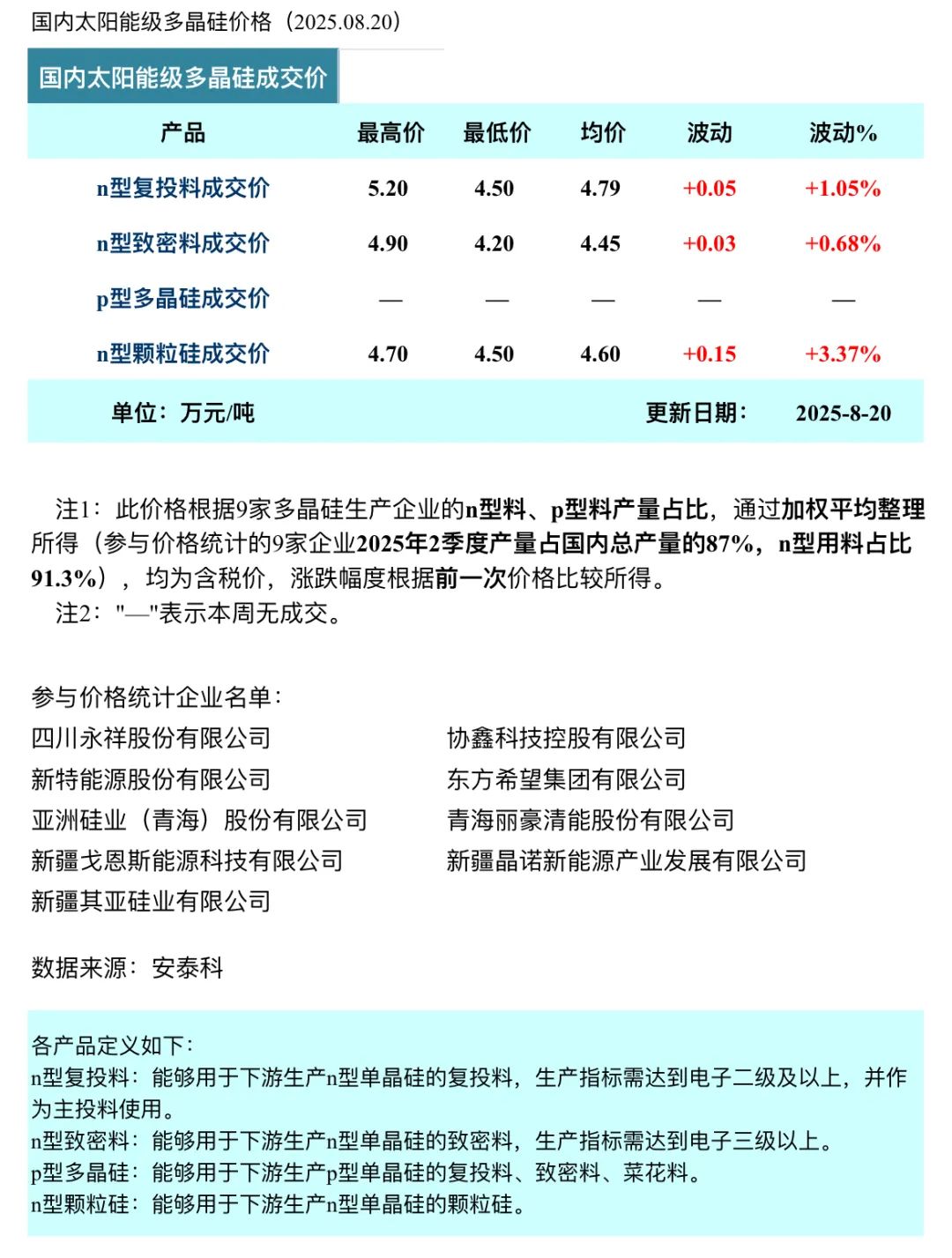
Core Viewpoint - The price of polysilicon continues to rise due to supply-demand dynamics and regulatory support in the photovoltaic industry [2] Price Trends - The transaction price range for n-type polysilicon is between 45,000 to 52,000 CNY/ton, with an average price of 47,900 CNY/ton, reflecting a week-on-week increase of 1.05% [1] - The transaction price range for n-type granular silicon is between 45,000 to 47,000 CNY/ton, with an average price of 46,000 CNY/ton, showing a week-on-week increase of 3.37% [1] - The number of companies signing contracts for polysilicon this week is six, indicating a stable yet rising market price [1] Market Dynamics - The price increase is supported by a joint meeting of six ministries aimed at regulating competition in the photovoltaic industry, signaling a commitment to avoid excessive competition [2] - Polysilicon companies are implementing production and sales restrictions, alleviating market pressure on supply and demand [2] - Major polysilicon producers are reducing production, which is expected to increase overall costs and lead to higher market prices due to regulatory constraints [2] Production and Inventory - The number of polysilicon producers remains at nine, with an expected production of approximately 125,000 tons in August [2] - If production and sales restrictions are effectively implemented in September, monthly output is expected to remain stable, but the current oversupply situation has not improved significantly [2] - Industry inventory is projected to continue accumulating, with an estimated increase of about 20,000 tons from August to September [2] Price Statistics - The highest and lowest transaction prices for n-type polysilicon are 52,000 CNY/ton and 45,000 CNY/ton, respectively, with an average price of 47,900 CNY/ton [3] - The price fluctuations for n-type granular silicon show a highest price of 47,000 CNY/ton and a lowest price of 45,000 CNY/ton, with an average price increase of 3.37% [3] Participating Companies - The companies involved in the price statistics include Sichuan Yongxiang Co., Ltd., GCL-Poly Energy Holdings Limited, and Xinjiang Goin Technology Co., Ltd., among others [4]
美联储上演鹰鸽大战!帮主郑重:9月降息别指望“大礼包”
Sou Hu Cai Jing· 2025-08-16 17:47
Core Viewpoint - The internal debate within the Federal Reserve regarding the extent of interest rate cuts is intensifying, with contrasting views from officials on the necessity and magnitude of potential cuts [1][4]. Group 1: Interest Rate Cut Perspectives - San Francisco Fed President Daly opposes a drastic 50 basis point cut in September, advocating for a gradual approach to avoid market misinterpretation of economic distress [3]. - Daly highlights the labor market's weakening, noting a significant drop in July's non-farm payrolls, which has shifted her view from "stable" to "weakening" [3]. - Concerns about inflation persist, as July's CPI was moderate, but the PPI saw its largest increase in three years, indicating potential inflationary pressures that could complicate aggressive rate cuts [3]. Group 2: Political and Market Dynamics - The Trump administration is pressuring for substantial rate cuts, with Treasury Secretary Mnuchin suggesting a reduction of 150-175 basis points, while Fed officials maintain their policy independence [4]. - Market expectations are heavily leaning towards a 98% probability of a 50 basis point cut in September, which could lead to volatility if the Fed does not meet these expectations [5]. - A potential reluctance from the Fed to cut rates could lead to a decline in the dollar index and a rebound in currencies like the euro and pound, as well as increased capital flows into emerging markets [6]. Group 3: Investment Implications - Investors are advised against betting on a significant rate cut, as the likelihood of a 50 basis point reduction is low, which could result in market turbulence if expectations are unmet [7]. - Focus should be on "policy divergence stocks," with bank stocks benefiting from a neutral rate environment and defensive sectors like gold and utilities gaining traction if the economy weakens [7]. - Long-term investment strategies should be data-driven, with upcoming non-farm payroll and CPI data serving as critical indicators before any rate decisions [7].

卜房者说|7月70城房价发布,长沙新房价格有何变化
Sou Hu Cai Jing· 2025-08-15 13:34
Group 1 - The core viewpoint of the article is that the housing prices in 70 major cities in China have shown a decline in sales prices month-on-month, although the year-on-year decline has narrowed overall [1] - In July, new home prices in Shanghai and Urumqi increased by 0.3%, while Sanya and Yichang rose by 0.2%, and Changchun and Changde saw a 0.1% increase [1] - For second-hand homes, only Taiyuan experienced a month-on-month increase of 0.2%, while all other cities reported declines [1] Group 2 - In Changsha, new home prices fell by 0.4% in July, ending a previous trend of four consecutive months of price increases [2] - The decline in Changsha's new home prices is attributed to the traditional off-peak season for the real estate market in July, leading to weakened demand [2] - Additionally, the market is experiencing an oversupply due to previous inventory accumulation, and consumer caution has led to reduced market activity, prompting developers to lower prices to stimulate sales [2]
外汇汇率受什么因素影响?
Sou Hu Cai Jing· 2025-08-14 07:16
Group 1 - Economic data plays a crucial role in foreign exchange rate fluctuations, with macroeconomic indicators such as GDP, inflation rate, and unemployment rate directly reflecting the health and development trends of an economy [1] - Strong GDP growth indicates economic prosperity, attracting foreign investors and increasing demand for the currency, thus pushing the exchange rate up; conversely, weak economic growth may lead to decreased currency demand and downward pressure on the exchange rate [1] - Inflation rates significantly impact exchange rates, with high inflation eroding purchasing power and causing currency depreciation, while stable low inflation helps maintain currency value [1] Group 2 - Interest rates are a key factor influencing foreign exchange rates, as differences in interest rates between countries can lead to international capital flows [1] - Higher interest rates attract foreign investors seeking better returns, increasing demand for the currency and pushing the exchange rate up; lower interest rates may result in capital outflows, increasing currency supply and decreasing demand, leading to a drop in the exchange rate [1] - Central banks adjust interest rates to achieve monetary policy goals, directly affecting supply and demand in the foreign exchange market and thus impacting exchange rate trends [1] Group 3 - Political stability, policy consistency, and diplomatic relations significantly affect foreign exchange rates, with political turmoil or sudden policy changes creating uncertainty that may lead investors to reduce holdings in that currency, causing depreciation [2] - A stable political environment and transparent policies enhance investor confidence, providing support for the exchange rate [2] - Geopolitical conflicts, such as wars and trade disputes, disrupt economic order and affect investor sentiment and market expectations, leading to significant impacts on foreign exchange rates [2] Group 4 - Market expectations and speculative behavior also have a notable influence on foreign exchange rates, as investors' anticipations regarding future economic data, policy directions, and international events are often reflected in the market [2] - Positive expectations about economic improvement or central bank rate hikes may lead investors to buy the currency in advance, pushing the exchange rate up; negative expectations can result in currency sell-offs and declines in exchange rates [2] - Speculative trading in the foreign exchange market can significantly increase exchange rate volatility in the short term due to large-scale trading based on predicted trends [2]