消费市场

Search documents
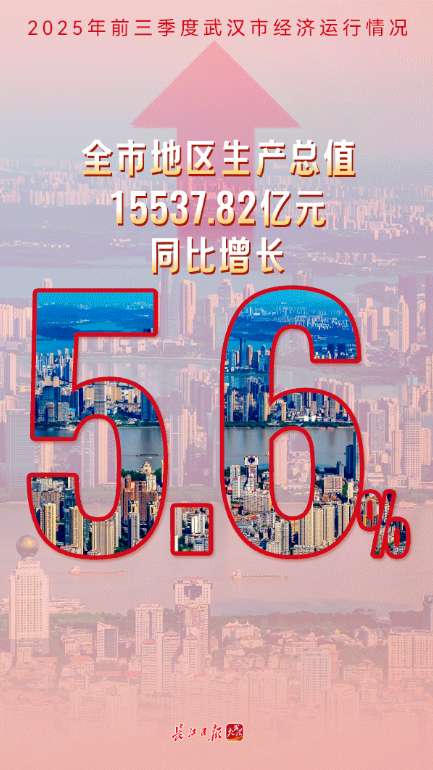
刚刚,武汉2025年前三季度GDP公布
Chang Jiang Ri Bao· 2025-10-29 08:20
Economic Overview - Wuhan's GDP for the first three quarters of 2025 reached 15,537.82 billion yuan, reflecting a year-on-year growth of 5.6% at constant prices [3] - The primary industry added value was 370.81 billion yuan, growing by 3.7%; the secondary industry added value was 5,068.39 billion yuan, growing by 4.8%; and the tertiary industry added value was 10,098.62 billion yuan, growing by 6.0% [4] Agricultural Sector - The total output value of agriculture, forestry, animal husbandry, and fishery reached 608.38 billion yuan, with a year-on-year growth of 3.9% [11] - Major agricultural products saw production increases, with summer grain and early rice totaling 120,500 tons, up by 0.6% from the previous year [11] Industrial Sector - The industrial added value for large-scale enterprises grew by 5.4%, accelerating by 0.3 percentage points compared to the first half of the year [13] - High-tech manufacturing added value increased by 16.3%, accounting for 25.2% of the total industrial added value [13] - Notable growth was observed in the computer, communication, and other electronic equipment manufacturing sector, which grew by 18.0% [13] Service Sector - The service industry added value increased by 6.0%, with transportation, warehousing, and postal services growing by 10.8% [15] - Revenue from large-scale service enterprises rose by 11.6%, with significant increases in various service sectors [15] Investment Trends - Fixed asset investment grew by 2.0%, with industrial investment increasing by 12.0% and infrastructure investment by 6.2% [17] - High-tech industry investment rose by 2.9%, with high-tech service and manufacturing investments growing by 13.2% and 0.4%, respectively [17] Consumer Market - The total retail sales of consumer goods reached 6,299.74 billion yuan, with a year-on-year growth of 5.5% [19] - The "old for new" policy positively impacted retail sales in home appliances and building materials, with increases of 28.6% and 21.0%, respectively [20] Trade and Finance - The total import and export volume was 3,369.6 billion yuan, growing by 15.8% year-on-year [22] - Financial institutions reported a deposit balance of 42,864.83 billion yuan, with a year-on-year growth of 5.1% [22] Income and Prices - Per capita disposable income reached 46,107 yuan, with urban and rural incomes growing by 4.6% and 5.9%, respectively [24] - The consumer price index rose by 0.3% year-on-year, with various categories showing different price trends [24] Conclusion - Overall, Wuhan's economy showed stable growth in the first three quarters of 2025, with a focus on consolidating the recovery and addressing external uncertainties [25]

连续七年成第一生育大省,广东人口“双料冠军”的经济密码
2 1 Shi Ji Jing Ji Bao Dao· 2025-10-28 01:28
Core Insights - Guangdong has maintained its position as the top province for birth rates in China for seven consecutive years, with a birth population of 1.13 million in 2024, an increase of 100,000 from the previous year [2][5] - The province's population growth is driven by both natural increase and migration, with a total population increase of 740,000 in 2024, comprising 470,000 from natural growth and 270,000 from net migration [5][6] - The demographic structure in Guangdong is favorable, with a high proportion of working-age population (66.38%) and a relatively low elderly population (10.18%), contributing to its robust birth rates [6][10] Population Growth Dynamics - Guangdong's population growth is characterized by a "dual-driven" model of natural and mechanical growth, contrasting with other provinces like Zhejiang, which relies primarily on migration [3][5] - The province's strong economic foundation, large base of reproductive-age population, and favorable cultural attitudes towards childbirth contribute to its high birth rates [3][6] - The influx of young migrants into Guangdong, particularly in the Pearl River Delta region, is a significant factor in its population growth, supported by the province's economic and social development [3][7] Economic and Industrial Implications - The continuous population growth in Guangdong is expected to positively impact industrial development and consumer markets, creating a virtuous cycle that stimulates economic growth [3][9] - Guangdong's advanced manufacturing and high-tech industries account for significant portions of its industrial output, with advanced manufacturing value-added accounting for 57.1% of industrial value [10] - The province's labor market is bolstered by a large pool of skilled workers, with over 20 million skilled workers and millions of high-skilled talents, facilitating industrial upgrades and innovation [10][12] Talent Attraction and Retention Strategies - Guangdong has implemented various talent attraction policies, such as the "Million Talents Gathering in South Guangdong" initiative, which has successfully attracted over 1 million college graduates to the province [12] - The province aims to transform its population advantage into a talent advantage by enhancing the quality of its workforce and aligning talent development with industrial needs [11][12] - The government is focusing on improving living conditions and job opportunities to retain talent, emphasizing the importance of a supportive environment for both local and migrant populations [8][11]

77115亿元!山东前三季度GDP增长5.6%
Da Zhong Ri Bao· 2025-10-28 01:01
Economic Overview - Shandong's GDP for the first three quarters reached 77,115 billion yuan, with a year-on-year growth of 5.6% at constant prices [2] - The economic performance is characterized by a steady and positive trend, supported by macroeconomic policies and a focus on high-quality development [2] Industrial Performance - The industrial added value for large-scale enterprises grew by 7.8%, an increase of 0.1 percentage points compared to the first half of the year [2] - The manufacturing sector saw a significant increase of 8.9%, with the equipment manufacturing industry growing by 12.0%, contributing 3.0 percentage points to the overall industrial growth [2] - Key industries such as automotive, railway, and electronics reported substantial growth rates of 17.0%, 14.9%, and 16.6% respectively [2] Service Sector - The revenue of large-scale service industries increased by 5.4% from January to August, with 28 out of 32 major industry categories experiencing growth [3] - Notable growth was observed in entertainment, public facilities management, and business services, with revenue growth rates of 19.4%, 18.9%, and 16.9% respectively [3] Consumer Market - The total retail sales of consumer goods reached 30,386.1 billion yuan, growing by 5.6% in the first three quarters [3] - Online retail sales of physical goods increased by 17.1%, significantly outpacing the overall retail sales growth [3] Investment Trends - Industrial investment grew by 7.7%, surpassing the overall investment growth rate by 11.4 percentage points, contributing to a 3.1% increase in total investment [3] - Specific sectors such as specialized equipment manufacturing, metal products, and general equipment manufacturing saw investment growth rates of 10.3%, 21.9%, and 29.5% respectively [3] Trade and Employment - The total import and export value reached 2.62 trillion yuan, with a growth rate of 5.5% [4] - The employment situation remained stable, with urban employment increasing by 105.9 thousand, and per capita disposable income rising to 33,826 yuan, reflecting a nominal growth of 5.0% [4]
商务部:9月份我国消费市场运行总体平稳
Zhong Guo Xin Wen Wang· 2025-10-27 06:19
Core Insights - The overall consumption market in China remained stable in September 2023, with significant contributions from various sectors and initiatives aimed at boosting consumer spending [1][2]. Group 1: Consumption Market Performance - In September, the total retail sales of consumer goods reached 4.20 trillion yuan, showing a year-on-year growth of 3.0%. For the first three quarters, the total retail sales amounted to 36.59 trillion yuan, with a growth rate of 4.5%, which is 1.0 percentage point faster than the entire previous year [1]. - Per capita consumption expenditure for residents was 21,600 yuan, reflecting a growth of 4.6%. The contribution rate of final consumption expenditure to economic growth was 53.5% [1]. Group 2: Trade-in Programs and Retail Growth - The trade-in program for consumer goods continued to show positive results, with retail sales of related goods increasing by 3.3% in September. Notably, retail sales of communication equipment, furniture, and cultural office supplies from large enterprises grew by 16.2%, 16.2%, and 6.2%, respectively [2]. - The retail volume of passenger cars reached 2.241 million units, marking a growth of 6.3%. As of October 22, 2023, applications for the 2025 automobile trade-in subsidy exceeded 10 million [1]. Group 3: Service Consumption Trends - Service retail sales grew by 5.2% in the first three quarters, outpacing the growth of goods retail sales by 0.6 percentage points. Sectors such as cultural and recreational services, communication services, tourism consulting, and transportation services experienced double-digit growth [2]. - The proportion of residents' service consumption expenditure accounted for 46.8% of total consumption expenditure [2]. Group 4: Emerging Consumption Trends - New types of consumption, including smart and green products, continued to expand. In September, sales of smart wearable devices and robotic vacuum cleaners increased by over 15%, while sales of energy-efficient dishwashers and organic food grew by more than 10% [2]. - The retail volume of new energy passenger vehicles reached 1.296 million units, with a growth of 15.5% and a penetration rate of 57.8% [2]. Group 5: Inbound Consumption Growth - The scale of inbound consumption has been expanding, supported by policies such as the expansion of visa-free entry and optimized tax refund processes. The popularity of "China tours" and "China shopping" continues to rise [2]. - According to the National Immigration Administration, the number of inbound and outbound foreign visitors reached 20.134 million in the third quarter, a growth of 22.3%. Among them, visa-free foreign visitors numbered 7.246 million, increasing by 48.3% [2].
高频:海运价格持续修复,关注中美贸易转机
CAITONG SECURITIES· 2025-10-25 11:31
Report Industry Investment Rating No information provided in the given content. Core Viewpoints - This week, the SCFI continued to rise. The container shipping bookings from China to the US have recovered to last year's level, and the US's restrictive measures may trigger a "rush to export" effect. Sino-US trade relations may see a turnaround. [2] - Real estate sales remained weak. New home sales were far below the seasonal level, while second-hand home sales were basically in line with the seasonality. [2] - Rebar and cement prices remained stable. In the short term, coking coal and coke performed well, supporting the steel price, but in the long term, it was limited by the weak supply-demand pattern. [2] - In terms of investment and production, commodity prices showed mixed trends. Rebar prices were flat, glass futures prices decreased, asphalt prices increased, and cement prices were basically unchanged. [2] - In industrial production, the operating rates were differentiated. The blast furnace operating rate of steel mills, PTA operating rate, and automobile tire operating rate increased, while the petroleum asphalt operating rate and coking enterprise operating rate decreased, and the polyester filament operating rate remained basically unchanged. [2] - In consumption, the mobility was strong. Subway ridership and domestic flights were above the seasonal level, automobile consumption was in line with the seasonality, and movie box office was below the seasonal level. [2] - In terms of inflation, pork prices decreased, vegetable prices increased, and oil prices increased. [2] - In exports, the SCFI increased, and the BDI decreased. [2] Summary by Directory 1. Real Estate Sales: Weak Real Estate Sales, Beijing Provides Support - New home sales this week (October 17 - October 23) increased slightly month-on-month, and the year-on-year decline continued to narrow. The new home sales area in Wind 20 cities increased by 2.83% month-on-month and decreased by 13.03% year-on-year. [7] - New home sales in first-tier and third/fourth-tier cities were significantly stronger than the previous period but weaker than the same period last year. Second-tier cities saw negative growth both month-on-month and year-on-year. [7] - In key cities, most cities saw an increase in new home sales month-on-month. Beijing was the only city with positive year-on-year growth. [7] - Second-hand home sales decreased slightly month-on-month and significantly year-on-year. All key cities saw a decline in second-hand home sales compared to the same period last year. [7] 2. Investment: Commodity Prices Show Mixed Trends - Commodity prices showed mixed trends this week. Rebar and cement prices were basically flat, glass futures prices decreased, and asphalt prices increased. [36] 3. Production: Operating Rates Show Differentiation - Operating rates showed differentiation this week. The blast furnace operating rate of steel mills, PTA operating rate, and automobile tire operating rate increased, while the petroleum asphalt operating rate and coking enterprise operating rate decreased, and the polyester filament operating rate remained basically unchanged. [45] 4. Consumption: Strong Mobility - Subway ridership and domestic flights were above the seasonal level, automobile sales were in line with the seasonality, and movie box office was below the seasonal level. [58] 5. Exports: SCFI Increases, BDI Decreases - The SCFI index increased this week, while the BDI index and CRB spot index decreased slightly. [61] 6. Prices: Pork Prices Decrease, Vegetable and Oil Prices Increase - Pork prices decreased, vegetable prices increased, oil prices increased, and rebar prices were basically flat. [65]
莫让价格套路给“双11”优惠打了折
Zheng Quan Ri Bao· 2025-10-21 16:23
Core Viewpoint - The "Double 11" shopping festival, originally intended to benefit consumers, has seen a decline in consumer trust due to practices like "different prices for different people" and "instant price changes" [1][2]. Group 1: Pricing Strategies and Algorithms - E-commerce platforms utilize user data to implement differential pricing, categorizing consumers based on their price sensitivity, leading to "algorithmic discrimination" [2]. - Dynamic pricing systems allow for real-time price adjustments based on inventory levels and competitor pricing, resulting in frequent price fluctuations [2]. - The pricing structure during "Double 11" often involves artificially inflating prices before discounts, creating a misleading perception of savings [3][4]. Group 2: Regulatory Challenges - Regulatory bodies have identified algorithm-driven price discrimination as a key area for governance, but platforms often evade regulations by citing differences in user status [3]. - The effectiveness of regulations is hampered by the complexity of determining what constitutes price discrimination [3]. Group 3: Consumer Trust and Market Impact - The prevalence of pricing irregularities during "Double 11" undermines consumer confidence and the overall health of the consumption ecosystem [4]. - A transparent and predictable pricing environment is essential for restoring consumer trust and stimulating economic growth [4][5]. Group 4: Recommendations for Improvement - Regulatory authorities should enhance governance through real-time monitoring of price fluctuations and establish clear rules for dynamic pricing [4]. - E-commerce platforms need to disclose pricing algorithms and establish compliance management systems to ensure fair pricing practices [4]. - Companies should focus on building stable pricing systems and improving product quality to regain consumer trust [5].
经济观察丨消费稳步扩大 中国经济主引擎持续发力
Zhong Guo Xin Wen Wang· 2025-10-21 06:15
Group 1 - The core viewpoint of the articles highlights that China's retail sales of consumer goods increased by 4.5% year-on-year in the first three quarters, with final consumption expenditure contributing 53.5% to economic growth, marking a 9 percentage point increase from the previous year [1] - The growth in consumer market size is attributed to effective consumption-boosting policies, including the issuance of 300 billion yuan in special bonds to support the replacement of old consumer goods [1] - The "old for new" policy has led to significant growth in retail sales of household appliances, cultural office supplies, furniture, and communication equipment, with over 8.3 million applications for vehicle replacements by September 10 [1] Group 2 - Service retail sales grew by 5.2% year-on-year in the first three quarters, outpacing goods retail sales by 0.6 percentage points, driven by policies aimed at expanding service consumption [2] - Online retail sales increased by 9.8% year-on-year, with a consistent acceleration in growth since May, indicating a strong shift towards e-commerce [2] - Despite the growth in retail sales, the increase in consumer goods retail sales was lower than the overall economic growth, suggesting a need to enhance consumer willingness to spend [2] Group 3 - Future strategies should focus on stabilizing and expanding employment, promoting sustained income growth, and enhancing consumer capacity and willingness [3] - There is a call for more systematic and comprehensive measures to stimulate domestic demand and release consumption potential, emphasizing the importance of confidence in economic stability [3] - The overall economic performance has exceeded expectations this year, highlighting the need for correct guidance of expectations among businesses and consumers to further boost consumption [3]
纺织服装社零数据点评:9月国内社零同比增长3.0%,化妆品单月增速环比提升
Shanxi Securities· 2025-10-20 07:17
Investment Rating - The report maintains an investment rating of "Synchronize with the market" for the textile and apparel industry [2][7]. Core Viewpoints - The textile and apparel industry has shown marginal improvement in retail sales growth, with a cumulative year-on-year growth of 3.1% from January to September 2025. The sports and entertainment products segment has experienced faster growth, with a cumulative year-on-year increase of 19.6% during the same period [7]. - In September 2025, the retail sales of textiles and apparel increased by 4.7% year-on-year, reflecting a 1.6 percentage point improvement from the previous month [6][7]. - The report highlights the performance of key companies in the industry, such as 361 Degrees and Xtep International, noting their healthy growth and market strategies [7]. Summary by Sections Retail Sales Performance - In September 2025, the total retail sales in China reached 4.20 trillion yuan, with a year-on-year growth of 3.0%, slightly below market expectations [4]. - From January to September 2025, the total retail sales amounted to 36.59 trillion yuan, with a year-on-year growth of 4.5% [4]. Online and Offline Channels - Online channels continue to outperform the overall retail market, with a year-on-year growth of 6.5% in physical goods online retail sales from January to September 2025 [5]. - Offline retail formats such as convenience stores and supermarkets showed stable performance, with year-on-year growth rates of 6.4% and 4.4%, respectively [5]. Cosmetics and Jewelry - The cosmetics sector saw a year-on-year growth of 8.6% in September 2025, while gold and silver jewelry retail sales grew by 9.7% [6]. - The average closing price of gold increased by 43.0% year-on-year, which has temporarily suppressed terminal demand for gold jewelry [6]. Investment Recommendations - The report recommends continuing to invest in 361 Degrees and suggests paying attention to Xtep International, Anta Sports, and other companies in the sector [7]. - For the textile manufacturing segment, companies like Yuyuan Group and Shenzhou International are highlighted for their stable performance and low valuations [8]. Retail Sector Insights - The report continues to recommend Miniso, noting its positive same-store sales growth and strong performance in new store openings [9]. - Yonghui Supermarket is also highlighted for its strategic adjustments and product offerings, which have led to significant increases in customer traffic and profitability [9].
老铺黄金天猫“双11”表现强劲,361度零售流水延续健康增长
Shanxi Securities· 2025-10-20 07:11
Investment Rating - The report maintains an investment rating of "A" for the textile and apparel industry [1]. Core Insights - The textile and apparel industry has shown a mixed performance in exports, with China's textile and apparel exports for January to September 2025 amounting to $106.48 billion and $115.21 billion respectively, reflecting a year-on-year growth of 2.1% and a decline of 2.5% [3][19]. - Vietnam's textile and apparel exports for the same period have shown a cumulative year-on-year growth of 8.77% [4][19]. - The report highlights strong retail performance for brands like 361 Degrees and Tebu International, with 361 Degrees achieving healthy growth in retail sales [2][12]. Summary by Sections Weekly Observation - Major Taiwanese textile manufacturers reported September 2025 revenue data, with notable performances including: - Yuanyuan Group: September revenue down 3.8%, but a 2.3% increase year-to-date [20]. - Fengtai Enterprises: September revenue down 0.87%, with a 4.29% decline year-to-date [5]. - Laiyi Industry: September revenue up 0.65%, with an 8.16% increase year-to-date [6]. - Juyang Industrial: September revenue down 28.22%, with a 0.99% decline year-to-date [7]. - Ruhong: September revenue up 1.59%, with a 5.39% increase year-to-date [8]. Market Performance - The SW textile and apparel sector saw a decline of 0.31% in the week, while the SW light industry sector fell by 2.22% [11][23]. - The SW textile manufacturing sub-sector dropped by 2.73%, while the SW apparel and home textile sector rose by 0.41% [11][23]. Industry Data Tracking - China's textile and apparel exports for January to September 2025 were $106.48 billion and $115.21 billion, with year-on-year changes of 2.1% and -2.5% respectively [19][48]. - Vietnam's textile and apparel exports showed a cumulative year-on-year growth of 8.77% for the same period [4][19]. Industry News - MUJI's parent company reported a global revenue increase of 18.6% for the last fiscal year, with significant growth in the Chinese market [63][64]. - LVMH reported a 4% decline in total revenue for the first nine months of 2025, but noted a return to growth in the Chinese market [68][69]. - Lao Feng Xiang announced a $24 million investment to acquire a 20% stake in Maybach Luxury Asia Pacific, aiming to enhance its high-end product offerings [70][71].

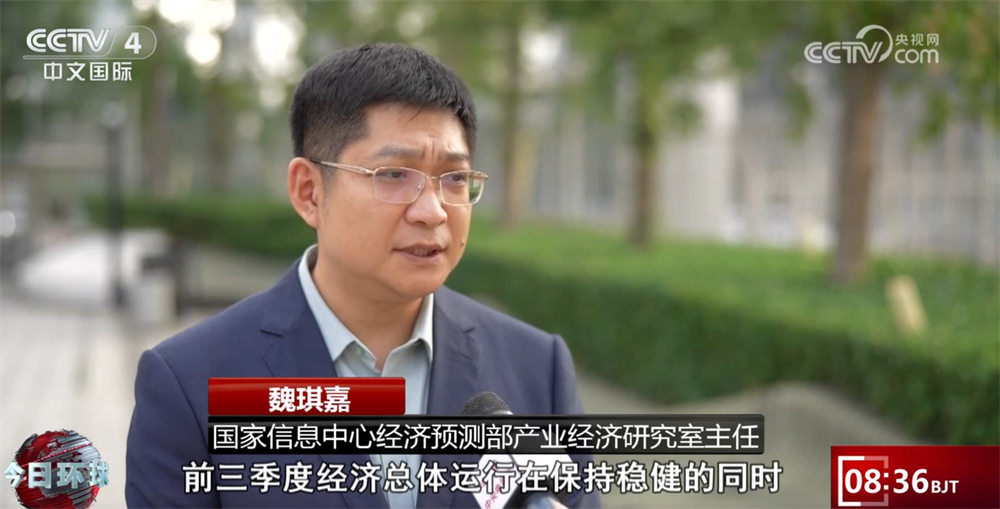
专家说|前三季度中国经济回升向好态势持续巩固 积极因素不断累积
Yang Shi Wang· 2025-10-20 02:31
Core Viewpoint - China's economy is expected to maintain a growth rate of over 5% in the first three quarters of the year, with a focus on steady growth and structural adjustments [1][3]. Economic Performance - The overall economic performance in the first three quarters is characterized by stable growth, supported by policies aimed at expanding domestic demand and promoting consumption [5]. - The consumption market has shown steady growth, with new consumption drivers continuing to strengthen [5]. Consumption and Market Dynamics - The implementation of a 300 billion yuan subsidy for trade-ins has had a significant impact, estimated to generate a 1:10 effect on consumption [5]. - There has been a rapid growth in service consumption, particularly in cultural tourism and performances [5]. Industrial Upgrading - Significant achievements in industrial upgrading are highlighted, with rapid growth in high-tech manufacturing sectors such as new energy vehicles, integrated circuits, artificial intelligence, and high-end equipment manufacturing [7]. - The support for innovation and bold attempts by businesses in their respective fields have contributed to enhancing overall productivity [9]. Export and Market Diversification - Despite a challenging external environment, foreign trade has performed well, showcasing the resilience and upgrading benefits of Chinese industries [11]. - There is a trend towards diversifying export markets, particularly optimizing export structures [11].