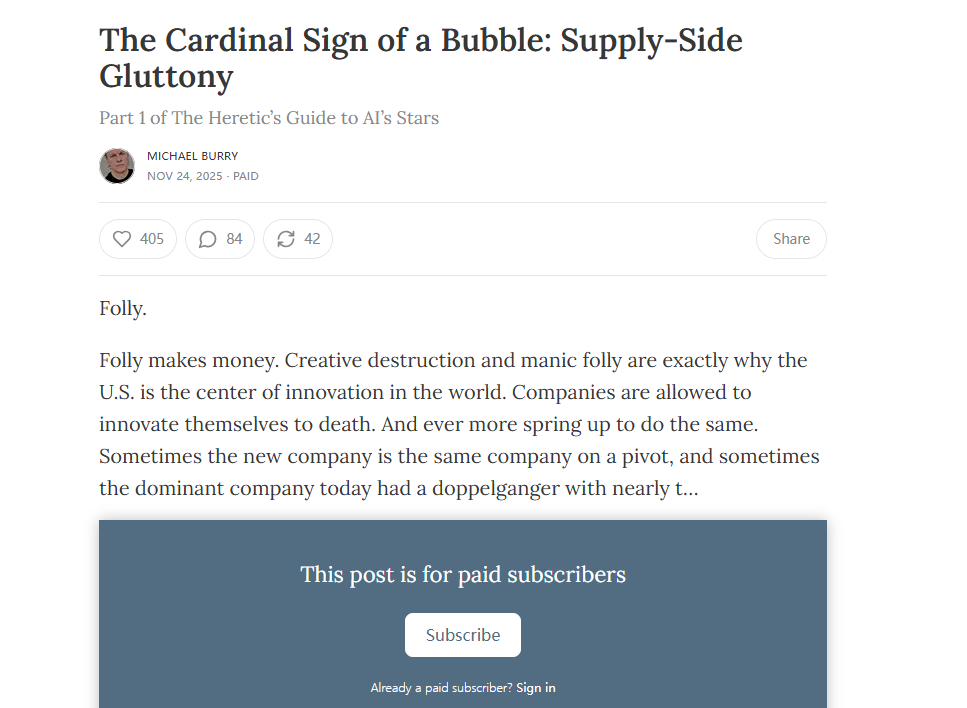
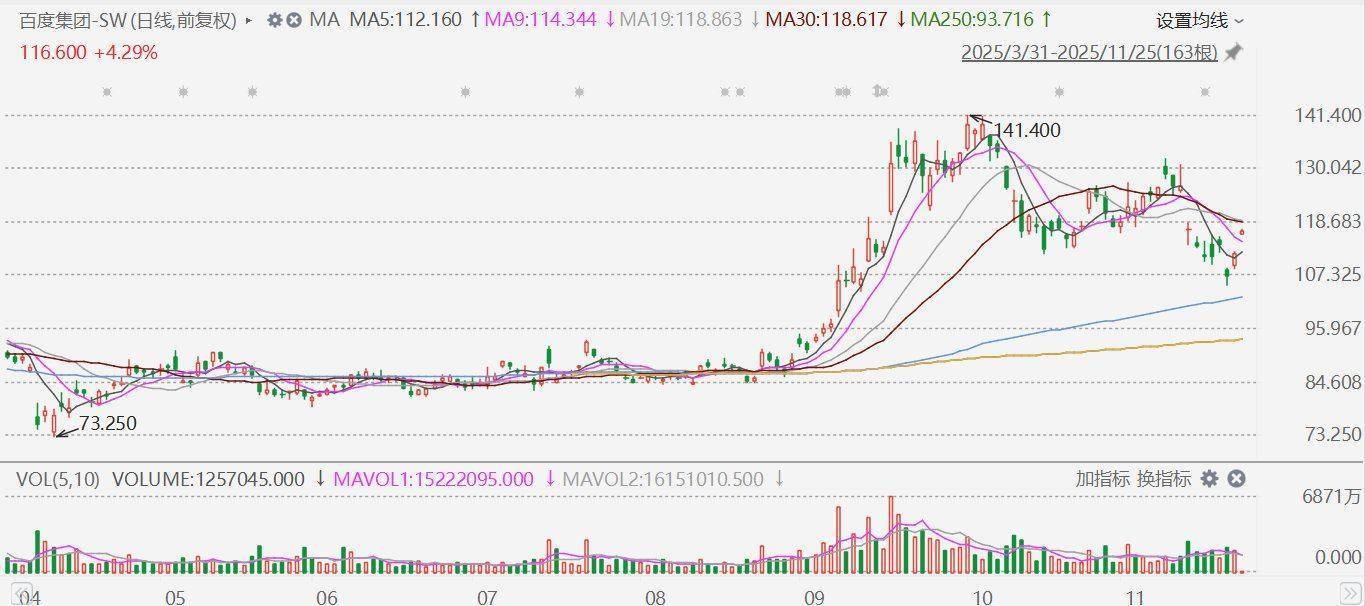
AI泡沫

Search documents
德意志银行:科技股引发股市全线下跌的可能性不大
Sou Hu Cai Jing· 2025-11-25 09:32
Core Viewpoint - Concerns about an AI bubble are unlikely to lead to a broad market decline, with recent pullbacks seen as a result of "extreme position unwinding" [1] Group 1: Market Sentiment - The report by Deutsche Bank strategists, including Maximilian Uleer and Carolin Raab, indicates that worries regarding investment cycles and AI monetization will persist but are not seen as urgent [1] - The adjustment of earnings expectations for the seven major tech stocks is viewed positively, suggesting resilience in their financial outlook [1] Group 2: Economic Outlook - Should the economic outlook worsen, these tech giants have the capacity to adjust their capital expenditures accordingly [1] - If concerns about a bubble continue, the Federal Reserve retains the option for further interest rate cuts [1]

英伟达反击“大空头”言论
Di Yi Cai Jing· 2025-11-25 08:01
Core Viewpoint - Nvidia has responded to criticisms regarding its business practices and the sustainability of its revenue model, asserting that its strategic investments contribute minimally to its overall revenue and that its core business remains robust and transparent [1][3][4] Group 1: Nvidia's Response to Criticism - Nvidia's CEO Jensen Huang and CFO Colette Kress addressed concerns about the AI bubble, emphasizing that the company is experiencing a positive cycle in AI development [2] - In response to Michael Burry's criticisms regarding revenue recognition and the sustainability of its business model, Nvidia clarified that its strategic investments account for a small portion of its revenue and that these companies primarily generate income from third-party clients [3] - Nvidia refuted Burry's claims about stock buybacks, stating that it has repurchased $91 billion worth of stock since 2018, not $112.5 billion as Burry suggested [3][4] Group 2: Michael Burry's Critique - Michael Burry criticized Nvidia's revenue model, suggesting that the actual demand is minimal and that many clients are financially supported by distributors [3] - Burry highlighted that Nvidia's stock buybacks have led to a dilution of shareholder value, estimating a 50% reduction in earnings for shareholders due to increased share count [3] - He also raised concerns about the longevity and profitability of Nvidia's chips, comparing older models to underperforming assets in other industries [4] Group 3: Financial Health and Transparency - Nvidia emphasized its financial stability, asserting that its core business is fundamentally sound and distinct from companies involved in past accounting frauds [4] - The company maintains that its financial reporting is complete and transparent, prioritizing its reputation for integrity [4]

【环球财经】美联储12月降息预期反复摇摆 风险资产市场波动加剧
Xin Hua Cai Jing· 2025-11-25 07:54
关于12月是否降息,多位美联储官员在近期表达了截然相反的观点,也使得市场对于美联储12月降息前 景的判断存在较大分歧。 新华财经上海11月25日电 针对美国就业下行风险与通胀上行风险的争论使得美联储内部对于12月降息 前景的分化进一步加剧,市场对于美联储降息预期也反复摇摆。当地时间24日,包括纽约联储行长威廉 姆斯在内的多位美联储官员均表示支持12月降息,极大提振市场情绪,推动市场预期12月降息概率再次 大幅回升,美股在内的风险资产大幅反弹。根据芝商所(CME)美联储观察工具,市场预期美联储12 月降息的概率已从不到30%回升至80%。 美联储内部分歧加剧 美国劳工部公布数据显示,9月非农新增就业人数超预期但失业率走高,显示美国就业市场表面"强 劲"实则走弱的状况。9月新增就业人数环比大幅增加受8月低基数影响较大,如果从两个月的平均数据 看,8月和9月月均新增就业仅5.75万人,并不乐观。 过去一个月以来,市场对美联储12月降息的预期有两次明显降温:第一次是10月美联储货币政策会议 后,市场对美联储降息概率押注从接近100%降至70%左右。彼时美联储主席鲍威尔称12月降息"并非已 成定局——远非如此"、"政策 ...
软件ETF等率先反弹,或预示着AI主线的变化?
Ge Long Hui· 2025-11-25 04:28
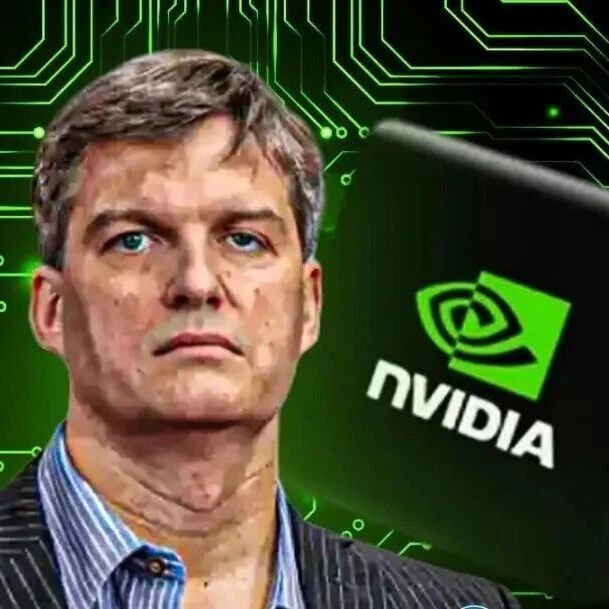
Core Viewpoint - The recent decline in major tech stocks, such as Nvidia, has led to a correction in the A-share technology sector, intensifying discussions about an "AI bubble" in global markets. Concerns stem from the fact that the demand for computing power from AI giants exceeds their free cash flow growth, leading to cash flow consumption and debt expansion [1][2]. Group 1: AI Industry Dynamics - The AI industry is currently viewed as being at the bottom of the Kondratiev wave cycle, suggesting that it is still in a developmental phase rather than a bubble [1]. - There is a prevailing opinion that the market focus may shift from "AI computing power" to "AI applications," indicating a potential new phase in AI investment opportunities [1][4]. Group 2: AI Applications Across Industries - AI applications are penetrating various sectors, including finance (e.g., smart risk control, intelligent investment advisory), healthcare (e.g., AI-assisted diagnosis, drug development), education (e.g., personalized learning), manufacturing (e.g., quality inspection, supply chain optimization), and more [1][2]. - The application of AI is not limited to a specific industry but is a cross-industry theme, highlighting its broad relevance [1]. Group 3: Investment Opportunities in AI - Companies providing AI applications are seen as essential "enablers" across industries, while semiconductor and chip companies are considered the foundational "builders" of the AI ecosystem [2]. - Several indices, such as the Artificial Intelligence Index and the ChiNext AI Index, have seen significant gains exceeding 60% this year, while other indices related to software and computing have underperformed [2][3]. Group 4: Recent Developments and Market Reactions - Notable recent developments include Google's launch of the Gemini3 model and Alibaba's introduction of the Qianwen app, both of which have generated positive market responses despite broader tech stock declines [3][4]. - In the recent market rebound, sector-specific ETFs related to media, gaming, software, and big data have outperformed hardware-focused indices, indicating a shift in investor sentiment towards AI applications [4].

准时上演!“大空头”大战英伟达,“AI泡沫”论战开启
美股IPO· 2025-11-25 03:40
Core Viewpoint - Michael Burry, known as the "Big Short" investor, has declared war on the AI bubble, arguing that the current market dynamics mirror the 1999 dot-com bubble, particularly highlighting Nvidia as the modern-day Cisco [1][3][6]. Group 1: AI Bubble and Nvidia - Burry asserts that Nvidia is at the center of the current AI hype, similar to how Cisco was central during the internet boom [3][5]. - He challenges the prevailing belief that strong profitability among tech giants negates the existence of a bubble, citing that the 1999 Nasdaq surge was driven by high-profit companies, not just unprofitable startups [6][7]. - Burry identifies the "Five Public Knights" of the current AI boom—Microsoft, Google, Meta, Amazon, and Oracle—who are projected to invest nearly $3 trillion in AI infrastructure over the next three years [7][9]. Group 2: Supply-Side Gluttony - Burry describes the current situation as "supply-side gluttony," warning of catastrophic overbuilding and insufficient demand in the AI sector [9]. - He criticizes tech companies for extending depreciation periods to inflate profits, predicting that from 2026 to 2028, large tech firms could overstate profits by $176 billion due to underestimated depreciation [8][9]. - Specific companies like Oracle and Meta are highlighted, with expected profit exaggerations of 26.9% and 20.8%, respectively, by 2028 [8]. Group 3: Burry's Transition and Market Response - Burry has transitioned from fund management to a full-time analyst role, launching a paid subscription newsletter titled "Cassandra Unchained," where he shares his market insights without restrictions [12][13]. - Despite facing backlash and skepticism, particularly from Nvidia's CEO Jensen Huang, who claims a different perspective on the AI landscape, Burry remains steadfast in his bearish outlook on AI [10][14].
中金:AI“泡沫”走到哪一步了?当前市场可能更多处于1996~1998年的情形
Sou Hu Cai Jing· 2025-11-25 01:58
Core Viewpoint - The recent resurgence of the AI bubble is a significant factor contributing to the decline of A-shares and risk assets in the three markets [1] Group 1: Discussion on Bubbles - A bubble is a neutral term and can drive industry development through investment impulses [1] - It is not advisable to exit an industry trend prematurely just because it may end in a bubble [1] - The key discussion point is to identify the current stage of the bubble rather than deny its existence [1] - Distinction should be made between capital market bubbles and the bubbles within the industry itself [1] Group 2: Judging Bubbles Effectively - The core of assessing a bubble in the industry lies in whether investment aligns with demand and capacity [1] - Accelerated investment does not equate to a bubble; a bubble occurs when investment significantly exceeds demand and capacity [1] - In equity markets, continuous price increases, high valuations, or concentration in leading companies do not necessarily indicate a bubble; a bubble is indicated when pricing deviates from fundamental support [1] Group 3: Current Market Analysis - Demand is comparable to the levels seen in 1996-1997, with internal cost reduction and efficiency gains realized, while external demand remains to be broken through [2] - Investment levels are similar to those in 1997-1998, with current scale still in its early stages but with a lower reliance on financing compared to that period [3] - Primary market pricing is akin to 1999, while secondary market valuations and policy environments resemble those of 1998 [3] Group 4: Implications for the Market - High valuations and expectations will lead to volatility; since 2023, the "seven sisters" of the US stock market have maintained valuations around 30 times, with concerns about bubbles arising as valuations approach 35 times [3] - Long-term industry trends remain intact, indicating continued investment value [3] - Market structure is expected to become more differentiated [3] Group 5: Future Market Predictions - The fundamental recovery logic is expected to support the rise of the US stock market, with short-term fluctuations not altering the long-term trend [3] - By the end of 2026, with the Federal Reserve potentially halting balance sheet reduction or even expanding it, financial liquidity is anticipated to boost the US stock market [3] - The index is predicted to reach between 7600 and 7800 points by the end of 2026, representing a potential increase of 13-16% [3]
AI泡沫、美联储、房地产
2025-11-25 01:19
AI 投资:当前 AI 投资尚未达到泡沫程度,需求端金融、地产等行业应用 增加,2025 年一、二季度 AI 相关投资分别贡献接近一半和四分之一的 经济增长,科技产业对整体经济贡献比例接近 60%。 美股市场:预计 2026 年标普 500 指数将升至 7,600~7,800 点,得益 于盈利增长和美联储可能采取的扩表措施,尤其购买短债而非长债,将 进一步利好市场。长期投资价值依然存在,不应因短期波动而放弃。 美联储政策:市场对美联储 12 月降息预期分歧大,但认为美联储有必 要且可以在 12 月降息,以应对当前经济融资成本偏高的问题。预计 2026 年新任美联储主席上任后,市场关注点将转移。 中国市场:近期波动受美股、美联储降息预期及 AI 泡沫担忧影响,内需 基本面弱势显现,房地产行业疲软。信用周期从四季度开始转弱,如果 没有政策加力对冲,大概率会走向震荡和放缓。 美元流动性:美国回购市场融资压力增大,美元流动性紧张成为全球市 场核心驱动变量。预计未来几个季度内,美联储将不得不重启扩表,以 稳定系统内的不稳定状态,对风险资产边际利好。 Q&A AI 泡沫、美联储、房地产 20251124 摘要 近期美股和 ...
大摩闭门会:全球震荡,何去何从
2025-11-25 01:19
Summary of Conference Call Notes Industry or Company Involved - Focus on the global macroeconomic environment, particularly the AI sector and its implications for China and the US markets - Discussion on the real estate market in China and its impact on financial institutions Core Points and Arguments 1. **Global Market Dynamics** - The global market is experiencing significant volatility, but this is seen as a foundation for future productivity improvements driven by AI [1][4][5] - The investment levels in AI by major Chinese companies are projected to be only one-tenth of that in the US over the next two years, primarily due to lower costs in infrastructure, talent, and data in China [1][2] 2. **China vs. US AI Investment Strategies** - The US is heavily investing in high-end AI technologies, while China is focusing on a more lightweight approach aimed at expanding its industrial ecosystem [2][3] - Concerns about an AI bubble in the US are less applicable to China due to its different investment scale and market dynamics [2][25] 3. **Impact of US Market on China** - A significant adjustment in the US stock market is viewed as the biggest external risk to the Chinese market [3][4] - Despite concerns, the overall sentiment towards the Chinese market remains cautiously optimistic, with expectations of manageable impacts from US market fluctuations [4][12] 4. **Monetary Policy and Interest Rates** - The expectation for a rate cut in December has been revised, with predictions now suggesting cuts in January and April instead [5][6] - The changing dynamics of market participants, including increased retail investor participation and algorithm-driven trading, are influencing market behavior [6][7] 5. **US Stock Market Outlook** - The outlook for the US stock market is optimistic, driven by broad-based earnings growth rather than just AI-related companies [7][8] - Approximately 60% of US listed companies reported earnings that met or exceeded expectations, indicating a healthy market environment [8][9] 6. **Consumer Sector Analysis** - The consumer discretionary sector has been upgraded to overweight due to the anticipated positive market conditions [10] - Comparisons to the dot-com bubble suggest that current market valuations are more reasonable than in the past [10][11] 7. **Chinese Real Estate Market Concerns** - The real estate market in China is facing challenges, but the risks are deemed manageable, with banks maintaining stable mortgage delinquency rates [17][18][19] - The potential for policy measures to support the real estate market is being discussed, including interest subsidies for new housing loans [38][39] 8. **Financial Sector Stability** - The financial sector is expected to remain stable, with banks gradually digesting bad debts and real estate losses [20][24] - The overall risk in the financial sector is considered controllable, with a focus on maintaining a balanced approach to lending [21][22] 9. **AI Sector in China** - Chinese companies like Tencent and Alibaba are expected to continue investing in AI, with positive outlooks for their future performance [28][29][30] - The competitive landscape in AI is still evolving, with no immediate signs of a bubble similar to that in the US [25][27] Other Important but Possibly Overlooked Content - The discussion highlighted the importance of understanding the different trajectories of the US and Chinese markets, particularly in the context of AI and real estate [2][4][25] - The potential for policy interventions in the Chinese real estate market is seen as a critical factor in stabilizing the sector and supporting economic growth [38][39] - The overall sentiment towards the Chinese economy remains cautiously optimistic, with expectations of gradual recovery and growth despite current challenges [12][42]


周周芝道 - 从宏观角度理解AI
2025-11-25 01:19
Summary of Key Points from Conference Call Industry and Company Involved - The discussion primarily revolves around the **technology sector**, with a specific focus on **AI** and its implications for the **U.S. economy** and **global asset allocation**. Core Insights and Arguments 1. **Technology Capital Expenditure as a Key Variable** Technology capital expenditure is identified as a crucial factor influencing the global economic cycle and asset allocation in 2026, affecting major assets like the dollar, U.S. Treasuries, and U.S. equities [2][4][12] 2. **Impact of AI on U.S. GDP Growth** The technology sector, particularly AI, contributes significantly to U.S. GDP growth, accounting for at least 0.5 percentage points of GDP increase. This contribution is more pronounced due to the U.S.'s leading position in technology capital expenditure compared to other countries like China [8][12] 3. **Current Monetary Policy Environment** The U.S. is currently in a loose monetary policy cycle, with the Federal Reserve likely to maintain this stance to address complex economic issues, reducing concerns about an AI bubble burst [5][6][7] 4. **Political Influence on Monetary Policy** The Federal Reserve's monetary policy may be influenced by political factors, leading to continued loose policies even in the face of improving employment data and rising inflation pressures [6][7] 5. **Global Capital Flows and the Dollar** AI development is expected to attract global capital into the U.S., supporting a strong dollar. In 2024, the U.S. technology sector is projected to outperform, maintaining a high dollar index despite potential trade war impacts [9][10] 6. **Debt Management through Technology Investment** The resolution of U.S. government debt issues relies heavily on technology capital expenditure and Federal Reserve policies. Sustained technology investment can attract foreign capital, aiding in debt management [14] 7. **Concerns about AI Bubble** Market concerns regarding an AI bubble are primarily focused on financing and over-investment issues. However, the current liquidity environment is relatively loose, mitigating these concerns [5][15] 8. **Future of the Dollar and Gold Prices** The strength of the dollar is influenced by economic cycles, demand changes, and liquidity conditions. While short-term fluctuations may occur, the long-term strength of the dollar is tied to the performance of the technology sector [16] 9. **Investment Opportunities in December** December presents potential investment opportunities in the technology sector, especially if market concerns about financing and investment arise, coinciding with expected interest rate cuts by the Federal Reserve [17] Other Important but Overlooked Content 1. **AI's Political Dimension** The current AI revolution is characterized by its strong political attributes, with the U.S. facing intense competition from China, leading to unprecedented governmental focus on technology development [11][12] 2. **Long-term Economic Strategy** The U.S. government is expected to increase investments in AI and emerging technologies to maintain its competitive edge, which will significantly impact global capital markets and international political economy [12][13]
准时上演!“大空头”大战英伟达,“AI泡沫”论战开启
Hua Er Jie Jian Wen· 2025-11-25 01:15
"这一次没有什么不同,无论多少人试图证明。再一次,有一个思科处于这一切的中心,它为所有人提供'镐和铲子',并伴随着宏大的愿 景。它的名字叫英伟达。" 在经历了基金注销传闻与"做空AI金额被媒体夸大百倍"的闹剧后,电影《大空头》原型、知名投资者Michael Burry于当地时间11月24日兑 现承诺,准时"回归"。 这一次,他并未如传言般通过巨额期权做空市场,而是选择通过首篇专栏文章《泡沫的主要迹象:供给侧的暴食》(The Cardinal Sign of a Bubble: Supply-Side Gluttony)来表达"做空AI"的观点。 Burry在这篇文章中,正式向当下的AI热潮宣战,而风暴的中心正是英伟达。他直指英伟达即是当年的思科。 核心论战:英伟达就是当年的思科 针对近期市场认为"科技巨头盈利能力强,因此不存在泡沫"的主流观点,Burry在文中进行了针锋相对的反驳。他列举了1999年互联网泡 沫巅峰时期的数据指出,当年的繁荣同样是由高利润公司推动的,而非仅仅是那些甚至没有收入的小网站。 他在文中写道: "并不像人们以为的那样是由无利可图的网络公司驱动,1999年强劲的纳斯达克指数是由当时高利润 ...