
人民币国际化

Search documents
杨德龙:年底是布局2026年行情的时间窗口
Xin Lang Cai Jing· 2025-12-22 08:00
Group 1: Market Overview - The capital market in China is expected to experience a slow bull market in 2025, with major indices surpassing the 4000-point mark, although there is significant structural differentiation in market performance [1][6] - Investors focusing on the banking and technology sectors have seen good returns, while others have had limited gains, leading to skepticism about the bull market despite the index levels [1][6] - As 2025 comes to a close, some investors are taking profits, resulting in market adjustments, but this phase is nearing its end, and funds are gradually entering the market for 2026 [1][6] Group 2: Economic Outlook for 2026 - The macroeconomic environment is expected to show signs of recovery in 2026, supported by more proactive growth policies and measures to stabilize the real estate market [1][2] - The Central Economic Work Conference has outlined specific economic tasks for 2026, emphasizing the importance of boosting domestic demand to stabilize economic growth [1][9] - Inflation is projected to rise, with CPI expected to gradually return to around 2%, while PPI may turn positive due to policies aimed at reducing overcapacity [1][2] Group 3: Domestic Demand and Consumption - Enhancing domestic demand requires increasing residents' income levels, as current pressures on businesses make it difficult to raise wages [2][9] - The capital market's strength may provide opportunities for stockholders and mutual fund investors to gain wealth, which could stimulate consumer spending [2][9] - New consumption models have shown strong performance in 2025, and as the stock market improves, consumer spending growth is anticipated to rebound in 2026 [4][9] Group 4: Monetary and Fiscal Policies - Monetary policy is expected to remain moderately accommodative, with potential further declines in deposit and loan rates, encouraging savings to shift towards capital markets [3][8] - The fiscal deficit rate exceeded 3% in 2025, reaching 4%, and is expected to remain around 4% in 2026, which will support local government debt management and consumption initiatives [2][3] Group 5: International Trade and Currency - China's export trade surplus surpassed $1 trillion for the first time in 2025, and exports are expected to remain stable in 2026, supported by a potential agreement in US-China trade relations [2][10] - The People's Bank of China has been increasing its gold reserves for 14 consecutive months, enhancing the international status of the RMB and its role in global trade [5][10] - The anticipated interest rate cuts by the Federal Reserve may lead to a depreciation of the US dollar, potentially strengthening the RMB and attracting more foreign investment into A-shares [4][10]
排雷、转型、国际化:吴晓求勾勒中国资本市场改革三大核心目标
Jing Ji Guan Cha Bao· 2025-12-22 07:58
Core Viewpoint - The modernization of China's financial system is essential for the country's transition to a modern state, with a focus on establishing a strong financial nation through the internationalization of the Renminbi and capital markets [1][2]. Capital Market Internationalization - The construction of a strong financial nation must focus on two indicators: the true internationalization of the Renminbi and the internationalization of capital markets, aiming to establish an international financial center centered on Renminbi-denominated assets [2][3]. - The ultimate goal for the Renminbi is to achieve free circulation as a payment or reserve currency in developed countries, beyond just regional trade settlements [2]. Capital Market Reform Directions - Capital market reform should advance on three levels: 1. A shift in perception from viewing the market solely as a financing tool to recognizing it as an investment market, emphasizing the establishment of incentive mechanisms [3]. 2. Reform of the funding side to reduce excessive constraints on large capital entering equity markets, particularly for commercial insurance funds [3]. 3. Institutional platform reform focusing on legal, regulatory, and rule-based improvements to ensure transparency and prevent fraudulent activities [3]. Core Goals of Capital Market Reform - The primary goal is to "clear mines" by eliminating fraud and deception in the market, with a call for stricter penalties and accountability for violators [4]. - The second goal is to develop a genuine wealth management market, which requires a transparent and trustworthy foundation to attract long-term capital [4]. - The ultimate vision is to establish an international financial center, which necessitates adherence to market-oriented, rule-of-law, and internationalization principles to support the strategy of becoming a strong financial nation [4].
华东政法大学李文莉:上海推动自贸离岸债发展,有利于推进人民币国际化进程
Xin Lang Cai Jing· 2025-12-22 07:25
Core Viewpoint - The 22nd China International Financial Forum held in Shanghai focuses on building an intelligent financial ecosystem in the digital economy era [1][5] Group 1: Development of Offshore Bonds - Shanghai's advantages in promoting free trade offshore bonds include the formation of a market, evidenced by over 130 billion yuan in offshore bond issuance [3][7] - The integration of FT accounts with offshore bonds, initiated in 2014, has been successfully replicated in other regions like Tianjin, Guangdong, and Shenzhen since 2019 [3][7] Group 2: Significance of Offshore Bonds - Promotes the opening of financial markets by aligning offshore bonds with international rules, facilitating global financial resource aggregation [4][7] - Advances the internationalization of the Renminbi by encouraging the issuance of offshore bonds denominated in Renminbi, meeting global investors' demand for Renminbi assets [4][7] - Supports the construction of a new development pattern characterized by dual circulation, leveraging the free trade zone to connect domestic and international markets [4][7] Group 3: Financial Security and Stability - The Central Clearing Company plays a crucial role in the issuance, registration, custody, clearing, and valuation of offshore bonds, enhancing financial security [8] - The option to designate the Shanghai Financial Court as an arbitration institution helps mitigate jurisdictional risks [8] - This framework allows for better control over the innovation practices of financial market openness, contributing to national financial security and stability [8]


上海外经贸大学苏立峰:资本项目的开放是人民币国际化必要条件
Xin Lang Cai Jing· 2025-12-22 07:20
Core Viewpoint - The 22nd China International Financial Forum emphasizes the construction of an intelligent financial ecosystem in the digital economy era, highlighting the importance of offshore financial functional zones to enhance the openness of capital projects and support the internationalization of the Renminbi [1][2]. Group 1: Capital Project Openness - The construction of offshore financial functional zones is proposed as a means to improve the openness of capital projects in China, which is deemed a necessary condition for the internationalization of the Renminbi [3][6]. - The strategy to support the internationalization of the Renminbi and assist enterprises in expanding overseas can be effectively implemented through the establishment of offshore financial functional zones, allowing for pilot projects to gather experience for broader application [3][6]. Group 2: Regional Advantages - Shanghai's Lingang New Area and the newly operational Hainan Free Trade Port are highlighted as experimental zones for offshore financial services, showcasing unique advantages in the development of offshore financial functional zones [4][6]. - Collaboration among Shanghai, Hong Kong, and Hainan is emphasized as essential for enhancing China's offshore financial system [4][6].

外媒关注:中国人民币贷款猛增将超海外美元贷款
Sou Hu Cai Jing· 2025-12-22 06:32
中国央行近日公布数据显示,截至11月底,以美元为主的外币贷款余额降至37500亿元人民币,低于 2022年的峰值58700亿元人民币,而人民币贷款金额达到35700亿元人民币。 标普全球则表示:"人民币相对于美元和欧元的相对稳定性进一步增强了这一吸引力,通过最小化昂贵 的货币对冲需求,减少了对外币发行人的汇率风险。" 路透社近日发文称,过去四年中国海外银行贷款增长三倍,达到2.52万亿元人民币;在岸和离岸人民币 债券销售连续第二年创纪录。得益于吸引人的利率定价,中国银行的人民币贷款余额猛增,即将超过海 外美元贷款,正推动人民币在全球舞台上的地位。 银行家对此表示,这种热潮受到了成本推动,因为人民币利率较低。但市场也正在产生自己的动力,以 及越来越多的持有和消费人民币的需求,这表明即使资本账户的放松还没有取得进展,但中国在全球化 的道路上仍取得进展。 德国商业银行中国境内债务资本市场负责人萨尔曼·费舍尔(Samuel Fischer)表示:"我认为这个阶段现 在更多是由人民币融资的基本兴趣驱动的。"他还提到:"越来越多的国际投资者不再只是将此视为套 利,而是真正有人民币预算,还有来自中国以外的大宗订单。美元正处 ...
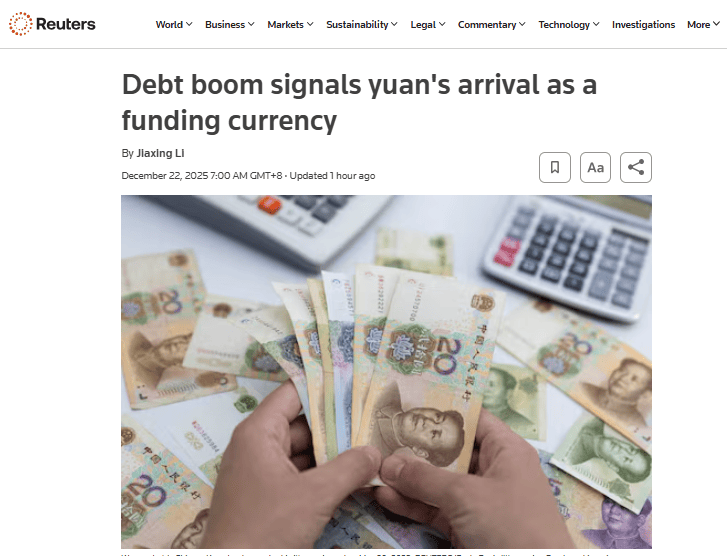
中国海外银行贷款猛增,推动人民币在全球舞台上的地位
Huan Qiu Wang· 2025-12-22 01:07
Core Insights - The People's Bank of China reported that as of the end of November, foreign currency loans in USD terms decreased to 37.5 trillion RMB, down from a peak of 58.7 trillion RMB in 2022, while RMB loans reached 35.7 trillion RMB [1] - Over the past four years, China's overseas bank loans have tripled to 2.52 trillion RMB, and onshore and offshore RMB bond sales have set records for the second consecutive year, driven by attractive interest rate pricing [1] - The surge in RMB loans is expected to surpass overseas USD loans, enhancing the global standing of the RMB [1] Group 1 - The current surge in RMB financing is primarily driven by fundamental interest rather than just arbitrage, with increasing demand for holding and spending RMB [2] - International investors are increasingly viewing RMB not just as a speculative asset but as a legitimate budget currency, indicating a diversification away from the USD [2] - The relative stability of the RMB compared to the USD and EUR has further enhanced its attractiveness, minimizing costly currency hedging needs and reducing exchange rate risks for foreign currency issuers [2]
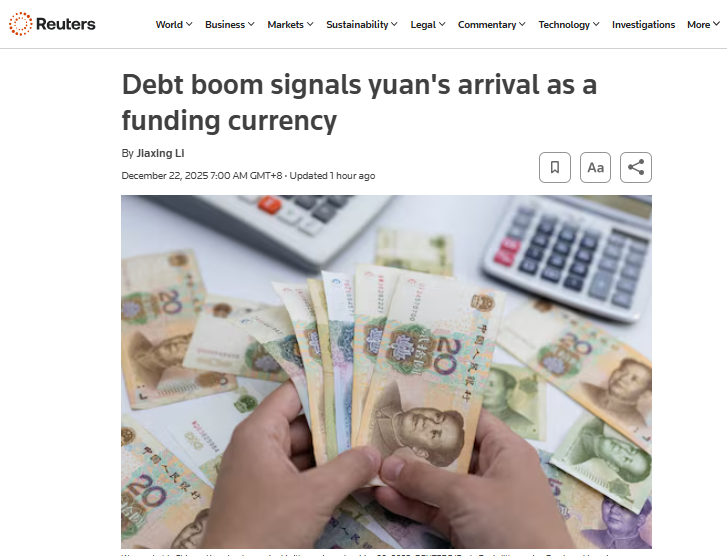
全球媒体聚焦|外媒:人民币融资掀国际热潮 市场需求成核心驱动
Sou Hu Cai Jing· 2025-12-21 23:40
Core Insights - The article highlights the increasing demand for RMB financing, driven by fundamental market needs, marking a significant step in the internationalization of the RMB [1][4]. Group 1: RMB as a Global Payment Currency - The RMB is now the fourth largest payment currency globally and the third largest trade financing currency [1]. - International investors are significantly purchasing RMB credit assets, indicating the RMB's rise as a global financing currency [1]. Group 2: Recent Developments in RMB Bond Issuance - Kazakhstan Development Bank issued 2 billion RMB offshore bonds in September, marking the first public issuance of RMB bonds in Central Asia [4]. - The Indonesian government successfully issued 6 billion RMB offshore bonds in October, representing the first issuance of long-term public "dim sum bonds" by a Southeast Asian sovereign entity [4]. Group 3: Market Dynamics and Investor Sentiment - Deutsche Bank's Samuel Fischer noted that the current RMB financing trend is driven by genuine market demand rather than mere arbitrage, with significant orders from international investors [4]. - Rating agencies have indicated that the RMB's relative stability compared to the volatile USD and EUR enhances its attractiveness for financing [5]. Group 4: Growth in Offshore RMB Bonds - As of now, the total issuance of offshore RMB bonds this year is approximately 870 billion RMB, surpassing the record total for the entire year of 2024 and achieving growth for eight consecutive years [5]. Group 5: Future Outlook and Policy Measures - Experts predict that RMB yields will not experience significant fluctuations in the short to medium term, supported by the People's Bank of China's "moderately loose" policies [7]. - Recent measures announced by the People's Bank of China aim to optimize the "southbound" operation of the Bond Connect and support domestic investors in expanding offshore bond market investment channels, further promoting RMB internationalization [7].
我国离岸金融迈入企稳回升新阶段
Xin Lang Cai Jing· 2025-12-21 20:41
Core Insights - The report indicates that China's offshore financial index increased from 106.16 to 106.50 from 2023 to 2024, marking a significant stabilization and recovery phase for China's offshore finance despite complex international monetary conditions [1] Group 1: Offshore Financial Index - The increase in the offshore financial index is seen as a sign of structural optimization rather than mere scale expansion [1] - The score for China's international balance of payments capital and financial projects improved by 7.7% in 2024 [1] - The offshore RMB asset scale continues to expand, with micro-risk indicators improving by over 25% [1] Group 2: Regional Collaboration - The report suggests enhancing collaboration among Shanghai, Hong Kong, and Hainan to create a complementary offshore financial ecosystem [2] - Shanghai is positioned as an "innovation source," focusing on institutional innovation and RMB liquidity supply [2] - Hong Kong is described as a "global hub," emphasizing pricing and clearing advantages [2] Group 3: Future Development - The report anticipates a structural increase in demand for offshore financial services driven by external environments and the deepening of RMB internationalization [1] - Recommendations include building an offshore RMB asset pool and innovating offshore financial products to attract investor participation [2] - The focus of China's offshore financial development is shifting from increasing volume to establishing functions and systems, aiming to create a comprehensive and secure financial hub [2]
中国抛售585亿美债,还会大量甩卖吗?美国开始急了,态度大转弯
Sou Hu Cai Jing· 2025-12-21 18:58
一、美国的回应与华尔街的忧虑 探讨中国逐步减持美国国债及其引发的美国反应,实则触及国际经济与地缘政治复杂交织的深层博弈。理解当前局势及未来走向,需从多维度审视: 面对中国持续减持美债,美国并非毫无察觉。美国财政部官员,甚至包括财长耶伦,多次公开表达与中国在经济金融领域保持沟通与合作的意愿,强调中国 持有美债的重要性。这一姿态,与过去几年美国对华强硬金融措辞形成鲜明对比,实则暴露出美国的"急"。 中国减持美债,并非单纯的"抛售甩卖",而是经过多年深思熟虑的结构性调整,背后蕴含多重战略考量: 外汇储备多元化: 降低对外汇储备中美元资产的过度依赖,是大型经济体进行理性风险管理的必然选择。通过分散投资于其他主权债券、黄金等资产,中 国可以增强外汇储备的安全性和稳定性。 地缘政治与金融安全: 中美战略竞争加剧,美国多次将美元金融体系"武器化"(如冻结俄罗斯外汇储备),这无疑给所有持有大量美元资产的国家敲响了 警钟。减持美债是中国应对潜在金融制裁风险的预防性措施。 市场与收益率因素: 美联储加息周期下,美债价格下跌、收益率波动,减持部分美债也是出于投资组合管理的市场行为。 支撑人民币汇率: 在人民币面临贬值压力时,出售美 ...

从“配角”到“主角” 点心债市场质变
Shang Hai Zheng Quan Bao· 2025-12-21 18:15
◎记者 黄冰玉 张欣然 离岸人民币债券市场正经历一轮结构性跃迁。 从发行规模持续扩张,到发行人与投资者结构明显多元,再到长期限品种逐步增多,业内人士认为,点 心债正由早期的小众市场,迈向具备配置属性的成熟债券市场。在人民币国际化稳步推进、债券通"南 向通"机制持续优化及全球融资需求多元化的背景下,点心债迎来了提升国际影响力的重要窗口期。 从制度层面看,债券通"南向通"机制对需求端形成重要支撑。熊奕称,自2022年起,监管部门允许在岸 银行直接投资点心债,迄今总规模已达6000亿元人民币。随着未来"南向通"将合格投资者范围进一步扩 大至非银金融机构,还将继续提振点心债市场的需求和增强流动性,进一步释放长期投资需求。 发行人与投资者结构变化显著 在规模扩张的同时,点心债市场的结构性变化更为深刻。 早期点心债主要由金融机构发行、银行资金参与。近年来,发行主体明显扩展至国企、优质民企、科技 企业以及境外机构,投资者结构也由银行主导逐步转向多元化。 2024年底以来,阿里巴巴、百度、腾讯、美团等中资科技企业,以及淡马锡、雀巢、安达保险 (Chubb)等境外发行人相继进入点心债市场,推动市场覆盖行业和主体类型进一步拓展。 ...