高端化

Search documents
山西大同发布“阳高红”西红柿产业支持措施
Zhong Guo Xin Wen Wang· 2025-09-11 10:41
Core Viewpoint - The Dazhong City government has introduced ten measures to support the high-quality development of the "Yanggao Red" tomato industry, focusing on technology, insurance, funding, and sales to enhance this specialty agricultural sector [1][2]. Group 1: Industry Development Measures - The "Yanggao Red" tomato is recognized for its unique volcanic soil, abundant sunlight, and temperature variations, leading to higher nutritional content compared to ordinary varieties. The planting area is expected to exceed 16,000 acres by 2025, with an estimated yield of 80,000 tons and a production value of 500 million yuan, benefiting 13,500 farming households [1]. - The local government plans to establish an expert database to promote green pest control and soil improvement techniques, ensuring scientific farming practices are implemented [1]. - A price insurance pilot program will be introduced, with the government subsidizing 180 yuan per acre for insurance premiums, aimed at reducing market risks for farmers [1]. Group 2: Financial Support Initiatives - For agricultural operators with over 50 acres, the county will increase interest subsidies by 0.4 percentage points on top of higher-level subsidies. Projects for trading markets on over 300 acres will receive a 30% subsidy on total investment, while new cold storage facilities will be subsidized between 48,000 to 280,000 yuan based on capacity [1]. - Additional rewards will be provided for seedling production, new variety promotion, and steel frame greenhouse construction [1]. Group 3: Sales and Brand Development - Distributors selling between 500 to 1,000 tons annually will receive a reward of 100,000 yuan, while those exceeding 1,000 tons will receive 200,000 yuan. The "Yanggao Red" has already entered online platforms such as 832 and JD Cloud, and established partnerships with major agricultural supermarkets in regions like Beijing-Tianjin-Hebei and the Yangtze River Delta [2]. - Financial incentives ranging from 20,000 to 80,000 yuan will be awarded to entities obtaining certifications such as "Zhenpin," green organic, and geographical indications [2]. Group 4: Farmer Income Enhancement Strategies - New profit-sharing mechanisms include encouraging farmers to invest land for dividends and labor, implementing "order price + insurance" models to secure farmer income, and a "village collective + enterprise + farmer" model to allow farmers to share profits from processing [2]. - The chairman of the Yanggao Vegetable Planting Cooperative emphasized the differentiation of "Yanggao Red" based on natural advantages, targeting market demands through selective breeding and building consumer trust via tasting experiences and transparent sourcing [2]. Group 5: Overall Industry Goals - The ten measures aim to drive the "Yanggao Red" tomato industry towards standardization, branding, and high-end development through a combination of technological empowerment, risk protection, and financial support [2].
供应链波动、旗舰机箭在弦上,手机厂商角逐下半年
2 1 Shi Ji Jing Ji Bao Dao· 2025-09-11 10:00
Group 1: Market Trends - The upstream supply chain is experiencing price increases, with SanDisk announcing a price hike of over 10% for all products, potentially signaling a new round of price increases across the industry [1] - The domestic smartphone market showed a "first rise then fall" trend in the first half of the year, with a 4% year-on-year decline in smartphone shipments in Q2 2025, ending six consecutive quarters of growth [2] - The high-end smartphone market is showing resilience, with shipments of devices priced over $600 increasing by approximately 9.2% year-on-year in the first half of the year [4] Group 2: Supply Chain Dynamics - Major storage manufacturers have announced production halts for DDR4 products, leading to a price inversion with DDR5, although some manufacturers are reconsidering complete halts due to ongoing demand [1][5] - DRAM prices have surged by about 72% in less than six months, with DDR4 and LPDDR4X prices starting to rise in Q2 and expected to continue through the end of the year [5] - The exit of Micron from the mobile NAND market is anticipated to cause a slight increase in NAND prices in Q4 [6] Group 3: Company Performance - Sunny Optical reported a revenue of 19.652 billion yuan in the first half of the year, a 4.2% increase year-on-year, despite a 21% decline in smartphone camera module shipments [3] - Qiu Tai Technology achieved a revenue of approximately 8.832 billion yuan, a 15.1% year-on-year increase, driven by growth in non-mobile sectors and an increase in average selling prices of camera modules [3] - The company plans to focus on high-end camera modules and expand into automotive and IoT sectors, which has positively impacted their gross margin [3] Group 4: Competitive Strategies - Companies are focusing on product differentiation and high-quality offerings to stimulate consumer demand in a competitive market [2][7] - Realme is planning to enhance its product offerings and marketing strategies, including the introduction of flagship models and the expansion of service outlets [7] - The competitive landscape is intensifying as major brands, including Apple, have launched new flagship products, prompting domestic manufacturers to prepare for aggressive market strategies [7]
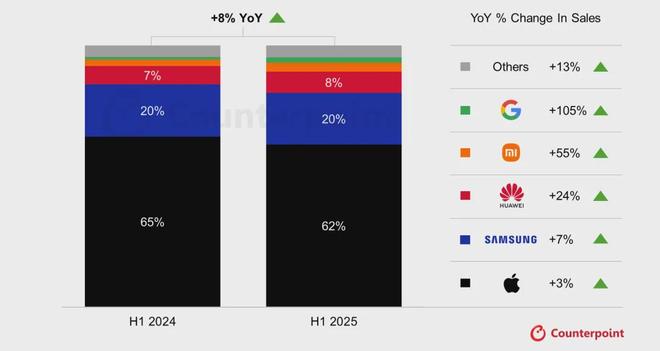
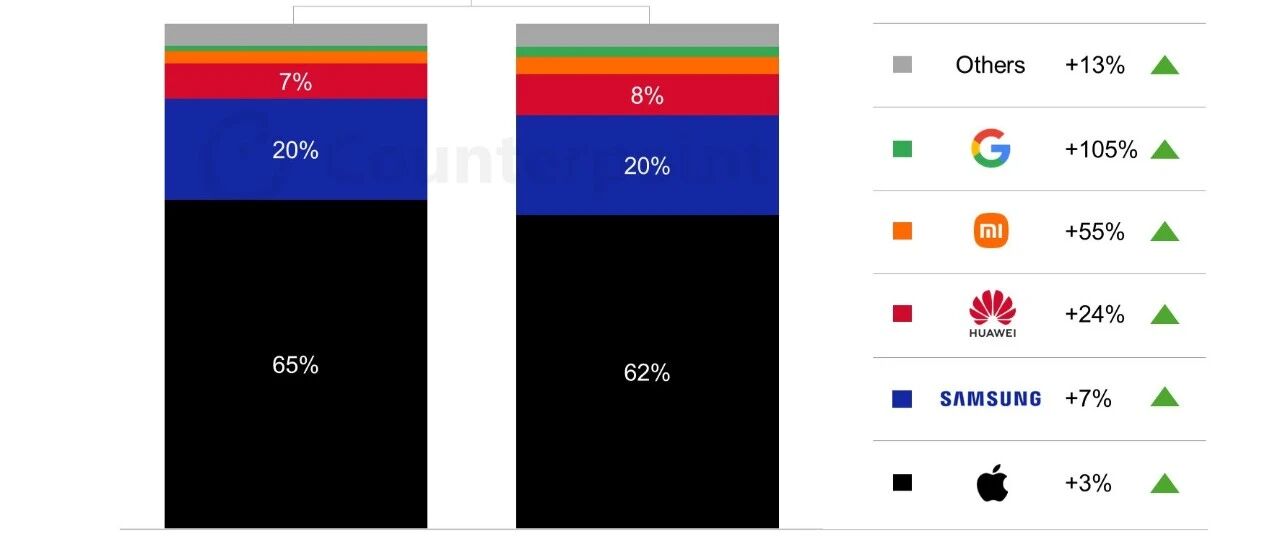
上半年全球高端手机份额:苹果独占62%,三星20%,华为升至8%
Guan Cha Zhe Wang· 2025-09-11 07:23
Core Insights - The global high-end smartphone market is experiencing significant growth, with a projected 8% year-on-year increase in sales for the first half of 2025, outpacing the overall smartphone market's 4% growth [1][4] - Apple continues to lead the high-end market with a 62% share, although its growth is slower compared to competitors [2][3] - Huawei and Xiaomi are gaining market share, with Huawei's sales up 24% and Xiaomi's up 55%, driven by strong performance in the Chinese market [1][3] - Google has re-entered the top five high-end smartphone brands after five years, with a 105% increase in sales due to the success of its Pixel 9 series [2][3] Market Dynamics - The high-end smartphone segment contributes over 60% of global smartphone revenue, highlighting its strategic importance [4] - The top ten high-end markets account for nearly 80% of sales, with India showing the fastest growth at 37% year-on-year, largely due to Apple's performance [4] - China remains the largest high-end market in absolute terms, contributing significantly to growth [4] Consumer Trends - There is a growing trend towards upgrading to high-end devices, with consumers increasingly favoring advanced features and innovations [4] - Generative AI models now account for over 80% of high-end devices, indicating a shift in consumer preference towards AI ecosystems [4] - Foldable smartphones are a niche but growing category, with Apple expected to enter this market in 2026 [4]



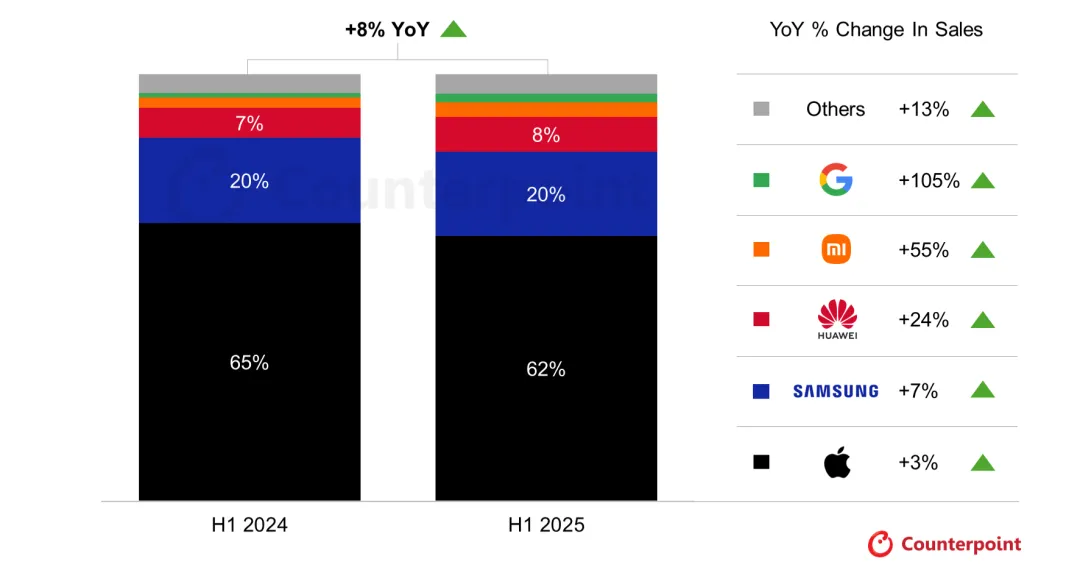
上半年全球高端手机市场份额:苹果独占62%,三星20%,华为升至8%
Guan Cha Zhe Wang· 2025-09-11 07:11
Core Insights - The global high-end smartphone market is experiencing significant growth, with a projected 8% year-on-year increase in sales for the first half of 2025, surpassing the overall smartphone market growth of 4% [1][3] - Apple continues to lead the high-end market with a 62% share, although its market share has slightly declined due to faster growth from competitors [3] - Huawei and Xiaomi are gaining market share, with Huawei showing a 24% year-on-year growth and Xiaomi achieving a remarkable 55% increase, primarily driven by the Chinese market [1][3] - Google has re-entered the top five high-end smartphone brands after five years, with a 105% increase in sales attributed to the strong performance of its Pixel 9 series [1][3] Market Trends - The trend towards "premiumization" is evident as consumers increasingly prefer to upgrade to high-end devices, contributing over 60% of global smartphone revenue [4] - The top ten high-end markets account for nearly 80% of sales in this segment, with India showing the fastest growth at 37% year-on-year, largely driven by Apple's performance [4] - China remains the largest high-end market in absolute terms, contributing significantly to growth [4] - Generative AI models now account for over 80% of high-end devices, indicating a shift in consumer preference towards innovative features [4] - Foldable smartphones are a niche but growing category, with Apple expected to enter this market in 2026 [4]
解码泸州老窖的韧性密码:“高端固本”与“低度拓新”的战略平衡术
Xin Jing Bao· 2025-09-11 01:52
Core Insights - In 2025, Luzhou Laojiao demonstrated resilience in a challenging environment, achieving total revenue of 16.454 billion yuan and a net profit of 7.663 billion yuan in the first half of the year, alongside a net cash flow from operating activities of 6.064 billion yuan [1][3][4] Group 1: High-End Strategy - Luzhou Laojiao has solidified its position in the high-end market with its flagship product, Guojiao 1573, which serves as a value anchor, contributing to 91.45% of total revenue and achieving a gross margin of 87.09% [3][4] - The company reported a 13.33% year-on-year increase in mid-to-high-end liquor sales, with inventory decreasing by 6.96%, indicating strong market performance [3][4] - Luzhou Laojiao's distribution network remains stable with 1,791 distributors, reflecting confidence in the brand, while sales expenses decreased by 6.86%, indicating improved sales efficiency [6] Group 2: Low-Alcohol Market Penetration - The rise of younger consumers, who now account for over 60% of liquor consumption, is driving a shift towards low-alcohol products, with the market expected to grow from 20 billion yuan in 2020 to over 74 billion yuan by 2025 [7][9] - Luzhou Laojiao has established a leading position in the low-alcohol segment with its 38% vol Guojiao 1573, which has become a top-selling low-alcohol product [7][9] - The company is investing in R&D for lower-alcohol products, including a 28-degree version of Guojiao 1573, to cater to diverse consumer preferences [9] Group 3: Digital Transformation - Luzhou Laojiao is prioritizing digital transformation in 2025, implementing a "five-in-one" system for comprehensive data application across its operations [11] - The establishment of a consumer data model enhances management and service capabilities, facilitating a shift from channel-driven to user-oriented operations [11] - The company aims to create innovative consumer experiences and engage younger audiences through events like the "Jiao Master Festival" and collaborations with art and sports [12][14]


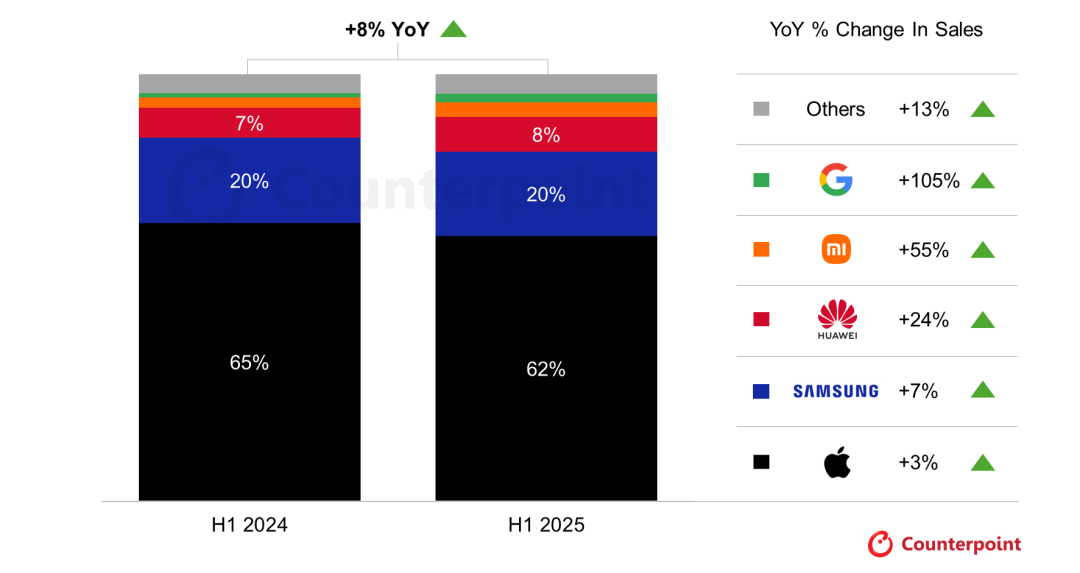
Counterpoint:2025年上半年全球高端智能手机销量同比增长8%
智通财经网· 2025-09-11 01:21
Core Insights - The global high-end smartphone market is experiencing significant growth, with a projected 8% year-on-year increase in sales for the first half of 2025, outpacing the overall smartphone market growth of 4% [1] - High-end smartphones now account for over 60% of global smartphone revenue, highlighting their strategic importance in the market [1] Company Performance - Apple remains the largest brand in the high-end market with a 3% year-on-year growth, holding a 62% market share, although its share has slightly declined due to faster growth from other OEMs [1] - Xiaomi has shown notable improvement in the high-end segment in China, leveraging its advancements in electric vehicles (EV) and Internet of Things (IoT) to enhance its smartphone business [4] - Google has re-entered the top five high-end smartphone brands after five years, with its Pixel 9 series seeing a doubling in sales due to strong performance and effective marketing [4] - Samsung has achieved growth through its S25 series, which has outperformed the S24, and anticipates further success with the upcoming Z Fold7 [4] Market Trends - The top ten high-end markets contribute nearly 80% of sales, with India being the fastest-growing market at 37% growth, driven by Apple's strong performance and accessible financing options [4] - China remains the largest contributor to growth in absolute numbers within the high-end market [4] - Foldable smartphones are emerging as a niche but growing category, serving as a key differentiator for brands and expanding high-end product lines [5] - Devices with generative AI capabilities accounted for over 80% of high-end smartphone sales in the first half of 2025, indicating a strong consumer preference for innovative technology [5]
安徽叉车集团上半年海外营收快速增长
Zhong Guo Chan Ye Jing Ji Xin Xi Wang· 2025-09-11 01:07
Core Viewpoint - Anhui Forklift Group has significantly expanded its overseas business in 2023, achieving over 4.3 billion yuan in overseas revenue in the first half of the year, representing a year-on-year growth of approximately 27.5% and maintaining the top market share in over 30 countries and regions [1][2]. Group 1: Overseas Business Expansion - The company has implemented a closed-loop management system to ensure the effective execution of its internationalization strategy, with 190 personnel dispatched for overseas visits and long-term assignments [1]. - The focus is on high-end, intelligent, and green development, targeting industry-leading clients and exploring new leasing business models [1]. Group 2: Market Strategy and Innovation - Anhui Forklift Group has adopted a series of innovative measures, such as "new product promotion," "heavy-duty competition," and "revenue red June," to enhance market guidance and optimize product structure [1]. - The company is actively participating in over 10 international exhibitions to strengthen brand influence and deepen local operations [2]. Group 3: Future Plans - The company aims to accelerate domestic and international dual circulation, enhance key technology breakthroughs, and continue expanding its overseas business layout to solidify the foundation for the successful completion of the 14th Five-Year Plan [2].

2025年上半年全球高端智能手机销量创历史新高
Counterpoint Research· 2025-09-11 01:03
Core Insights - The global high-end smartphone market saw an 8% year-on-year growth in the first half of 2025, marking the highest record for this period [4][5] - The high-end segment contributed over 60% of global smartphone revenue, highlighting its strategic importance [5] - Apple remains the largest brand in the high-end market with a 62% share, although its market share has slightly declined due to faster growth from other OEMs [5][9] Market Trends - The trend of "premiumization" is becoming increasingly evident across various regions, driven by enhanced consumer engagement and affordability [5] - The top ten high-end markets accounted for nearly 80% of sales, with India being the fastest-growing market at 37% year-on-year [9][10] - Foldable smartphones are emerging as a niche but growing category, with Apple expected to enter this market in 2026 [10] Brand Performance - Xiaomi has significantly improved its position in the high-end segment, with a 55% year-on-year increase, primarily driven by its performance in China [9][10] - Google has re-entered the top five high-end smartphone brands after five years, with its Pixel 9 series seeing a doubling in sales [9][10] - Samsung achieved a 7% year-on-year growth, supported by the performance of its S25 series [9][10] Technological Innovations - Devices with generative AI capabilities accounted for over 80% of high-end smartphone sales in the first half of 2025, indicating a shift in consumer preference towards AI ecosystems [10]

零跑豪言“明年智驾第一梯队”,车主们懵了……|次世代车研所
Xin Lang Cai Jing· 2025-09-11 00:43
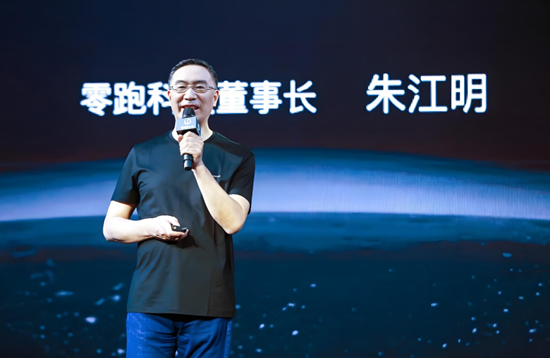
Core Viewpoint - The article discusses the challenges faced by Leap Motor, particularly regarding its autonomous driving features and ambitious sales targets, amidst customer dissatisfaction and skepticism about its brand positioning in the market [2][10]. Group 1: Customer Feedback and Product Performance - Customers have expressed significant dissatisfaction with Leap Motor's autonomous driving capabilities, citing instances of system failures shortly after purchase [4][6]. - A specific case highlighted a customer experiencing two failures of the autonomous driving system within 12 days of ownership, raising safety concerns [4]. - The sales team acknowledged the shortcomings of the autonomous driving features, indicating that they are still in the early stages of development and will require further upgrades [6]. Group 2: Sales Performance and Market Position - Leap Motor reported a substantial increase in vehicle deliveries, with 57,066 units delivered in August, marking an 88% year-on-year growth [7]. - Despite this growth, the average selling price of Leap Motor vehicles remains low at 109,000 yuan, significantly lower than competitors like Xiaopeng and NIO [8][11]. - The company aims to introduce a new model priced at 300,000 yuan, but faces skepticism regarding its ability to support this price point given its current brand perception and product performance [9]. Group 3: Future Goals and Financial Performance - Leap Motor's chairman set an ambitious target of achieving annual sales of one million vehicles, a goal that appears increasingly unrealistic based on current performance metrics [10][15]. - The company reported a revenue of 24.25 billion yuan in the first half of the year, with a net profit of only 33 million yuan, indicating that while it has achieved profitability, the scale of profit is minimal [11][12]. - Leap Motor plans to expand its product lineup significantly over the next three years, aiming to cover the 60,000 to 300,000 yuan market segment with multiple series of vehicles [8][14].
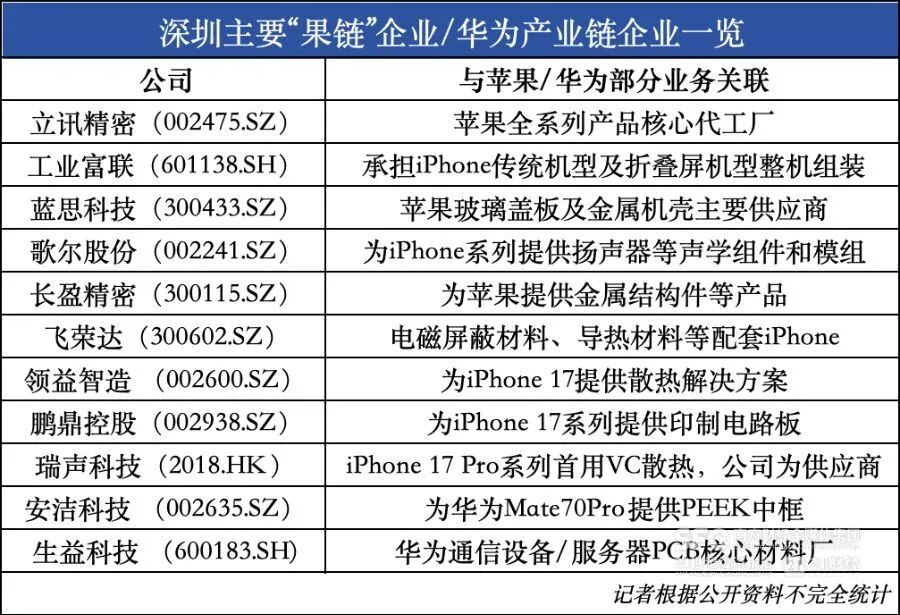
华为苹果发新品,深圳电子厂忙翻:面试第二天即上班,时薪涨到23元
2 1 Shi Ji Jing Ji Bao Dao· 2025-09-10 13:18
Core Viewpoint - The recent product launches by Apple and Huawei are expected to drive a surge in the global consumer electronics market, particularly in the high-end smartphone segment, leading to increased demand across the supply chain [2][3][6]. Group 1: Product Launches and Market Trends - Apple officially launched the iPhone 17 series on September 10, featuring four new models [1]. - Huawei released its Mate XTs, the second commercial foldable smartphone, on September 4, achieving a market share of 75% with 3.74 million units shipped in the first half of 2025 [5]. - The high-end smartphone market is projected to grow by 8% year-on-year in the first half of 2025, marking a historical high for that period [2]. Group 2: Supply Chain and Manufacturing Impact - The launches are anticipated to stimulate orders in the consumer electronics supply chain, particularly for OLED panels, camera modules, thermal components, and hinges [3]. - Shenzhen, as a major hub for consumer electronics, is experiencing increased hiring and production activity in response to the new product releases [8][9]. - Companies like Luxshare Precision and Lens Technology are reaching full production capacity to meet the rising demand [10]. Group 3: Financial Performance and Market Response - The stock market has reacted positively to the announcements, with companies in the supply chain, such as Lens Technology and Luxshare Precision, seeing significant revenue growth [12][13]. - Luxshare Precision reported a revenue of 124.5 billion yuan, a year-on-year increase of 20.18%, while Lens Technology's net profit grew by 32.68% [12][13]. - The overall consumer electronics sector in Shenzhen achieved a revenue of 579.72 billion yuan and a net profit of 24.31 billion yuan in the first half of the year, reflecting growth of 25.6% and 17.4% respectively [13]. Group 4: Technological Advancements and Future Outlook - The introduction of Huawei's Kirin 9020 chip signifies advancements in domestic chip technology, enhancing competitiveness in the high-end smartphone market [6]. - Companies are diversifying into new sectors such as automotive electronics and AI, leveraging their precision manufacturing expertise to capture emerging market opportunities [14]. - The shift towards high-end and intelligent ecosystems in the consumer electronics industry is expected to continue, driven by technological collaboration and supply chain resilience [14].