美联储货币政策

Search documents
人工智能泡沫担忧加剧 美股由涨转跌 巨幅震荡
Sou Hu Cai Jing· 2025-11-21 07:21
由于市值龙头股英伟达公司财报未能持续提振市场人气,纽约股市三大股指20日由涨转跌,收盘时三大 股指均明显走低,遭遇少见的大幅反转行情。 截至当天收盘,道琼斯工业平均指数比前一交易日下跌386.51点,收于45752.26点,跌幅为0.84%;标 准普尔500种股票指数下跌103.40点,收于6538.76点,跌幅为1.56%;纳斯达克综合指数下跌486.18点, 收于22078.05点,跌幅为2.15%。 标普500指数11大板块10跌1涨。科技板块和非必需消费品板块分别以2.66%和1.73%跌幅领跌,仅必需 消费品板块上涨1.11%。 英伟达19日盘后发布的财报显示,在截至10月26日的本财年第三季度,该公司营业收入和净利润均显著 增长,利润率改善。英伟达还对本财年第四季度业绩给出乐观预期。财报公布后,英伟达股价在19日盘 后交易中出现超5%的涨幅。不过,20日英伟达股价在涨至每股196美元后回落,收盘时下跌超3%。 分析人士指出,美国多家科技巨头围绕AI推出总规模达数万亿美元的资本开支,引发投资者质疑,市 场对AI领域出现泡沫的担忧刺激相关股票明显回调。 与此同时,因美国联邦政府"停摆"而延迟发布的9月 ...

【comex黄金库存】11月20日COMEX黄金库较上一交易保持不变
Jin Tou Wang· 2025-11-21 07:14
Group 1 - COMEX gold inventory remained unchanged at 1149.87 tons as of November 20, 2025 [1][2] - On November 20, 2025, COMEX gold closed at $4075.70 per ounce, reflecting a slight increase of 0.02% [1] - The daily price range for COMEX gold on November 20, 2025, was between a high of $4109.60 and a low of $4034.00 per ounce [1] Group 2 - ING's chief international economist, James Knightley, noted that due to the recent hawkish stance of the Federal Reserve and the lack of official economic data before the December monetary policy meeting, the market anticipates that the Fed will not lower interest rates until early 2026 [2]
综述|人工智能泡沫担忧加剧 美股遭遇巨幅震荡
Xin Hua She· 2025-11-21 05:21
截至当天收盘,道琼斯工业平均指数比前一交易日下跌386.51点,收于45752.26点,跌幅为0.84%;标 准普尔500种股票指数下跌103.40点,收于6538.76点,跌幅为1.56%;纳斯达克综合指数下跌486.18点, 收于22078.05点,跌幅为2.15%。 标普500指数11大板块10跌1涨。科技板块和非必需消费品板块分别以2.66%和1.73%跌幅领跌,仅必需 消费品板块上涨1.11%。 新华社纽约11月20日电 综述|人工智能泡沫担忧加剧 美股遭遇巨幅震荡 新华社记者刘亚南 由于市值龙头股英伟达公司财报未能持续提振市场人气,纽约股市三大股指20日由涨转跌,收盘时三大 股指均明显走低,遭遇少见的大幅反转行情。 与此同时,因美国联邦政府"停摆"而延迟发布的9月就业数据当日早间出炉。美国劳工部数据显示,9月 美国失业率升至4.4%,为2021年11月以来最高水平。 芝加哥商品交易所美联储观察工具显示,截至当日17时45分,市场认为美联储在12月货币政策会议上降 息25个基点的概率从前一日的30.1%升至39.5%,但仍明显低于一周前的50.1%和一个月前的98.8%。市 场对美联储12月继续降息 ...
综述|人工智能泡沫担忧加剧 美股遭遇巨幅震荡
Sou Hu Cai Jing· 2025-11-21 05:17
新华社纽约11月20日电 综述|人工智能泡沫担忧加剧 美股遭遇巨幅震荡 新华社记者刘亚南 由于市值龙头股英伟达公司财报未能持续提振市场人气,纽约股市三大股指20日由涨转跌,收盘时三大 股指均明显走低,遭遇少见的大幅反转行情。 截至当天收盘,道琼斯工业平均指数比前一交易日下跌386.51点,收于45752.26点,跌幅为0.84%;标 准普尔500种股票指数下跌103.40点,收于6538.76点,跌幅为1.56%;纳斯达克综合指数下跌486.18点, 收于22078.05点,跌幅为2.15%。 标普500指数11大板块10跌1涨。科技板块和非必需消费品板块分别以2.66%和1.73%跌幅领跌,仅必需 消费品板块上涨1.11%。 英伟达19日盘后发布的财报显示,在截至10月26日的本财年第三季度,该公司营业收入和净利润均显著 增长,利润率改善。英伟达还对本财年第四季度业绩给出乐观预期。财报公布后,英伟达股价在19日盘 后交易中出现超5%的涨幅。不过,20日英伟达股价在涨至每股196美元后回落,收盘时下跌超3%。 分析人士指出,美国多家科技巨头围绕AI推出总规模达数万亿美元的资本开支,引发投资者质疑,市 场对AI ...
未来宽松取向明确 降息节奏充满变数
Qi Huo Ri Bao Wang· 2025-11-21 03:23
Core Viewpoint - The Federal Reserve's October meeting minutes reveal significant internal divisions regarding the decision to lower interest rates and the potential for further cuts in December, leading to increased uncertainty about future monetary policy direction [1][2][3] Group 1: Interest Rate Decisions - The Federal Reserve lowered the federal funds rate by 25 basis points in October, bringing the target range to 3.75% to 4.0%, marking the second consecutive rate cut of the year [1] - There is a notable split among Federal Reserve members regarding the appropriateness of the October rate cut, with some members expressing support for maintaining rates unchanged [2] - The outlook for a potential December rate cut is uncertain, with some members suggesting it may be suitable if economic conditions align with expectations, while others caution against further cuts due to inflation risks [2][3] Group 2: Economic Indicators - The labor market is expected to soften gradually, with recent data indicating a relatively weak job market, which may support the Fed's continued accommodative stance [4] - Initial jobless claims were reported at 232,000, and continuing claims at 1.957 million, both higher than previous values, indicating labor market challenges [4] - The uncertainty surrounding key economic data, particularly employment and inflation figures, may lead the Fed to adopt a cautious approach in its December meeting [4][6] Group 3: Monetary Policy Outlook - The current monetary policy approach is characterized as "risk management-style easing," reflecting the Fed's cautious stance amid internal disagreements on the pace of rate cuts [3][6] - The Fed's future policy path may enter a new phase, marked by a clear accommodative stance but with variable timing based on economic data performance [3] - The potential for inflation to exceed expectations poses a significant constraint on the Fed's ability to lower rates further, especially in light of the recent tariff policies [4][6]
研究所晨会观点精萃:美国非农就业数据大超预期,全球风险偏好大幅下降-20251121
Dong Hai Qi Huo· 2025-11-21 01:24
1. Report Industry Investment Ratings - **Equities**: Short - term shock, short - term cautious and wait - and - see [2][3] - **Treasury Bonds**: Short - term shock, cautious long - position [2] - **Black Metals**: Short - term shock, short - term cautious and wait - and - see [2] - **Non - ferrous Metals**: Short - term shock, short - term cautious and wait - and - see [2] - **Energy and Chemicals**: Short - term shock, cautious and wait - and - see [2] - **Precious Metals**: Short - term shock, short - term cautious and wait - and - see, long - term buy on dips [2][3] 2. Core Views of the Report - Overseas, US employment data is better than expected, the Fed's interest - rate cut expectation further declines, and global risk appetite cools significantly. Domestically, China's October economic data slows down year - on - year and falls short of expectations, and the central bank restarts treasury bond trading operations to release liquidity. The short - term macro upward drive weakens, and the market focuses on domestic incremental stimulus policies, economic growth, and the Fed's monetary policy expectations [2]. - Different asset classes have different trends. Equities, treasury bonds, and various commodity sectors are mainly in a short - term shock state, and corresponding investment strategies are proposed [2]. 3. Summaries According to Relevant Catalogs Macro Finance - **Macro**: US September non - farm payrolls exceed expectations, the unemployment rate rises to a four - year high, and the Fed's interest - rate cut expectation further declines. China's October economic data slows down and falls short of expectations. The central bank releases liquidity, but the Fed's hawkish signals suppress global risk appetite. The short - term macro upward drive weakens, and equities are in short - term shock [2]. - **Equities**: Affected by sectors such as silicon energy, military, and coal, the domestic stock market falls. Due to weak economic data and the Fed's hawkish signals, the short - term macro upward drive weakens, and equities are in short - term shock. Short - term cautious and wait - and - see [3]. - **Precious Metals**: After the US non - farm payrolls exceed expectations, the prospect of a December interest - rate cut weakens, and precious metals prices weaken in the short term. They are in short - term shock, and the long - term upward pattern remains unchanged. Short - term cautious and wait - and - see, long - term buy on dips [3]. Black Metals - **Steel**: The steel spot and futures markets continue to weaken. Although demand improves slightly, supply increases, and the price has no room for a sharp decline or a significant rise in the short term. Treat it with an interval - shock mindset [4][5]. - **Iron Ore**: The iron ore spot and futures prices weaken slightly. The key factor determining the price is the decline process and the bottom - reaching time of hot - metal production. Short - term interval - shock [5]. - **Silicon Manganese/Silicon Iron**: The spot price of silicon iron falls, and that of silicon manganese remains flat. The futures prices are expected to continue interval - shock [6]. - **Soda Ash**: The supply decreases marginally due to some device overhauls, but the overall supply pressure remains. The demand for heavy soda is stable, and that for light soda recovers slightly. Short - term interval - shock, long - term bearish [7]. - **Glass**: The glass production remains stable, and the demand improves marginally. The downstream demand is still weak, and the inventory is high. Short - term weak operation [7]. Non - ferrous and New Energy - **Copper**: US copper inventories are at a historical high, and domestic refined - copper de - stocking is less than expected. The shutdown of an Indonesian copper mine supports the futures price. There is a risk of a downward break in the short term [8][9]. - **Aluminum**: The price of Shanghai aluminum falls slightly. Although the downstream replenishes inventory at low prices, the inventory is still high. The aluminum shortage is a false proposition, and the price may have a large correction. Short - term shock [9]. - **Tin**: The supply side recovers from overhauls, but the mine supply is tight. The demand side is weak in the peak season. The tin price is at a historical high, and the actual trading activity is insufficient. Short - and medium - term high - level interval - shock [10]. - **Lithium Carbonate**: The main contract of lithium carbonate rises. The exchange strengthens risk control. Short - term cautious long - position or wait - and - see [11]. - **Industrial Silicon**: The main contract of industrial silicon falls. Organic silicon monomer factories plan to jointly reduce emissions and support prices. Pay attention to the continuity of funds and buy on dips [12]. - **Polysilicon**: The main contract of polysilicon falls. There is a game between strong policy expectations and weak reality. Expected to be in a high - level interval - shock [13][14]. Energy and Chemicals - **Crude Oil**: If a peace agreement is reached between Ukraine and Russia and energy sanctions are lifted, Russian oil supply will return to the market. Due to better - than - expected non - farm data and a lower Fed interest - rate cut probability, oil prices are under pressure and will remain weakly volatile [15]. - **Asphalt**: Oil prices fall, and the asphalt futures price is approaching last year's low. The social and factory inventories are slightly decreasing, but the demand is in the off - season, and the over - supply pressure is high [15]. - **PX**: Crude oil falls slightly, and PX has limited upward momentum. It can still get some demand support. The short - term price is mainly driven by crude - oil cost fluctuations [16]. - **PTA**: Driven by PX, PTA rebounds, but the supply is still high, and the downstream demand is seasonally weakening. The long - term bearish pressure is large [16]. - **Ethylene Glycol**: The port inventory accumulates significantly, and the downstream demand is weakening. The price is expected to remain in low - level interval - shock [16]. - **Short - fiber**: Short - fiber rebounds slightly following the polyester sector, but the future pressure is large. The terminal orders are seasonally decreasing, and the inventory is slightly increasing [16]. Agricultural Products - **US Soybeans**: Commodity funds sell soybean futures contracts. The US faces competition from Brazilian soybeans in exports but has some support from sales to China. South American soybean planting is affected by floods [17][18]. - **Soybean and Rapeseed Meal**: The domestic soybean and soybean - meal supply and demand are loose, and the basis is weakly stable. With the weakening of US soybeans, soybean meal may have a phased correction [19]. - **Soybean and Rapeseed Oil**: US biodiesel policy disturbances increase, and the domestic soybean - oil supply is stronger than demand. The state's rapeseed - oil reserve sales are good, and the supply is becoming more abundant [19]. - **Palm Oil**: Malaysian palm - oil futures fall, and exports decline. The domestic palm - oil inventory increases, and the price is under pressure [20]. - **Corn**: The price of Northeast corn is stable. The inventory of ports, feed enterprises, and deep - processing enterprises is low, and the futures may repair the basis [20]. - **Hogs**: The live - hog price is stable and slightly strong. The market supply is in excess, and the futures price may continue to fall [20].
宏观金融类:文字早评2025-11-21-20251121
Wu Kuang Qi Huo· 2025-11-21 01:23
Report Industry Investment Rating No specific industry investment rating is provided in the report. Core Viewpoints of the Report - The stock market's technology - growth sector remains the main line, and in the long - term, there is a policy - supported attitude towards the capital market, suggesting a mid - to - long - term strategy of buying on dips [4]. - The bond market is expected to oscillate and recover, with its supply - demand pattern potentially improving in the fourth quarter, but influenced by factors such as the stock - bond seesaw and increasing allocation forces [7]. - For precious metals, the U.S. labor market shows a trend of weakening, and it is recommended to buy silver on dips [9]. - In the non - ferrous metals sector, different metals have different price trends and investment suggestions based on their supply - demand fundamentals [12][14][16]. - The steel market is in the off - season, with prices likely to oscillate weakly in the short term but may have a marginal inflection point with policy implementation and macro - environment improvement [29]. - The energy - chemical sector presents various trends, such as rubber having both bullish and bearish factors, and different chemical products having different supply - demand and price trends [44][50]. - The agricultural products market has different outlooks for different products, like pigs having a bearish long - term outlook but potential short - term rebounds, and eggs expected to oscillate in the short term [69][71]. Summaries by Relevant Catalogs Macro - finance Stock Index - **Market Information**: News includes potential Chinese counter - measures against Japan, AI development plans in Guangdong, Google's Gemini 3 leading in the large - model competition, and warnings about the venture - capital sector [2]. - **Strategy**: After a previous rise, hot sectors rotate rapidly. Technology - growth is the main line, and a mid - to - long - term strategy of buying on dips is recommended [4]. Treasury Bonds - **Market Information**: TL, T, TF, and TS contracts have different price changes. The 11 - month LPR remains stable, and the central bank conducts 3000 billion yuan of 7 - day reverse repurchases, with a net injection of 1100 billion yuan [5]. - **Strategy**: The fourth - quarter bond market's supply - demand pattern may improve, and it is expected to oscillate and recover, influenced by factors such as the stock - bond seesaw [7]. Precious Metals - **Market Information**: Gold and silver prices decline. U.S. employment data is mixed, with some sectors showing weakness [8]. - **Strategy**: The U.S. labor market is trending weakly. It is recommended to buy silver on dips, with reference price ranges provided for Shanghai gold and silver [9]. Non - ferrous Metals Copper - **Market Information**: Copper prices oscillate and decline. LME copper inventory increases, and domestic social inventory shows slight changes [11]. - **Strategy**: The probability of the Fed cutting interest rates remains low, but copper prices have strong support due to tight supply and reduced inventory - accumulation pressure [12]. Aluminum - **Market Information**: Aluminum prices rise and then fall. Domestic and overseas aluminum inventories show different trends [13]. - **Strategy**: With a marginal decrease in domestic aluminum ingot inventory and low overseas inventory, aluminum prices have strong support and may strengthen after oscillation [14]. Zinc - **Market Information**: Zinc prices decline. Zinc ore inventory slightly increases, and LME zinc ingot inventory shows certain changes [15]. - **Strategy**: Zinc ore is in short supply during the winter stockpiling period. Zinc prices are expected to be weak in the short term [16]. Lead - **Market Information**: Lead prices decline. Lead ore inventory slightly increases, and domestic social inventory shows marginal accumulation [17]. - **Strategy**: Lead prices are expected to be weak in the short term, with the net position of the top 20 in the Shanghai lead market turning from long to short [17]. Nickel - **Market Information**: Nickel prices rise and then fall. Nickel ore prices are stable, and nickel - iron prices continue to decline [18]. - **Strategy**: The short - term downward space of nickel prices is limited, but there is a risk of negative feedback. It is recommended to wait and see in the short term [18]. Tin - **Market Information**: Tin prices decline. Supply is affected by raw - material shortages, and demand in emerging fields provides support [19]. - **Strategy**: Tin supply and demand are in a tight - balance state, and prices are expected to oscillate strongly. Buying on dips is recommended [20]. Carbonate Lithium - **Market Information**: Carbonate lithium prices show different trends. Production increases, and inventory decreases [21]. - **Strategy**: The industry has strong demand, but price increases may trigger potential disturbances. Attention should be paid to relevant factors, and a reference price range is provided [21]. Alumina - **Market Information**: Alumina prices decline. Overseas ore prices are expected to oscillate downward, and domestic inventory shows accumulation [22]. - **Strategy**: It is recommended to wait and see in the short term, with a reference price range provided and attention to relevant policies [24]. Stainless Steel - **Market Information**: Stainless - steel prices decline. Supply is excessive, and demand is weak [25]. - **Strategy**: Stainless - steel prices are expected to continue to decline due to over - supply, weak demand, and insufficient cost support [25]. Casting Aluminum Alloy - **Market Information**: Casting aluminum - alloy prices decline. Inventory shows different trends [26]. - **Strategy**: Casting aluminum - alloy prices are expected to oscillate in the short term due to strong cost support and general demand [26]. Black Building Materials Steel - **Market Information**: Steel prices decline. Threaded steel and hot - rolled coil show different supply - demand and inventory situations [28]. - **Strategy**: Steel demand is in the off - season, with short - term weak oscillation expected, but a marginal inflection point may occur later [29]. Iron Ore - **Market Information**: Iron - ore prices decline. The Ximangduo project starts production, and overseas shipments increase [30]. - **Strategy**: Iron - ore supply is strong, demand is stable, and prices are expected to oscillate within a range [31]. Glass and Soda Ash - **Market Information**: Glass prices decline, and inventory increases. Soda - ash prices decline, and inventory decreases [32][34]. - **Strategy**: Glass industry fundamentals are weak, and soda - ash prices are expected to oscillate at a low level [34][35]. Manganese Silicon and Ferrosilicon - **Market Information**: Manganese - silicon and ferrosilicon prices decline. They are in an oscillation range [36]. - **Strategy**: It is recommended to pay attention to the market - sentiment inflection point. Buying on dips may be more cost - effective [37]. Industrial Silicon and Polysilicon - **Market Information**: Industrial - silicon and polysilicon prices decline. Supply and demand show different trends [39][41]. - **Strategy**: Industrial silicon is expected to oscillate, and polysilicon prices are expected to oscillate widely, with attention to relevant factors [40][42]. Energy - Chemical Rubber - **Market Information**: Rubber prices oscillate and rebound. There are both bullish and bearish factors [44]. - **Strategy**: A bullish approach is recommended, with a stop - loss set, and a hedging strategy is suggested [46]. Crude Oil - **Market Information**: Crude - oil prices decline. U.S. inventory data shows different trends [47]. - **Strategy**: It is recommended to wait and see in the short term, with a low - buying and high - selling strategy in the long term [48][49]. Methanol - **Market Information**: Methanol prices decline. High - inventory pressure persists [50]. - **Strategy**: Methanol prices are expected to continue to decline, with high - inventory pressure suppressing prices [50]. Urea - **Market Information**: Urea prices oscillate and rise. Supply and demand show certain changes [51]. - **Strategy**: Urea prices are expected to oscillate and bottom out, and buying on dips is recommended [51]. Pure Benzene and Styrene - **Market Information**: Pure - benzene prices are stable, and styrene prices rise. Supply and demand show different trends [52]. - **Strategy**: Styrene prices may stop falling, and attention should be paid to the BZN spread [53]. PVC - **Market Information**: PVC prices decline. Supply is high, and demand is weak [54]. - **Strategy**: PVC prices are expected to be weak, and short - selling on rallies is recommended [55]. Ethylene Glycol - **Market Information**: Ethylene - glycol prices decline. Supply is high, and inventory accumulates [56]. - **Strategy**: Ethylene - glycol prices are expected to decline, and short - selling on rallies is recommended [57]. PTA - **Market Information**: PTA prices decline. Supply and demand show different trends [58]. - **Strategy**: PTA prices are expected to oscillate, with attention to the PXN spread [59]. p - Xylene - **Market Information**: p - Xylene prices decline. Supply and demand show different trends [60]. - **Strategy**: p - Xylene prices are expected to oscillate, with attention to the valuation increase opportunity [61]. Polyethylene (PE) - **Market Information**: PE prices rise slightly. Supply and demand show different trends [62]. - **Strategy**: PE prices are expected to oscillate at a low level, influenced by factors such as inventory and demand [63]. Polypropylene (PP) - **Market Information**: PP prices decline. Supply and demand show different trends [64]. - **Strategy**: PP prices are expected to be weak in the short term, with potential support in the first quarter of next year [66]. Agricultural Products Pigs - **Market Information**: Pig prices show different trends. Supply is normal, and demand is limited [68]. - **Strategy**: The long - term outlook is bearish, but there may be short - term rebounds. An anti - arbitrage strategy is recommended [69]. Eggs - **Market Information**: Egg prices are stable or decline. Supply is sufficient, and demand is weak [70]. - **Strategy**: Egg prices are expected to oscillate in the short term, and short - selling on rallies is recommended in the medium term [71]. Soybean and Rapeseed Meal - **Market Information**: CBOT soybean prices decline. Global soybean supply is tightening, and domestic inventory is high [73]. - **Strategy**: Soybean - meal prices are expected to oscillate, with cost support and pressure on squeezing profits [74]. Oils and Fats - **Market Information**: Malaysian palm - oil export data is weak, and domestic oil prices decline [75]. - **Strategy**: Palm - oil prices are expected to oscillate. A bullish approach can be considered if production declines [76]. Sugar - **Market Information**: Sugar prices decline. The global sugar market is expected to have a surplus in the 2025/26 season [77]. - **Strategy**: It is recommended to short - sell on rallies due to expected oversupply and high import profits [79]. Cotton - **Market Information**: Cotton prices oscillate. Domestic production is high, and demand is weak [80]. - **Strategy**: Cotton prices are expected to oscillate in the short term due to weak demand and high selling - hedging pressure [82].
21评论丨美联储或将再度进入“观望式降息”
Sou Hu Cai Jing· 2025-11-20 22:55
肖宇(中国社会科学院亚太与全球战略研究院副研究员) 据新华社报道,当地时间11月19日,美国联邦储备委员会公布的10月货币政策会议纪要显示,由于经济温和扩张、劳动力市场逐步降温但 未现急剧恶化,美联储官员对12月是否进一步降息出现明显分歧。这一决议符合市场预期,主要原因在于,长达43天的美国联邦政府停 摆,使得就业和通胀等关键数据缺失,而这些都是美联储决策所依赖的关键变量。 受数据迷雾的影响,美联储货币政策的能见度大大下降。在这一情况下,美联储官员们的发声,成为了市场观察美联储接下来货币政策走 向的重要窗口。 11月17日,美联储理事克里斯托弗·沃勒,在英国伦敦专业经济学家协会年度晚宴上,发表了《持续降息的理由》的主题演讲,认为政府 停摆导致数据缺失的挑战在许多方面被夸大了。政策制定者和预测者并非"盲目飞行"或在"迷雾中",尽管政府关门,但美联储仍然拥有大 量私营和部分公共部门数据,提供了一幅不完美但完全可作参考的美国经济图景。而且根据这些数据,进一步降息的条件仍然具备。 但在美联储副主席菲利普·杰斐逊看来,当前利率的走向,需要继续根据最新的数据、不断变化的前景和潜在的风险进行平衡。在11月17 日于密苏里州 ...


瑞达期货沪锌产业日报-20251120
Rui Da Qi Huo· 2025-11-20 09:14
| | | 地产板块构成拖累,而汽车、家电等领域政策支持带来部分亮点。下游市场以逢低按需采购为主,氛围有 研究员: 陈思嘉 期货从业资格证F03118799 期货投资咨询从业证书号Z0022803 所回暖,现货升水回升,国内库存小幅下降;LME锌去库放慢,现货升水高位。技术面,持仓减量价格调 整,多头氛围减弱,关注MA60支撑。观点参考:预计沪锌震荡调整,关注2.23-2.26。 免责声明 本报告中的信息均来源于公开可获得资料,瑞达期货股份有限公司力求准确可靠,但对这些信息的准确性及完整性不做任 何保证,据此投资,责任自负。本报告不构成个人投资建议,客户应考虑本报告中的任何意见或建议是否符合其特定状况。本 报告版权仅为我公司所有,未经书面许可,任何机构和个人不得以任何形式翻版、复制和发布。如引用、刊发,需注明出处为 瑞达期货股份有限公司研究院,且不得对本报告进行有悖原意的引用、删节和修改。 沪锌产业日报 2025-11-20 | 项目类别 | 数据指标 | 最新 | 环比 数据指标 | 最新 | 环比 | | --- | --- | --- | --- | --- | --- | | 期货市场 | 沪锌主力合 ...
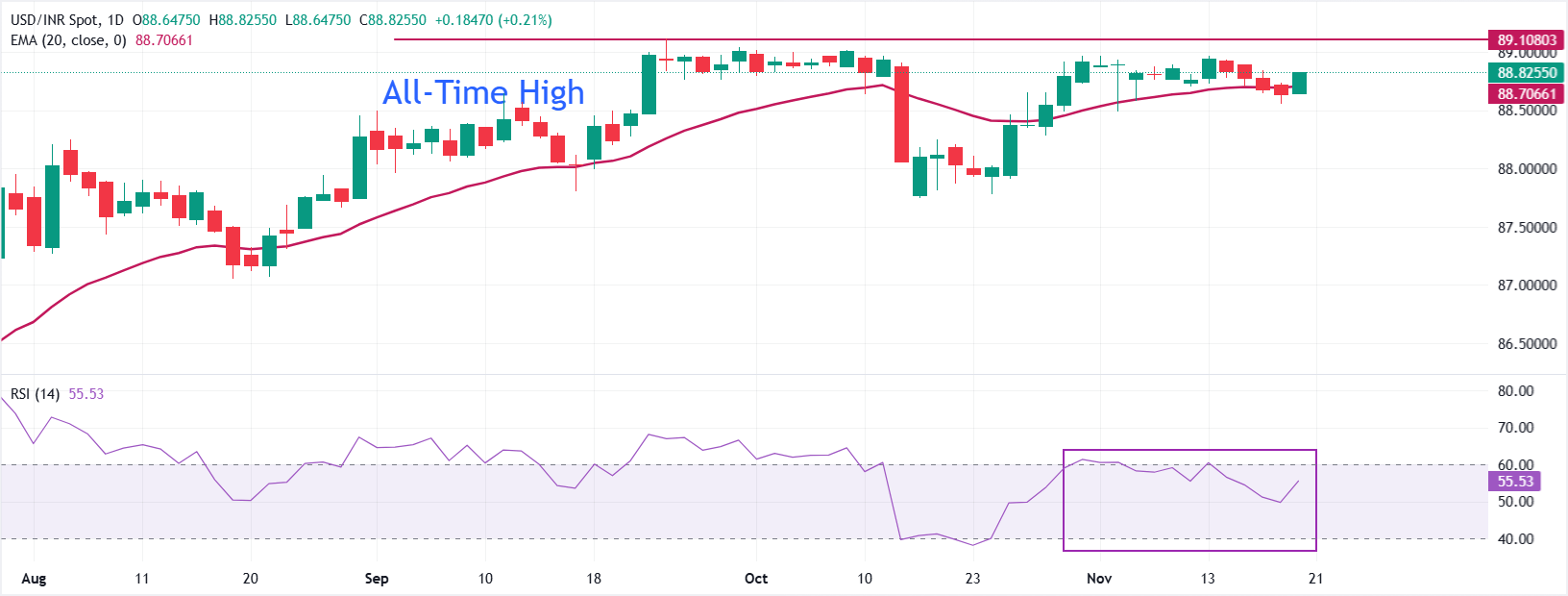
美联储降息预期生变,美元兑印度卢比为何应声跳涨?
Sou Hu Cai Jing· 2025-11-20 06:45
Core Insights - The recent surge in the exchange rate, approaching 88.80, is primarily influenced by the overall strength of the US dollar and market adjustments to Federal Reserve monetary policy expectations [1][2]. Policy Background and Market Expectations - In October, the Federal Reserve lowered interest rates by 25 basis points to a range of 3.75%-4.00%, with most policymakers favoring rate stability to avoid hindering inflation's return to the 2% target [2]. - Disagreements emerged among officials regarding further rate cuts during the December meeting, with some arguing that continued easing could elevate inflation expectations and undermine public confidence in achieving inflation targets [2]. - Market tools indicate that the probability of a 25 basis point cut to 3.50%-3.75% in December dropped from 50.1% to 32.8%, reflecting a significant re-evaluation of monetary policy expectations [2]. Dollar Index and Exchange Rate Dynamics - The dollar index recently reached a five-month high of approximately 100.40, indicating the dollar's strength against a basket of currencies, which has supported the rise of the dollar against the Indian rupee [3]. - The dollar's strength is attributed to market expectations of sustained high interest rates by the Federal Reserve and uncertainties in the global economic environment [3]. Technical Analysis Perspective - Technically, the dollar-rupee exchange rate found support near the 20-day exponential moving average, ending a four-day decline, with the average positioned around 88.70 [5]. - Momentum indicators show the 14-day Relative Strength Index (RSI) has rebounded to around 60.00, suggesting potential bullish momentum if it remains above this level [5]. - Key support is identified at the August 21 low of 87.07, while the historical high of 89.12 is noted as a critical resistance level to watch [5].