
估值修复

Search documents
15只白酒股上涨 贵州茅台1525元/股收盘
Bei Jing Shang Bao· 2026-02-04 09:09
从个股来看,贵州茅台收盘价达1525.00元/股,上涨3.40%;五粮液收盘价达108.52元/股,上涨1.16%; 山西汾酒收盘价180.58元/股,上涨3.57%;泸州老窖收盘价达126.30元/股,上涨3.27%;洋河股份收盘 价达55.61元/股,上涨0.72%。 北京商报讯(记者刘一博冯若男)2月4日尾盘,沪指4102.20点上涨0.85%。白酒板块以2312.26点收盘上涨 0.90%,其中15只白酒股上涨,贵州茅台1525元/股收盘。 天风证券在其研报中指出,行业整体基本面回暖还需要外部宏观需求复苏的配合。但是在目前股市背景 下,股价有可能领先于基本面见底。天风证券认为。目前对板块或可以乐观一些。目前板块或处于基本 面出清的最后阶段,茅台批价企稳是边际改善的积极信号,板块估值修复或领先于业绩修复。 ...

港股通互联网ETF基金(520910)跌幅持续收窄,机构称“春季躁动”驱动下或存在阶段性修复机会
Sou Hu Cai Jing· 2026-02-03 06:32
Group 1 - The Hong Kong stock market showed mixed performance on February 3, with the Hang Seng Index rising by 0.2%, while the Hang Seng Tech Index and the National Enterprises Index fell by 1.32% and 0.22% respectively [1] - The decline in tech stocks was attributed to investor concerns over potential increases in value-added tax (VAT) for internet service companies, following a VAT hike for Chinese telecom stocks [1] - Institutions believe that the concerns regarding tax increases for internet companies are exaggerated and lack solid evidence, noting that any tax hikes would contradict current policies aimed at promoting consumption [1] Group 2 - GF Securities indicated that the global dollar cycle is at a peak and is now in a decline phase, while the RMB has transitioned from depreciation to a mild appreciation, creating a favorable revaluation window for Chinese equity assets [2] - The report suggests embedding currency logic into asset allocation, focusing on "core manufacturing assets + beneficiaries of appreciation" in A-shares, and prioritizing sectors sensitive to import costs and high-quality liquid stocks in Hong Kong [2] - The Hong Kong Stock Connect Internet ETF (520910) tracks the CSI Hong Kong Stock Connect Internet Index, focusing on leading internet companies such as Alibaba, Tencent, Meituan, and Kuaishou, which are expected to benefit from AI penetration [2]

创新兑现+估值修复,医药生物强劲“吸金”
Sou Hu Cai Jing· 2026-02-03 01:31
Group 1 - The pharmaceutical and biotechnology sector has shown strong capital attraction, with significant market sentiment recovery, as evidenced by the net inflow of 667 million yuan into the Kexin Innovation Drug ETF (589720) over ten consecutive trading days [1] - Recent mergers and acquisitions, such as China National Pharmaceutical's acquisition of Hejia Bio for 1.2 billion yuan and Rongchang Bio's exclusive licensing agreement with AbbVie worth up to 650 million USD, have boosted market confidence and highlighted the internationalization efforts of Chinese pharmaceutical companies [1] - The investment logic in the pharmaceutical sector is supported by "innovation realization" and "valuation repair," with domestic innovative drugs entering a commercialization and internationalization phase, indicating improved cash flow for leading pharmaceutical companies [1] Group 2 - The policy environment is increasingly supportive, with the Ministry of Commerce and other departments issuing guidelines to promote high-quality development in the pharmaceutical retail sector, encouraging mergers and acquisitions, which may lead to increased industry concentration [2] - Comprehensive support for innovative drug development through policy implementation lays a foundation for sustained growth in the industry [2] - The Kexin Innovation Drug ETF (589720) closely tracks the Kexin Innovation Drug Index, focusing on leading companies, with over 90% of its holdings in innovative drug firms, making it an attractive option for interested investors [2]
ETF日报:随着反内卷政策的实质性落地以及AI算力对能源需求的拉动 光伏行业有望迎来“量利齐升”的修复周期
Xin Lang Cai Jing· 2026-02-02 23:19
Market Overview - The A-share market experienced a significant decline, with the Shanghai Composite Index dropping 2.48% to 4015.75 points and the Shenzhen Component Index falling 2.69% to 13824.35 points, as trading volume reached 2.6 trillion yuan, slightly lower than the previous day [1] - The market sentiment was negatively impacted by the nomination of Kevin Warsh as the next Federal Reserve Chairman, raising concerns about prolonged high interest rates and a notable drop in risk appetite [1] Pharmaceutical and Biotech Sector - The pharmaceutical and biotech sector demonstrated strong capital attraction, with the Guotai Innovation Drug ETF (589720) seeing a net inflow of 667 million yuan over ten consecutive trading days [3][4] - Key mergers and acquisitions, such as China Biopharmaceutical's acquisition of Hejia Biotech for 1.2 billion yuan and Rongchang Biopharmaceutical's exclusive licensing agreement with AbbVie worth up to 650 million USD, have boosted market confidence and highlighted the global competitiveness of Chinese pharmaceutical companies [3][4] - The investment logic in the pharmaceutical sector is supported by "innovation realization" and "valuation recovery," as domestic innovative drugs enter a commercialization and internationalization phase [3][4] Solar Energy Sector - The solar energy sector saw a strong performance, with the solar industry index rising over 2% before retreating, driven by Tesla CEO Elon Musk's proposal for a "space solar" project [5][6] - The sector is transitioning from a "post-decline rebound" to a deeper "supply-demand pattern reshaping," with significant potential for Chinese solar companies due to their advantages in equipment and core material supply [5][6] - The solar industry has faced intense price competition, leading to significant losses for major players, but recent policies aimed at reducing competition and clearing out outdated capacity are expected to enhance market concentration and improve the profitability of leading firms [5][6] Electric Grid Sector - The electric grid sector is experiencing robust domestic demand, with transformer factories in regions like Guangdong and Jiangsu operating at full capacity, and significant investments expected from the State Grid Corporation [7][8] - Major electric grid equipment companies reported impressive earnings, with projected revenues of 21.205 billion yuan, a 37.18% increase year-on-year, and net profits of 3.163 billion yuan, up 54.35% from the previous year [7][8] - The global energy transition is driving demand for electric grid construction, particularly in underdeveloped regions, presenting substantial growth opportunities for domestic electric grid companies [7][8] Precious Metals Sector - The precious metals sector, particularly gold, is undergoing significant volatility, with COMEX gold prices dropping below 4500 [9][10] - Concerns over monetary policy tightening following Warsh's nomination have led to market sell-offs, exacerbated by high leverage and profit-taking after previous price surges [9][10] - Despite short-term adjustments, long-term support for gold prices remains due to expectations of Federal Reserve rate cuts and ongoing geopolitical tensions [9][10]

白酒板块上涨难掩资金分歧,拐点临近还是短期博弈?
第一财经· 2026-02-02 15:43
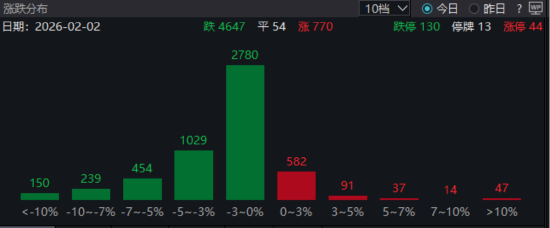
Core Viewpoint - The recent rebound in the liquor sector, particularly in the white liquor segment, suggests a potential turning point after four years of deep adjustments, although there are concerns about whether this is a genuine recovery or merely a short-term reaction to market conditions [3][9]. Market Performance - On February 2, the A-share market declined by 2.48%, while the white liquor sector saw a counter-trend rise, with the Wind white liquor index increasing by 3% and the food and beverage sector leading with a 1.11% gain [4][5]. - Major brands like Kweichow Moutai experienced a 1.86% increase, and several other liquor stocks hit their daily limits, indicating strong market interest despite overall market weakness [4]. Fund Holdings and Market Sentiment - As of the end of Q4 last year, public fund holdings in white liquor stocks dropped to 3.93%, down from a peak of 16% in 2020, indicating a significant reduction in market presence [7]. - There is a notable divergence in fund operations, with some funds increasing their positions in specific stocks like Shede Spirits and Yanghe Brewery, while others have reduced their holdings, reflecting mixed sentiment among investors [8]. Short-term and Long-term Outlook - The recent price increases are attributed to short-term factors such as pre-Spring Festival demand and low valuations, but there is skepticism about the sustainability of this rebound [5][9]. - Analysts suggest that while the sector may benefit from seasonal demand, the long-term outlook remains dependent on economic recovery and structural changes within the industry, with a focus on leading companies [9].

2026年2月2日盘后播报:贵金属板块继续剧烈调整
Sou Hu Cai Jing· 2026-02-02 14:03
Market Overview - The A-share market experienced a correction today, with the Shanghai Composite Index falling by 2.48% to close at 4015.75 points, and the Shenzhen Component Index dropping by 2.69% to 13824.35 points. Most sectors declined, with the precious metals sector nearly hitting the limit down, while only the food and beverage industry saw a slight increase. The market is currently in a deleveraging phase, indicating potential for further pullback, but as valuation pressures ease, new investment opportunities may gradually emerge [1] Solar Industry - The solar sector showed strong performance in the morning, with the solar industry index rising over 2% at one point, although it later retreated but still outperformed the broader market. Tesla CEO Elon Musk's recent proposal for "space solar" has opened new imaginative possibilities for the industry. Additionally, the Ministry of Industry and Information Technology held a meeting to address "involution" in the solar industry, emphasizing mergers and acquisitions and standard-setting to eliminate excessive competition. With the implementation of "anti-involution" policies and a surge in energy demand, the solar industry is expected to enter a recovery cycle characterized by simultaneous growth in volume and profit. For investors optimistic about energy transition and industry recovery, this may be an opportune time to consider the Guotai Solar ETF (159864) [1] Pharmaceutical and Biotech Sector - The pharmaceutical and biotech sector has demonstrated strong capital attraction recently, with market sentiment significantly improving. The investment rationale for the sector is primarily supported by "innovation realization" and "valuation recovery." Domestic innovative drugs are entering a phase of commercial explosion and internationalization. Furthermore, supportive policies from the Ministry of Commerce and other departments have been released to promote mergers and high-quality development in the pharmaceutical retail industry. The Biopharmaceutical ETF (512290) closely tracks the CSI Biopharmaceutical Index, encompassing both the growth potential of innovative drugs and the stability of medical device performance. This ETF's focus on leading companies and comprehensive industry coverage makes it a representative of core assets in China's biopharmaceutical industry, warranting investor attention [2] Electric Grid Sector - The Electric Grid ETF (561380) rose by 1.06% today. In terms of domestic demand, reports indicate that transformer factories in Guangdong and Jiangsu are operating at full capacity, with some orders for data center business extending to 2027. During the 14th Five-Year Plan, the State Grid Corporation's fixed asset investment is expected to reach 4 trillion yuan, a 40% increase compared to the previous plan. Additionally, the ongoing global energy transition is driving demand for new energy integration. The sector benefits from a combination of "order explosion, increased domestic investment, and overseas demand potential," supported by strong performance from leading grid equipment companies, making it a sector to watch for investors [2] Precious Metals Sector - The precious metals sector continued to experience significant adjustments today. Concerns over tightening U.S. monetary policy have heightened market sensitivity to negative news, leading to sharp corrections as a result of emotional and trading structure responses. However, long-term expectations regarding potential interest rate cuts by the Federal Reserve have not fundamentally changed, and geopolitical risks continue to provide long-term support for gold prices. In the short term, after the release of concentrated selling pressure, there may be a rebound and recovery window. In the medium to long term, the logic supporting gold prices remains intact, driven by the "Federal Reserve's rate cut cycle, increasing overseas uncertainties, and the global trend of de-dollarization." Investors are encouraged to monitor investment opportunities in the Guotai Gold ETF (518800) and Gold Stock ETF (517400) [3]
白酒板块全线飘红,机构喊投资机遇
Huan Qiu Wang· 2026-02-02 07:54
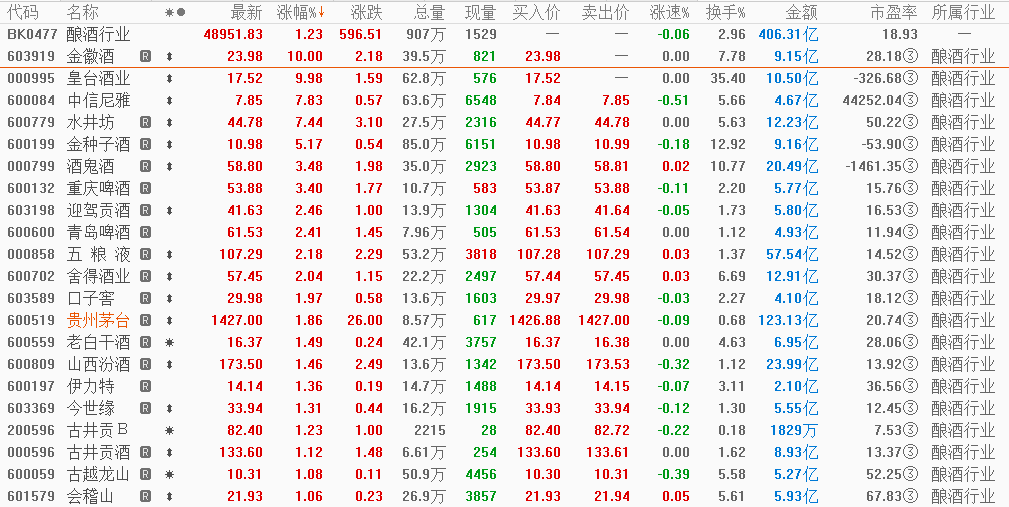
Core Viewpoint - The A-share market's liquor sector is experiencing a strong performance, with individual stocks showing a general upward trend as the traditional sales peak season approaches due to the upcoming Spring Festival [1] Group 1: Market Performance - The liquor sector index (BK0477) closed at 48,951.83, with a 1.23% increase, indicating a positive market sentiment [2] - Notable stocks such as Jinhuijiu and Huangtaijiu reached their daily limit, while others like Wuliangye and Moutai also saw significant gains [1][2] Group 2: Seasonal Factors - The upcoming Spring Festival is expected to boost sales in the liquor industry, with Moutai's price showing signs of recovery, providing strong price support for liquor stocks [1][3] - The 2026 Spring Festival is anticipated to have one additional day compared to previous years, which may enhance actual sales performance [1][3] Group 3: Macro Environment - The improvement in macroeconomic policies is seen as a positive factor for the liquor sector, with a focus on boosting domestic demand and real estate [3] - The government plans to implement a strategy for expanding domestic demand from 2026 to 2030, which could benefit the liquor industry [3] Group 4: Investment Sentiment - The allocation of public funds to the liquor sector has decreased to 3.93%, indicating a low historical level that may provide room for recovery [3] - Notable investor Duan Yongping expressed confidence in Moutai's stock price, suggesting it is undervalued from a long-term perspective [3] Group 5: Industry Outlook - Despite some companies facing earnings pressure, the valuation of the liquor sector is at historical lows, which may lead to a recovery ahead of earnings improvement [4] - Analysts believe that the liquor industry, as a barometer of the macro economy, is likely to benefit from government support for real estate and domestic demand [4]


1月公募FOF业绩爆发!多只基金涨超30%,新品发行再提速
Mei Ri Jing Ji Xin Wen· 2026-02-02 07:49
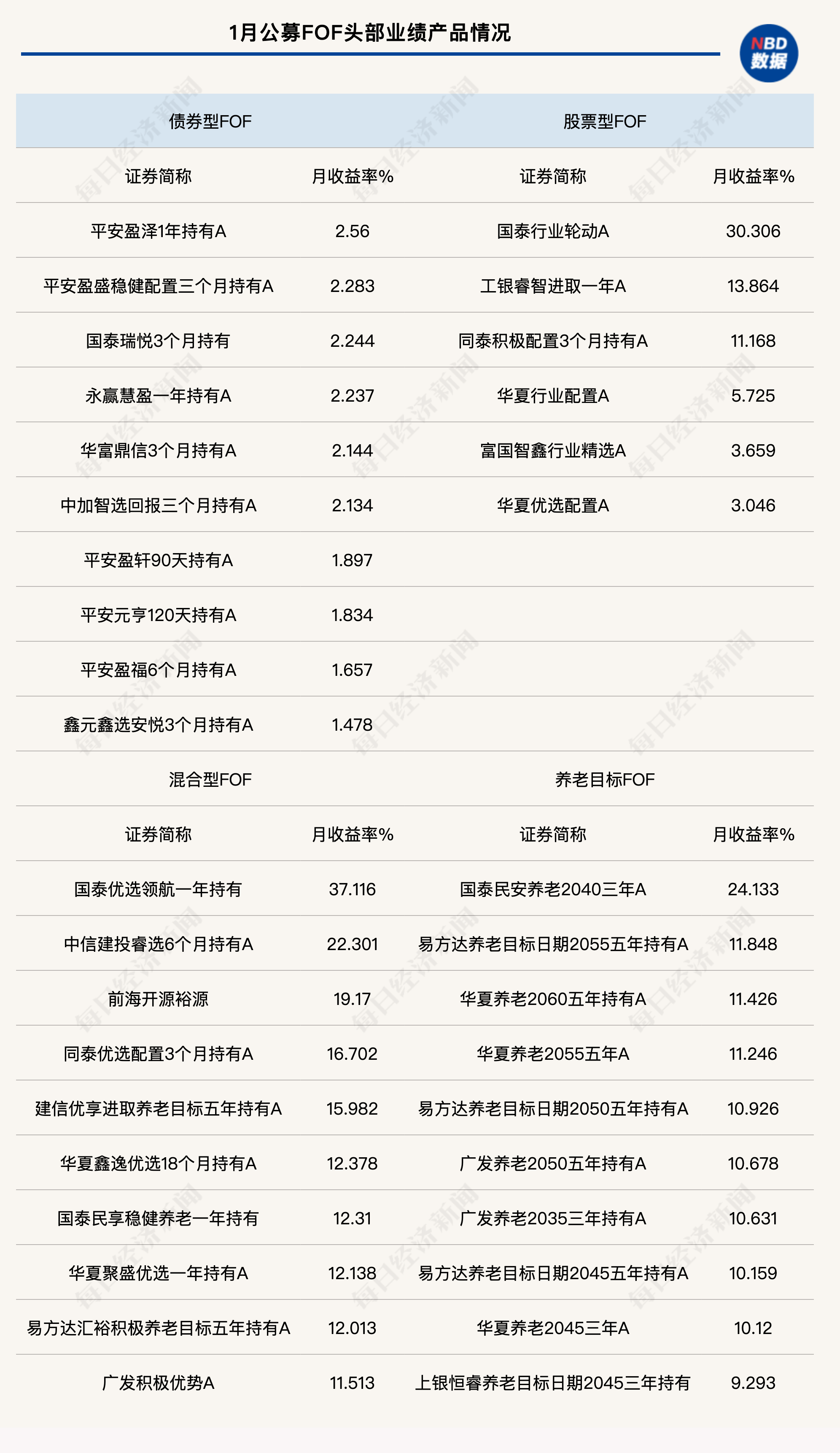
Core Viewpoint - In January, the global asset allocation logic shifted from valuation recovery to profit-driven, with A-shares continuing an upward trend supported by policies, funding, and valuation [1][2]. Group 1: A-share Market Performance - The A-share market showed a steady upward trend in January, with the Shanghai Composite Index rising by 3.76%, the ChiNext Index by 4.47%, and the Shenzhen Index by 5.03% by the end of January [2]. - The non-ferrous metals sector led the gains with a 22.59% increase, followed by media, oil and petrochemicals, construction materials, and basic chemicals with respective increases of 17.94%, 16.31%, 13.31%, and 12.72% [2]. Group 2: Fund Performance - Public FOFs (funds of funds) performed well, with some products achieving monthly returns exceeding 30%. For instance, the Guotai Industry Rotation A fund had a monthly return of 30.31%, while the Guotai Preferred Navigation fund reached 37.12% [3][5]. - A total of 35 FOFs had monthly performance exceeding 10%, with 4 funds surpassing 20% [3]. Group 3: Market Trends and Predictions - Analysts noted that the core drivers of asset performance in January were cross-year capital reallocation and sentiment recovery, with expectations of a "spring excitement" in the stock market in the first quarter [3][7]. - The transition from valuation-driven to profit-driven narratives in global asset allocation is expected to continue, with a focus on sectors showing clear performance improvements, particularly in technology and cyclical industries [7]. Group 4: Fund Issuance and Research Activity - The issuance of public funds accelerated in January, with a significant number of FOFs focusing on themes like technological innovation and high-end manufacturing, reflecting market interest in economic transformation opportunities [6][7]. - A total of 156 public fund institutions participated in A-share research activities in January, covering 486 stocks across 30 first-level industries, indicating high research engagement [7].
跨年债市的关键-供需错配的节奏
2026-02-02 02:22
Summary of Conference Call Records Industry Overview - The conference call primarily discusses the bond market dynamics, focusing on supply-demand imbalances and their implications for interest rates and investment strategies in the context of the current economic environment [1][2][3]. Key Points and Arguments Supply-Demand Dynamics - The bond market is currently characterized by a significant supply-demand mismatch, particularly with ultra-long bonds. When supply exceeds demand, the market faces increased risks, while a rise in demand can lead to interest rate recovery [1][2]. - The economic environment is showing signs of improvement, leading to a gradual upward trend in interest rates, although this increase is expected to be moderate and not abrupt [2][3]. Institutional Behavior - Large financial institutions are stable in terms of liabilities but are experiencing general loan performance issues. There is a notable lack of interest rate risk indicators (VAE), which complicates their strategies in managing ultra-long bond issuance pressures [3][4]. - Smaller banks have been more lenient in their interest rate risk management due to regulatory easing, but this may change as upward pressure on rates becomes more pronounced [3]. Local and Special Government Bonds - The issuance of local and special government bonds is expected to exceed previous forecasts, with February's issuance projected to reach between 900 billion to 1 trillion yuan, which could create additional market pressure [4][5][6]. - The issuance of long-term bonds, particularly those with maturities over 30 years, is a critical area of concern, as it may influence secondary market rates [7]. Credit Market Insights - The credit market is entering a phase where the recovery momentum is expected to weaken, with credit spreads likely to stabilize within a narrow range. The focus for investors should shift back to yield generation [8][11]. - There is a growing interest in mid-to-high-grade real estate bonds, particularly those issued by state-owned enterprises, as market sentiment improves [10]. Investment Strategies - Investment strategies should prioritize stable yield generation, focusing on bonds with maturities of two to three years while being cautious about credit risks [11]. - For institutional investors, particularly insurance funds, there are opportunities in mid-to-high-grade bonds with maturities over five years, especially those from state-owned enterprises [9]. Market Sentiment and Future Outlook - The sentiment around real estate bonds has improved, with increased trading activity in mid-to-high-grade bonds, indicating a potential for valuation recovery [10]. - The overall bond market is expected to experience a phase of narrow fluctuations dominated by yield considerations, with long-term bonds facing challenges due to supply pressures [10][11]. Other Important Insights - The bond market's supply-demand issues are not solely a result of central bank liquidity but also involve systemic impacts from interest rate risk indicators [4]. - The upcoming issuance of bonds and the associated market dynamics will require careful monitoring, particularly in the context of the upcoming Chinese New Year and its impact on market operations [2][6].
金融行业周报(2026、02、01):券商业绩预告亮眼,保险有望延续估值修复-20260201
Western Securities· 2026-02-01 13:06
Investment Rating - The report indicates a positive outlook for the non-bank financial sector, with specific recommendations for insurance, brokerage, and banking stocks [1][2][3]. Core Insights - The non-bank financial index increased by 1.04%, outperforming the CSI 300 index by 0.95 percentage points. The insurance sector showed a significant increase of 5.50%, while the brokerage sector declined by 0.69% [1][2]. - The insurance sector is expected to continue its valuation recovery, driven by strong performance in premium growth and favorable market conditions. The brokerage sector is anticipated to see a fundamental recovery in profitability by 2025, supported by potential policy easing [2][3]. - The banking sector is projected to benefit from a stabilization in interest margins and a recovery in macroeconomic conditions, leading to improved profitability and valuation recovery [3][21]. Summary by Sections Insurance Sector - The insurance sector's index rose by 5.50%, significantly outperforming the CSI 300 index by 5.42 percentage points. The sector is expected to maintain a valuation recovery trend, supported by strong premium growth and favorable asset conditions [2][14][15]. - Key recommendations include New China Life Insurance, China Pacific Insurance, China Life Insurance (H), and China Taiping Insurance, focusing on companies with strong dividend yields and robust operational stability [15][16]. Brokerage Sector - The brokerage sector's index decreased by 0.69%, underperforming the CSI 300 index by 0.77 percentage points. Despite this, 21 out of 42 listed brokerages reported positive earnings forecasts for 2025, indicating an overall improvement in industry performance [2][17][18]. - Recommended stocks include Guotai Junan, Huatai Securities, and other major brokerages with strong fundamentals and potential for mergers and acquisitions [18][19]. Banking Sector - The banking sector's index increased by 0.86%, outperforming the CSI 300 index by 0.78 percentage points. The sector is expected to see a recovery in net interest income and a reduction in risks associated with real estate lending [3][21][22]. - Recommended banks include Hangzhou Bank, with additional attention on Ningbo Bank, Nanjing Bank, and others that show strong dividend yields and potential for valuation recovery [22][60].