
巴菲特指标

Search documents
周末要闻汇总:央行本周将有超2万亿逆回购到期
Zhong Jin Zai Xian· 2025-08-25 00:14
Group 1 - The State Council, led by Premier Li Qiang, is focusing on enhancing sports consumption and advancing the high-quality development of the sports industry [2] - The People's Bank of China will have a total of 20,770 billion yuan in reverse repos maturing this week, with specific amounts maturing each day [3] - Goldman Sachs reports that hedge funds have net bought Chinese stocks at the fastest pace in seven weeks, indicating strong institutional interest in the Chinese market [5] Group 2 - Huawei Cloud is restructuring its organization to focus on its "3+2+1" business model, which includes computing, intelligent computing, storage, AI PaaS, databases, and security [15] - The Hang Seng Index has added China Telecom, JD Logistics, and Pop Mart to its constituents, increasing the number of component stocks to 88 [7] - The China Photovoltaic Industry Association is advocating for self-discipline in the industry to combat malicious competition and promote high-quality development [7] Group 3 - The electronic sector in A-shares has reached a market capitalization of 11.54 trillion yuan, surpassing the banking sector to become the largest [11] - The smart computing scale in China is expected to grow by over 40% this year, driven by the rapid development of artificial intelligence [12] - Several ride-hailing platforms, including Didi and T3, have announced reductions in commission rates, with Didi lowering its maximum commission to 27% [13]
杨德龙:天时地利人和 这轮牛市行情启动的深刻逻辑
Xin Lang Ji Jin· 2025-08-22 01:04
Market Overview - The current market trend indicates the establishment of a bull market, which began on September 24 last year with a series of housing policies [1] - The market experienced a rapid increase, with a notable surge of 1000 points within a few trading days, followed by a correction phase lasting over a quarter [1] - Recent policies have shifted towards economic stimulation, emphasizing the need to boost domestic demand and consumption [1] Policy Impact - Central government meetings have increasingly focused on stabilizing the real estate market and enhancing the attractiveness of the capital market [1] - A significant policy signal was the joint announcement by five departments to promote long-term capital inflow into the market, indicating institutional investors are increasing their equity positions [1] Valuation Insights - The current market valuation remains low, with a price-to-earnings ratio of approximately 13-14, compared to a historical average of 17-18, suggesting over 20% potential upside [3] - Chinese stocks are significantly undervalued compared to U.S. stocks, with many trading at only 1/2 to 1/3 of their U.S. counterparts [3] Capital Flow Dynamics - There is a clear trend of household savings shifting towards the capital market, with total household savings increasing by nearly 60 trillion over five years, now reaching 160 trillion [4] - The stock market is seen as the primary outlet for these savings, especially as the real estate market can no longer absorb significant capital [4] Market Participation - In July, new stock accounts reached 2 million, and many equity funds launched with initial scales exceeding 1 billion, indicating a strong recovery in market participation [5] - The balance of margin trading has surpassed 2 trillion for the first time in a decade, reflecting increased investor engagement [5] Economic Implications - The current bull market is expected to enhance consumer spending, as rising stock prices will directly increase household wealth, leading to greater consumption [6] - A thriving stock market is anticipated to positively impact sectors like dining, tourism, and real estate, as increased wealth will enable consumers to pay off loans and potentially invest in property [6] IPO and Innovation - A bullish market will likely accelerate the pace of IPOs, providing more opportunities for tech innovation and supporting the growth of new enterprises [7] - The stock market is viewed as a crucial engine for economic growth, complementing traditional drivers like investment, consumption, and exports [7]
巴菲特指标显示A股被严重低估!沪深300仅13倍PE,消费龙头估值创历史新低
Sou Hu Cai Jing· 2025-08-21 23:42
Group 1 - Current market conditions are creating rare investment opportunities due to multiple converging factors, leading to a significant deviation between asset prices and intrinsic values [1] - The overall valuation of the Chinese stock market is at a relatively low level, with the CSI 300 index's price-to-earnings (PE) ratio at 13.11 times, significantly below historical averages [3] - The Buffett indicator shows that Chinese stocks are significantly undervalued, with the total market capitalization of A-shares accounting for only 70% of GDP, and even when including Hong Kong and US-listed Chinese companies, the overall ratio is below 90% [3] Group 2 - The consumer sector shows clear potential for value recovery, with the CSI Consumer Index PE at 18.9 times, marking a historical low at the 1.2 percentile [4] - Leading companies in the liquor and food and beverage sectors, such as Luzhou Laojiao with a 35% return on equity (ROE) corresponding to a 12.3 times PE, and Yili with a 20% ROE at 11.5 times PE, indicate significant undervaluation of quality enterprises [4] - The technology innovation sector presents substantial opportunities, particularly in emerging industries like renewable energy, artificial intelligence, and biomedicine, driven by policy support and technological advancements [4] Group 3 - The financial sector's investment value is notable, with bank stocks trading below book value at price-to-book (PB) ratios between 0.4 and 0.6 times, and dividend yields exceeding 5% [4] - Sub-industries such as insurance and securities also show considerable valuation recovery potential amid favorable policies and market recovery expectations [4]


霍华德·马克斯:美股处于泡沫的“早期阶段”,尽管回调的关键点尚未到来
美股IPO· 2025-08-21 03:28
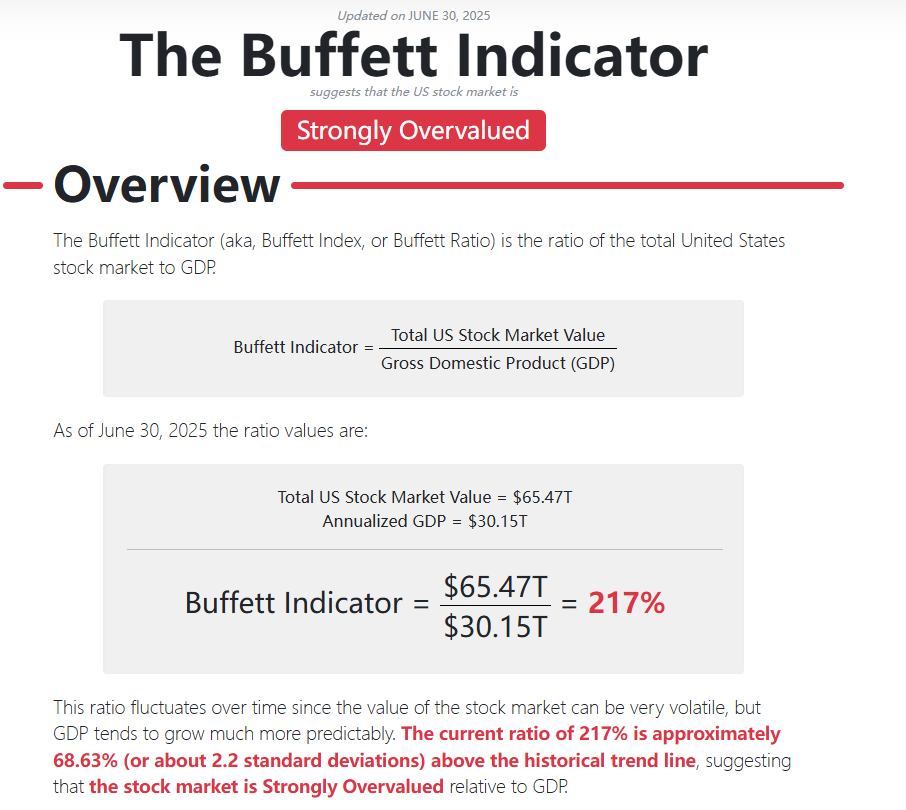
Core Viewpoint - The current valuation of the U.S. stock market is at historical highs, particularly the ratio of total market capitalization to GDP, which raises concerns about potential market corrections [1][4][7]. Valuation Concerns - The U.S. stock market is showing signs of being in the "early stages" of a bubble, with high valuations particularly in technology stocks [3][4]. - The "Buffett Indicator," which measures total market capitalization against GDP, indicates that the U.S. stock market is "severely overvalued" at 217% [7]. - The actual valuation pressure may be underestimated due to many companies being privatized or delaying IPOs, leading to a more concerning situation than it appears [4]. Historical Context - The current market environment is reminiscent of the late 1990s, when there was significant enthusiasm for technology stocks, leading to Alan Greenspan's warning about "irrational exuberance" [5]. - Despite the warning, the market continued to rise for several years before the tech bubble eventually burst, suggesting that the current upward trend may still have room to continue [5]. Investment Strategy - Given the high valuations, the recommendation is to adopt a defensive investment strategy [7]. - Although the investment environment in the U.S. has slightly deteriorated, it remains one of the best investment destinations globally, akin to a "high-priced good car" [8]. - The focus should be on selecting more defensive assets, such as credit, within this high-priced investment landscape [8].

霍华德·马克斯:美股处于泡沫的“早期阶段”,尽管回调的关键点尚未到来
Hua Er Jie Jian Wen· 2025-08-21 02:17
Group 1 - Howard Marks warns that despite the absence of key factors triggering a significant market correction, U.S. stock valuations are already high and show signs of an "early stage" bubble [1] - A critical valuation metric, the ratio of total market capitalization of U.S. listed companies to U.S. GDP, known as the "Buffett Indicator," is currently at a historical high of 217%, raising concerns about overvaluation [6] - Marks emphasizes that the current market's inflated valuations need reasonable support, and investors have not experienced a "real market correction" in 16 years, leading to a potential underestimation of valuation pressures [1][2] Group 2 - The current market environment reminds Marks of the late 1990s when enthusiasm for tech stocks led to Alan Greenspan's famous warning about "irrational exuberance," suggesting that the current upward trend may still have room to continue [2] - Based on his analysis, Marks advises a defensive investment strategy, describing the U.S. market as "an expensive good car," indicating that while the investment environment has slightly deteriorated, it remains the best global investment destination [7]
国金证券:全球TACO牛市,谁泡沫更大?
Xuan Gu Bao· 2025-08-19 08:14
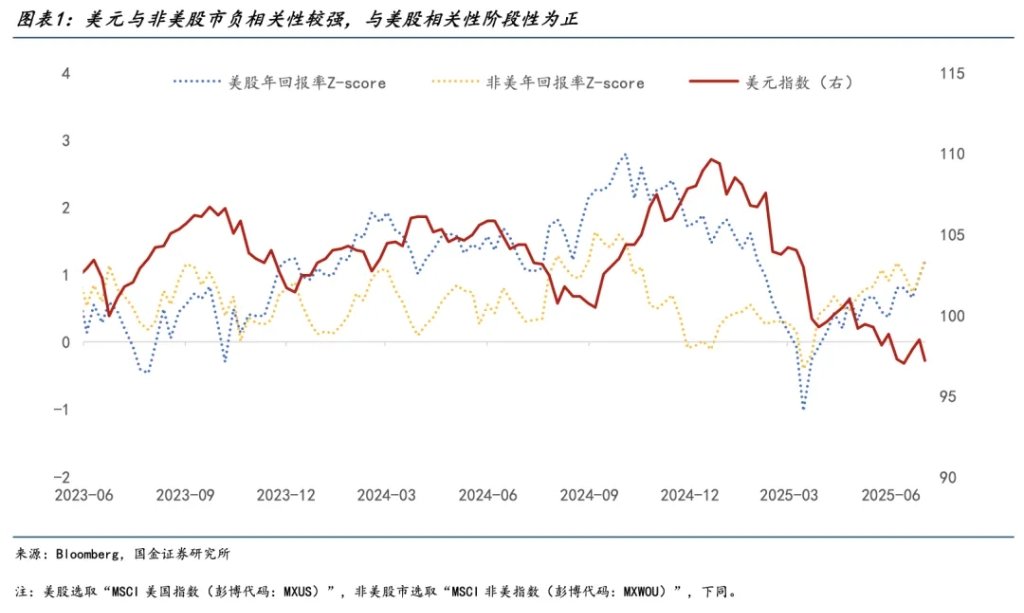
Group 1 - The core viewpoint of the article is that global market risk appetite has significantly improved following the TACO (Trump Always Chickens Out) trades, leading to new highs in various stock markets, including developed and emerging markets [1][2] - The primary driver of the recent global stock market rally is the increased dollar liquidity, which is closely linked to U.S. monetary policy and cross-border capital flows [2][3] - The dollar index has declined by 2.4% in the past quarter and 10% year-to-date, contributing to the warming of non-U.S. stock markets [3][6] Group 2 - The actual interest rates on U.S. Treasury bonds have decreased, which influences both U.S. and non-U.S. stock markets, providing a foundation for risk sentiment to be released [6][7] - Global central banks have accelerated their monetary supply, with a notable increase in the growth rate of global central bank money supply by nearly 7 percentage points in the past quarter [7][10] - The cost of offshore dollar financing has decreased, indicating a more favorable liquidity environment for non-U.S. equity markets [10][12] Group 3 - There is a noticeable trend of foreign capital inflow into non-U.S. equity markets, with A-shares seeing a 0.75% increase in foreign ownership value compared to the end of last year [13][19] - Various Asian markets, including Japan, South Korea, and Vietnam, have experienced net foreign inflows since July, contrasting with the net outflows observed over the past 12 months [19][20] - The article discusses how to measure market bubbles, particularly in the U.S. stock market, where concerns about the effectiveness of capital expenditures by tech giants are prevalent [20][22] Group 4 - The "Buffett Indicator" for the U.S. stock market has reached a historical high of 2.1, indicating a significant divergence from the economic output [25][28] - A comparison of current TTM P/E ratios shows that U.S. stocks, Indian stocks, and Vietnamese stocks have higher valuations, while Korean, A-shares, and British stocks are relatively lower [28][29] - The article highlights that the risk premium levels in developed markets are at historical lows, while emerging markets still exhibit higher risk premiums [31][32] Group 5 - The article concludes that the high valuation levels in global equity markets are reflective of abundant dollar liquidity and the potential vulnerabilities in both U.S. and non-U.S. markets due to economic cycles and TACO trades [39][40]

宋雪涛:全球TACO牛市,谁泡沫更大?
Xin Lang Cai Jing· 2025-08-19 06:25
Group 1 - The core of the global market's risk appetite recovery is attributed to the loosening of dollar liquidity, with potential risks arising from changes in Federal Reserve policy or cross-border capital flows [3][5] - The TACO (Trump Always Chickens Out) trades have led to increased confidence among investors, resulting in new highs for developed and emerging markets, including US, European, and Asian stocks [4][5] - The current environment of dollar liquidity is closely linked to the Federal Reserve's monetary policy and cross-border capital movements, impacting multiple markets and asset classes [5] Group 2 - Recent changes in dollar liquidity can be observed through five dimensions, including a significant decline in the dollar index, which has dropped 2.4% in the last quarter and 10% year-to-date [6][9] - The actual yield on US Treasury bonds has decreased by over 20 basis points since the peak in April, contributing to a more favorable risk sentiment [9] - Global central banks have accelerated their monetary supply, with a notable increase in the growth rate of global central bank money supply by nearly 7 percentage points in the last quarter [11] Group 3 - The cost of offshore dollar financing has decreased, indicating a more favorable liquidity environment for non-US equity markets [13] - Foreign capital inflows into non-US equity markets are becoming evident, with A-shares seeing a 0.75% increase in foreign ownership value compared to the end of last year [15] - In the broader non-US equity markets, foreign capital inflows have been observed in various Asian markets, contrasting with the net outflows seen over the past 12 months [19] Group 4 - The current AI wave has led to significant capital expenditures among tech giants, with an average capital expenditure growth rate of 18% from 2021 to 2024, raising concerns about the effectiveness of these investments [24] - The recent rise in US stocks has shown a barbell structure, with tech giants on one end and small-cap stocks on the other, reflecting a market pricing in economic resilience and policy risk reduction [27] - The Buffett Indicator, which measures the ratio of total market capitalization to nominal GDP, has reached a historical high of 2.1, indicating potential overvaluation in the US stock market [30][37]

宋雪涛:全球TACO牛市,谁泡沫更大?
雪涛宏观笔记· 2025-08-19 06:18
Group 1 - The core viewpoint of the article is that the recovery of global risk appetite and stock market increases are primarily driven by the loosening of dollar liquidity, with potential risks arising from changes in Federal Reserve policies or cross-border capital flows [2][4] - The article discusses the phenomenon of TACO (Trump Always Chickens Out) trading, which has led to increased confidence among investors and a bullish atmosphere in various global markets, including US, European, and Asian stocks [4][5] Group 2 - The improvement in global risk appetite is attributed to the loosening of dollar liquidity, which is closely linked to the Federal Reserve's monetary policy and cross-border capital flows [5][6] - The dollar index has significantly declined, dropping 2.4% in the past quarter and 10% year-to-date, which has positively impacted non-US stock markets [7][9] - The actual interest rates of US Treasury bonds have decreased, providing a foundation for risk sentiment release, with a decline of over 20 basis points since April [9][11] - Global central banks have accelerated monetary supply, with a notable increase in the growth rate of global central bank money supply by nearly 7 percentage points in the past quarter [11][14] - The cost of offshore dollar financing has decreased, indicating a more favorable liquidity environment for non-US equity markets [14][16] Group 3 - There is a noticeable trend of foreign capital inflow into non-US equity markets, with A-shares seeing a 0.75% increase in foreign ownership value compared to the end of last year [16][19] - Various Asian markets, including Japan, South Korea, and Vietnam, have experienced net inflows of foreign capital since July, contrasting with the previous 12 months of net outflows [19][20] Group 4 - The article highlights concerns regarding the effectiveness of capital expenditures by technology giants amid the current AI boom, with an average capital expenditure growth rate of 18% projected for tech stocks from 2021 to 2024 [20][22] - The current market structure shows a "barbell" effect, with significant gains in both large tech companies and small-cap stocks, indicating a potential increase in market fragility [22][26] Group 5 - The "Buffett Indicator," which measures the ratio of total market capitalization to nominal GDP, has reached a historical high of 2.1, suggesting a potential overvaluation of the market [26][28] - Comparisons of risk premiums across global indices reveal that US and Indian stocks have low risk premiums, while A-shares and Korean stocks maintain higher levels [31][34] - The article concludes that the high valuation levels across major stock indices, combined with the low risk premiums in developed markets, indicate a potential bubble in the current market environment [39]

“申”挖数据 | 估值水温表
申万宏源证券上海北京西路营业部· 2025-08-19 02:23
Core Viewpoint - The current valuation levels of the A-share market indicate a relatively high risk, with the Buffett indicator at 83.15%, slightly above the safe zone, and various indices showing elevated PE ratios compared to historical levels [6][22]. Market Overview - The total market capitalization of listed companies in Shanghai is approximately 593.11 billion yuan, with a circulating market value of about 557.97 billion yuan and an average PE ratio of 15.14 [19][26]. - The Shenzhen market has a total market capitalization of around 389.16 billion yuan, with a circulating market value of 334.34 billion yuan and an average PE ratio of 28.50 [26]. Valuation Levels Buffett Indicator - The Buffett indicator, which measures the ratio of stock market capitalization to GDP, currently stands at 83.15%, indicating a relatively high valuation [22][23]. PE Valuation Levels - Major indices such as the Shanghai Composite Index and the ChiNext Index have PE ratios above 20%, with specific values being 15.88 (↑2.97%) for the Shanghai Composite and 36.21 (↑7.70%) for the ChiNext [27]. - The PE ratios for the major indices are as follows: - Shanghai Composite: 15.88 (↑2.97%) - Shenzhen Component: 28.05 (↑4.98%) - ChiNext: 36.21 (↑7.70%) [27]. Industry Valuation Levels - The PE ratios for the food and beverage industry and the agriculture, forestry, animal husbandry, and fishery industry are notably low, at 6.98% and 8.81% of their historical levels, respectively, suggesting potential investment opportunities [8]. - Conversely, industries such as construction materials, media, steel, electronics, retail, computer, and real estate have PE ratios at high historical percentiles, indicating increased investment risk [8]. PB Valuation Levels - The PB ratios for various indices show significant variation, with the Shanghai Composite at 1.45 (↑3.11%) and the ChiNext at 4.60 (↑7.94%) [29]. - The PB ratios for key industries are as follows: - Agriculture, forestry, animal husbandry, and fishery: 2.02 - Basic chemicals: 1.41 - Steel: 0.73 [37]. PS Valuation Levels - The PS ratios for several industries indicate varying levels of valuation, with agriculture, forestry, animal husbandry, and fishery at 0.82 and basic chemicals at 0.55 [41]. Conclusion - The current market conditions reflect a high valuation environment, with specific sectors showing both potential opportunities and risks based on their historical valuation levels. Investors should consider these factors when making investment decisions.

全球TACO牛市,泡沫有多大?
SINOLINK SECURITIES· 2025-08-18 14:52
Group 1: Market Trends and Drivers - Recent global market risk appetite has significantly improved, with many developed and emerging market indices reaching new highs, including A-shares and Hong Kong stocks entering a bull market atmosphere[2] - The decline of the US dollar index by 10% this year has notably boosted non-US stock markets[2] - The actual yield on US Treasury bonds has decreased, alleviating valuation pressure on global assets[2] - Global central banks have accelerated monetary supply growth, with 76 rate cuts this year compared to only 19 rate hikes, particularly benefiting non-US markets[2] Group 2: Valuation Concerns - The "Buffett Indicator" (total market capitalization/GDP) for US stocks has reached a historical high of 2.1, approximately 2.9 standard deviations above the long-term average, indicating potential overvaluation[3] - The capital expenditure growth rate for tech giants is projected at 18% from 2021 to 2024, raising concerns about the sustainability of this growth and potential valuation corrections[3] - The current valuation levels of major markets show that US, Indian, Vietnamese, and German stocks are at absolute highs, while risk premiums for Indian, US, and Vietnamese stocks are relatively low[4] Group 3: Market Sensitivities and Risks - The high non-fundamental premium in markets like A-shares and German stocks suggests increased sensitivity to potential reversals in dollar liquidity or changes in capital flows[4] - If the Federal Reserve's policies or cross-border capital flows change, markets with high non-fundamental premiums may be more vulnerable to corrections[4] - The report highlights the potential for a "shrinking circle" effect in global markets if risk appetite declines, particularly affecting markets with high non-fundamental premiums[4]