
拉尼娜现象

Search documents
拉尼娜概率55%,南美农业产出或受影响
Xuan Gu Bao· 2025-12-05 00:33
Group 1 - The World Meteorological Organization forecasts a 55% probability of a weak La Niña phenomenon occurring in the next three months, with ocean and atmospheric indicators reaching critical thresholds as of mid-November [1] - La Niña typically leads to temporary cooling effects but many regions will continue to experience warmer weather [1] - La Niña is associated with significant weather events such as droughts and floods, impacting agricultural production [1] Group 2 - CITIC Futures indicates that La Niña may result in reduced soybean yields in central and southern South America and the central United States, with Brazil, the United States, and Argentina contributing over 80% of global soybean production [1] - The La Niña phenomenon is likely to affect the traditional rubber tapping season in China and Southeast Asia, potentially impacting rubber production due to increased rainfall [1] Group 3 - Hainan Rubber is identified as a leading company in China's natural rubber industry [2] - Guannong Co., Ltd. specializes in cotton processing, with a processing capacity exceeding 150,000 tons [3]
豆粕库存快速积累 价格或震荡偏弱
Qi Huo Ri Bao· 2025-12-03 00:56
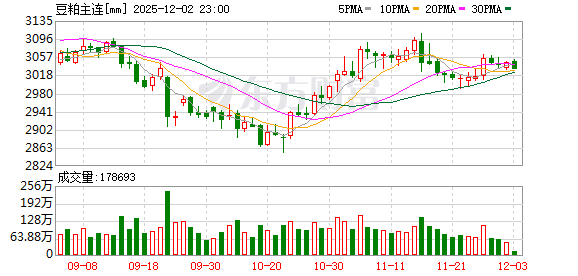
Group 1 - The domestic soybean meal market is currently experiencing a complex interplay of bullish and bearish factors, with tight U.S. soybean supply but a generally loose global soybean supply [2] - The USDA has lowered U.S. soybean yield, production, and ending stocks, with the stocks-to-use ratio dropping to a three-year low of 6.74%, despite some recovery in Chinese purchases of U.S. soybeans [2] - Global soybean inventory is projected to decrease to 122 million tons for the 2025/2026 season, but this still represents a year-on-year increase of 1.1%, indicating a shift from accumulation to moderate destocking [2] Group 2 - The La Niña phenomenon may introduce complexities for South American soybean growth, with Brazil's soybean planting progress lagging behind last year, yet yield forecasts remain high [3] - Argentina's soybean planting is significantly delayed due to flooding, and if adverse weather persists into December, the estimated production of 48.5 million tons may face downward revision [3] Group 3 - China's port soybean inventory remains high, with a year-on-year increase of 292.95 million tons, reaching 9.425 million tons as of November 21 [4] - Market expectations indicate that China will import 8 million tons and 7.5 million tons of soybeans in November and December, respectively, with total imports expected to exceed 110 million tons in 2025 [4] - Even without U.S. soybean imports, domestic soybean supply is expected to remain ample through the fourth quarter due to high inventory levels [4] Group 4 - Domestic oil mills are operating at high capacity, with weekly soybean crushing volumes around 2.3 million tons, leading to a significant increase in soybean meal inventory [5] - As of November 21, soybean meal inventory reached 1.1515 million tons, a year-on-year increase of 38.11 million tons, reflecting a 49.47% rise [5] - Despite stable demand from livestock and poultry, cautious purchasing behavior from feed companies limits the growth of soybean meal consumption [5] Group 5 - The cost of imported soybeans is providing strong support for soybean meal prices, with high premiums for Brazilian soybeans and a rebound in U.S. soybean futures prices [6] - The overall global soybean supply remains loose, but high import costs are limiting the downside potential for soybean meal prices [6] - Future price movements will depend on South American weather conditions and developments in U.S.-China trade relations [6]

农产品组行业研究报告:定价逻辑切换,静待供需改善
Hua Tai Qi Huo· 2025-11-30 09:28
期货研究报告 | 农产品组 行业研究报告 随着中美贸易政策博弈尘埃落定,市场逻辑已从前期的政策驱动逐步回归基本面主导。供应端来看,本年度巴西大豆丰产为我国提供 了充足的进口来源,国内油厂大豆及豆粕库存均攀升至历史高位,市场供应呈现宽松格局。尽管未来美国大豆进口预期有所改善,但 豆粕价格并未出现大幅回落,核心原因在于...... 定价逻辑切换,静待供需改善 农产品组行业研究报告 本期分析研究员 邓绍瑞 从业资格号:F3047125 投资咨询号:Z0015474 李馨 从业资格号:F03120775 投资咨询号:Z0019724 白旭宇 从业资格号:F03114139 投资咨询号:Z0023055 薛钧元 从业资格号:F03114096 投资咨询号:Z0023045 华泰期货研究院农产品研究 2025 年 11 月 30 日 期货研究报告 | 饲料年报 2025-11-30 定价逻辑切换,静待供需改善 研究院 农产品组 研究员 邓绍瑞 010-64405663 dengshaorui@htfc.com 从业资格号:F3047125 投资咨询号:Z0015474 李馨 lixin@htfc.com 从业资格号:F0 ...
中泰国际每日晨讯-20251127
ZHONGTAI INTERNATIONAL SECURITIES· 2025-11-27 10:36
Market Overview - The Hang Seng Index and the Hang Seng China Enterprises Index rose by 0.1% and 0.04% respectively, while the Hang Seng Tech Index also increased by 0.1%[1] - Market sentiment has improved recently, but trading remains cautious with a decrease in main board turnover by approximately 10%[1] - U.S. stock indices rose by 0.7% to 0.8%, with expectations of a potential interest rate cut by the Federal Reserve in December rising to 83%[1] Company Performance - Chow Tai Fook (1929 HK) reported half-year results below Bloomberg forecasts, leading to a 6.1% drop in stock price[1] - NIO (9866 HK) narrowed its third-quarter net loss to 3.66 billion yuan, but management's slightly conservative outlook for Q4 caused a 6.2% decline in stock price[3] - Meituan (3690 HK) saw a stock price increase of 5.7% due to favorable market conditions anticipated from Alibaba's expected reduction in flash sales investment[1] Sector Insights - In the automotive sector, NIO's total revenue increased by 16.7% year-on-year and 14.7% quarter-on-quarter, with a gross margin of 13.9%[3] - In the energy sector, coal prices are showing a cautious trend, with power generation stocks rising by 0.5% to 1.3%[3] - In the pharmaceutical sector, Heng Rui Medicine (1276 HK) rose by 4.6% after its new drug application was accepted, leading the innovation drug sector's increase[4]
全球食糖丰产周期延续 原糖价格长线持续承压
Qi Huo Ri Bao· 2025-11-25 23:22
2025/2026榨季全球食糖预期供应过剩 今年下半年以来,白糖价格持续走弱,当前市场已进入新旧糖转换阶段。受大量进口加工糖冲击,新糖 价格直接下探至国内制糖成本线。 国际糖业组织(ISO)最新预测显示,受产量增长推动,预计2025/2026榨季全球食糖供应将过剩163万 吨。具体来看,该榨季全球糖产量预计同比增长3.15%,达到1.8177亿吨;而消费量预计仅增长0.6%, 至1.8014亿吨。此外,2024/2025榨季全球食糖预计将出现292万吨的供需缺口。 巴西方面,10月下半月,巴西中南部地区甘蔗入榨量为3110.8万吨,较去年同期增长14.34%;糖产量为 206.8万吨,同比增长16.40%。尽管该地区甘蔗ATR(总可回收糖分)显著低于往年同期水平,但制糖 比大幅提升有效弥补了这一不足。截至目前,本榨季累计制糖比为51.97%,较去年同期的48.59%提高 3.38个百分点,进一步支撑了全球食糖整体增产格局。 印度方面,维持食糖增产预期。据印度糖厂协会(ISMA)数据,2025/2026榨季食糖总产量预计为3435 万吨。若扣除用于乙醇生产的340万吨食糖,该榨季食糖净产量预计为3095万吨。 ...
国投期货农产品日报-20251125
Guo Tou Qi Huo· 2025-11-25 11:14
| | | | | 操作评级 | 2025年11月25日 | | --- | --- | --- | | 昆一 | ☆☆☆ | 杨蕊霞 农产品组长 | | 豆油 | ☆☆☆ | F0285733 Z0011333 | | 棕榈油 | ☆☆☆ | 吴小明 首席分析师 | | | | F3078401 Z0015853 | | 豆粕 | ななな | 董甜甜 高级分析师 | | 菜油 | ななな | F0302203 Z0012037 | | 薬粕 | ななな | 宋腾 高级分析师 | | 玉米 | ななな | F03135787 Z0021166 | | 生猪 | ☆☆☆ | | | 鸡蛋 | な☆☆ | 010-58747784 | | | | gtaxinstitute@essence.com.cn | 【豆一】 国产大豆波动反复,反弹之后再度回调。目前现货市场报价稳定,市场参与者挺价意愿偏强。政策端上周仍然在进行拍卖,不 过市场预计短期拍卖量尚未对供应端带来冲击。今年国产高蛋白太豆供应趋紧,因此市场对高蛋白大豆给予乐观的预期,给整 体大豆市场带来偏强的预期。美豆方面11月份显现出中国在采购美国大豆,预计中国 ...
国投期货综合晨报-20251125
Guo Tou Qi Huo· 2025-11-25 05:17
Group 1: Energy and Metals Crude Oil - Overnight international oil prices rebounded, with the Brent 01 contract rising 1.41%. The Russia-Ukraine geopolitical risk is entangled between sanctions and peace talks. Supply and demand face greater inventory accumulation expectations in Q4 and Q1 next year, and the downward drive for oil prices remains. Focus on the progress of the Russia-Ukraine peace plan negotiation and the Venezuelan geopolitical risk [1] Precious Metals - Overnight precious metals rose. As several Fed officials advocated a December rate cut, the implied rate cut probability in the interest rate market rose to 80%. The market is uncertain, and precious metals are oscillating at high levels waiting for a directional breakthrough [2] Copper - Overnight copper prices oscillated. LME copper rose with precious metals at the end of the session. The domestic spot market has a certain bullish sentiment, and the SMM social inventory decreased by 1.39 million tons to 18.06 million tons [3] Aluminum - Overnight SHFE aluminum fluctuated narrowly. The social inventory of aluminum ingots and bars decreased by 0.8 million tons on Monday. The aluminum price may continue to adjust, with support around 21,100 yuan [4] Alumina - Alumina's operating capacity is at a historical high, and the supply surplus pattern remains unchanged. It will operate weakly before large-scale production cuts [5] Cast Aluminum Alloy - The spot price of Baotai ADC12 remained at 20,700 yuan. The supply of scrap aluminum is tight, and it will continue to follow the aluminum price, with the possibility of a narrowing spread with AL [6] Zinc - Domestic and overseas mine TC continued to decline. SHFE zinc oscillated in the range of 22,200 - 23,000 yuan/ton. The external demand supports zinc consumption, but the domestic demand is expected to weaken [7] Lead - SHFE lead oscillated in the range of 17,000 - 17,500 yuan/ton. The export of lead-acid batteries is expected to remain under pressure [8] Nickel and Stainless Steel - SHFE nickel rebounded, and stainless steel inventory decreased. However, the short-term contradiction lies in the macro level, and it is advisable to short on rebounds [9] Tin - LME tin closed higher, and SHFE tin oscillated at high levels. It is still advisable to short, and at the same time, match with out-of-the-money call options to hedge risks [10] Lithium Carbonate - The futures price of lithium carbonate opened low and moved lower. The market is highly divergent, and risk control should be prioritized [11] Polysilicon - The fundamentals of polysilicon are weak. The futures price will maintain an oscillating pattern [12] Industrial Silicon - The industrial silicon futures closed slightly lower. It will maintain an oscillating pattern in the short term [13] Iron Ore - The iron ore futures oscillated strongly overnight. The fundamentals are marginally looser, and the price is expected to oscillate [15] Coke - The coke price oscillated. It may oscillate weakly [16] Coking Coal - The coking coal price oscillated weakly. It may oscillate weakly [17] Manganese Silicon - The manganese silicon price oscillated. The bottom support is expected to move down [18] Silicon Ferrosilicon - The silicon ferrosilicon price oscillated. The bottom support will be tested [19] Fuel Oil and Low-Sulfur Fuel Oil - Both high-sulfur and low-sulfur fuel oils face pressure from abundant supply and weak demand [21] Asphalt - The asphalt price is expected to oscillate weakly under pressure [22] Group 2: Chemicals Urea - Urea supply remains sufficient. The market may return to a stalemate [23] Methanol - The methanol futures rose sharply. It is advisable to try to go long on the 5 - 9 spread at low prices [24] Pure Benzene - It is advisable to continue the idea of shorting on rebounds and consider option allocation [25] Styrene - The supply and demand of styrene are in a tight balance, but the support from the cost and demand sides is questionable [26] Polypropylene, Plastic, and Propylene - The market lacks guidance. Polyethylene supply pressure increases, and polypropylene supply is expected to increase slightly [27] PVC and Caustic Soda - PVC may follow the cost. Caustic soda will operate weakly [28] PX and PTA - PX is still strong before new capacity is put into production. PTA is driven by cost [29] Ethylene Glycol - The ethylene glycol price has a short-term rebound expectation, but the rebound space is limited [30] Short Fiber and Bottle Chip - Short fiber prices fluctuate with raw materials. Bottle chip is cost-driven [31] Group 3: Agricultural Products Soybean and Soybean Meal - The soybean meal futures rebounded. Pay attention to the impact of La Niña on South American soybean production [35] Soybean Oil and Palm Oil - Soybean oil and palm oil will oscillate in the short term. Palm oil is weaker [36] Rapeseed Meal and Rapeseed Oil - The rapeseed market focuses on Australian seeds. It is advisable to wait and see in the short term [37] Domestic Soybeans - Domestic soybeans rebounded strongly. Pay attention to the spot market and policy guidance [38] Corn - The corn futures oscillated at a high level. Pay attention to the sales progress of new corn in the Northeast [39] Live Hogs - The far-month hog futures rose, and the near-month is weak. The price may form a double bottom [40] Eggs - The number of newly laid hens is expected to decrease in December. Pay attention to the spot price [41] Cotton - The cotton futures may oscillate in the short term. It is advisable to wait and see [42] Sugar - The international sugar supply is sufficient. Pay attention to the production in India, Thailand, and Guangxi [43] Apples - The apple futures oscillated at a high level. Pay attention to the inventory removal [44] Wood - The wood futures oscillated. It is advisable to wait and see [45] Pulp - The pulp futures fell slightly. It is advisable to wait and see [46] Group 4: Financial Futures Stock Index Futures - A-shares rose in a shrinking volume. The short-term macro liquidity is uncertain. It is advisable to wait and see [47] Treasury Bond Futures - The treasury bond futures oscillated upward. The yield curve may flatten slightly [48] Group 5: Shipping Container Freight Index (European Line) - The SCFIS European route index rose sharply. The 02 contract may maintain a discount [20]
紫金天风期货白白白白白皮书
Zi Jin Tian Feng Qi Huo· 2025-11-25 03:51
1. Report Industry Investment Rating - There is no information about the industry investment rating in the provided content. 2. Core View of the Report - The core view on sugar is neutral - bearish. In the context of the global sugar production increase cycle, although the sugar price is close to the historically low - valuation range, there is still no obvious upward driving force. It needs additional weather - driven factors to break out of the bottom - range oscillation. Considering the weak intensity of this La Nina, the supply - demand situation may not reverse until the 26/27 sugar - crushing season [3]. 3. Summary According to Relevant Catalogs 3.1 Market Review 3.1.1 ICE Sugar - After the Brazilian sugar production became clearer, the price rose periodically due to India's lower - than - expected production increase, and the overall market was in a range - bound pattern. The market had high - yield expectations for Brazil, but the high - yield expectations continuously suppressed the market. Although Brazil maintained production with a record - high sugar - production rate, institutions began to lower the forecast of Brazil's final sugar output. As Brazil's sugar production exceeded that of the previous year due to the increase in the sugar - making ratio, the market expected Brazil's production to recover, and the sugar price continued to decline [6]. 3.1.2 Domestic Sugar - As the raw sugar price fell, there was an import profit in the far - month contracts, and the import volume was expected to increase after May. The far - month contracts were still under the expectation of the opening of imported syrup, so the market showed a back structure. During the Spring Festival, the domestic sugar market had a prosperous production and sales situation. From July to October, the increasing imports led to a decline in domestic prices, and the domestic - foreign positive arbitrage was realized. The domestic price challenged the new - sugar production cost [9]. 3.2 International Market: Production Increase Cycle 3.2.1 Global Sugar Market - The International Sugar Organization (ISO) predicted that the global sugar market would have a supply surplus of 1.63 million tons in the 2025/26 sugar - crushing season. The sugar production was expected to increase by 3.15% year - on - year to 181.77 million tons, while consumption would only increase by 0.6% to 180.14 million tons. The global sugar market had a supply - demand gap of 2.92 million tons in the 2024/25 season. The expected production increase in the 2025/26 season would likely continue to suppress the sugar price in the next year [12]. 3.2.2 Major Producing Countries - **Brazil**: In the second half of October, the sugar production in the central - southern region of Brazil increased year - on - year. As of the second half of October in the 2025/26 season, ethanol production also increased year - on - year in the short term but decreased in the cumulative amount. The Brazilian government approved an increase in the ethanol blending ratio in gasoline. As of the week of November 19, the quantity of sugar waiting to be shipped at ports decreased. Although the ATR was low, Brazil's sugar production exceeded that of the previous year due to the high sugar - making ratio. Currently, the raw - sugar price was below Brazil's production cost, and the sugar - making ratio began to decline [20][38][39]. - **India**: The 2025/26 season's sugar production (excluding the amount for ethanol production) was expected to be 34.35 million tons, and the net production (after excluding ethanol use) was 30.95 million tons. The sugar - crushing season in Uttar Pradesh had started. The Indian Sugar Mills Association (ISMA) urged the government to revise the minimum sugar sales price and ethanol procurement price [44][48]. - **Thailand**: The expected production increase remained basically unchanged, and the impact of the Thai market, especially on China, mainly came from syrup exports [50]. 3.2.3 Weather Impact - The La Nina phenomenon was expected to last until the Northern Hemisphere winter and was most likely to turn into a normal El Nino - Southern Oscillation state from January to March 2026. La Nina might cause drought in the central - southern region of Brazil during the 2025 - 2026 sugar - cane growing season, potentially affecting the 26/27 production, but the impact was uncertain due to the weak intensity of this La Nina. It was not expected to affect the planting seasons in India and Thailand [60]. 3.3 Domestic Market: Surge in Imports - **Import Situation**: There was a clear profit window for out - of - quota imports this year, and the domestic market was hit by a large amount of imported sugar from July to October. The import volume was expected to remain high in November. The price of processed new sugar was 5750 - 5890 yuan/ton. The control on Thai syrup was restarted, and the cumulative import volume of syrup and syrup + pre - mixed powder decreased significantly year - on - year [72][81]. - **Production and Sales**: As of the end of October, 29 sugar mills had started operation, one less than the same period last year. The sugar production was 413,400 tons, an increase of 21,300 tons year - on - year, while the sales volume was 91,600 tons, a decrease of 24,600 tons year - on - year. New sugar was sold at a high price due to cost support, and the 01 - contract position was still increasing [94]. - **Price Outlook**: The basis was converging. In terms of the monthly spread, the near - end spot price was supported by cost and was more likely to form a positive - arbitrage trend. In the long term, the raw - sugar price was under pressure, but the downside was limited. The Zhengzhou sugar price was supported by new - sugar cost in the short term but was suppressed by imported sugar in the long term. In 2026, attention should be paid to the expected differences between the production increase expectations and actual production in India and Thailand, as well as the impact of La Nina on Brazil's winter precipitation and sugar - cane yield [103].
综合晨报-20251125
Guo Tou Qi Huo· 2025-11-25 03:37
Group 1: Energy and Metals - International oil prices rebounded overnight, with the Brent 01 contract up 1.41%. The Russia-Ukraine geopolitical risk is entangled between sanctions and peace talks. There is a greater expectation of inventory accumulation in Q4 and Q1 next year, and the downward drive for oil prices remains [1]. - Precious metals rose overnight. With multiple Fed officials advocating a December rate cut, the implied probability of a rate cut in the interest rate market rose to 80%. The market is uncertain, and precious metals are oscillating at high levels [2]. - Copper prices oscillated overnight. The domestic spot market shows a certain bullish sentiment, and the SMM social inventory decreased by 1.39 million tons to 18.06 million tons [3]. - Shanghai aluminum fluctuated narrowly overnight. The inventory decreased, and the demand has resilience but lacks highlights. The price adjustment may continue, with support at around 21,100 yuan [4]. - Alumina supply is in an oversupply pattern, and it will mainly operate weakly before large-scale production cuts [5]. - Cast aluminum alloy continues to follow the aluminum price, and the spread with AL may narrow [6]. - Zinc prices found support at the 60 - day moving average. The LME zinc 0 - 3 month spot premium remains high. The rebound height of Shanghai zinc is limited, and it is expected to oscillate in the range of 22,200 - 23,000 yuan/ton [7]. - Lead prices are looking for support at the annual line. The export of lead - acid batteries is expected to remain under pressure. Shanghai lead is expected to oscillate in the range of 17,000 - 17,500 yuan/ton [8]. - Shanghai nickel rebounded, and the stainless - steel cost support continues to move down [9]. - Tin prices are mainly considered for short - selling, and call options can be used to hedge risks [10]. - Lithium carbonate futures prices oscillated sharply at high levels, and risk control should be prioritized [11]. - Polysilicon futures prices maintain an oscillating pattern due to weak supply and demand [12]. - Industrial silicon futures maintain an oscillating operation, and attention should be paid to the dynamics of silicone prices [13]. - Steel prices oscillated narrowly at night. Supply pressure is gradually easing, and demand is still weak. Steel prices are expected to oscillate in a range [14]. - Iron ore fundamentals are becoming more relaxed, and the price is expected to oscillate [15]. - Coke prices may oscillate weakly [16]. - Coking coal prices may oscillate weakly [17]. - Silicomanganese prices oscillated. The bottom support expectation has moved down [18]. - Ferrosilicon prices oscillated. The bottom support will be tested [19]. - The SCFIS European route index rose significantly. The 02 contract may maintain a discount, and the price of the 12 contract has limited up - and - down space [20]. - Both high - and low - sulfur fuel oils face pressure from abundant supply and weak demand [21]. - Asphalt prices are expected to oscillate weakly under pressure [22]. Group 2: Chemicals - Urea supply is sufficient, and the market may return to a stalemate [23]. - Methanol futures rose sharply. You can try to go long on the 5 - 9 spread at low prices, but beware of weak reality [24]. - Pure benzene continues the idea of short - selling on rebounds, and options can be considered for allocation [25]. - Styrene supply and demand are in a tight balance, but the sustainability of support is questionable, and the rebound height is limited [26]. - Polypropylene, polyethylene, and propylene prices have certain low - level support, but the supply pressure of polyethylene increases, and the demand of polypropylene and polyethylene is weak [27]. - PVC may follow the cost, and caustic soda runs weakly [28]. - PX is still strong before new capacity is put into production, and PTA is mainly driven by cost [29]. - Ethylene glycol prices have a short - term rebound expectation, but the rebound space is limited [30]. - Short - fiber prices fluctuate with raw materials, and bottle - chip prices are mainly driven by cost [31]. Group 3: Agricultural Products - Soybean meal futures rebounded. Pay attention to the impact of La Nina on South American soybean production and wait for the Sino - US trade agreement [35]. - Soybean oil and palm oil prices are expected to oscillate in a range. Palm oil supply is increasing while demand is weak [36]. - Rapeseed meal and rapeseed oil prices are supported by supply shortages. It is recommended to wait and see in the short term [37]. - Domestic soybeans rebounded strongly. Pay attention to the spot market and policy guidance [38]. - Corn futures oscillated at a high level. There are still differences in the new - season corn output. Pay attention to the sales progress of new corn in the Northeast [39]. - Live hog futures had a large increase in the far - month contract. The price may have a second bottoming next year [40]. - Egg prices: Pay attention to the spot price performance and the convergence of the basis [41]. - Cotton prices are expected to oscillate in a range. It is recommended to wait and see [42]. - Sugar prices: International supply is sufficient, and domestic production expectations are good. Pay attention to production progress [43]. - Apple prices oscillated at a high level. Pay attention to the inventory reduction situation [44]. - Wood prices oscillated. Low inventory supports prices, and it is recommended to wait and see [45]. - Pulp prices fell slightly. Supply is loose, demand is weak, and it is recommended to wait and see [46]. Group 4: Financial Instruments - A - shares rose in a narrow range with shrinking volume. The short - term macro - liquidity uncertainty restricts the market. It is recommended to wait and see [47]. - Treasury bond futures oscillated upward. The yield curve may flatten slightly, but there may be phased adjustments [48].
大宗商品周报 2025年11月24日:美联储关于降息态度反复商品短期或震荡运行-20251124
Guo Tou Qi Huo· 2025-11-24 11:54
Report Information - Report Title: Commodity Weekly Report - Report Date: November 24, 2025 - Author: Hu Jingyi from Guotou Futures - Investment Consulting Number: Z0019749 - Futures Practitioner Qualification Number: F03090299 1. Report Industry Investment Rating No relevant content provided. 2. Report's Core View - The commodity market was under pressure last week, with an overall decline of 1.81%. All sectors closed lower, led by precious metals with a 4.07% drop. The Fed's wavering stance on interest rate cuts may lead to short - term volatility in the commodity market [2]. - The Fed's hawkish remarks tightened dollar liquidity, causing risk assets to fall. However, the weakening yen and a "dovish" speech by New York Fed President Williams on Friday improved market sentiment, though its sustainability is uncertain [2]. 3. Summary by Related Catalogs 3.1 Market Review - **Overall Market Performance**: The commodity market declined 1.81% last week. All sectors fell, with precious metals down 4.07%, energy and chemicals down 2.36%, agriculture down 1.55%, non - ferrous metals down 1.52%, and black metals down 0.25% [2][6]. - **Top - performing and Under - performing Varieties**: Iron ore, corn, and hot - rolled coils led the gainers with increases of 1.68%, 0.46%, and 0.43% respectively. Coking coal, silver, and pulp were the top losers, dropping 7.47%, 5.62%, and 4.6% respectively [2][6]. - **Volatility and Capital Flow**: The decline in the 20 - day average volatility of the commodity market narrowed, and the volatility of the precious metals sector further decreased. The overall market capital scale dropped significantly, with net outflows in all sectors, mainly concentrated in non - ferrous and precious metal varieties [2][6]. 3.2 Outlook for Different Sectors - **Precious Metals**: US economic data showed resilience, and Fed officials had different views. The probability of keeping interest rates unchanged in December is high, and the sector may remain volatile at high levels in the short term [2]. - **Non - ferrous Metals**: The release of lagging US economic data cooled the expectation of interest rate cuts, pushing up the dollar index and pressuring the sector. However, China's electricity consumption growth in October indicated economic resilience. The supply - demand structure is still loose, and the sector may fluctuate in the short term [3]. - **Black Metals**: The apparent demand for rebar improved last week, production increased, and inventory decreased. Iron - making still showed a seasonal decline, and steel mills continued to operate at a loss. The probability of further blast - furnace production cuts is high. The inventory of iron ore ports continued to accumulate, and the supply of coking coal tightened marginally. The sector may face pressure in the short term [3]. - **Energy**: The US is promoting the Russia - Ukraine agreement, suppressing the geopolitical risk premium. There is a greater expectation of inventory accumulation in the fourth quarter and the first quarter of next year, and oil prices may weaken in the short term [3]. - **Chemicals**: Positive news such as potential disruptions to PX imports, planned shutdowns of Korean toluene disproportionation plants, and PX flowing to the US initially boosted the market. However, the decline in oil prices and gasoline crack spreads and the drop in terminal weaving loads led to a weakening demand expectation, and the industry chain may fluctuate in the short term [3]. - **Agriculture**: The La Nina phenomenon is ongoing and is expected to last until the Northern Hemisphere winter. Attention should be paid to its impact on soybean production in Brazil and Argentina. Soybean meal may continue to adjust following US soybeans, and the oil and oil - seed sector may weaken in the short term [4]. 3.3 Commodity Fund Overview - **Gold ETFs**: Most gold ETFs had negative weekly returns. The total scale of gold ETFs was 223.739 billion yuan, with a 2.87% increase in share. The total trading volume was 1.297571899 billion, with an 8.02% decrease [35]. - **Other Commodity ETFs**: The energy - chemical ETF, soybean - meal ETF, non - ferrous metal ETF, and silver fund also had different degrees of decline in weekly returns. The total scale of all commodity ETFs was 234.997 billion yuan, with a 2.67% increase in share, and the total trading volume was 2.005203321 billion, with a 1.41% increase [35].