科技革命

Search documents
摩根资产管理盛楠:多重积极因素吸引外资 继续流入中国市场
Shang Hai Zheng Quan Bao· 2025-12-14 21:20
Core Insights - Morgan Asset Management's latest report predicts structural opportunities for long-term economic growth and market returns due to positive fiscal policy shifts and advancements in AI technology [1][2] - The report forecasts a 7% annualized return for global equities over the next 10 to 15 years, supported by strong corporate earnings growth [1] - Emerging market equities are expected to yield an annualized return of 7.8%, driven by favorable valuations and increased focus on shareholder returns [1][2] Group 1: Global Market Outlook - The report covers over 200 asset classes and 20 currencies, aiming to provide professional investors with long-term return expectations [1] - Despite high current valuations, the solid earnings growth outlook supports the anticipated returns for global equities [1] - Bonds are expected to provide significant income due to high initial yields and act as a hedge during economic downturns [1] Group 2: Emerging Markets and Asia - Morgan Asset Management is optimistic about Asian equities, particularly due to their exposure to technology and AI developments [2] - Chinese A-shares are projected to have returns close to the overall emerging market level, benefiting from the broader market trends [2] - The report indicates a 20 basis point upward adjustment in the assumption for China's long-term total factor productivity growth to 1% due to faster-than-expected advancements in AI and high-tech sectors [2] Group 3: A-shares vs. H-shares - A-shares exhibit lower correlation with global markets compared to H-shares, potentially offering better risk diversification in global investment portfolios [3] - Potential new capital inflows into the A-share market may arise from maturing fixed deposits and improved policy environments attracting foreign investment [3]
白银正在抢走黄金的“风头”?它真能成为新一代“硬通货”吗?
Sou Hu Cai Jing· 2025-12-13 07:27
朋友们,我是帮主郑重。今天咱们聊一个近期风头甚至盖过黄金的品种——白银。如果你最近关注市 场,一定会被它的涨势吓一跳:价格接连刷新历史纪录,年内涨幅超过100%,直接把黄金甩在了身 后。市场上甚至开始出现一种声音,说"白银正在成为新的黄金"。这到底是一时的炒作,还是一场深刻 的投资逻辑变局?今天,帮主就带你穿透价格的喧嚣,看看白银到底"成色"几何。 3. 当前暴涨中混杂着强烈的散户 "FOMO"(错失恐惧)情绪,这加剧了行情的脆弱性。 首先,我们必须承认,白银这次上涨的"底气"比以往都足。 它正摆脱过去作为黄金"影子"或"附属 品"的传统角色,拥有了自己独立的投资叙事。这个新故事的核心,是它强大的 "工业金属"属性。全球 绿色转型和科技革命,为白银创造了前所未有的需求。 · 光伏是头号功臣,太阳能电池板里的导电银浆离不开它,光伏用银目前已占工业需求的近三成。 · 电动汽车的普及,让每辆车的平均用银量比传统汽车高出约67%-79%。 · 甚至炙手可热的 AI和数据中心,其服务器、芯片封装也离不开白银的导电特性。 与此同时,供应却跟不上。全球白银市场已连续第五年出现供应缺口,2025年的缺口预计高达约1.17亿 ...


熬下去,转折点要来了!
大胡子说房· 2025-12-11 10:15
Group 1 - The article suggests that a recovery trend may be emerging in the macroeconomic environment, indicating a potential wealth reshuffling opportunity that occurs approximately every ten years [1][11]. - It emphasizes the importance of the macroeconomic environment in determining individual investment success, highlighting that ordinary investors can benefit from aligning with prevailing trends [1][3]. - The current international environment is described as tense, which, while seemingly negative, could signal a breaking point for economic intervention by governments [2][3]. Group 2 - Governments typically respond to economic downturns with three main strategies: monetary policy (e.g., interest rate cuts), fiscal policy (e.g., infrastructure spending), and institutional reforms [3][4]. - The article notes that liquidity increases through these interventions can lead to rising market valuations, suggesting that investors should be prepared to capitalize on these opportunities [3][4]. - The discussion includes the observation that the current market volatility may indicate a transition phase, where the presence of differing opinions on market conditions is seen as a healthy sign [4][5]. Group 3 - The article highlights the potential for a significant industrial upgrade, particularly in the AI sector, which is expected to coincide with a technological revolution involving multiple disruptive technologies [16][18]. - It references a prediction that the global GDP growth rate could double to 7% over the next decade, driven by simultaneous breakthroughs in five key technological areas [29][32]. - The author argues that this technological convergence could lead to unprecedented economic growth, emphasizing the need for investors to recognize and adapt to these changes [30][32]. Group 4 - The article stresses the importance of embracing trends in specific industries and countries, as future economic growth will likely be uneven, with some sectors thriving while others may decline [38][41]. - It warns that investors should avoid concentrating their assets in a single category, as the current market dynamics present high risks [52][54]. - The conclusion encourages investors to remain adaptable and informed, as the market is subject to rapid changes influenced by external factors and liquidity shifts [43][46].

中欧基金邓欣雨:低利率时期“固收+”的稳健增强逻辑
Xin Lang Cai Jing· 2025-12-10 06:51
Group 1 - The core viewpoint of the article emphasizes the importance of understanding the investment logic and focus areas for 2026, particularly in the context of the technology sector, cyclical industries, and structural transformations [1][6] - The investment strategy meeting highlighted the need for a systematic approach to research and investment, aiming to convert systematic capabilities into sustainable value for investors [1][6] - The fixed income investment manager noted the increasing difficulty of achieving stable high returns in a low-interest-rate environment, which is a central goal of "fixed income plus" strategies [1][6] Group 2 - The recent stock market rally has been primarily driven by valuation expansion, with technology expected to be the main strategic focus for the upcoming year [2][7] - Three key lines of inquiry for identifying quality assets include: the anticipated dominance of technology in the market, the global expansion of outstanding Chinese companies, and opportunities arising from high prosperity sectors and potential reversals in cyclical industries [2][7] - High prosperity sectors to watch include computer equipment, marine equipment, batteries, and power grid equipment, while cyclical reversals may be found in sub-industries within chemicals, new energy, and consumption [2][7] Group 3 - Different asset classes present varying investment opportunities, with pure debt assets likely to remain in a low-interest-rate environment and limited upside potential [3][8] - Stock assets are expected to experience increased volatility, with limited valuation uplift and a positive performance driven by earnings [3][8] - Convertible bonds are viewed as overvalued, with a focus on structural opportunities and swing trading as key strategies moving forward [3][8]
10年投资年化收益近7%,中投公司是如何布局全球资产的?
Di Yi Cai Jing· 2025-12-10 04:33
Group 1 - The core viewpoint of the news is that China's sovereign wealth fund, the China Investment Corporation (CIC), is increasing its investment in global technology stocks while maintaining stable annualized returns despite changing external investment environments [2][3]. Group 2 - CIC's annualized net return on foreign investments over the past decade is 6.92% in USD, exceeding performance targets by 61 basis points [2]. - The annualized net return since its establishment is 6.39% in USD [2]. - The investment performance is evaluated over a 10-year cycle, with rolling annualized returns showing consistent outperformance against targets [2]. Group 3 - CIC's asset allocation includes alternative assets, public market equities, fixed income, and cash products, with alternative assets being the largest category [4]. - The allocation to alternative assets over the past five years has been 43%, 47%, 53.21%, 48.31%, and 48.49% respectively [4]. - The investment in public market equities has varied, with proportions of 38%, 35.4%, 28.60%, 33.13%, and 34.65% over the last five years [5]. Group 4 - The focus sectors for CIC's stock investments include information technology, finance, consumer discretionary, healthcare, industrials, communication services, and consumer staples, with notable shifts in investment proportions [7]. - Since 2020, the investment in information technology has consistently exceeded that in finance, maintaining over 20% in most years [7]. - The investment proportions in information technology from 2020 to 2024 are 20.39%, 22.76%, 19.55%, 21.91%, and 25.85%, while finance proportions are 12.94%, 13.89%, 15.54%, 15.02%, and 16.41% [7]. Group 5 - Geographically, developed economies are the primary focus for CIC's stock investments, although there has been a trend of increasing allocations to emerging markets [8]. - The investment proportions in U.S. stocks from 2020 to 2023 are 57%, 61.48%, 59.18%, and 60.29%, while non-U.S. developed regions are 31%, 25.39%, 26.81%, and 25.58% [8]. Group 6 - In fixed income assets, developed sovereign debt is a key focus, with increasing allocation trends compared to emerging sovereign debt [9]. - The allocation to developed sovereign debt from 2020 to 2024 is 55%, 51.63%, 52.75%, 66.02%, and 64.4% [9]. - The report highlights challenges in the global macroeconomic environment, including high interest rates and inflation, while also noting opportunities arising from technological and industrial transformations [9].
我们真的,处在一个巨大的转折点上
大胡子说房· 2025-12-01 09:02
Group 1 - The article discusses the perception of consumption downgrade in China, suggesting that it is not due to a lack of money but rather a shift towards value-for-money purchases [1][2] - Basic living costs in China are relatively low, with prices for essential goods like potatoes at 1.68 per pound, vegetables at 3-4 per pound, and pork around 12-13 per pound [1] - The article highlights that while there is a focus on improving quality of life, the economic growth has slowed down, leading to a feeling of financial strain among consumers [2][3] Group 2 - The article explains that income growth has historically been driven by factors such as WTO accession and infrastructure investments, which have now plateaued [4] - There is a concern that without new demand, production becomes meaningless, leading to oversupply and price drops, which in turn affects income and employment [4][5] - The current economic environment is characterized by a lack of large-scale demand, resulting in slower economic growth and a perception that making money is more difficult than before [6][7] Group 3 - The article points out that the global economic landscape is also facing challenges, with the internet's impact on growth diminishing and geopolitical tensions affecting trade and technology [8] - It emphasizes the importance of being aware of macroeconomic signals and finding the right direction for investment, particularly in technology [9] - The article advises a balanced approach to asset management, suggesting caution in investment strategies during this transitional period [10][11]

六大机构,最新研判
Zhong Guo Zheng Quan Bao· 2025-11-30 14:32
国家航天局已于近期设立商业航天司,相关业务正在逐步开展,标志着我国商业航天产业迎来专职监管 机构,未来将持续推动我国商业航天高质量发展,产业链有望全线受益。 机构后市投资观点 在经历震荡调整后,本周A股三大股指呈现小幅反弹趋势,但整个11月三大股指均收跌。展望即将到来 的12月行情,机构认为,或以结构性行情为主,市场即将迎来重要政策时间窗口,美联储议息会议表态 对全球市场流动性的潜在影响也值得关注。 在具体配置上,红利等防御性板块配置关注度升温,AI应用、资源品、医药生物、新消费方向投资机 会值得重视。面对波动行情,建议从中长期视角布局,利用市场的短期波动,以更合理的价格买入长期 看好的公司。 影响后市投资大事件 11月PMI上升0.2个百分点 国家统计局11月30日发布数据显示,11月份,制造业采购经理指数(PMI)为49.2%,比上月上升0.2个 百分点。11月份,生产指数和新订单指数分别为50.0%和49.2%,分别比上月上升0.3个百分点和0.4个百 分点。11月份,高技术制造业PMI为50.1%,连续10个月位于临界点以上。 央行召开打击虚拟货币交易炒作工作协调机制会议 11月28日,中国人民银行召 ...
熬下去,转折点要来了!
大胡子说房· 2025-11-28 03:52
Group 1 - The article suggests that a recovery trend may be emerging in the macroeconomic environment, indicating a potential wealth reshuffling opportunity that occurs approximately every ten years [1][11]. - It emphasizes the importance of the macroeconomic environment in determining individual investment success, highlighting that ordinary investors can benefit from aligning with prevailing trends [1][3]. - The current international environment is described as tense, which, while seemingly negative, may also signal opportunities for economic intervention and recovery [2][3]. Group 2 - Governments typically respond to economic downturns with intervention strategies, which can create investment opportunities. These strategies include monetary policy adjustments, fiscal stimulus, and institutional reforms [3][4]. - The article notes that liquidity is crucial for market performance, with historical examples showing that increased liquidity often leads to rising asset valuations [3][6]. - The discussion includes the importance of institutional reforms in capital markets, suggesting that these reforms are necessary for a healthy market cycle and can lead to a more favorable investment environment [4][10]. Group 3 - The article identifies a third signal of a turning point: the potential for an industrial upgrade, particularly in the AI sector, which is expected to experience significant growth due to technological convergence [16][29]. - It highlights that the current technological revolution is unique because it involves multiple disruptive technologies maturing simultaneously, which could lead to substantial economic growth [18][19]. - Predictions indicate that if these technologies succeed, global GDP growth could double, with inflation potentially decreasing to zero or even negative levels [29][41]. Group 4 - The article stresses the need for investors to adapt their strategies in response to market changes, emphasizing that the market is not linear and can be influenced by various factors [46][48]. - It warns against the risks of holding a single type of asset in a volatile environment, suggesting that diversification is essential for managing risk [52][54]. - The article concludes by encouraging investors to prepare for upcoming market shifts and to consider joining membership programs that provide insights and strategies for navigating these changes [56][68].

超跌逾30%的小市值高成长科技股,33股上榜,关注超跌反弹板块
Sou Hu Cai Jing· 2025-11-27 07:49
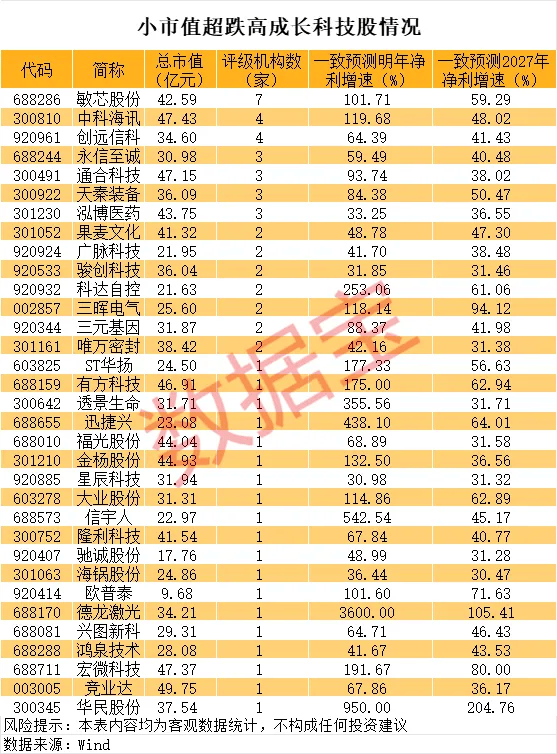
Group 1 - The core viewpoint emphasizes a strong focus on technology stocks, with the ChiNext 50 Index continuing to rise, indicating a bullish sentiment in the tech sector [1] - Various technology sub-sectors such as consumer electronics, electronic chemicals, and semiconductors have shown gains of over 1%, reflecting positive market trends [1] - A notable number of low market capitalization tech stocks have experienced significant price increases, with several stocks hitting the 20% daily limit up, indicating strong investor interest [1] Group 2 - Data indicates that there are 33 low market capitalization tech stocks with a predicted net profit growth rate exceeding 30% for the next two years, highlighting potential investment opportunities in this segment [2] - Among these, Guomai Culture has seen the largest decline, with its latest price down over 57% from its yearly high, suggesting a potential rebound opportunity [2] - The lowest market capitalization stock listed is Oputai, valued at under 1 billion, focusing on solar cell defect identification technology, which may benefit from the growing solar energy market [2] Group 3 - Companies like Delong Laser and Huamin Co. are projected to have net profit growth rates exceeding 100% in the coming years, indicating strong future growth potential [3] - Delong Laser specializes in high-end industrial laser processing equipment, while Huamin Co. focuses on photovoltaic new energy and advanced materials, both positioned to benefit from industry trends [3] - The MEMS chip manufacturer Minxin Co. has garnered attention from multiple institutions, indicating strong market interest and growth potential in the MEMS sector [3][5]
山东招金梁永慧:黄金牛市没有结束,预计年底前将是一个震荡行情,长期应该是持续的稳步上涨
Sou Hu Cai Jing· 2025-11-27 03:54
Core Viewpoint - The long-term bull market for gold is not over, but a correction is expected in the short to medium term due to rapid price increases in 2025, leading to a forecast of a volatile market until the end of the year, followed by steady long-term growth [2][12]. Long-term Factors - Gold prices are influenced by long-term factors such as currency devaluation, global debt, and geopolitical issues, which are expected to have a lasting impact [7][8]. - The trend of de-dollarization is ongoing, with many countries increasing their gold reserves to support their currencies, which is likely to continue for over three years [8][12]. - Global debt and credit are expanding, particularly U.S. debt, with some countries selling U.S. bonds to buy gold, providing long-term support for gold prices [8][12]. - Historical inflation trends suggest that inflation may rise significantly after 2025, potentially leading to a substantial increase in gold prices [9][12]. - The global economy is entering a recession, which is expected to last for over a decade, further supporting gold as a safe-haven asset [9][10]. Medium-term Factors - The ongoing divergence in global monetary policies is expected to maintain a loose monetary environment, providing support for gold prices over the next three years [10][12]. - The uncertainty surrounding global economic recovery and the current economic cycle suggests that demand for gold as a safe asset will continue to rise [10][12]. Short-term Factors - The probability of interest rate cuts by the Federal Reserve is decreasing, which has led to a recent decline in gold prices, but the overall outlook remains bullish for the end of the year [10][12]. - Ongoing trade negotiations, particularly between the U.S. and China, have created short-term pressures on gold prices [11][12]. - Recent price movements indicate that gold is currently experiencing a downward adjustment, with key support levels identified at $3,900 and $3,520 [11][12]. Investment Recommendations - Investors and the general public are advised to consider allocating 5% to 30% of their asset portfolio to physical gold or gold ETFs, reflecting a long-term optimistic view on gold [6][13].