
美国财政赤字

Search documents
张尧浠:以伊停火但降息重燃、金价仍待回踩支撑再攀升
Sou Hu Cai Jing· 2025-06-24 00:52
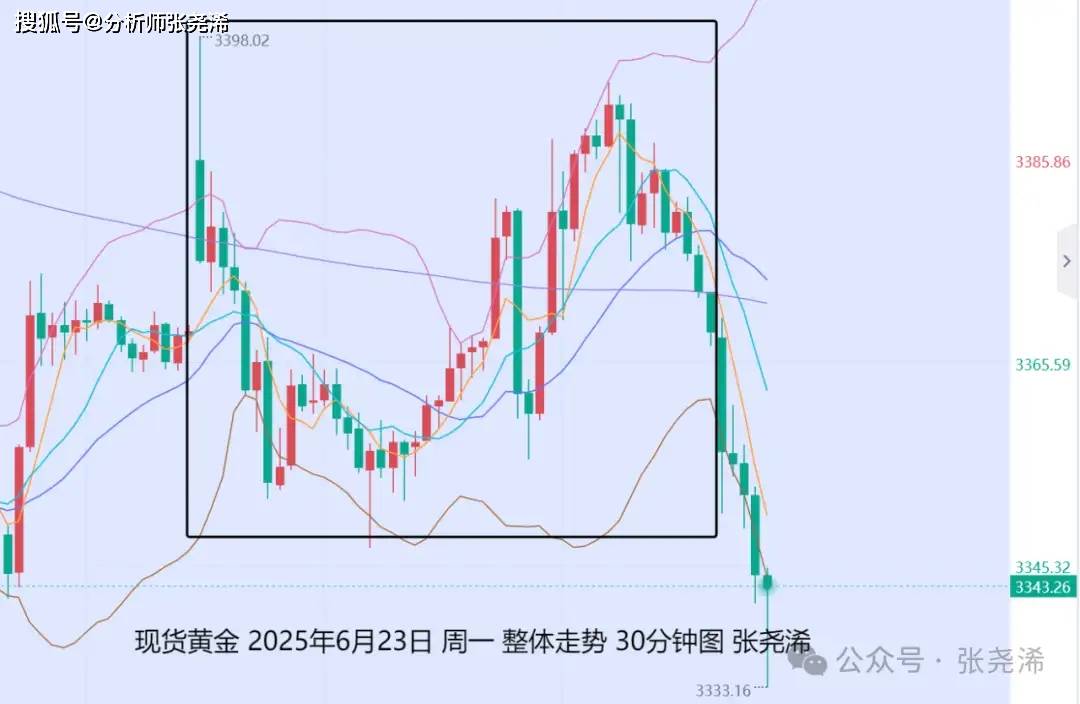
Core Viewpoint - The article discusses the fluctuations in gold prices influenced by geopolitical tensions, U.S. monetary policy, and market sentiment, indicating a potential bullish trend in the long term despite short-term volatility [1][3][5]. Group 1: Gold Price Movements - On June 23, gold opened over $20 higher but later fell, reaching a low of $3347.10 before recovering slightly to close at $3368.96, reflecting a daily fluctuation of $48.78 [1][3]. - The price was initially supported by geopolitical tensions but faced resistance due to profit-taking and comments from President Trump regarding a ceasefire between Israel and Iran [1][3]. - The outlook for June 24 suggests continued volatility, with gold prices expected to test previous lows while being supported by a declining U.S. dollar index [3][5]. Group 2: Economic Indicators and Central Bank Policies - Upcoming economic data releases, including the U.S. current account and consumer confidence index, are anticipated to positively impact gold prices [5]. - The article highlights that the market's focus is shifting back to the Federal Reserve's monetary policy and the economic impact of tariffs, with expectations of potential interest rate cuts later in the year [5][6]. Group 3: Long-term Outlook for Gold - Despite short-term fluctuations, the long-term outlook for gold remains bullish, with expectations of prices potentially exceeding $4000 in the next year due to ongoing geopolitical risks and central bank gold purchases [6][7]. - The technical analysis indicates that gold prices are in a bullish trend, supported by moving averages, although there are concerns about a potential peak in the near term [9][11].

海外投资者4月大笔抛售美债 中国减持82亿美元 加拿大砍仓13%
Xin Hua Cai Jing· 2025-06-19 02:19
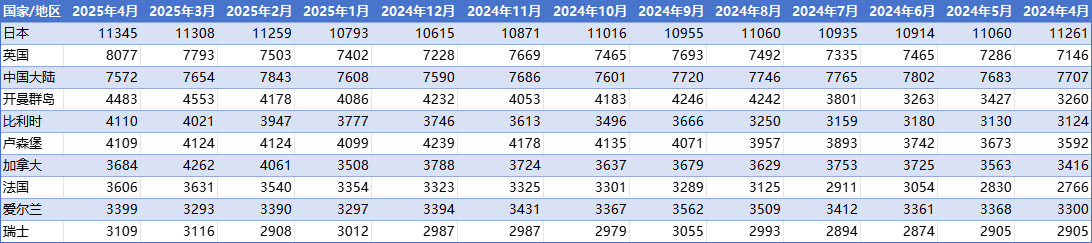
Core Viewpoint - The U.S. Treasury Department reported significant selling of U.S. Treasury bonds in April 2025, with a total reduction of $36.1 billion in holdings by major foreign investors, raising concerns about international confidence in U.S. debt and its implications for U.S.-Canada relations [1][6]. Group 1: International Capital Flows - In April 2025, major foreign investors reduced their holdings of U.S. Treasury bonds by $36.1 billion, with official foreign investors decreasing their holdings by $8.7 billion [1]. - Canada significantly cut its holdings by over 13%, selling $57.8 billion worth of U.S. debt, which contributed to a total decline of $26.1 billion among the top ten foreign holders [6]. - Japan increased its holdings by $3.7 billion to $1,134.5 billion, maintaining its position as the largest foreign holder of U.S. debt [4]. Group 2: U.S. Debt and Economic Implications - The U.S. federal government debt has surpassed $36 trillion, with a fiscal deficit exceeding $1.3 trillion for the first half of the 2025 fiscal year [8]. - The U.S. Treasury will face approximately $7 trillion in maturing federal debt in 2025, marking the largest debt maturity in U.S. history [9]. - Moody's downgraded the U.S. long-term credit rating from Aaa to Aa1, citing rising debt and interest payment ratios significantly above those of similarly rated countries [7][10]. Group 3: Legislative and Fiscal Policy Changes - The U.S. Congress passed a large tax and spending bill that extends tax cuts from the Trump administration and increases defense spending, which is expected to exacerbate the fiscal deficit [10][11]. - Moody's projects that the U.S. federal debt burden could reach 134% of GDP by 2035, with deficits potentially rising to 9% of GDP [10].
特朗普再次敦促鲍威尔降息
Sou Hu Cai Jing· 2025-06-18 16:09
Group 1 - President Trump has publicly urged Federal Reserve Chairman Jerome Powell to lower interest rates, suggesting that a reduction could allow for cheaper debt purchases and that rates should be two percentage points lower than current levels [2] - The market generally anticipates that the Federal Reserve will maintain the federal funds rate in the range of 4.25% to 4.50% during the June meeting, despite Trump's calls for a reduction [2] - The Federal Reserve's rationale for keeping rates steady is the potential for a rebound in inflation, although recent economic data indicates that inflation rates in the U.S. are steadily declining without significant rebounds [2] Group 2 - Maintaining high interest rates for an extended period is viewed as a mistake, with concerns that it could negatively impact the U.S. economy and accelerate its downturn [3] - Lowering interest rates is seen as a necessary step to reduce the financing costs of U.S. national debt, especially in light of ongoing fiscal deficits that may increase the national debt scale [2]

机构看金市:6月18日
Xin Hua Cai Jing· 2025-06-18 03:22
Core Viewpoints - The geopolitical situation, particularly the escalation of conflicts in the Middle East, is expected to continue driving gold prices upward until there is a perceived easing of tensions [1][2] - Weak economic data from the U.S., including a 0.9% decline in retail sales and a 0.2% drop in industrial output, has increased expectations for a more dovish monetary policy from the Federal Reserve, benefiting silver prices [2][3] - Gold is seen as a hedge against currency devaluation, with its price rising nearly 30% against the U.S. dollar this year, driven by increasing fiscal deficits and potential inflation [4] Group 1: Economic Data Impact - U.S. retail sales fell by 0.9% in May, marking the largest month-over-month decline in four months, reflecting consumer caution ahead of tariff policy implementations [3] - Industrial production data also fell short of market expectations, reinforcing the outlook for a shift in Federal Reserve policy [3] - The Senate's proposal to make corporate tax cuts permanent and raise the debt ceiling poses long-term challenges for the U.S. dollar and treasury credit [3] Group 2: Market Sentiment and Price Trends - Despite a strong dollar, gold prices have been resilient, with a potential consolidation around $3,400 before the upcoming FOMC meeting [5] - Silver prices have surged, breaking through $37 per ounce, indicating a strong market response to expectations of monetary easing [1][2] - The overall market sentiment remains cautious, with geopolitical tensions and economic data influencing trading strategies [5]
KVB App:为逼美联储降息,特朗普找到“新借口”!华尔街疯狂预警
Sou Hu Cai Jing· 2025-06-18 01:14
Core Viewpoint - The article discusses President Trump's ongoing pressure on the Federal Reserve to lower interest rates as a means to alleviate the burden of the U.S. government's debt costs, highlighting the intersection of the U.S. fiscal deficit and complex financial systems [1][3][4]. Group 1: Economic Context - The U.S. is facing a significant federal budget deficit, which has become a critical issue for the economy, described as a "sword of Damocles" hanging over it [3]. - Recent data from the U.S. Treasury indicates that interest payments on federal debt reached approximately $776 billion over the past eight months, a 7% increase compared to the same period last year [3]. - The current interest burden has surpassed defense spending, marking it as a major component of U.S. fiscal expenditures [3]. Group 2: Political Dynamics - Trump has openly pressured Federal Reserve Chairman Jerome Powell to lower interest rates, stating that failure to do so would result in significant financial costs for the government [4]. - The Trump administration estimates that a 2% reduction in interest rates could save the U.S. up to $600 billion annually in interest costs [4]. - The ongoing conflict between the Trump administration and the Federal Reserve reflects deeper economic contradictions, with the administration seeking to reduce debt burdens and stimulate growth while the Fed aims to balance inflation control and financial stability [4]. Group 3: Market Implications - The outcome of the struggle between the Trump administration and the Federal Reserve is expected to have significant implications for the future trajectory of the U.S. economy and could create ripples in global financial markets [4].

BlueberryMarkets蓝莓市场:金价狂飙还能持续多久?
Sou Hu Cai Jing· 2025-06-17 06:55
Group 1 - The core viewpoint of the article is that Citigroup predicts a potential turning point for the historically rising gold prices, warning that gold prices may drop below the psychological threshold of $3000 per ounce in the coming quarters, signaling the end of the current commodity market rally [1][3] - The analysis team led by Max Layton indicates that by the second half of 2026, international gold prices may return to the range of $2500 to $2700, driven by multiple factors creating downward pressure, including a decline in investment demand as risk aversion diminishes and a gradual improvement in global economic growth expectations [3] - The report highlights that the core drivers of the recent surge in gold prices were geopolitical tensions and economic uncertainties, with a 30% increase attributed to market volatility from the Trump administration's trade policies and escalating Middle East tensions [3] Group 2 - Current spot gold prices are hovering around $3396, with Citigroup providing a 60% probability forecast that gold prices will fluctuate above $3000 in the next quarter before entering a correction phase, reflecting a reassessment of the global economic outlook [4] - The anticipated value correction in the gold market is expected to test investors' risk appetite and indicates a significant turning point as the interplay between risk demand and policy expectations evolves [4] - The report warns that the supportive factors for gold prices, such as concerns over the U.S. fiscal deficit and central banks' continued accumulation of gold reserves, are undergoing qualitative changes, particularly as the 2025 U.S. midterm elections approach [3]

深度 | 美债适合逢低买入—— “特朗普经济学”系列之十七【陈兴团队·财通宏观】
陈兴宏观研究· 2025-06-12 14:57
Group 1 - The core viewpoint of the article is the potential impact of the "One Big Beautiful Bill Act" on the U.S. fiscal deficit and debt growth, raising concerns about fiscal sustainability [1][3][17] - The bill proposes a tax reduction of approximately $3.8 trillion over the next decade, accounting for about 5.8% of fiscal revenue, with a significant portion aimed at extending individual tax cuts [1][6][12] - The projected increase in net deficit is about $2.4 trillion over the next ten years, with spending cuts estimated at $1.5 trillion, primarily affecting healthcare, student loans, and food stamps [6][17][20] Group 2 - The bill includes provisions for punitive taxes on foreign investors, potentially raising an estimated $116.3 billion over ten years [8][10] - The Senate is expected to propose a more lenient version of the bill, allowing for a net deficit increase of up to $5.8 trillion, compared to the House's $2.4 trillion [12][13] - The current debt-to-GDP ratio is projected to reach 120.8% by Q1 2025, surpassing World War II peaks, indicating growing concerns over fiscal sustainability [20][18] Group 3 - The U.S. Treasury is likely to issue more short-term debt to manage cash flow, especially after the debt ceiling crisis is resolved [2][25][37] - The demand for short-term debt has been primarily driven by money market funds, with a significant reduction in overnight reverse repurchase agreement (ON RRP) balances [26][28] - The introduction of stablecoin regulations may alleviate some pressure on short-term debt, as the market for stablecoins is growing rapidly [32][33]


喜娜AI速递:今日财经热点要闻回顾|2025年6月12日
Sou Hu Cai Jing· 2025-06-12 11:45
Group 1: US-China Trade Relations - The US and China have reached a framework for measures to stabilize and develop their economic relationship, following a meeting in London on June 9-10 [2] - The agreement is seen as a positive step towards "restarting" US-China trade relations, leading to a rise in Asian stock markets [2] Group 2: A-Share Market Dynamics - On June 11, the Shanghai Composite Index rose above 3400 points, with over 3400 stocks increasing in value, despite a decrease in trading volume [2] - The net buying of financing exceeded 15 billion yuan in June, while stock ETFs saw a net outflow of over 9 billion yuan, indicating mixed market sentiment [2] Group 3: US Fiscal Situation - In May, US customs tariff revenue reached a record high of 23 billion USD, a 270% increase year-on-year, but government spending was significantly higher at 687.2 billion USD [2] - The adjusted fiscal deficit for May was 316 billion USD, a 17% decrease from the previous year, but the total deficit for the first eight months of the fiscal year reached 1.37 trillion USD [2] Group 4: Oil and Gold Market Reactions - Tensions in the Middle East led to a 4.88% increase in WTI crude oil prices and a 4.33% rise in Brent crude oil prices, with gold prices also rising by over 20 USD [3] Group 5: Automotive Industry Challenges - Volvo's new models, including the XC60, have seen significant price reductions due to a 6% decline in global sales and a 12% drop in the Chinese market in Q1 [4] - The company announced a global workforce reduction of approximately 3000 employees as part of its response to declining sales and financial pressures [4] Group 6: Neta Auto's Financial Struggles - Employees of Neta Auto protested for unpaid wages, highlighting the company's financial difficulties after a failed debt-to-equity swap proposal [5] - The chairman of Neta Auto has been involved in discussions regarding the company's future, as employees are set to work from home starting June 12 [5]
美国温和通胀数据背后的隐忧
2 1 Shi Ji Jing Ji Bao Dao· 2025-06-12 09:45
Group 1 - The new tariff policies announced by the Trump administration have raised concerns among financial institutions and businesses about potential inflation, despite recent CPI reports indicating manageable inflation levels [1][2] - The May CPI report showed a nominal inflation increase of 0.1% month-on-month and a year-on-year increase of 2.4%, slightly above April's 2.3% [1] - Core inflation, excluding food and energy, remained stable at 2.8%, but was below market expectations of 2.9% [1] Group 2 - The employment market has shown a downward trend, with average monthly job additions from January to May at 123,800, lower than the previous year's average of 179,600 [2][3] - The service sector has been the primary source of job growth, while manufacturing and federal government sectors have seen job losses [3] Group 3 - The U.S. federal debt has reached $36.97 trillion, with a recent bill increasing the debt ceiling by $4 trillion, raising concerns about fiscal sustainability [3][4] - Investor confidence in U.S. Treasury bonds is declining, as evidenced by a high issuance rate of 5.047% for 30-year bonds in May, indicating increased risk perception [4] Group 4 - The recent surge in cryptocurrency prices and the depreciation of the dollar suggest a growing distrust in U.S. fiscal policy and the dollar's stability [5] - The impact of tariff policies on the global supply chain is significant, with reduced cargo volumes at several ports and rising production costs affecting economic growth [5][6] Group 5 - The stock market has returned to previous levels, but there are concerns about whether inflated stock prices can be supported by upcoming earnings reports [6] - The concentration of market value in the top ten stocks of the S&P 500, which account for 40% of the index, poses a serious risk to market stability [6]