
高阶智驾

Search documents
智驾平权系列五:智驾与机器人共振,激光雷达乘风起势
Changjiang Securities· 2025-09-21 10:12
Investment Rating - The report maintains a "Positive" investment rating for the industry [13] Core Insights - The dual drivers of advanced intelligent driving and robotics are expected to significantly boost the demand for LiDAR, which is a core component of perception systems. The trend towards affordability is likely to accelerate market penetration [4][11] - Domestic leaders in the LiDAR market, such as Suoteng and Hesai Technology, are well-positioned to benefit from technological advancements in digitalization and solid-state solutions, with multiple competitive products being launched [4][11] Summary by Sections LiDAR: Core Component of Perception Systems - LiDAR, known as the "mechanical eye," is essential for high-precision perception in advanced driving systems. Its applications have expanded from military and research to autonomous driving, robotics, and smart security [7][20] - The multi-sensor fusion approach, which includes LiDAR, emphasizes redundancy and safety, making it a dominant choice in high-level driving solutions [7][36] Market Potential - The combination of intelligent driving and robotics presents a vast market opportunity, with LiDAR demand expected to grow rapidly. The penetration rate for advanced driving in passenger vehicles is projected to reach between 10% and 50% [8][41] - The Robotaxi and specific commercial applications are anticipated to further expand the LiDAR market, with the number of LiDAR units per vehicle typically exceeding that of passenger cars [8][49] Competitive Landscape - Chinese companies are leading the LiDAR market, with domestic firms expected to capture over 90% of the global market share by 2024. Major players include Suoteng and Hesai Technology, with a combined market share exceeding 95% [9][41] - The report highlights the strong competitive positioning of Suoteng and Hesai, with projected market shares of 33.5% and 25.6% respectively by 2024 [9] Trends and Innovations - The report identifies a shift towards digitalization and solid-state LiDAR technologies, which are expected to enhance performance while reducing costs. The introduction of next-generation digital SPAD-SoC LiDAR products is underway [10][11] - The affordability trend in LiDAR is driven by technological advancements and economies of scale, with significant cost reductions expected as solid-state solutions replace traditional mechanical systems [11][53] Investment Recommendations - The report suggests that the dual drivers of advanced intelligent driving and robotics will create substantial growth opportunities for LiDAR, with domestic leaders poised to benefit from ongoing technological transformations [11][41]
独家丨地平线明年发布并争取量产舱驾一体芯片;比亚迪补强智舱团队,斑马智行原 CTO 加入
晚点Auto· 2025-09-19 11:49
Group 1 - Horizon is set to release a new integrated cockpit and driving chip in 2026, which is expected to be the most complex chip designed by the company to date [3] - The new chip development is led by Horizon's VP and Chief Architect Su Qing, focusing on defining computing power based on software algorithm requirements, which is becoming a mainstream development model in the autonomous driving chip sector [3][4] - The integrated cockpit and driving chip aims to reduce data transmission latency and simplify vehicle hardware design, offering a cost advantage over separate chips for mid-to-low-end autonomous driving and cockpit systems [5] Group 2 - Qualcomm is a major player in the integrated chip market, with its Snapdragon 8775 chip offering AI computing power of 72 Tops, and an upgraded version, the SA8797, providing 320 Tops, which is set to be used by companies like Li Auto and Leap Motor [4][5] - Horizon's lower-tier chips (J2/J3) still account for a significant portion of its shipments, with an expected shipment volume of around 4 million units in 2025, split evenly between low-tier and mid-to-high-tier solutions [5][6] - BYD is actively integrating its cockpit and driving teams to develop its own integrated chip products, with plans to launch a One-Board solution that combines cockpit and driving functions on a single PCB [6][7] Group 3 - BYD's "Heavenly Eye" driving assistance system is categorized into three platforms based on computing power and configuration, with plans to mass-produce the B platform by 2025, potentially offering advanced driving features at lower price points [7][8] - BYD aims to maintain its scale through smart technology, planning to introduce high-level driving assistance features at competitive prices as it faces increasing competition in the electric vehicle market [8]



地平线机器人-W(09660):重大事项点评:星纪元ET5首搭HSD,有望驱动加速成长
Huachuang Securities· 2025-09-19 08:56
Investment Rating - The report maintains a "Recommended" rating for Horizon Robotics (09660.HK) with a target price of HKD 12.44 [2][7]. Core Views - The introduction of the Chery Star Era ET5 featuring Horizon's HSD autonomous driving solution is expected to drive accelerated growth, with the product anticipated to launch in November 2025 [2]. - The revenue forecasts for 2025-2027 have been adjusted positively, with expected shipments of 4 million, 5.04 million, and 7 million units respectively, reflecting year-on-year growth of 38%, 26%, and 39% [2]. Financial Summary - Main revenue projections for 2024A, 2025E, 2026E, and 2027E are HKD 2,384 million, HKD 3,620 million, HKD 5,851 million, and HKD 8,386 million, with year-on-year growth rates of 53.6%, 51.9%, 61.6%, and 43.3% respectively [3][8]. - The net profit attributable to shareholders is projected to be HKD 2,347 million in 2024, with losses of HKD 7,082 million, HKD 2,726 million, and HKD 1,436 million in 2025, 2026, and 2027 respectively [3][8]. - Earnings per share (EPS) are forecasted at HKD 0.17 for 2024, with negative EPS of HKD -0.51, -0.20, and -0.10 for the following years [3][8]. Market Position and Growth Potential - Horizon Robotics holds the leading market share in China for basic ADAS and overall ADAS solutions, with respective shares of 45.8% and 32.4% [7]. - The company has achieved significant growth in chip shipments, with 1H25 figures showing a doubling in J series chip shipments to 1.98 million units and a fivefold increase in J5/J6 chips supporting NOA functionality to 980,000 units [7]. - The establishment of a European headquarters and partnerships with international clients like Bosch and Volkswagen positions the company favorably for global expansion [7]. Valuation Perspective - The report suggests a target price-to-sales (PS) ratio of 27x for 2026, leading to a target market capitalization of HKD 158 billion [7]. - The valuation is compared to peers such as Nvidia, ARM, and Cambricon, with their projected PS ratios for 2026 being 21, 32, and 26 respectively [7].
L2级辅助驾驶将迎来国家标准 智慧的车如何驶好安全的路?
Xin Hua She· 2025-09-17 16:16
Core Viewpoint - The introduction of national standards for Level 2 (L2) driving assistance systems is crucial for ensuring safety in the rapidly developing smart connected vehicle market [1][2]. Group 1: Industry Context - The Ministry of Industry and Information Technology has solicited public opinions on the mandatory national standard for "Safety Requirements for Intelligent Connected Vehicles' Combined Driving Assistance Systems," which aims to establish a safety benchmark for system applications [1][2]. - In the first seven months of 2025, the sales of passenger cars equipped with combined driving assistance systems reached 7.76 million units, a year-on-year increase of 21.31%, with a penetration rate of 62.58% [1]. Group 2: Challenges and Risks - There is a lack of unified performance baselines for products, leading to discrepancies in reliability and stability among different manufacturers' systems, which poses potential risks to road safety [1][2]. - The industry is facing challenges with the blurring of lines between "driving assistance" and "automated driving," which may lead some drivers to underestimate the limitations of these systems [1]. Group 3: Standard Development - The new standard aims to fill the safety baseline gap for combined driving assistance systems, providing critical technical support for industry access, quality supervision, and post-event traceability [2]. - The standard will regulate system safety capabilities from multiple dimensions, including risk design during the R&D phase, production stability and traceability, and dynamic monitoring during operation [2][3]. Group 4: Specific Considerations of the Standard - The standard includes testing scenarios for various traffic environments, such as intersections, construction zones, and tunnels, and enhances detection capabilities for motorcycles and temporary obstacles [3]. - It mandates that systems confirm whether drivers have completed training before activation and includes features to detect hand and gaze disengagement, prompting alerts if necessary [3]. Group 5: Future Implications - The introduction of this standard is expected to provide strong technical support for regulatory bodies, guiding the entire industry chain towards technological innovation and quality improvement [4]. - The Ministry of Industry and Information Technology plans to expedite the standard's publication, implementation, and supervision to ensure effective safety requirements are met, thereby safeguarding public travel safety [4].
比亚迪20250831
2025-09-01 02:01
Summary of BYD Electronics Conference Call Industry and Company Overview - **Company**: BYD Electronics - **Industry**: Electric Vehicles, AI Data Centers, Robotics, Consumer Electronics Key Points and Arguments Financial Performance - **Overall Revenue**: In the first half of 2025, BYD Electronics reported total revenue of 806 billion RMB, with a slight increase year-on-year [3] - **Gross Profit**: Gross profit reached 55 billion RMB, with a net profit of 17.3 billion RMB, indicating an improvement in gross margin compared to the previous year [3] - **New Energy Vehicle (NEV) Revenue**: NEV business revenue was 124.5 billion RMB, a 60% year-on-year increase, accounting for over 15% of total revenue for the first time [2][3] - **Cash Flow**: Operating cash flow was strong, with total assets around 826 billion RMB and net assets of 328 billion RMB, reflecting a 4 billion RMB increase [3] Business Segments Performance - **Consumer Electronics**: Revenue from consumer electronics was 609 billion RMB, with assembly business contributing 472 billion RMB and components 138 billion RMB, showing a slight decline [4] - **Liquid Cooling Technology**: The company is focusing on liquid cooling products for AI data centers, with expectations for mass shipments within the year [4][5] - **Robotics**: BYD has deployed nearly 2000 Autonomous Mobile Robots (AMR) and is advancing in industrial AI robotics, targeting trials in manufacturing by 2025 [8][9] Research and Development - **R&D Investment**: R&D expenditure was 22.3 billion RMB in the first half of 2025, with a focus on new business areas [10][15] - **Patents**: The company holds 11,580 patents, with nearly 2000 related to automotive technology and hundreds in AI data centers and robotics [10][11] Future Strategies - **Growth in AI Data Centers**: BYD Electronics aims to start mass shipments of liquid cooling products and power systems in the second half of 2025, with a long-term goal of achieving a revenue target in the hundreds of billions [6][7][18] - **Automotive Sector Expansion**: The company plans to enhance high-end driving systems and expand into overseas markets, particularly targeting European customers within the next two to three years [14][24] - **Profitability Focus**: The strategy includes improving efficiency, reducing costs, and increasing gross margins to enhance profitability [6][32] Market Trends and Projections - **NEV Market**: The average selling price (ASP) of NEVs exceeded 5000 RMB, indicating a shift towards higher-end products [12] - **AI Data Center Growth**: Liquid cooling technology is becoming mainstream in overseas AI data centers, with expectations for significant growth in domestic markets by 2026 [17] - **Consumer Electronics**: The foldable phone market is anticipated to provide substantial incremental revenue in the coming year [19] Additional Insights - **Cash Flow Management**: The company maintains a cautious approach to cash flow management, considering potential acquisitions but prioritizing effective fund utilization [22] - **Metal Business Outlook**: The Chengdu factory's metal business is expected to see a 50% revenue increase next year due to new high-value models [23] - **Stability in Automotive Margins**: Automotive parts gross margins are expected to remain stable, with a focus on high-tech projects to mitigate pricing pressures [25] Emerging Technologies - **CPU and High Voltage Power Development**: BYD is in the early stages of developing CPUs and high-voltage power supplies, with potential mass production by 2026 [30] - **Liquid Cooling Projects with NVIDIA**: The company is involved in several projects with NVIDIA, focusing on components like quick connectors and cooling plates [30] This summary encapsulates the key insights from BYD Electronics' conference call, highlighting the company's financial performance, strategic initiatives, and market outlook across various sectors.
独家丨东风岚图发布新款梦想家,将采用华为与鉴智两套智驾方案
雷峰网· 2025-08-29 06:41
Core Viewpoint - Lantu Automotive is set to launch approximately four new models next year, indicating a strong growth trajectory and strategic partnerships in the autonomous driving sector [1][3]. Group 1: Product Launch and Sales Performance - At the Chengdu Auto Show on August 29, Lantu unveiled the new Lantu Dreamer, available in intelligent super hybrid and intelligent pure electric versions, with a pre-sale price range of 389,900 to 459,900 yuan [2]. - Lantu aims to deliver 85,697 vehicles in 2024, representing a year-on-year growth of about 70%. Since 2025, the company has achieved over 10,000 monthly sales for five consecutive months, with July's delivery surpassing 12,000 units [2]. Group 2: Strategic Partnerships and Market Position - In early 2024, Lantu signed a strategic cooperation agreement with Huawei, adopting the HI model, which includes the HarmonyOS cockpit and the QianKun intelligent driving system [2]. - The company is working closely with JianZhi to launch around 10 models across various brands, including Lantu and Yipai, over the next year, with a focus on capturing market share in the mid-level intelligent driving segment [3]. - JianZhi has received a $100 million investment from Chery this year, indicating a tightening collaboration on vehicle models [3].

25年中报公布!地平线机器人,势头正猛
贝塔投资智库· 2025-08-29 04:03
Core Viewpoint - Horizon Robotics (09660.HK) reported significant revenue growth but also an increase in losses for the second quarter and first half of 2025, driven by ongoing R&D investments and product optimization in a competitive smart driving market [1][10]. Financial Performance - Revenue for the first half of 2025 reached 1.567 billion yuan, a year-on-year increase of 67.6% [2] - Automotive solutions contributed 1.516 billion yuan, growing by 66% [2] - Product solutions surged to 777 million yuan, marking a 250% increase [2] - Gross profit was 1.024 billion yuan, up 38.6%, with a gross margin of 65.4% [2] - Operating loss expanded to 1.592 billion yuan, a 44% increase [2] - Net loss for the period was 5.233 billion yuan, up 2.6% [2] - R&D expenditure reached 2.3 billion yuan, increasing by 62% [2] - Cash reserves stood at 16.1 billion yuan [2] Highlights and Progress - Revenue growth was driven by both volume and price increases, with product solutions revenue reaching 778 million yuan, a 3.5-fold increase [4] - Shipment volume of automotive-grade processing hardware doubled to 1.98 million units [4] - Average selling price of product solutions increased to 1.7 times that of the previous year due to a higher proportion of high-value chips [4] - The share of mid-to-high-end assisted driving products rose to 49.5% of total shipments, contributing over 80% of revenue [5] - Software licensing and service revenue grew to 738 million yuan, a 6.9% increase [6] - Market share in China's autonomous brand automotive market reached 32.4% for assisted driving solutions and 45.8% for ADAS front-view integrated machines, both leading the market [6] - Successful international collaborations with major automotive groups, including partnerships with Volkswagen and Japan's largest automotive group, have been established [6] Future Outlook - The focus is on the mass production of high-level driving solutions (HSD), with several models already designated for production [8] - Improvement in profitability is anticipated as high-end products continue to scale and the HSD solution is launched [8] - Global expansion efforts with international automotive companies and Tier 1 suppliers are expected to create new growth opportunities [8]

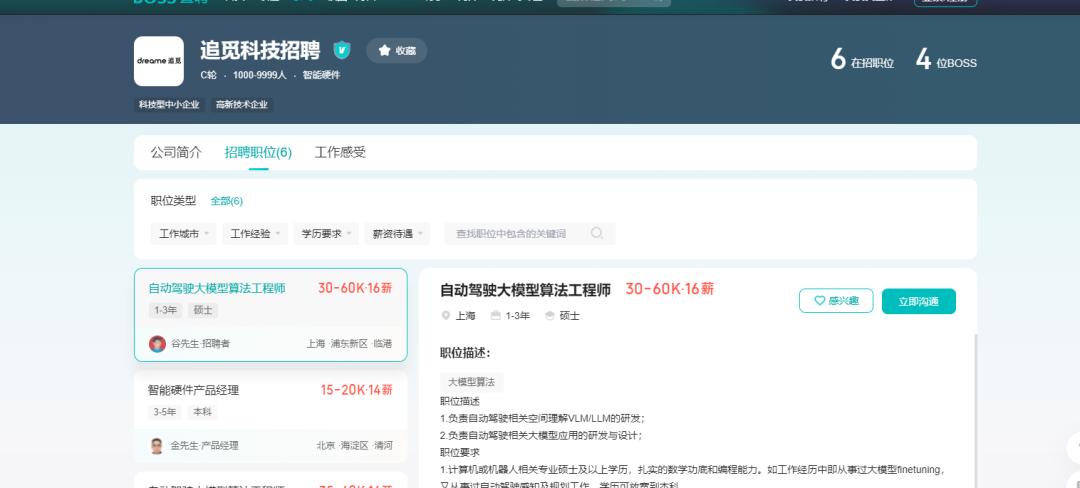
年薪近百万招人,追觅高调官宣造车
3 6 Ke· 2025-08-28 09:55
Group 1 - The core point of the article is that Chasing Technology has officially announced its entry into the automotive industry, planning to launch a luxury electric vehicle that will compete with Bugatti Veyron by 2027 [2][4] - Chasing Technology aims to establish itself as a new benchmark in the global ultra-high-end electric vehicle market, focusing on high performance, intelligence, and luxury [2][4] - The company has formed a nearly 1,000-person team dedicated to vehicle manufacturing and is expanding its capabilities in key technology areas such as high-speed digital motors and AI algorithms [4][5] Group 2 - As of the end of 2024, Chasing Technology has applied for a total of 6,379 patents globally, with 45% being invention patents covering core areas of intelligent automotive technology [5] - The company has a global presence, operating in over 100 countries and regions, with more than 6,000 offline stores and serving over 30 million households [5] - Chasing Technology has established a subsidiary, "Starry Sky Plan (Shanghai) Automotive Technology Co., Ltd.," with a registered capital of 1 billion yuan, and is planning a factory in Shanghai [7] Group 3 - The company is actively recruiting for positions related to autonomous driving technology, indicating a focus on high-level autonomous driving solutions [6][7] - Chasing Technology has already secured some intention contracts with first-tier automotive companies for its autonomous driving technology [6] - The company has raised funds through six rounds of financing, with notable investors including Shunwei Capital and Xiaomi Group [7][8] Group 4 - Chasing Technology is not the only home appliance company venturing into the automotive sector, as other companies like Midea, Gree, and Haier have also made similar moves [12][13] - The company has diversified its business by announcing new ventures in home appliances and drones in 2025, showcasing its ambition to expand beyond its original market [9][10][11]
再落一子?华为注册“绝界”商标
Jing Ji Guan Cha Bao· 2025-08-28 05:30
Group 1 - Huawei successfully registered the "绝界" trademark on August 27, covering key areas such as automotive wheels, seats, electric vehicles, and hybrid/automated driving cars [1] - The registration is part of Huawei's ongoing trademark strategy, which includes over ten trademarks like "仙界," "天界," "君界," "峥界," and "江界," creating a robust brand protection framework [1] - The registration has dual strategic significance: defensive to avoid malicious trademark registrations amid intense competition in the smart automotive sector, and proactive to reserve naming space for advanced driving systems and potential niche markets [1] Group 2 - Huawei is deepening collaboration with car manufacturers through a three-tier cooperation model: providing basic hardware like motors and controllers, offering full-stack solutions for smart cockpits and autonomous driving under the HI model, and leading R&D and sales in the "智选" model [2] - The "智选" model has become a core driver of growth, with partnerships expanding rapidly after the successful validation with the Seres Aito brand, leading to collaborations with Chery, BAIC, Jianghuai, and SAIC [2] - The "鸿蒙智行" alliance aims to build a comprehensive brand matrix, targeting a price range from 150,000 to 1,500,000 yuan, with the youngest model, 尚界H5, set to launch in the fall [1][2]
尚界H5正式开启预售??,??预售价16.98万元起??
Jing Ji Guan Cha Bao· 2025-08-25 10:21
Core Viewpoint - The Huawei and SAIC jointly launched the Hongmeng Zhixing "Fifth Realm" brand, the Shangjie H5, which officially starts pre-sales at a price of 169,800 yuan, aiming to penetrate the 200,000 yuan level new energy SUV market [1] Group 1 - The Shangjie H5 offers both pure electric and range-extended power versions [1] - All models are equipped with Huawei's Qiankun ADS 4.0 advanced driving system [1] - The vehicle will be publicly displayed for the first time at the Chengdu Auto Show [1] Group 2 - The official launch of the Shangjie H5 is scheduled for September 23 in Shenzhen [1] - The strategy of "laser radar equality" is employed to compete in the new energy SUV market [1]